Welcome to this free A1 English story! This is a simple retelling of the classic nursery rhyme 'Simple Simon'. It is perfect for beginners who are starting to learn English. You can read the story, listen to the audio, and click on any word to see its meaning. We have also included some helpful lesson notes to guide you.
In this story, you will meet Simple Simon. He goes to the fair and sees a pieman selling hot pies. Simon wants a pie, but he does not have any money. He tries to find some money in funny ways. Along the way, you will learn useful words like 'pie', 'fair', 'money', and 'sixpence'.
This graded reader is designed for CEFR level A1. Read at your own pace, listen to the story anytime, and enjoy learning English with Yak Yacker!
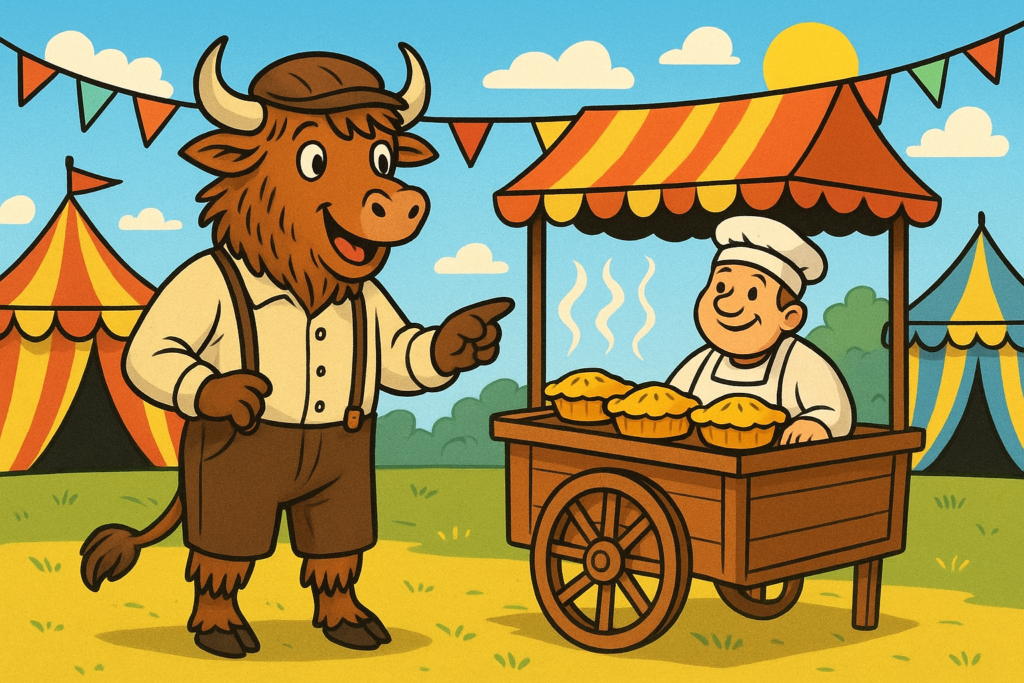
Simple Simon is a boy. He goes to the fair. He sees a with .
Simon , 'Do you have ?' The pieman says, 'Yes, I have pies.'
Simon says, 'I a pie.' The pieman , 'Do you have money?'
Simon his pocket. He has no money. He says, 'I have no money.' The pieman says, 'No money, no pie.'
Simon is . He goes home. He his mother, 'Can I have some money?' She gives him a .
Simon says, 'Thank you!' He to the fair. He sees the pieman. He says, 'Here is my penny. One pie, please.'
The pieman him a pie. Simon it. Yum! He is .
Simon is a boy. He goes to a fair. He sees a man with pies.
Simon asks, 'Do you have pies?' The man says, 'Yes, I have hot pies.'
Simon says, 'I want a pie.' The man asks, 'Do you have money?'
Simon checks his pocket. He has no money. He says, 'I have no money.' The man says, 'No money, no pie.'
Simon is sad. He goes home. He asks his mother for money. She gives him a penny.
Simon says, 'Thank you!' He runs to the fair. He sees the man. He says, 'Here is a penny. One pie, please.'
The man gives him a pie. Simon eats it. Yum! He is happy.
Let's look at some key words from Simple Simon's day. These are useful in many everyday situations.
- fair - a place with rides, games, and food
- pieman - a person who sells pies
- pie - a baked dish with fruit or meat inside
- pocket - a small bag in your clothes for keeping things
- penny - a small coin of money
- sad ↔ happy - feeling unhappy or feeling good
The story uses the simple present tense. This is very common when telling a story or talking about things that happen again and again.
If the subject is he, she, or it, the verb usually adds an -s (he goes, she sees). With I, you, we, and they, the verb stays the same (I want, you have).
- Simple Simon goes to the fair. (he + go → goes)
- The pieman gives him a pie. (he + give → gives)
- Simon says, 'Thank you!' (he + say → says)
- I have no money. (I + have → have, no -s)
To make a question in the simple present, we often use do or does. Do you have money? Does he want a pie?
For short answers, we repeat the helping word: Yes, I do. / No, he doesn't.
- Do you have pies? → Yes, I have hot pies.
- Does Simon have money? → No, he doesn't have money.
- Do you want a pie? → Yes, I want a pie, please!
Read the story again and point to each word. Notice how often the simple present is used. Can you find all the words from our vocabulary list?
Next time you want something politely, try using 'Can I have...?' like Simon. Small practice makes a big difference!
Simple Simon comes from the English / nursery rhyme tradition and is best known as a nursery rhyme. This Yak Yacker article is an original learner retelling based on Traditional nursery rhyme; public domain, so the wording here is simplified for modern learners rather than copied from one old edition.
Older printings, translations, and retellings of this story can vary quite a bit. The original audience was usually kids, but this version is adapted for A1 Beginner learners studying English. Market/food vocabulary.
If you want to look into the source tradition, start with Wikisource.
If you want to keep going, browse more in our English section and review the A1 English Vocabulary List. After that, try English Question Words for another useful next step.