Read this story on Yak Yacker with clickable word help, full story audio, and lesson notes below the text.
This version is written for English-speaking learners who want a friendly reading experience in English.
A long time ago, in a small English town, a baby boy was born in the workhouse. His mother was very sick and died soon after he was born. The baby had no father, no family, and no name. The workhouse gave him a name: Oliver Twist.
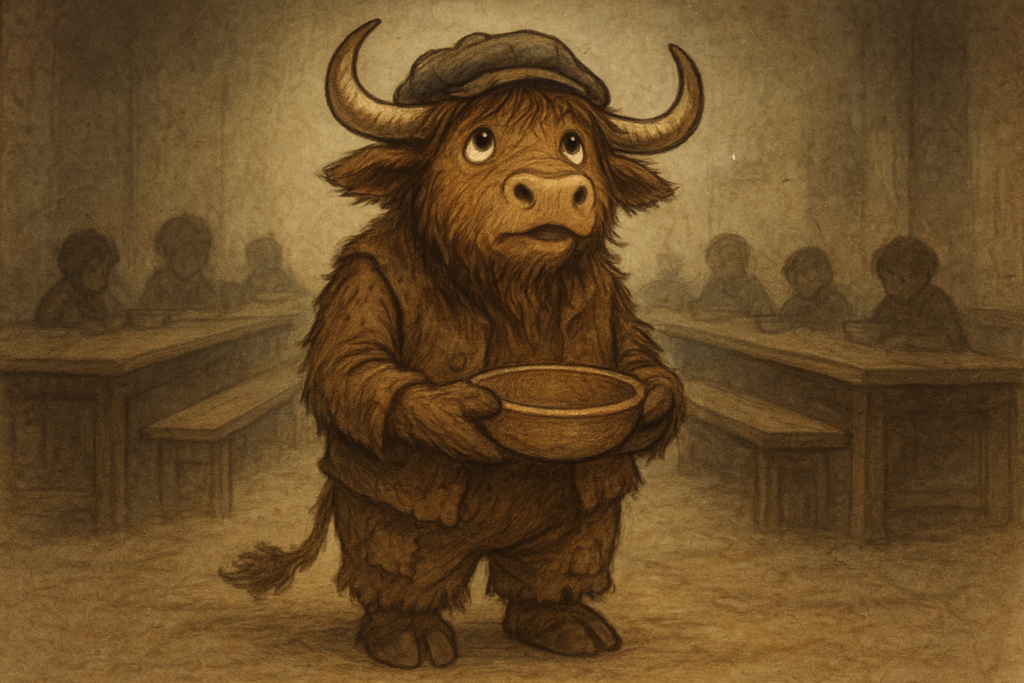
Oliver grew up in the workhouse. It was a with little food. Every day, the boys ate a thin soup called . They were always . One evening, the boys were so that they decided someone must ask for more. Oliver was chosen. After supper, he walked up to the master, holding his empty bowl.
The master was . "What?!" he cried. He hit Oliver and called for the . The board members were angry. "This boy is a !" they said. They decided to send him away. Mr. Sowerberry, the undertaker, came to take him.
"I'll make him ," said Mr. Sowerberry with a cold smile.
At the undertaker's, Oliver was given a dirty bed and little food. Noah Claypole, another worker, was to him. One day, Noah Oliver's mother. Oliver lost his temper and . Noah screamed, and Mrs. Sowerberry locked Oliver in a dark room. That night, Oliver decided to to London.
After a long, tiring journey, Oliver reached London. He was tired, hungry, and alone. A boy with a funny hat and a confident walk came up to him. "Hello, mate. Are you looking for a place to stay?" he asked. This was Jack Dawkins, but everyone called him the Artful Dodger.
The Dodger took Oliver to a dirty old house. Inside, an old man with long, greasy hair was cooking sausages. Around him, many boys were laughing and talking. "This is Fagin," said the Dodger. "He'll take care of you."
"Welcome, my dear," said Fagin, showing . "We're a happy family here."
Oliver thought the boys learned to make handkerchiefs. The next morning, Fagin gave him a lesson. "See how my fingers are," he said, a watch from his pocket. But Oliver still didn't understand. One day, he went out with the Dodger and another boy, Charley Bates. Suddenly, Oliver saw them: they a handkerchief from an old gentleman's pocket! Oliver was terrified. "Stop, thief!" someone cried. Oliver ran, but he was caught.
At the police station, the old gentleman, Mr. Brownlow, looked at Oliver's . "This boy is not a thief," he said. He took Oliver to his fine house. For the first time, Oliver had good food, a warm bed, and . He was very happy. One day, Mr. Brownlow gave him some books and money to take to the bookseller.
"Hurry back, my boy," he said.
But Oliver never returned. On the street, a woman grabbed him. "You bad boy! from your poor mother!" she cried. It was Nancy, and with her was the Bill Sikes. They dragged Oliver back to Fagin's house. Oliver cried, but no one helped.
Fagin was angry but also . "You're too valuable to lose," he whispered. Soon after, Sikes forced Oliver to a house with him. It was dark and silent. Sikes put Oliver through a small window. "Walk to the front door and open it," he ordered. But inside, a servant heard a noise. A gun fired, and Oliver fell, shot.
When Oliver woke up, he was in a soft bed. A kind, beautiful lady, Rose Maylie, and her aunt, Mrs. Maylie, were taking care of him. They had found him in a field. Oliver told them his sad story, and they believed him. "You can stay with us," said Mrs. Maylie gently.
Oliver grew stronger and happier. He helped in the garden and played in the sunshine. But one night, Nancy came to see Rose. She had followed Fagin and heard secrets. "There is a man named Monks," she said, "who knows that Oliver is from a good family. He wants to the boy." Nancy was afraid, but she wanted to help.
Nancy told Rose and Mr. Brownlow where to find Monks. But Sikes learned about her . In a rage, he killed Nancy and tried to run away. The police him, and he died while trying to escape. Fagin was caught and put in prison.
Mr. Brownlow brought Monks to face the truth. Monks was forced to tell Oliver's story: Oliver's father was a wealthy man, and Monks was his half-brother. He had wanted to destroy Oliver's chance for a good life. Now the truth was out.
Mr. Brownlow Oliver. They lived in a peaceful house near their friends, Mrs. Maylie and Rose. Oliver finally had a family who loved him. He never forgot the of his early years, but now his days were filled with learning, laughter, and love.
And every night, as he looked out at the stars, Oliver whispered, "Thank you for my home."
The story begins in a grim place called a workhouse - a public institution where poor people lived and worked in exchange for basic food and shelter. Many of the words from this part of the tale carry strong feelings of hunger and harsh treatment.
Let's look at some of them more closely. A 'master' was the person in charge, while the 'board' was a group of managers. The thin, watery soup the boys ate was 'gruel'. When Oliver felt 'desperate', he was ready to risk punishment because he was so hungry.
- workhouse (n.) - a place where very poor people lived and worked in the 19th century
- gruel (n.) - a thin, watery porridge that was often the only food for poor people
- master (n.) - a man in authority, like a boss or owner
- desperate (adj.) - feeling that you have no hope and are willing to do anything to change a bad situation
Oliver's famous line - "Please, sir, I want some more." - is a simple but dramatic way to make a request. It mixes politeness ('please, sir') with a direct statement of what he wants. In modern English, we often use 'Could I have…?' or 'May I have…?' to sound more formal.
The story also uses strong reaction words: the master 'cried' out in shock, people shouted 'Stop, thief!', and later Nancy 'said gently'. When you read or tell stories, these speaking verbs (cried, shouted, whispered, ordered) help show emotion and create drama.
- requests: 'Please, sir, I want some more.' (old-fashioned but memorable) vs. 'Could I have some more, please?' (modern polite form)
- speaking verbs: he cried (= shouted with strong feeling), he whispered (= spoke very quietly), she said gently (= in a soft, kind way)
- reacting with short phrases: 'What?!' (shock), 'Stop, thief!' (urgent command), 'Hurry back' (warm instruction)
Oliver's journey is full of movement. He 'runs away' from the undertaker's, is 'dragged back' by Sikes and Nancy, and later is forced to 'break into' a house. These phrasal verbs and strong verbs make the action come alive.
Phrasal verbs can be tricky because their meaning isn't always obvious from the individual words. For example, 'break into' means to enter somewhere illegally, not just 'break' + 'into'. Notice also how 'hunt' is used: the police 'hunted' Sikes, meaning they searched for him intensely.
- run away - to leave a place quickly and secretly, especially to escape
- break into - to enter a building by force, often to steal something
- drag back - to pull someone back to a place against their will
- hunt down - to search for someone until you catch them, often used for criminals
The story ends with warmth and security. Words like 'kindness', 'gentle', and 'peaceful' paint a picture of Oliver's new life. On the other side, words like 'rage', 'betrayal', and 'jealous' describe the darker emotions that drove Monks and Sikes.
Think about a time when you felt really safe or grateful. Could you describe that feeling using some of the words from the story? The next time you read or talk about an experience, try using 'fear', 'relief', or 'laughter' to express the emotions more vividly.
- kindness (n.) - being friendly, generous, and considerate towards others
- jealous (adj.) - feeling angry or unhappy because someone has something you want
- betrayal (n.) - the act of not being loyal to someone who trusts you
- Finally, Oliver's whisper - 'Thank you for my home' - shows gratitude. How would you express a moment of happiness in your own life?
Oliver Twist comes from an older public-domain story tradition and is best known as a public_domain_story_retelling. This Yak Yacker article is an original learner retelling based on public-domain source material, so the wording here is simplified for modern learners rather than copied from one old edition.
Older printings, translations, and retellings of this story can vary quite a bit. This version is adapted for B1 Intermediate learners studying English.
If you want to keep going, browse more in our English section and review the B1 English Vocabulary List. After that, try 1,200 English Phrases and Expressions for another useful next step.