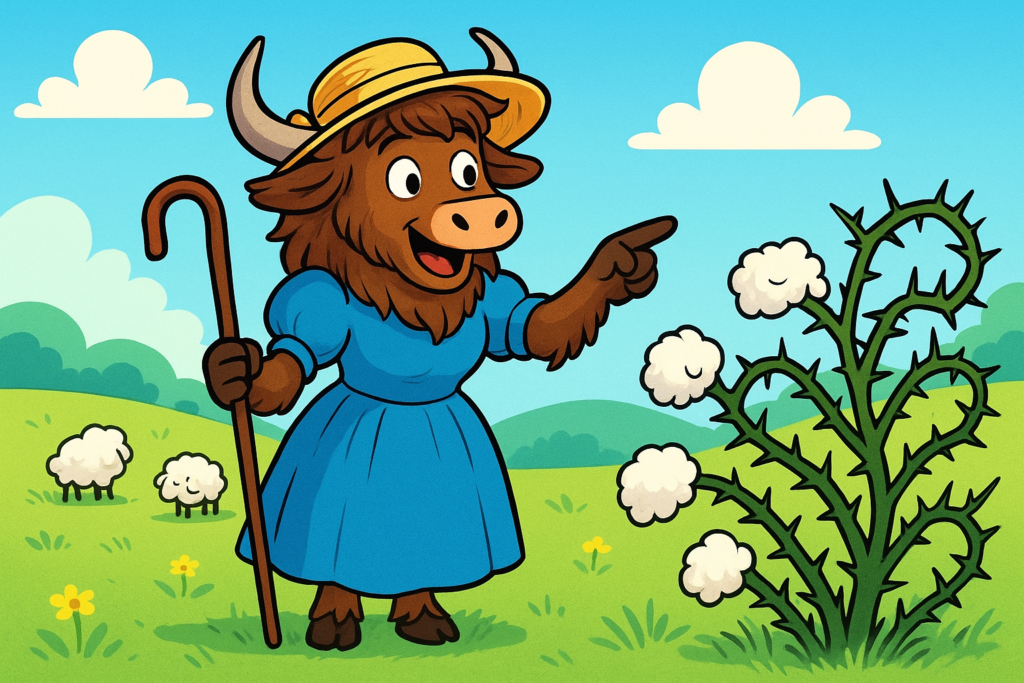
Little Bo-Peep is a sweet story about a girl and her sheep. She looks after them every day, but one afternoon she falls asleep. When she opens her eyes, she cannot find them anywhere! She looks behind the hill and near the stream, but all she finds are their fluffy tails hanging on a bush. This gentle, classic tale is now a free graded reader for English beginners.
And the best part? You can listen to the story with clear, slow audio perfect for learning. If you see a new word, just click it to see the meaning in your language. At the end, there are easy exercises and a short lesson to help you remember. This story is written for CEFR A1 learners-if you're just starting with English, you'll feel right at home.
Little Bo-Peep lived on a green hill.
She had ten white sheep.
They ate grass near the hill.
One day, Bo-Peep sat on the grass.
She .
The sheep .
They walked behind the trees.
Bo-Peep .
"Where are my sheep?" she said.
She looked near the hill.
She looked on the path.
She saw a cow.
"Did you see my sheep?" asked Bo-Peep.
"No, I did not," said the cow.
Bo-Peep .
She found a small .
Behind the barn, she saw something.
"There they are!" she called.
Her sheep .
Their tails behind them.
"Oh, you are safe!" said Bo-Peep.
She was happy.
She took them home.
The end.
Little Bo-Peep lived on a green hill.
She had ten white sheep.
They ate grass near the hill.
One day, Bo-Peep sat on the grass.
She fell asleep.
The sheep walked away.
They went behind the trees.
Bo-Peep woke up.
She said, "Where are my sheep?"
She looked near the hill.
She looked on the path.
She saw a cow.
Bo-Peep asked, "Did you see my sheep?"
The cow said, "No, I did not see them."
Bo-Peep walked a lot.
She found a small barn.
Behind the barn, she saw something.
She called, "There they are!"
Her sheep came out.
Their tails wagged behind them.
Bo-Peep said, "Oh, you are safe!"
She was happy.
She took them home.
The end.
Bo-Peep's world has a few simple words that are very useful. You saw them in the story-let's look at them again.
Here are some words to remember. They describe places, animals, and feelings.
- a sheep - an animal with white wool; more than one: sheep
- a hill - a small, high place with grass
- a barn - a building on a farm for animals
- behind - at the back of something
- safe - not in danger
The story tells us what happened before. We use the past simple for finished actions. For many verbs, we add -ed.
Some verbs change in a special way. You just need to meet them and use them!
- Regular: walk → walked, look → looked, call → called
- Irregular: sit → sat, see → saw, find → found, say → said
- Bo-Peep walked and walked. She found a small barn.
When Bo-Peep wanted an answer about the past, she used did. The pattern is: Did + subject + base verb?
The answer can be short: Yes, I did. / No, I did not. Try to notice it in the story: "Did you see my sheep?" "No, I did not."
- Did + she + see …? → Did she see the sheep?
- Did + you + look …? → Did you look behind the barn?
- Yes, I did. / No, I did not.
You have met past tense verbs and some new words. Now you can tell Little Bo-Peep's story again, using your own voice.
Try to say what happened step by step: first she slept, then the sheep walked away, then she looked. The more you do it, the easier it feels.
Little Bo-Peep comes from the English / nursery rhyme tradition and is best known as a nursery rhyme. This Yak Yacker article is an original learner retelling based on Traditional nursery rhyme; public domain, so the wording here is simplified for modern learners rather than copied from one old edition.
Older printings, translations, and retellings of this story can vary quite a bit. The original audience was usually kids, but this version is adapted for A1 Beginner learners studying English. Can expand into a simple lost sheep story.
If you want to look into the source tradition, start with Wikisource.
If you want to keep going, browse more in our English section and review the A1 English Vocabulary List. After that, try English Question Words for another useful next step.