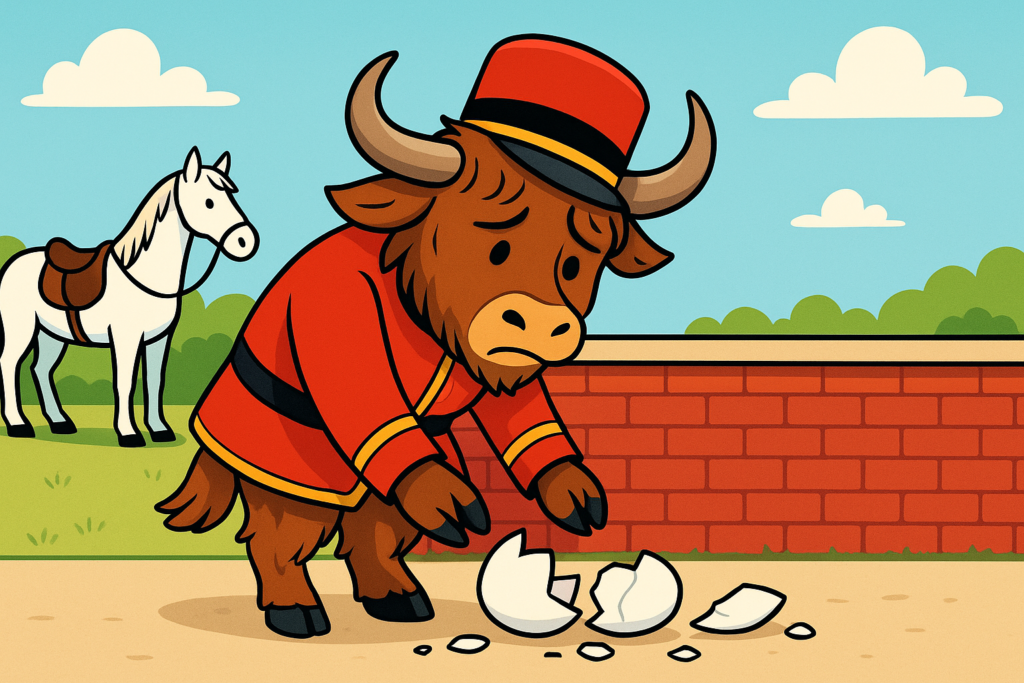
This A1 Beginner retelling of Humpty Dumpty keeps the plot clear for learners while still giving the story some atmosphere and momentum. He sat on a big wall.
This version is written for English-speaking learners and includes clickable word help inside the story, full story audio, and lesson notes after the reading. It is free to use on Yak Yacker and is designed to feel natural, readable, and manageable in English.
Humpty Dumpty was an egg.
He sat on a big wall.
"I like it here," he said.
Then he fell.
The king's horses and men came quickly.
They tried and tried.
But they could not him.
Humpty Dumpty was an egg.
He sat on a big wall.
He said, "I like it here."
Then he fell.
The king's horses and men came quickly.
They tried many times.
But they could not put him back together.
Let's look at some key words. They will help you understand the story and use English every day.
- wall - a tall, hard thing. You can sit on a wall.
- fall - to go down suddenly. Humpty fell from the wall.
- horses - big animals. The king's horses came quickly.
- fix - to make something broken good again. They could not fix Humpty.
The story uses the past tense to talk about things that happened before. Look at these verbs from the story.
- is → was (Humpty was an egg.) / sit → sat (He sat on a wall.)
- say → said ("I like it here," he said.) / fall → fell (Then he fell.)
- come → came (The horses and men came.) / try → tried (They tried and tried.)
- can → could (They could not fix him.)
Here are some useful phrases from the story. You can use them in your own English.
- "on a wall" - use "on" when something is on top of something else.
- "like it here" - say this when you enjoy a place.
- "try and try" - repeat a verb to show you do it many times.
- "could not" - means you tried but it was not possible.
You read the story. Now try to tell it in your own words. Use the past tense and the new phrases. Practice makes perfect!
- Draw Humpty on the wall and tell a friend: "He sat on a wall. He fell. They could not fix him."
Humpty Dumpty comes from the English / nursery rhyme tradition and is best known as a nursery rhyme. This Yak Yacker article is an original learner retelling based on Traditional nursery rhyme; public domain, so the wording here is simplified for modern learners rather than copied from one old edition.
Older printings, translations, and retellings of this story can vary quite a bit. The original audience was usually kids, but this version is adapted for A1 Beginner learners studying English. Very short; use as micro-reading or expand.
If you want to look into the source tradition, start with Wikisource.
If you want to keep going, browse more in our English section and review the A1 English Vocabulary List. After that, try 1,200 English Phrases and Expressions for another useful next step.