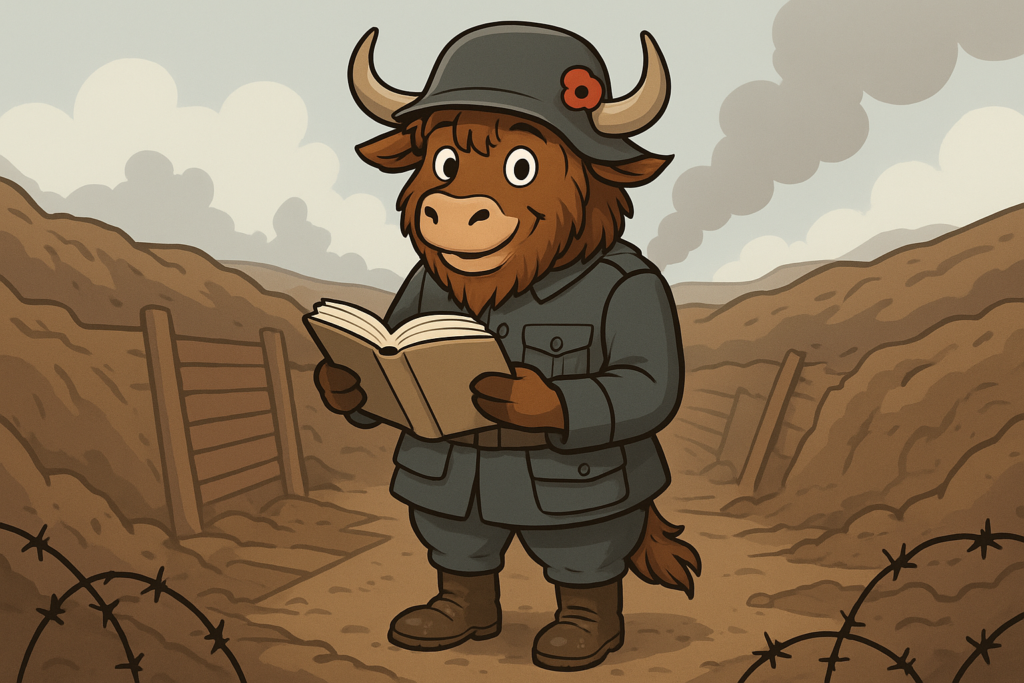
All Quiet on the Western Front is a powerful story about the realities of war. Our retelling is written in clear, intermediate-level English (B1), so you can enjoy the story and improve your language skills at the same time. Follow the young soldier Paul Bäumer and his classmates as they experience the horrors of World War I.
At first, Paul and his friends are excited to join the army. But soon, they face hunger, fear, and loss in the trenches of the Western Front. Through Paul's eyes, we see how war changes people and destroys dreams.
This interactive graded reader includes clickable word help, so you can easily check new vocabulary. You can also listen to the story audio to improve your pronunciation. Along with free lesson notes, this is a complete English learning experience.
Our schoolmaster, , stood before us, his face . 'Young men, your country needs you!' he cried. 'Go and fight for our glorious Germany!' We looked at each other-Paul, Müller, Kropp, and me-our hearts pounding.
'It will be a ,' Müller whispered to me later. 'Maybe we'll come home .' We all agreed, even though we were barely eighteen. In our minds, war meant , uniforms, and marching bands.
We together, a group of school friends full of dreams. But training camp with Sergeant Himmelstoss quickly. He made us , stand at attention for hours, and punished us for the smallest mistake.
'You call yourselves soldiers?' he would scream. 'You are !' We hated him, but that hate . Finally, we were sent to the . That's when we learned the truth.
The first came at night. The earth shook, and the sky turned orange. We pressed ourselves into the ground, . 'Is this what we signed up for?' Kropp shouted over the noise. No one answered.
In the trenches, we met older soldiers. Katczinsky, or Kat as we called him, showed us how to find food and avoid danger. 'Listen to me, boys,' he said with a kind smile. 'In war, a full stomach is more important than a medal.'
Our friend Kemmerich was . We visited him in the . The leg was gone, and he looked so small and pale. 'I can't feel my foot anymore,' he whispered. Paul held his hand, but Kemmerich later that night.
Müller wanted his boots, and Paul took them. It felt wrong, but we had learned to be . The boots were good. They mud, blood, and rain-from one soldier to the next, until they were all that remained of many.
One afternoon, I jumped into a during an attack. A French soldier after me. In panic, I stabbed him. He fell, and for hours I lay beside him as he died. His face was young, just like mine.
'I didn't want to you,' I said to the still body. 'You were only . We are both the same-poor, frightened creatures.' I promised to write to his family, but in the , I never did.
When I returned home on leave, everything felt wrong. My family talked about the war as if it were a . I couldn't explain the mud, the screams, the . 'It's not like the newspapers say,' I told my mother quietly.
Back at the front, things were worse. My friends were . Kropp lost a leg and talked of . Müller was killed by a shell. And one by one, our little group of schoolboys vanished, until only Kat and I were left.
Then Kat was hit in the leg. I carried him through the , talking to him, trying to keep him awake. But when I reached safety, a tiny piece of had hit the back of his head. He was dead, and my last friend was gone.
By October 1918, I was the last. The war was ending, but I felt no joy. On a day so quiet that the army report simply said, 'All quiet on the Western Front,' I stood up, and a found me. My face seemed almost calm, as if I was finally at home.
This story uses many strong, vivid words that describe life in a war. Below are some key terms that appear in the text. Learning them will help you talk about serious topics like conflict and feelings.
Each word comes with a simple definition and an example sentence so you can see how it's used in context.
- enlisted - officially joined the army. 'We enlisted because we thought it was an adventure.'
- bombardment - a continuous attack with bombs or shells. 'The bombardment shook the ground for hours.'
- shrapnel - small pieces of metal from an exploding weapon. 'A piece of shrapnel killed my last friend.'
- sniper - a soldier who shoots from a hidden position. 'A sniper's bullet ended the young soldier's war.'
Remarque's style is famous for being simple but full of emotion. He often uses short, direct sentences to create a strong picture in your mind. For example: "The first bombardment came at night. The earth shook, and the sky turned orange." These plain words let you feel the fear without extra decoration.
Look at how a simple description can carry deep meaning: "The boots were good. They walked through mud, blood, and rain." This repetition shows loss, survival, and the soldiers' practical but painful world.
- Short sentences build tension: "I stabbed him. He fell." instead of a long, complicated description.
- Emotional words like terrified, emptiness, and calm create contrasting moods that mirror the soldiers' inner states.
- Notice the contrast between abstract ideas like glory or honour and concrete images like mud, blood, and boots to see how the writer reveals the true face of war.
At its heart, this story is not about heroes or victories. It shows how war destroys young people, friendships, and dreams. The main character, Paul, speaks to a dead French soldier and says, "We are both the same - poor, frightened creatures." That sentence tells us that soldiers on both sides share fear and suffering.
The famous ending - where the army report simply says "All quiet on the Western Front" on the day Paul dies - is deeply ironic. It means that a single death means nothing to the huge war machine.
- The schoolmaster's speech ("Your country needs you!") versus Kropp's question ("Is this what we signed up for?") shows how propaganda hides the ugly truth.
- Losing humanity: the men are called "worms" by their trainer, and they later care more about boots than a dead friend's feelings.
- The last line is powerful because it contrasts a quiet report with the violent, lonely death of a young man nobody remembers.
You have now met some memorable words and ideas from this important novel. Try to use the new vocabulary when you speak or write about conflicts, personal struggles, or any time reality was different from your expectations.
Reading only a summary is just the beginning. You can deepen your English and your understanding by going a step further - maybe even by exploring the original novel one day.
- Write a short paragraph about a moment when you lost an illusion (a false belief). Start with: "I thought it would be… but in reality…"
- If you feel ready, try reading a graded version of the book for B1/B2 learners. The simple style makes it easier to follow.
- Talk with a friend: What would you miss most if you had to leave home and couldn't return for a long time?
All Quiet on the Western Front comes from the Mixed / needs review tradition and is best known as a war film/novel. This Yak Yacker article is an original learner retelling based on 1930 film now public domain in U.S. as of 2026, so the wording here is simplified for modern learners rather than copied from one old edition.
Older printings, translations, and retellings of this story can vary quite a bit. The original audience was usually adult, but this version is adapted for B1 Intermediate learners studying English. Anti-war story; adult violence.
If you want to look into the source tradition, start with Duke Center for the Study of the Public Domain.
If you want to keep going, browse more in our English section and review the B1 English Vocabulary List. After that, try 1,200 English Phrases and Expressions for another useful next step.