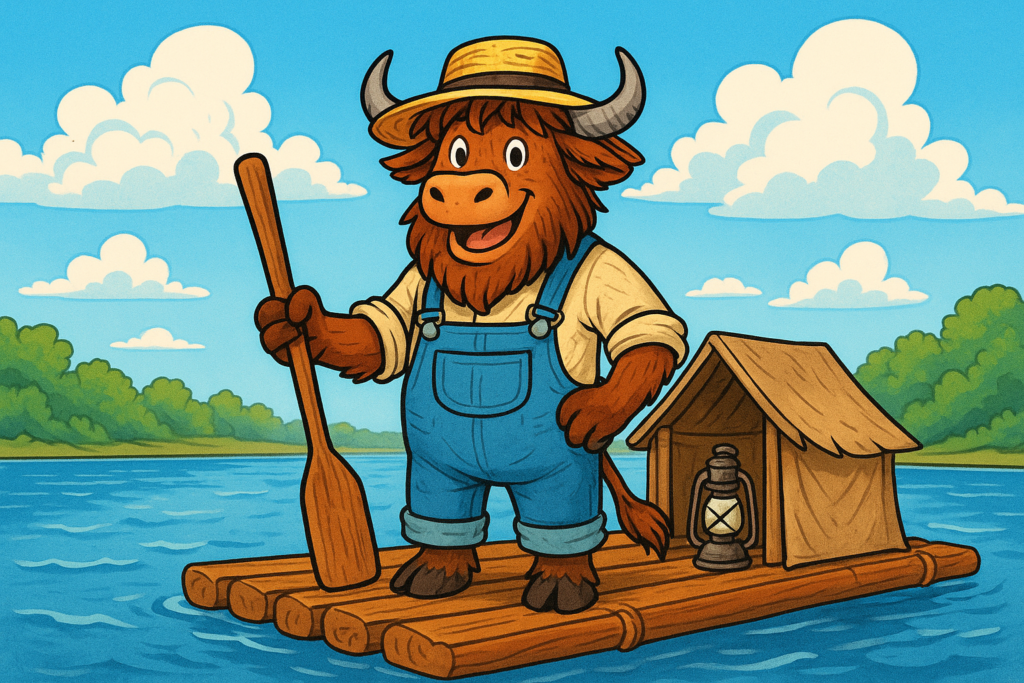
This B1 Intermediate retelling of The Adventures of Huckleberry Finn keeps the plot clear for learners while still giving the story some atmosphere and momentum. I used to live with the Widow Douglas, but I didn't like it much. She wanted me to be 'sivilized.
This version is written for English-speaking learners and includes clickable word help inside the story, full story audio, and lesson notes after the reading. It is free to use on Yak Yacker and is designed to feel natural, readable, and manageable in English.
My name is Huckleberry Finn. You can call me Huck. I used to live with the Widow Douglas, but I didn't like it much.
She wanted me to be '.' She made me wear , eat at a table, and go to . It was awful.
Then one day my came back. He was a , man. He took me to a in the woods and .
I couldn't stay there. So I made a plan. I and its blood around. I made it look like someone me.
Then I took a and down the Mississippi River. I found a little island called Jackson's Island. I thought I was alone, but I wasn't.
There I met Jim. Jim was Miss Watson's . He because they were going to him down South, away from his family.
"Jim!" I said. "What are you doing here?"
"Huck!" he cried. "I thought you was dead! I'm . I'm going to be ."
I promised Jim I wouldn't tell anyone. We decided to . We built a and floated down the river at night.
We had many adventures. One night, we saw a that hit a rock and was . We climbed on it and found some .
"We got to get away quick," Jim whispered. But their raft had floated off. We took the robbers' boat and left them there.
Later, we got lost in a thick . I couldn't see Jim on the raft. "Jim! Jim!" I shouted, but he didn't answer.
When the fog cleared, Jim was asleep. "I was so scared I lost you," I said. Jim didn't believe me at first, but then he smiled.
"You was there all along, Huck. I just didn't know it."
Down the river, we met two men running from . They called themselves the Duke and the King, but they were just .
They took over our raft. They made us help them with their . One time, they pretended to be the brothers of a dead man named Peter Wilks.
They wanted his money. The man's three daughters were so sad and kind. I felt bad for them.
"These girls think the Duke and King are their uncles," I thought. "They don't know the truth. I got to do something."
I took the bag of and hid it in Peter Wilks's . Then I told one of the daughters what really happened.
Just then, the real brothers arrived! There was a big fight. The Duke and King ran away, and we escaped on the raft.
But they caught up with us later. The King was mad. Then he did something even worse. He Jim to a family for forty dollars.
I was angry and sad. Jim was my friend. I had to save him, even if it meant going to . That's what I thought at the time.
I found out Jim was at the Phelps farm. The Phelps family thought I was their nephew, Tom Sawyer, who was coming to visit.
So I to be Tom. When the real Tom arrived, he thought it was a great joke. He pretended to be his brother Sid.
"Tom," I said, "we got to Jim. He's locked up in a ."
"Don't you worry, Huck," Tom said. "We'll do it with . Like in the adventure books."
Tom made a huge plan. We dug a , we wrote secret messages, and we even put snakes and rats in the shed with Jim. Jim was .
Finally, we escaped. But Tom got shot in the leg. Jim said, "I ain't moving till a doctor sees that boy."
So Jim stayed with Tom, even though it meant he might be caught. The doctor came, and soon everyone found out.
Then Tom woke up and told the truth. "Jim's not a slave anymore," he said. "Miss Watson died and him in her will."
Jim was free all along! I was so happy. And Tom's Aunt Polly came and sorted everything out.
Now Jim could go back to his family. As for me, I decided to for the Territory. I hear they don't have so much sivilizing there.
And that suits me just fine.
Huck's story is full of movement, but it starts with a simple feeling: he does not fit the life other people choose for him. The Widow Douglas wants to "sivilize" him, but Huck prefers freedom, dirt, and a little trouble. That tension is the engine of the whole tale.
This is a classic adventure story, but it is also a story about independence, friendship, and conscience. Huck keeps asking, in actions more than words, what kind of life is truly right.
- Huck = Huckleberry Finn, the narrator and main character.
- "Sivilized" is Huck's playful spelling of "civilized."
- The story often contrasts rules with freedom.
A lot of the story's vocabulary belongs to travel and danger. A canoe is a small boat you paddle, while a raft is a flat floating platform. A steamboat is a larger boat powered by steam, and a cabin is a small simple house, often in the woods.
The people in the story matter too. A trickster is someone who cheats or deceives others for fun or profit. A scam is a dishonest plan to get money. If someone is mean or drunk, that tells you a lot about how unsafe they are.
- paddle = move a boat with a paddle
- float = move gently on water
- run away = leave secretly to escape danger
- sell someone down South = send them far away, often in slavery
Most of the story is told in the past tense because Huck is looking back on events: I used to live, he came back, we built a raft, they ran away. This keeps the story moving and helps the reader feel that the adventure is already complete.
The dialogue makes the story lively: "Jim!" I said. "What are you doing here?" Notice how short spoken lines create urgency. Huck also shares his thoughts directly, like "I got to do something." That gives us a close view of his feelings and decisions.
- Use past tense for finished events in stories.
- Short dialogue can make danger or surprise feel immediate.
- "Got to" is informal speech for "have to."
- "Ain't" is nonstandard English used to show character voice, not formal grammar.
Huck begins by trying to escape control, but he ends up showing real moral courage. He lies, sneaks, and improvises, yet he also protects Jim when it matters most. Their friendship becomes the heart of the story.
If you want to read like a stronger learner, notice how the story mixes action with values. Ask yourself not only what happens, but why Huck chooses it. That habit will help you understand stories faster and talk about them more clearly.
- Watch for choices, not just events.
- Friendship in this story is tied to loyalty and risk.
- A good next step: retell one scene using past tense and 3-5 key vocabulary words.
The Adventures of Huckleberry Finn comes from the American / Mark Twain tradition and is best known as a adventure/social novel. This Yak Yacker article is an original learner retelling based on Mark Twain, 1884; public domain, so the wording here is simplified for modern learners rather than copied from one old edition.
Older printings, translations, and retellings of this story can vary quite a bit. The original audience was usually general/adult, but this version is adapted for B1 Intermediate learners studying English. Contains racial language/themes; adapt carefully.
If you want to look into the source tradition, start with Project Gutenberg.
If you want to keep going, browse more in our English section and review the B1 English Vocabulary List. After that, try 1,200 English Phrases and Expressions for another useful next step.