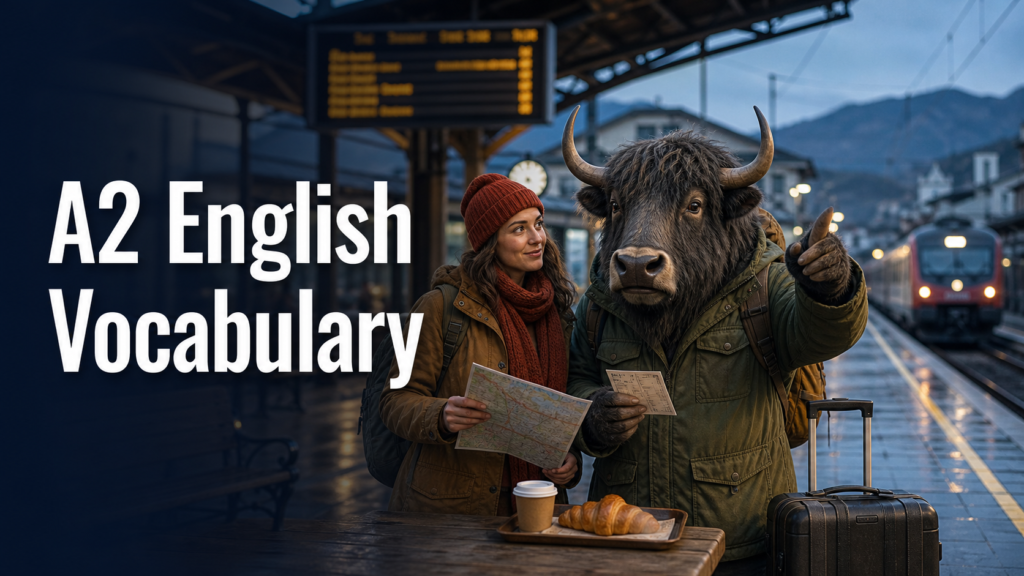
Ready to move from simple phrases to real conversations? This CEFR-aligned A2 list gives you around 1600 practical words you’ll actually hear and use — on the street, while traveling, or at a café. No fluffy lists, just vocabulary that helps you connect.
Each entry comes with a clear meaning, an everyday example sentence, and easy-to-read US IPA so you can say it right. Tap the play button next to any word to hear it spoken aloud — that way you’re not just reading, you’re training your ears too.
Ready to grow your English step by step? This friendly A2 set is packed with useful words for everyday life, and you can find the free printable A2 English vocabulary list list PDF plus the free downloadable printable A2 English list flashcards when you scroll to the bottom of the article.
Words are great, but you need chunks you can blurt out without thinking. Our free chunk-based lessons teach real phrases with audio and speaking practice. If you’re just starting, Lesson 1 — First Greetings will have you chatting in minutes.
- English Vocabulary hub
- Learn English guide
- Pre-A1 English Vocabulary List
- A1 English Vocabulary List
- B1 English Vocabulary List
- CEFR levels overview (Council of Europe)
- British Council — English learning resources
A2 Vocabulary Quiz
Think you know these A2 words? Give the list a quick scroll, then jump into the quiz below to see how many stick.
Keep building your English
Choose a practical next step when you are ready.
Everyday A2 English Vocabulary
| Word | IPA | Type | Meaning | Example | Audio |
|---|---|---|---|---|---|
| Swimmer | /ˈswɪmər/ | n. | A person who swims | She is a strong swimmer. | |
| Swimming | /ˈswɪmɪŋ/ | n. | The activity or sport of moving through water by moving your body | We go swimming every week. | |
| swimming pool | /ˈswɪmɪŋ puːl/ | n. | a place filled with water for swimming | The children are in the swimming pool. | |
| Swimsuit | /ˈswɪmˌsuːt/ | n. | A piece of clothing that you wear for swimming | I forgot to bring my swimsuit. | |
| Switch | /swɪtʃ/ | v. | To use a switch to change a device from one state or type of operation to another | Can you switch the light on? | |
| Symbol | /ˈsɪmbəl/ | n. | A sign shape or object that is used to represent something else | The dove is a symbol of peace. | |
| Sympathy | /ˈsɪmpəθi/ | n. | An expression of understanding and care for someone else's suffering | I have a lot of sympathy for her. | |
| System | /ˈsɪstəm/ | n. | A set of connected things or devices that operate together | The heating system is broken. | |
| T-shirt | /ˈtiːˌʃɜrt/ | n. | A casual shirt with short sleeves | I wear a T-shirt in summer. | |
| Table | /ˈteɪbəl/ | n. | A flat surface usually supported by four legs used for putting things on | The book is on the table. | |
| Tablet | /ˈtæblɪt/ | n. | A small solid piece of medicine | Take two tablets with water. | |
| Tail | /teɪl/ | n. | A part of an animal's body pointing backward from the end of its back | The dog wagged its tail. | |
| Take | /teɪk/ | v. | To move something or someone from one place to another | Take this book to the library. | |
| take a bath | /teɪk ə bæθ/ | verb phrase | to wash in a tub | The baby takes a bath at night. | |
| take off | /teɪk ɔf/ | phr. v. | to leave the ground and begin to fly | The plane will take off soon. | |
| take out the garbage | /teɪk aʊt ðə ˈɡɑːrbɪdʒ/ | verb phrase | to carry trash outside | He takes out the garbage after dinner. | |
| take out the recycling | /teɪk aʊt ðə riˈsaɪklɪŋ/ | verb phrase | to put recycling outside | We take out the recycling on Friday. | |
| take out the trash | /teɪk aʊt ðə træʃ/ | verb phrase | to carry the garbage outside | I take out the trash after dinner. | |
| take part | /teɪk pɑrt/ | phr. v. | to join in an activity or event | I want to take part in the race. | |
| Tale | /teɪl/ | n. | A story especially one that might be invented or difficult to believe | He told a tale about a dragon. | |
| Talent | /ˈtælən/ | n. | A natural ability to be good at something especially without being taught | She has a talent for drawing. | |
| Talk | /tɔk/ | v. | To say words aloud to speak to someone | We need to talk. | |
| Tall | /tɔl/ | adj. | Of more than average height or of a particular height | He is very tall. | |
| Tank | /tæŋk/ | n. | A large military fighting vehicle designed to protect those inside it from attack driven by wheels that turn inside moving metal bands | The army used tanks in the war. | |
| Tap | /tæp/ | n. | A device that controls the flow of liquid especially water from a pipe | Turn off the tap. |