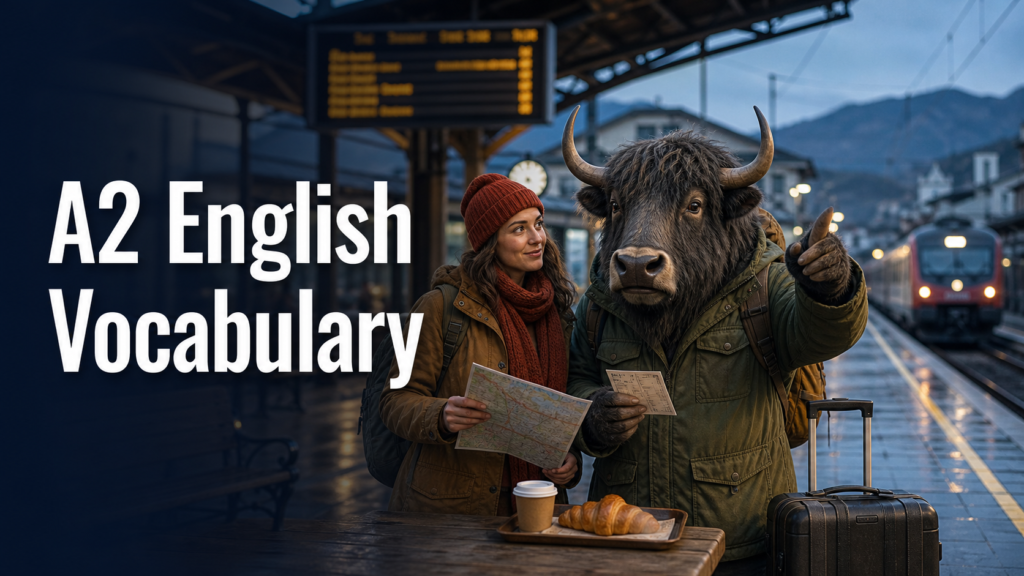
Ready to move from simple phrases to real conversations? This CEFR-aligned A2 list gives you around 1600 practical words you’ll actually hear and use — on the street, while traveling, or at a café. No fluffy lists, just vocabulary that helps you connect.
Each entry comes with a clear meaning, an everyday example sentence, and easy-to-read US IPA so you can say it right. Tap the play button next to any word to hear it spoken aloud — that way you’re not just reading, you’re training your ears too.
Ready to grow your English step by step? This friendly A2 set is packed with useful words for everyday life, and you can find the free printable A2 English vocabulary list list PDF plus the free downloadable printable A2 English list flashcards when you scroll to the bottom of the article.
Words are great, but you need chunks you can blurt out without thinking. Our free chunk-based lessons teach real phrases with audio and speaking practice. If you’re just starting, Lesson 1 — First Greetings will have you chatting in minutes.
- English Vocabulary hub
- Learn English guide
- Pre-A1 English Vocabulary List
- A1 English Vocabulary List
- B1 English Vocabulary List
- CEFR levels overview (Council of Europe)
- British Council — English learning resources
A2 Vocabulary Quiz
Think you know these A2 words? Give the list a quick scroll, then jump into the quiz below to see how many stick.
Keep building your English
Choose a practical next step when you are ready.
Everyday A2 English Vocabulary
| Word | IPA | Type | Meaning | Example | Audio |
|---|---|---|---|---|---|
| Invite | /ɪnˈvaɪt/ | v. | To ask or request someone to go to an event | I will invite them to the party. | |
| Involve | /ɪnˈvɑlv/ | v. | If an activity situation etc involves something that thing is a part of the activity etc | The job involves a lot of travelling. | |
| Iron | /ˈaɪ.ərn/ | n. | A piece of equipment for making clothes flat and smooth that has a handle and a flat base and is usually heated with electricity | I need to use the iron. | |
| Is | /ɪz/ | v. | Third person singular present of be | He is a teacher. | |
| Issue | /ˈɪʃ.u/ | n. | A subject or problem that people are thinking and talking about | Environmental issues are important. | |
| Item | /ˈaɪ.təm/ | n. | Something that is part of a list or group of things | I bought three items at the shop. | |
| Itself | /ɪtˈsɛlf/ | pron. | Used when the subject of the verb is it and the object is the same thing animal situation or idea | The cat washed itself. | |
| jazz | /dʒæz/ | n. | A type of modern music with a strong rhythm | He enjoys listening to jazz. | |
| jellyfish | /ˈdʒɛliˌfɪʃ/ | n. | a sea animal with a soft body and tentacles | We saw a jellyfish near the beach. | |
| jewellery | /ˈdʒuːəlri/ | n. | Decorative objects worn on your clothes or body | She wears a lot of gold jewellery. | |
| jigsaw puzzle | /ˈdʒɪsɔː ˌpʌzəl/ | noun phrase | a picture game with many pieces | I like doing a jigsaw puzzle. | |
| jog | /dʒɑɡ/ | v. | to run slowly for exercise | She jogs in the morning. | |
| Join | /dʒɔɪn/ | v. | To get involved in an activity or journey with another person or group | Would you like to join us for dinner? | |
| Joke | /dʒoʊk/ | n. | Something such as a funny story or trick that is said or done in order to make people laugh | He told a funny joke. | |
| Journalist | /ˈdʒɜrnəlɪst/ | n. | A person who writes news stories or articles for a newspaper or magazine or broadcasts them on radio or television | She is a journalist for the local paper. | |
| Journey | /ˈdʒɜrni/ | n. | The act of travelling from one place to another especially in a vehicle | The journey takes three hours. | |
| Joy | /dʒɔɪ/ | n. | Great happiness | The children jumped with joy. | |
| Judge | /dʒʌdʒ/ | n. | A person who is in charge of a trial in a court and decides how a person who is guilty of a crime should be punished or who makes decisions on legal matters | The judge sentenced him to prison. | |
| Keep | /kip/ | v. | To have or continue to have in your possession | You can keep the change. | |
| Kid | /kɪd/ | n. | A child or young person | The kids are playing in the garden. | |
| Kill | /kɪl/ | v. | To cause someone or something to die | Smoking can kill you. | |
| Kilogram | /ˈkɪləˌɡræm/ | n. | A unit of mass equal to 1000 grams | I bought two kilograms of apples. | |
| Kilometre | /kɪˈlɑːmɪtər/ | n. | A unit of length equal to 1000 metres | The town is five kilometres away. | |
| King | /kɪŋ/ | n. | A male ruler of a country who usually inherits his position and rules for life | The king lives in a castle. | |
| Kiss | /kɪs/ | v. | To touch with your lips especially as a greeting or to show love or sexual desire | She kissed her children goodnight. |