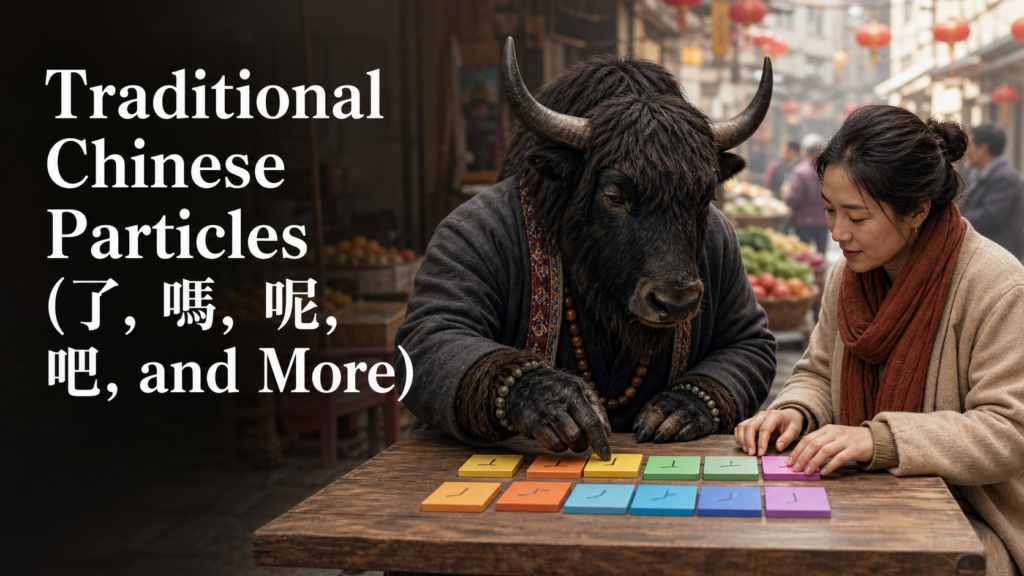
Particles are the tiny seasoning words that give Traditional Chinese its rhythm and attitude – without them, your sentences can sound a bit flat. You’ve probably already met 了, 嗎, 呢, and 吧 in your first few lessons, and maybe even wondered why they keep showing up in different spots. That’s because they don’t just decorate a sentence; they tweak the timing, the tone, the whole vibe of what you’re saying.
This list collects around 30 of the most practical Traditional Chinese particles you’ll bump into again and again – the ones that turn a statement into a question, soften a command, or signal that something’s just changed. We’ve kept the focus on everyday usage, not dusty grammar theory.
Each entry comes with a straightforward meaning and a natural example sentence so you can see exactly how the particle behaves in real conversation. When you’re ready to take your study offline, just hit the free PDF download button below the table – it’s a clean, printable sheet for when you’re on the go or just want to rest your eyes from the screen.
Want more than one list? Browse our Traditional Chinese section for more Yak Yacker study pages, printable lists, and quiz-friendly review material.
Quick Quiz
Think you can tell your 嗎 from your 呢 in your sleep? The quick quiz below gives you a low-pressure nudge toward the particles that could use a second look.
Keep building your Traditional Chinese
Choose a practical next step when you are ready.
Quiz data not found. No rows have values for both headword and meaning.
Browse the Full List
| Word | Pinyin |
|---|---|
| A | |
| B | |
| 八 | bā |
| 包 | bāo |
| 包子 | bāozi |
| 半 | bàn |
| 吧 | ba |
| 啊 | a |
| 報紙 | bàozhǐ |
| 安全 | ānquán |
| 安靜 | ānjìng |
| 幫 | bāng |
| 幫忙 | bāngmáng |
| 愛 | ài |
| 把 | bǎ |
| 抱 | bào |
| 搬 | bān |
| 杯 | bēi |
| 棒 | bàng |
| 棒球 | bàngqiú |
| 爸爸 | bàba |
| 班 | bān |
| 白 | bái |
| 百 | bǎi |
| 百貨公司 | bǎihuògōngsī |