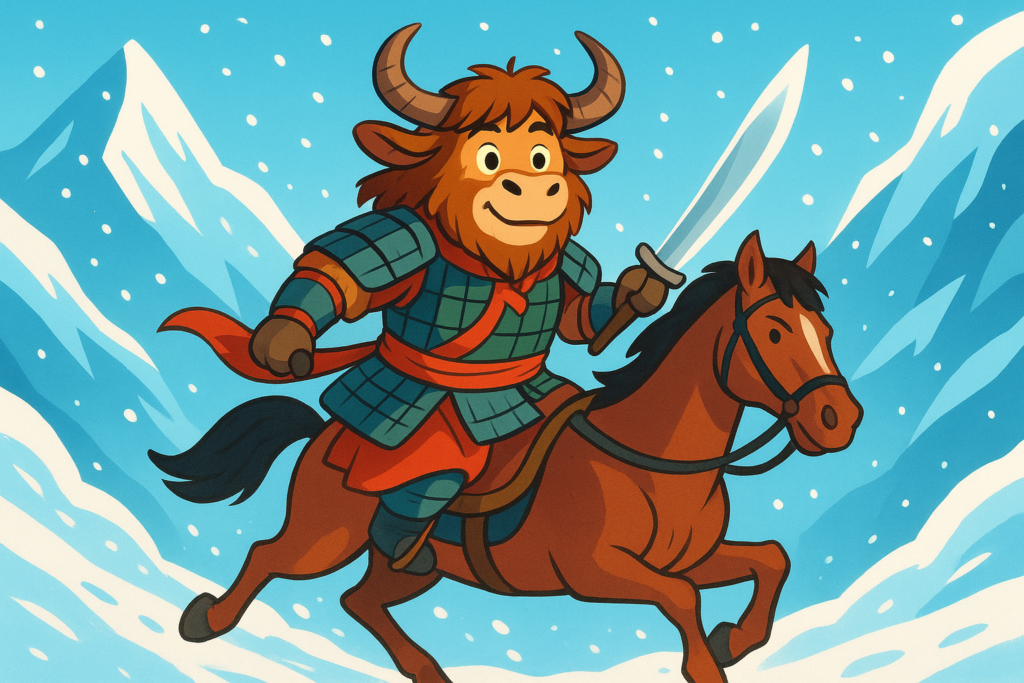
Step into the world of ancient China and meet Mulan, a courageous young woman who disguises herself as a man to take her father's place in the army. In this retelling of the beloved legend, you'll follow Mulan as she trains hard, goes to war, and uses her wit and bravery to save her country-all while protecting her family's honor. Along the way, you'll discover useful words like 'disguise,' 'army,' and 'courage' that make the story come alive.
This interactive A2 reader is designed just for you. Click any word to see its meaning instantly, listen to the full story audio to practice your listening, and check out the free lesson notes to learn more about the vocabulary and grammar. No stress, just a fun way to improve your English-straight from a classic Chinese tale.
Long ago in China, there was a young woman named Mulan. She lived with her mother, father, and younger brother. One day, a soldier came to their village. He said, "Every family must send one man to fight in the war." Mulan's father was old and not strong. Mulan was very worried.
That night, Mulan could not sleep. She thought, "My father cannot go to war. I must help my family." So she made a big decision. She cut her hair short and put on her father's armor. She looked like a young man. The next morning, she took her horse and went to the army camp.
and . The other soldiers called her "Ping." They all worked together. Mulan made friends, but she always remembered her secret. She often thought, "I am doing this for my family. I must be strong."
. He said, "Thank you, Ping. You are a great soldier." Mulan smiled and said, "We are a team."
. Everyone said, "Follow Ping! He is smart and strong!"
. What reward do you want?" Mulan thought for a moment. She said, "I only want to go home to my family." The emperor gave her a horse and sent her home with honor.
and put on a dress. Her mother and father cried with joy. Her brother hugged her. They were all so happy. Mulan said, "I missed you so much."
comes from the heart, not from being a man or a woman.
A long time ago in China, a young woman named Mulan lived with her parents and brother. A soldier came and said each family must send a man to war. Her father was old and weak, so Mulan was worried.
Unable to sleep, Mulan decided to take her father's place. She cut her hair, wore his armor, and looked like a man. The next day, she rode to the army camp.
Mulan, now called Ping, trained daily in sword fighting and riding. She made friends but kept her secret, reminding herself to stay strong for her family.
In battle, Mulan was brave. She saved the captain, who praised her. She replied humbly, emphasizing teamwork.
Through many hard battles, Mulan remained fearless. She became a beloved leader, with soldiers admiring her intelligence and strength.
When the war ended, the emperor offered a reward, but Mulan only wished to return home. He gave her a horse and sent her off with honor.
Mulan returned home, changed into women's clothes, and was greeted tearfully by her overjoyed family. She expressed how much she missed them.
Her soldier friends visited and were shocked to discover she was a woman. They declared her the bravest, and Mulan realized bravery isn't about gender but heart.
This story is full of words about courage, family, and secrets. Let's pick a few that you'll want to remember. Each word is shown in Traditional Chinese with pinyin and a short meaning.
- 勇敢 (yǒnggǎn) - brave, courageous
- 秘密 (mìmì) - secret
- 士兵 (shìbīng) - soldier
- 戰鬥 (zhàndòu) - battle, fight
- 家庭 (jiātíng) - family
- 榮譽 (rónɡyù) - honor
In the story, you saw many moments of dialogue: "He said, '…'" or "She thought, '…'". To express this in Chinese, we usually use the verb 說 (shuō, to say) or 想 (xiǎng, to think). Notice the punctuation: Traditional Chinese often uses 「 」 or 『 』 for quotes. For example, Mulan might say: 她說:「我必須幫助我的家人。」(Tā shuō: "Wǒ bìxū bāngzhù wǒ de jiārén.") - She said, "I must help my family."
When you want to sound more like a native speaker, remember that the quoted speech often comes right after the verb without a conjunction like "that". Practice by taking any line from the story and turning it into a quote with 說 or 想.
- Use 說 (shuō) for spoken words: 爸爸說:「…」 "Dad said, '…''"
- Use 想 (xiǎng) for thoughts: 她想:「…」 "She thought, '…'"
Mulan's choice wasn't just about being brave-it was also about 孝 (xiào), or filial piety. In Chinese culture, respecting and protecting your parents is a deep value. The word 榮譽 (honor) appears when the emperor rewards her, but Mulan's true honor comes from her family's love. Her story shows that 勇氣 (yǒngqì, courage) isn't about being a man or a woman; it's about doing what's right.
When you learn Chinese, you often meet words that carry centuries of cultural meaning. Next time you see a character like 孝, think about the story behind it-just like Mulan, you're discovering a new world through language.
Now that you know the key words, try retelling Mulan's story in your own words. Use phrases like 她決定 (tā juédìng, she decided) or 她告訴自己 (tā gàosù zìjǐ, she told herself). You can also write a few sentences about a time when you were brave-big or small. Describe what happened and how you felt using the new vocabulary.
If you're feeling creative, imagine you are a soldier in Mulan's camp. What would you say to "Ping" when you learned the truth? Write a short dialogue using 說 and 「 」. Keep exploring, and remember: every new word is a step toward your own adventure in Chinese.
- Retell the story in 3-4 sentences with 勇敢 and 秘密.
- Write about a brave moment using 勇敢 and 家庭.
- Create a short dialogue between two soldiers after Mulan's secret is revealed.
Mulan: The Brave Daughter comes from the Chinese / legend tradition and is best known as a legend/ballad. This Yak Yacker article is an original learner retelling based on Ballad of Mulan, ancient poem; public domain, so the wording here is simplified for modern learners rather than copied from one old edition.
Older printings, translations, and retellings of this story can vary quite a bit. The original audience was usually kids/general, but this version is adapted for A2 Elementary learners studying Traditional Chinese. Avoid Disney-specific sidekicks/details; retell from ballad tradition.
If you want to look into the source tradition, start with Wikisource.
If you want to keep going, browse more in our Traditional Chinese section. After that, try Essential Traditional Chinese Grammar Words for another useful next step.