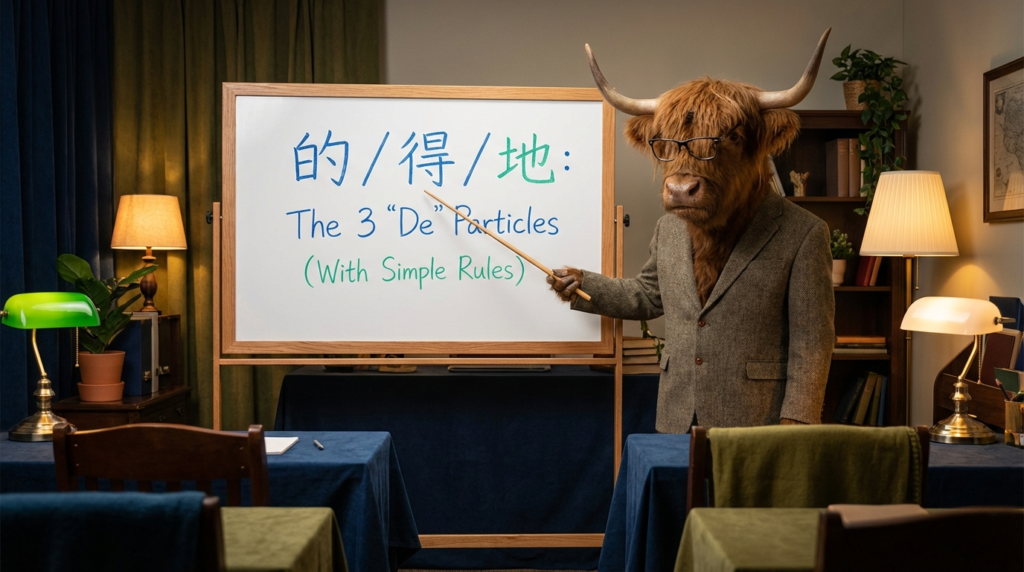
These three little “de” particles (的 / 得 / 地) sound the same, and that’s exactly why they bully beginners. You’ll get simple rules, plus Traditional Chinese characters, pinyin with tone marks, clear meanings, and real-life example sentences.
Goal: stop guessing and start choosing the right one in under 2 seconds. (Yes, even when typing fast and panicking.)
If 的 / 得 / 地 were a friend group, they’d all wear the same outfit and insist you “should just know.” Cool. We’re going to outsmart them with three tiny questions instead.
The 3-question test that saves your sanity
- Does it come before a noun? Use 的 (possessive / description → “my…”, “pretty…”, “the one that…”)
- Does it come before a verb/action? Use 地 (adverb → “slowly”, “carefully”, “seriously”)
- Does it come after a verb/adjective? Use 得 (result/degree/potential complement → “run fast”, “do well”, “can/can’t”)
Fast Visual Cards: the stuff you’ll actually use
Tap the audio buttons to hear each key pattern. Every card includes a real example (with pinyin + translation).
的
Modifier marker (before a noun): possession or description (“…’s / of / the … one”).
得
Complement marker (after a verb): how well / to what degree / can or can’t.
地
Adverb marker (before a verb): “-ly” vibes (slowly, carefully, etc.).
好的
“Okay / got it” (and also “the good one” when used like a noun).
跑得快
“Run fast” (verb + 得 + degree).
做得好
“Do well” (classic 得 pattern).
認真地
“Seriously” (adverb + 地).
我買的
“The one I bought” (clause + 的 → turns into a noun-like modifier).
Relevant phrases & sentence patterns (copy-paste friendly)
These are the “muscle memory” patterns. Learn a handful and your brain will start auto-sorting 的 / 得 / 地 like it’s doing taxes (but less painful).
A 的 B
… de …
Possession or description before a noun: “A’s B / the B that is A.”
Adj 的 N
… de …
Adjective + 的 + noun: “pretty clothes,” “important meeting,” etc.
Clause 的 N
… de …
A whole clause + 的 + noun: “the dish I cooked,” “the place you mentioned.”
Adj 的 (as a noun)
… de
“The … one” (nominalizer). Super common in daily speech.
V 得 Adj
… de …
After the verb: describes degree/result. “Write clearly,” “speak fast,” etc.
V 得 很 Adj
… de hěn …
Common “degree” structure: “do it very well/badly.”
V 得 懂 / 見 / 完
… de dǒng / jiàn / wán
Potential/result complements: “can understand / can see / can finish.”
來得及 / 來不及
lái de jí / lái bù jí
“In time / too late” (yes, it’s 得 — it’s about possibility/time).
Adv 地 V
… de …
Adverb + 地 + verb: the “-ly” pattern.
小心地 + V
xiǎoxīn de …
“Carefully …” (great for real life: roads, stairs, hot soup).
認真地 + V
rènzhēn de …
“Seriously …” (polite way to tell someone to focus).
開心地 + V
kāixīn de …
“Happily …” (because not every sentence needs to be stress-themed).
他說得快 / 他快快地說
tā shuō de kuài / tā kuàikuài de shuō
Same idea, different angle: 得 = outcome/degree after the verb; 地 = manner before the verb.
不要…的 (tone)
bú yào … de
Using 的 to label a “type of thing/way” (often casual speech). Use it lightly.
A small but important curiosity: why native speakers still mix them up
In speech, people sometimes blur 地 and write 的 casually (especially in fast texting). In more careful writing, though, the “before noun / before verb / after verb” test stays the cleanest.
Two quick comparisons (so you can feel the difference)
- 他快快地說。 (Manner before the action → “He speaks quickly.”)
- 他說得快。 (Degree after the action → “He speaks fast.”)
- 快快的腳步 vs 快快地走 → 的 sticks to a noun, 地 sticks to a verb.
Word Tables: build your “de” muscle memory
These are grouped by how you use them. Each row includes the Traditional Chinese term, pinyin, meaning, and a real example (with pinyin + translation).
的: possession & description (before a noun)
| Traditional Chinese | Pinyin | Meaning (EN) | Example (ZH + pinyin) | Translation (EN) | Audio |
|---|---|---|---|---|---|
我的 | wǒ de | my | 這是我的手機。 Zhè shì wǒ de shǒujī. | This is my phone. | |
你的 | nǐ de | your | 這是你的杯子嗎? Zhè shì nǐ de bēizi ma? | Is this your cup? | |
他的 | tā de | his | 我找不到他的鑰匙。 Wǒ zhǎo bú dào tā de yàoshi. | I can’t find his keys. | |
她的 | tā de | her | 這是她的包包。 Zhè shì tā de bāobāo. | This is her bag. | |
我們的 | wǒmen de | our | 這是我們的計畫。 Zhè shì wǒmen de jìhuà. | This is our plan. | |
你們的 | nǐmen de | your (plural) | 你們的座位在那邊。 Nǐmen de zuòwèi zài nàbiān. | Your seats are over there. | |
他們的 | tāmen de | their | 這是他們的想法。 Zhè shì tāmen de xiǎngfǎ. | This is their idea. | |
自己的 | zìjǐ de | one’s own | 我想要自己的房間。 Wǒ xiǎng yào zìjǐ de fángjiān. | I want my own room. | |
漂亮的 | piàoliang de | pretty (as a modifier) | 那是一家漂亮的咖啡店。 Nà shì yì jiā piàoliang de kāfēidiàn. | That’s a pretty café. | |
重要的 | zhòngyào de | important (as a modifier) | 今天有重要的會議。 Jīntiān yǒu zhòngyào de huìyì. | There’s an important meeting today. | |
有名的 | yǒumíng de | famous (as a modifier) | 那裡有有名的夜市。 Nàlǐ yǒu yǒumíng de yèshì. | There’s a famous night market there. | |
便宜的 | piányi de | cheap (as a modifier) | 我想買便宜的票。 Wǒ xiǎng mǎi piányi de piào. | I want to buy a cheaper ticket. | |
貴的 | guì de | expensive (as a modifier) | 這家店的咖啡比較貴的。 Zhè jiā diàn de kāfēi bǐjiào guì de. | The coffee at this shop is on the expensive side. | |
乾淨的 | gānjìng de | clean (as a modifier) | 我想住乾淨的飯店。 Wǒ xiǎng zhù gānjìng de fàndiàn. | I want to stay in a clean hotel. | |
有趣的 | yǒuqù de | interesting (as a modifier) | 他講了有趣的故事。 Tā jiǎng le yǒuqù de gùshì. | He told an interesting story. | |
無聊的 | wúliáo de | boring (as a modifier) | 這是一部無聊的電影。 Zhè shì yí bù wúliáo de diànyǐng. | This is a boring movie. | |
新的 | xīn de | the new one / new (as modifier) | 我想換新的。 Wǒ xiǎng huàn xīn de. | I want to switch to a new one. | |
舊的 | jiù de | the old one / old (as modifier) | 這台太舊了,我不要舊的。 Zhè tái tài jiù le, wǒ bú yào jiù de. | This one is too old; I don’t want the old one. | |
對的 | duì de | the correct one / correct | 你選的是對的。 Nǐ xuǎn de shì duì de. | You picked the right one. | |
錯的 | cuò de | the wrong one / wrong | 這個答案是錯的。 Zhège dá’àn shì cuò de. | This answer is wrong. | |
真的 | zhēn de | real / really (often used like an emphatic “seriously”) | 真的嗎? Zhēn de ma? | Really? |
得: degree, result & potential (after a verb)
| Traditional Chinese | Pinyin | Meaning (EN) | Example (ZH + pinyin) | Translation (EN) | Audio |
|---|---|---|---|---|---|
說得清楚 | shuō de qīngchu | speak clearly | 你可以說得清楚一點嗎? Nǐ kěyǐ shuō de qīngchu yìdiǎn ma? | Can you speak a bit more clearly? | |
說得快 | shuō de kuài | speak fast | 他說得太快了。 Tā shuō de tài kuài le. | He speaks too fast. | |
走得慢 | zǒu de màn | walk slowly | 今天我走得比較慢。 Jīntiān wǒ zǒu de bǐjiào màn. | Today I’m walking slower than usual. | |
學得快 | xué de kuài | learn quickly | 她學得很快。 Tā xué de hěn kuài. | She learns quickly. | |
學得慢 | xué de màn | learn slowly | 我學得慢,但我不放棄。 Wǒ xué de màn, dàn wǒ bù fàngqì. | I learn slowly, but I won’t give up. | |
睡得好 | shuì de hǎo | sleep well | 昨天我睡得很好。 Zuótiān wǒ shuì de hěn hǎo. | I slept very well yesterday. | |
睡得不夠 | shuì de bú gòu | not sleep enough | 我睡得不夠,所以很累。 Wǒ shuì de bú gòu, suǒyǐ hěn lèi. | I didn’t sleep enough, so I’m tired. | |
吃得飽 | chī de bǎo | eat enough / be full | 多吃一點,吃得飽才有力氣。 Duō chī yìdiǎn, chī de bǎo cái yǒu lìqì. | Eat a bit more—being full gives you energy. | |
吃得下 | chī de xià | be able to eat (it) / have appetite | 太辣了,我吃不下。 Tài là le, wǒ chī bù xià. | It’s too spicy—I can’t eat it / I have no appetite. | |
吃得完 | chī de wán | be able to finish eating | 這麼大份,我吃得完嗎? Zhème dà fèn, wǒ chī de wán ma? | It’s such a big portion—can I finish it? | |
看得懂 | kàn de dǒng | can understand (by reading) | 這個菜單我看得懂。 Zhège càidān wǒ kàn de dǒng. | I can understand this menu. | |
聽得懂 | tīng de dǒng | can understand (by listening) | 他講得很快,我聽不懂。 Tā jiǎng de hěn kuài, wǒ tīng bù dǒng. | He speaks fast; I can’t understand. | |
看得見 | kàn de jiàn | can see | 我看得見那座山。 Wǒ kàn de jiàn nà zuò shān. | I can see that mountain. | |
聽得見 | tīng de jiàn | can hear | 你聽得見我說話嗎? Nǐ tīng de jiàn wǒ shuōhuà ma? | Can you hear me? | |
來得及 | lái de jí | make it in time | 現在出門還來得及。 Xiànzài chūmén hái lái de jí. | If we leave now, we can still make it. | |
來不及 | lái bù jí | too late / not in time | 糟了,要來不及了! Zāo le, yào lái bù jí le! | Oh no, we’re going to be late! | |
買得到 | mǎi de dào | can buy (it) | 這個口味不一定買得到。 Zhège kǒuwèi bù yídìng mǎi de dào. | You can’t always find/buy this flavor. | |
買不到 | mǎi bú dào | can’t buy (it) | 太熱門了,我買不到。 Tài rèmén le, wǒ mǎi bú dào. | It’s too popular—I can’t buy it. | |
找得到 | zhǎo de dào | can find (it) | 我覺得你找得到路。 Wǒ juéde nǐ zhǎo de dào lù. | I think you can find the way. | |
找不到 | zhǎo bú dào | can’t find (it) | 我找不到我的耳機。 Wǒ zhǎo bú dào wǒ de ěrjī. | I can’t find my earphones. | |
受得了 | shòu de liǎo | can handle it | 這麼吵,你受得了嗎? Zhème chǎo, nǐ shòu de liǎo ma? | It’s so noisy—can you handle it? | |
受不了 | shòu bù liǎo | can’t stand it | 太熱了,我受不了。 Tài rè le, wǒ shòu bù liǎo. | It’s too hot—I can’t stand it. | |
站得住 | zhàn de zhù | can stand firmly / holds up | 這個理由站得住腳。 Zhège lǐyóu zhàn de zhù jiǎo. | This reason holds up. | |
站不住 | zhàn bú zhù | can’t stand steadily / doesn’t hold up | 我頭很暈,快站不住了。 Wǒ tóu hěn yūn, kuài zhàn bú zhù le. | I’m dizzy—I can barely stand. |
地: adverbs (before a verb)
| Traditional Chinese | Pinyin | Meaning (EN) | Example (ZH + pinyin) | Translation (EN) | Audio |
|---|---|---|---|---|---|
慢慢地 | mànmàn de | slowly | 請慢慢地念。 Qǐng mànmàn de niàn. | Please read it slowly. | |
快快地 | kuàikuài de | quickly (manner) | 他快快地跑回家。 Tā kuàikuài de pǎo huí jiā. | He quickly ran home. | |
認真地 | rènzhēn de | seriously | 我會認真地練習。 Wǒ huì rènzhēn de liànxí. | I’ll practice seriously. | |
輕鬆地 | qīngsōng de | easily / relaxedly | 他輕鬆地完成了工作。 Tā qīngsōng de wánchéng le gōngzuò. | He finished the work easily. | |
小心地 | xiǎoxīn de | carefully | 請小心地拿。 Qǐng xiǎoxīn de ná. | Please hold it carefully. | |
悄悄地 | qiāoqiāo de | quietly | 他悄悄地離開了。 Tā qiāoqiāo de líkāi le. | He left quietly. | |
大聲地 | dàshēng de | loudly | 請不要大聲地講電話。 Qǐng bú yào dàshēng de jiǎng diànhuà. | Please don’t talk on the phone loudly. | |
安靜地 | ānjìng de | quietly (calmly) | 他安靜地坐著。 Tā ānjìng de zuò zhe. | He’s sitting quietly. | |
仔細地 | zǐxì de | carefully (detail-focused) | 請仔細地看說明。 Qǐng zǐxì de kàn shuōmíng. | Please read the instructions carefully. | |
清楚地 | qīngchu de | clearly | 請清楚地回答。 Qǐng qīngchu de huídá. | Please answer clearly. | |
簡單地 | jiǎndān de | simply | 我簡單地說一下。 Wǒ jiǎndān de shuō yíxià. | I’ll explain it briefly. | |
直接地 | zhíjiē de | directly | 你可以直接地告訴我。 Nǐ kěyǐ zhíjiē de gàosù wǒ. | You can tell me directly. | |
禮貌地 | lǐmào de | politely | 請禮貌地拒絕。 Qǐng lǐmào de jùjué. | Please refuse politely. | |
友善地 | yǒushàn de | kindly / friendly | 他友善地跟我打招呼。 Tā yǒushàn de gēn wǒ dǎzhāohū. | He greeted me in a friendly way. | |
努力地 | nǔlì de | hard (努力 = hard-working; with 地 = “work hard” manner) | 我會努力地學好中文。 Wǒ huì nǔlì de xué hǎo Zhōngwén. | I’ll work hard to learn Chinese well. | |
自然地 | zìrán de | naturally | 多練習就會自然地說出口。 Duō liànxí jiù huì zìrán de shuō chūkǒu. | Practice more and you’ll speak naturally. | |
突然地 | tūrán de | suddenly | 他突然地停下來。 Tā tūrán de tíng xiàlái. | He suddenly stopped. | |
開心地 | kāixīn de | happily | 她開心地收下禮物。 Tā kāixīn de shōu xià lǐwù. | She happily accepted the gift. | |
生氣地 | shēngqì de | angrily | 他生氣地關上門。 Tā shēngqì de guān shàng mén. | He angrily shut the door. |
Quick “variants” table: the classic confusion pairs
Same sound, different job. If you remember these pairs, your brain stops mixing them (most days).
| Pair | Pinyin | What it means | Mini example (ZH + pinyin) | Translation (EN) | Audio |
|---|---|---|---|---|---|
快快的腳步 / 快快地走 | kuàikuài de jiǎobù / kuàikuài de zǒu | 的 + noun (“quick footsteps”) vs 地 + verb (“walk quickly”). | 他用快快的腳步,快快地走出車站。 Tā yòng kuàikuài de jiǎobù, kuàikuài de zǒu chū chēzhàn. | With quick footsteps, he walked out of the station quickly. | |
說得快 / 快快地說 | shuō de kuài / kuàikuài de shuō | 得 focuses on degree after speaking; 地 focuses on manner before speaking. | 他說得快,所以我請他快快地說慢一點。 Tā shuō de kuài, suǒyǐ wǒ qǐng tā kuàikuài de shuō màn yìdiǎn. | He speaks fast, so I asked him to (please) speak more slowly. | |
我買的咖啡 / 我買得起 | wǒ mǎi de kāfēi / wǒ mǎi de qǐ | 的 = “the coffee I bought”; 得 = potential (“can afford”). | 這杯是我買的咖啡,但那杯太貴,我買不起。 Zhè bēi shì wǒ mǎi de kāfēi, dàn nà bēi tài guì, wǒ mǎi bù qǐ. | This cup is the coffee I bought, but that one is too expensive—I can’t afford it. |
If you mess these up sometimes, congratulations: you are a normal human. Just run the 3-question test: noun → 的, verb (before) → 地, verb (after) → 得. Then act smug about it.