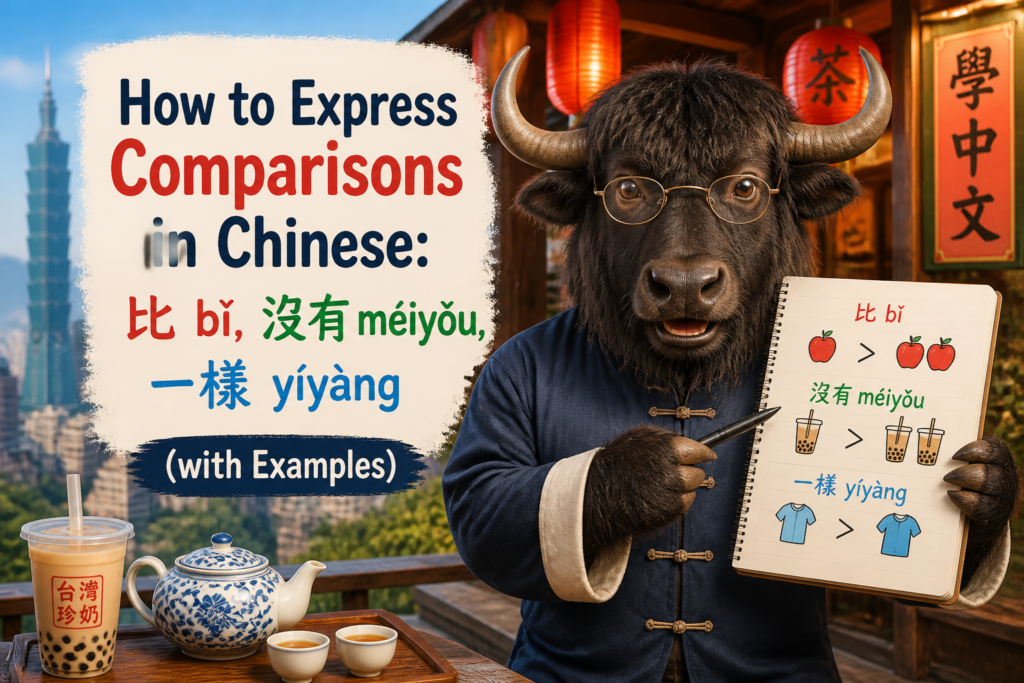
比較 bǐjiào means “comparison,” and Mandarin has a few very tidy ways to do it. Nice, right? No dramatic grammar jungle. Just three big tools: 比 bǐ for “more than,” 沒有 méiyǒu for “not as… as,” and 一樣 yíyàng for “the same as.”
For the broader learning path, visit our parent guide.
If English comparison grammar feels slippery, this lesson will make it much less annoying. By the end, you should be able to say who is taller, what is cheaper, and which thing is the same — without sounding like the sentence is doing push-ups.
For a quick background on the word 比 bǐ, a boring but reliable place to peek is the Chinese grammar comparison overview on Wikipedia.
The Three Main Comparison Patterns
| Pattern | Meaning | Example (ZH) | Pinyin | English |
|---|---|---|---|---|
| A 比 B + adjective | A is more adjective than B | 台北 比 高雄 貴。 | Tái běi bǐ Gāo xióng guì. | Taipei is more expensive than Kaohsiung. |
| A 沒有 B + adjective | A is not as adjective as B | 這間咖啡店 沒有 那間 安靜。 | Zhè jiān kā fēi diàn méi yǒu nà jiān ān jìng. | This café is not as quiet as that one. |
| A 跟 B 一樣 + adjective | A is as adjective as B | 我 跟 你 一樣 忙。 | Wǒ gēn nǐ yí yàng máng. | I am as busy as you are. |
1) Using 比 Bǐ For “More Than”
The structure is:
A 比 B + adjective
This means A has more of the adjective than B.
| Traditional Chinese | Pinyin | Meaning | Example (ZH) | Example (Pinyin) | Translation (EN) |
|---|---|---|---|---|---|
| 比 | bǐ | than; compared with | 今天 比 昨天 冷。 | Jīn tiān bǐ zuó tiān lěng. | Today is colder than yesterday. |
| 更 | gèng | even more | 這家店 更 便宜。 | Zhè jiā diàn gèng pián yi. | This store is even cheaper. |
| 比較 | bǐ jiào | relatively; rather | 這本書 比較 難。 | Zhè běn shū bǐ jiào nán. | This book is rather difficult. |
比 bǐ needs a comparison partner, so you usually say both things. Mandarin is not in the mood for mystery here.
Example sentences
- 他比我高。 Tā bǐ wǒ gāo. He is taller than me.
- 這家餐廳比那家貴。 Zhè jiā cān tīng bǐ nà jiā guì. This restaurant is more expensive than that one.
- 台灣的夏天比我想像中熱。 Tái wān de xià tiān bǐ wǒ xiǎng xiàng zhōng rè. Taiwan’s summer is hotter than I imagined.
- 這個手機比那個輕。 Zhè ge shǒu jī bǐ nà ge qīng. This phone is lighter than that one.
- 我覺得今天比昨天忙。 Wǒ jué de jīn tiān bǐ zuó tiān máng. I think today is busier than yesterday.
Common structure notes
- Often, the adjective comes at the end: A 比 B + adjective.
- You can add a degree word like 多了 duō le for emphasis: 他比我高多了。 Tā bǐ wǒ gāo duō le. He is much taller than me.
- Use 更 gèng for “even more” or “even better,” but it is not the same as the comparison marker 比.
小提醒 xiǎo tí xǐng: In Mandarin, adjectives often act like stative verbs. That means you do not need a form of “to be” before them in comparison sentences. Chinese grammar loves efficiency. English, of course, loves extra words for sport.
2) Using 沒有 Méiyǒu For “Not As… As”
Use 沒有 méiyǒu when you want to say one thing is less than another thing in a comparison.
A 沒有 B + adjective
This means A is not as adjective as B.
| Traditional Chinese | Pinyin | Meaning | Example (ZH) | Example (Pinyin) | Translation (EN) |
|---|---|---|---|---|---|
| 沒有 | méi yǒu | not have; not as | 我 沒有 你 忙。 | Wǒ méi yǒu nǐ máng. | I am not as busy as you. |
| 沒那麼 | méi nà me | not that much | 今天 沒那麼 熱。 | Jīn tiān méi nà me rè. | It is not that hot today. |
Example sentences
- 這本書沒有那本有趣。 Zhè běn shū méi yǒu nà běn yǒu qù. This book is not as interesting as that one.
- 我的中文沒有你那麼好。 Wǒ de Zhōng wén méi yǒu nǐ nà me hǎo. My Chinese is not as good as yours.
- 這間房間沒有上一間大。 Zhè jiān fáng jiān méi yǒu shàng yī jiān dà. This room is not as big as the previous one.
- 今天沒有昨天冷。 Jīn tiān méi yǒu zuó tiān lěng. Today is not as cold as yesterday.
- 這家店沒有那家便宜。 Zhè jiā diàn méi yǒu nà jiā pián yi. This store is not as cheap as that one.
In real conversation, people often use 沒那麼 méi nà me instead of the full comparison structure. It sounds natural and easy:
今天沒那麼冷。 Jīn tiān méi nà me lěng. Today is not that cold.
This does not always compare directly with another object, but the meaning is often similar.
3) Using 一樣 Yíyàng For “The Same As”
一樣 yíyàng means “the same” or “just like.” In comparisons, it often appears with 跟 gēn or 和 hé.
A 跟 B 一樣 + adjective
This means A is as adjective as B.
| Traditional Chinese | Pinyin | Meaning | Example (ZH) | Example (Pinyin) | Translation (EN) |
|---|---|---|---|---|---|
| 一樣 | yí yàng | the same; alike | 他 跟 我 一樣 高。 | Tā gēn wǒ yí yàng gāo. | He is as tall as I am. |
| 跟 | gēn | with; and; compared with | 這杯咖啡 跟 那杯 一樣 熱。 | Zhè bēi kā fēi gēn nà bēi yí yàng rè. | This coffee is as hot as that one. |
| 和 | hé | and; with | 這件衣服 和 那件 一樣 好看。 | Zhè jiàn yī fú hé nà jiàn yí yàng hǎo kàn. | This piece of clothing is as good-looking as that one. |
Example sentences
- 我的手機跟你的手機一樣新。 Wǒ de shǒu jī gēn nǐ de shǒu jī yí yàng xīn. My phone is as new as yours.
- 這兩家咖啡店一樣有名。 Zhè liǎng jiā kā fēi diàn yí yàng yǒu míng. These two cafés are equally famous.
- 她和她妹妹一樣聰明。 Tā hé tā mèi mei yí yàng cōng míng. She is as smart as her younger sister.
- 這個包跟那個一樣重。 Zhè ge bāo gēn nà ge yí yàng zhòng. This bag is as heavy as that one.
- 我們的想法一樣。 Wǒ men de xiǎng fǎ yí yàng. Our ideas are the same.
4) Big Difference: 比, 沒有, 一樣
| Word | Core Meaning | Common Use | Example | Translation |
|---|---|---|---|---|
| 比 bǐ | than; more than | A is more adjective than B | 她比我高。 | She is taller than me. |
| 沒有 méiyǒu | not have; not as | A is not as adjective as B | 她沒有我高。 | She is not as tall as me. |
| 一樣 yíyàng | the same | A is as adjective as B | 她跟我一樣高。 | She is as tall as me. |
This is the cleanest way to remember them:
- 比 = more than
- 沒有 = not as… as
- 一樣 = as… as / the same as
If you can keep that trio straight, you are already doing better than many learners who treat comparison like a spelling bee in a thunderstorm.
5) Useful Extra Words You Will Hear All The Time
| Traditional Chinese | Pinyin | Meaning | Example (ZH) | Example (Pinyin) | Translation (EN) |
|---|---|---|---|---|---|
| 更 | gèng | even more | 這個方案 更 好。 | Zhè ge fāng àn gèng hǎo. | This plan is even better. |
| 比較 | bǐ jiào | rather; relatively | 這個房子 比較 貴。 | Zhè ge fáng zi bǐ jiào guì. | This house is rather expensive. |
| 多了 | duō le | a lot more | 他現在忙 多了。 | Tā xiàn zài máng duō le. | He is much busier now. |
| 一點 | yì diǎn | a little | 這件比較大 一點。 | Zhè jiàn bǐ jiào dà yì diǎn. | This one is a little bigger. |
| 最 | zuì | most | 這是我 最 喜歡的。 | Zhè shì wǒ zuì xǐ huān de. | This is my favorite. |
6) Useful Comparison Sentences In Daily Life
- 這家超商比那家方便。 Zhè jiā chāo shāng bǐ nà jiā fāng biàn. This convenience store is more convenient than that one.
- 捷運比公車快。 Jié yùn bǐ gōng chē kuài. The MRT is faster than the bus.
- 這個便當比那個好吃。 Zhè ge biàn dāng bǐ nà ge hǎo chī. This lunch box is tastier than that one.
- 今天比昨天早下班。 Jīn tiān bǐ zuó tiān zǎo xià bān. Today I got off work earlier than yesterday.
- 這裡沒有昨天那麼吵。 Zhè lǐ méi yǒu zuó tiān nà me chǎo. It is not as noisy here as yesterday.
- 這間房間跟那間一樣大。 Zhè jiān fáng jiān gēn nà jiān yí yàng dà. This room is as big as that one.
- 她比我更會說中文。 Tā bǐ wǒ gèng huì shuō Zhōng wén. She is even better at speaking Chinese than I am.
- 這條路沒有我想像中遠。 Zhè tiáo lù méi yǒu wǒ xiǎng xiàng zhōng yuǎn. This road is not as far as I imagined.
- 這家餐廳和那家一樣受歡迎。 Zhè jiā cān tīng hé nà jiā yí yàng shòu huān yíng. This restaurant is as popular as that one.
- 今天的天氣比昨天好一點。 Jīn tiān de tiān qì bǐ zuó tiān hǎo yì diǎn. Today’s weather is a little better than yesterday’s.
7) Important Grammar Notes
Note 1: Don’t overuse 是
In Mandarin comparison sentences, you usually do not need 是 shì.
| Wrong | Correct | Why |
|---|---|---|
| 他是比我高。 | 他比我高。 | Adjectives in comparison usually do not need 是. |
| 她是跟我一樣忙。 | 她跟我一樣忙。 | Use 跟/和 + 一樣 directly. |
Note 2: 比 and 了
Sometimes you add 了 le for a new situation or a change:
- 他比以前忙了。 Tā bǐ yǐ qián máng le. He is busier than before now.
- 今天比昨天冷了。 Jīn tiān bǐ zuó tiān lěng le. Today has become colder than yesterday.
Note 3: 兩 vs 二
When counting “two” before a measure word, Mandarin usually uses 兩 liǎng, not 二 èr.
- 兩個人 liǎng ge rén — two people
- 兩本書 liǎng běn shū — two books
This matters in comparison too:
- 這兩本書一樣厚。 Zhè liǎng běn shū yí yàng hòu. These two books are equally thick.
Note 4: “Than” Can Sound Redundant In English, But Not In Mandarin
Mandarin comparison usually wants both things in the sentence. That second object is not optional decoration. It is doing real work.
8) Common Mistakes And Fixes
| Mistake | Fix | Explanation |
|---|---|---|
| 他高過我。 | 他比我高。 | In basic everyday Mandarin, 比 is the safest and most natural choice for “more than.” |
| 我比你忙一樣。 | 我跟你一樣忙。 | 一樣 goes with “as … as,” not “more than.” |
| 她沒有比我高。 | 她沒有我高。 | Do not stack 沒有 and 比 in this basic pattern. |
| 這個比那個一樣大。 | 這個跟那個一樣大。 | If it is “the same,” use 跟/和 + 一樣. |
| 他是比我高多了。 | 他比我高多了。 | Drop 是 in comparison sentences with adjectives. |
9) Quick Practice
Try changing each sentence into the correct comparison pattern.
- 1. 我 busy than you → 我比你忙。 Wǒ bǐ nǐ máng. I am busier than you.
- 2. This one not as expensive as that one → 這個沒有那個貴。 Zhè ge méi yǒu nà ge guì. This one is not as expensive as that one.
- 3. My bag is the same as yours → 我的包跟你的一樣。 Wǒ de bāo gēn nǐ de yí yàng. My bag is the same as yours.
- 4. This class is a little easier than yesterday’s class → 這堂課比昨天那堂課簡單一點。 Zhè táng kè bǐ zuó tiān nà táng kè jiǎn dān yì diǎn. This class is a little easier than yesterday’s class.
- 5. Today is not as hot as yesterday → 今天沒有昨天那麼熱。 Jīn tiān méi yǒu zuó tiān nà me rè. Today is not as hot as yesterday.
Fill in the blank
- 1. 他 ___ 我高。 → 比
- 2. 這家店 ___ 那家便宜。 → 沒有
- 3. 我們 ___ 一樣忙。 → 跟
- 4. 這本書跟那本 ___ 有趣。 → 一樣
10) Quick Reference Summary
| Use | Structure | Example | English |
|---|---|---|---|
| More than | A 比 B + adjective | 他比我高。 | He is taller than me. |
| Not as… as | A 沒有 B + adjective | 我沒有你忙。 | I am not as busy as you. |
| The same as | A 跟 B 一樣 + adjective | 她跟我一樣高。 | She is as tall as I am. |
| A little more | A 比 B + adjective + 一點 | 這個比較大一點。 | This one is a little bigger. |
| Much more | A 比 B + adjective + 多了 | 今天比昨天冷多了。 | Today is much colder than yesterday. |
If you want a broader grammar refresher, the linked lessons on Chinese adjectives and why you usually skip 是, 的 / 地 / 得, coverbs like 在、跟、給、對, and directional complements like 來 / 去 can help you build the rest of the sentence without guessing and hoping for the best.
Yak takeaway: if you remember just three tools — 比 for more, 沒有 for not as much, and 一樣 for the same — you can compare almost anything in Mandarin. Not bad for a grammar topic that used to look like a tiny math problem.