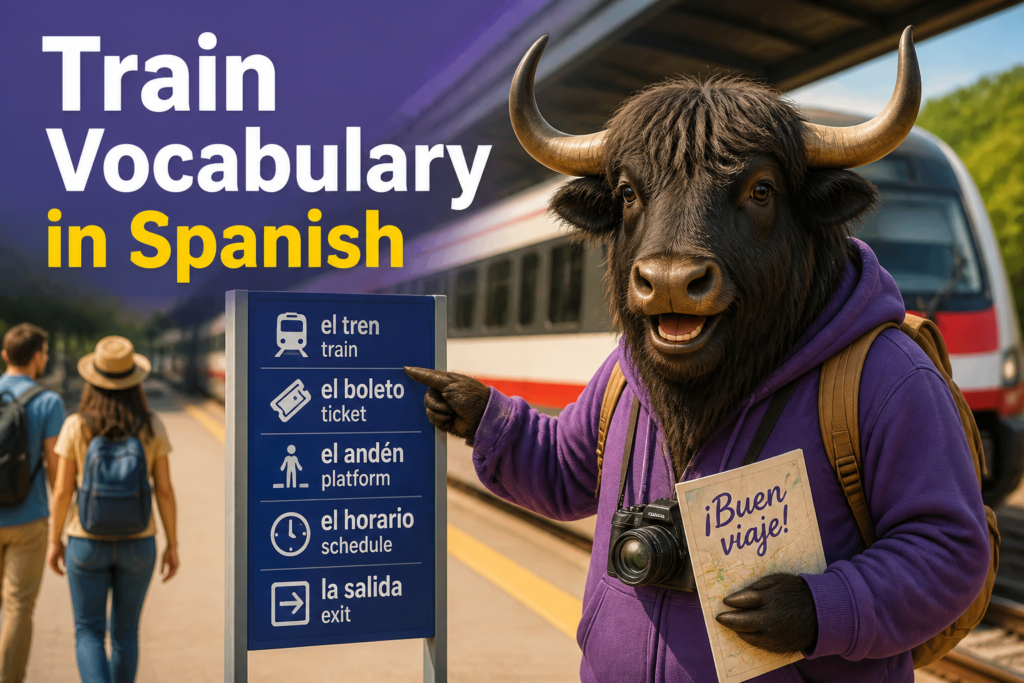
If you want to talk about trains in Spanish, you’re in luck: the vocabulary is practical, pretty regular, and useful in real life. Whether you’re buying a ticket, asking where the platform is, or trying not to miss your stop because you were staring at the scenery like a dramatic movie extra, these words will save you.
For the broader learning path, visit our parent guide.
This guide uses standard Latin American Spanish by default, but I’ll point out Spain Spanish when it matters. You’ll learn the most useful train words and phrases, plus pronunciation help, example sentences, and a few traps that English speakers step into with surprising confidence.
For a bigger base of everyday Spanish, you can also check the 100 Essential Spanish Words & Phrases guide. It’s the kind of boring-fabulous foundation that makes everything else easier.
And yes, trains in Spanish can be simple… until a station has three similar-sounding names and you realize “platform 2” was not, in fact, the same as “track 2.” Language is fun like that.
Core Train Vocabulary
Here are the most important train words first. These are the ones you’ll actually see on signs, hear from staff, and need in conversations. I’ve kept the pronunciation help simple so you can say the words without turning into a phonetics thesis.
| Spanish | Pronunciation | Meaning | Example Sentence | Translation | Learner Note |
|---|---|---|---|---|---|
| el tren | trehn | train | El tren sale a las ocho. | The train leaves at eight. | Masculine noun: el tren. |
| la estación | es-tah-THYON / es-tah-syon | station | La estación está cerca del centro. | The station is near the center. | In Spain, c before i/e can sound like “th” in many regions. In Latin America, it sounds like “s.” |
| el andén | an-DEN | platform | El andén 4 está al fondo. | Platform 4 is at the back. | Common in many countries. In some places people may also say plataforma. |
| la vía | BEE-ah | track, rail line | El tren llega por la vía 2. | The train arrives on track 2. | V and b often sound very similar in Spanish. |
| el vagón | vah-GON | carriage, rail car | Nos sentamos en el último vagón. | We sat in the last carriage. | Useful for talking about where you are on the train. |
| el boleto | boh-LEH-toh | ticket | Compré el boleto por internet. | I bought the ticket online. | Latin America: boleto. In Spain, more common: billete. |
| el billete | bee-YEH-teh | ticket | ¿Dónde compro el billete? | Where do I buy the ticket? | Spain default. In Latin America, people may still understand it, but boleto is safer. |
| la taquilla | tah-KEE-yah | ticket office, cashier window | La taquilla abre a las seis. | The ticket office opens at six. | Common at stations and theaters too. |
| el horario | oh-RAH-ryoh | schedule, timetable | Revisé el horario antes de salir. | I checked the schedule before leaving. | Very useful word. A train station without a schedule is just organized chaos. |
| la parada | pah-RAH-dah | stop | Mi parada es la siguiente. | My stop is the next one. | Also used for bus stops. |
| el transbordo | trans-BOR-doh | transfer, change of trains | Este viaje tiene un transbordo. | This trip has one transfer. | A very useful travel word. It sounds fancy because it is slightly annoying. |
| directo | dee-REK-toh | direct, non-stop | ¿Hay un tren directo a Madrid? | Is there a direct train to Madrid? | Can mean “direct” or “non-stop” depending on context. |
| ida y vuelta | EE-dah ee VWEHL-tah | round trip | Quiero un boleto de ida y vuelta. | I want a round-trip ticket. | Very common travel phrase. |
| solo ida | SOH-loh EE-dah | one-way | Necesito un pasaje solo de ida. | I need a one-way ticket. | Pasaje is also used in some countries for ticket. |
Notice the ticket word difference: boleto in much of Latin America and billete in Spain. If you say the “wrong” one, people will still understand you most of the time. Spanish speakers are not waiting to pounce with a red pen. Usually.
Useful Train Phrases For Real Life
This is the part that matters when your brain is busy, your bag is heavy, and the departure board is being unhelpful. These phrases cover buying tickets, asking for directions, boarding, and checking your stop. Keep them handy.
| Spanish | Pronunciation | Meaning | Example Sentence | Translation | Learner Note |
|---|---|---|---|---|---|
| ¿Dónde está la estación? | DOHN-deh es-TAH lah es-tah-SYON | Where is the station? | Disculpe, ¿dónde está la estación? | Excuse me, where is the station? | Disculpe is a polite “excuse me.” |
| ¿A qué hora sale el tren? | ah keh OH-rah SAH-leh ehl trehn | What time does the train leave? | ¿A qué hora sale el tren a Puebla? | What time does the train leave for Puebla? | Good question pattern: ¿A qué hora…? |
| ¿Cuánto cuesta el boleto? | KWAHN-toh KWES-tah ehl boh-LEH-toh | How much does the ticket cost? | ¿Cuánto cuesta el boleto de ida y vuelta? | How much is the round-trip ticket? | Cuesta comes from costar. |
| Quiero un boleto para hoy. | KYEH-roh oon boh-LEH-toh PAH-rah oy | I want a ticket for today. | Quiero un boleto para hoy por la tarde. | I want a ticket for today in the afternoon. | Neutral and useful at ticket counters. |
| ¿Este tren va a…? | ES-teh trehn bah ah | Does this train go to…? | ¿Este tren va a Guadalajara? | Does this train go to Guadalajara? | Super common travel question. |
| ¿Dónde cambio de tren? | DOHN-deh KAHM-byoh deh trehn | Where do I change trains? | ¿Dónde cambio de tren para llegar al aeropuerto? | Where do I change trains to get to the airport? | Cambiar de tren = transfer trains. |
| ¿En qué andén sale? | ehn keh an-DEN SAH-leh | Which platform does it leave from? | ¿En qué andén sale el tren a las nueve? | Which platform does the 9:00 train leave from? | Use this when the board is huge and your stress is larger. |
| ¿A qué hora llega? | ah keh OH-rah YEH-gah | What time does it arrive? | ¿A qué hora llega el tren a Monterrey? | What time does the train arrive in Monterrey? | Llega comes from llegar. |
| Voy a bajar en la próxima parada. | voy ah bah-HAR ehn lah PROKS-ee-mah pah-RAH-dah | I’m getting off at the next stop. | Voy a bajar en la próxima parada. | I’m getting off at the next stop. | Helpful if someone asks where you’re going. |
| ¿Está ocupado este asiento? | es-TAH oh-kuh-PAH-doh ES-teh ah-SYEN-toh | Is this seat taken? | Hola, ¿está ocupado este asiento? | Hello, is this seat taken? | Very polite and very practical. |
| Me bajé en la estación equivocada. | meh bah-HAY ehn lah es-tah-SYON eh-kee-boh-KAH-dah | I got off at the wrong station. | Me bajé en la estación equivocada por distraído. | I got off at the wrong station because I was distracted. | Equivocado/a = wrong, mistaken. |
| ¿Hay retraso? | ahy reh-TRAH-soh | Is there a delay? | ¿Hay retraso en el tren de las diez? | Is there a delay on the 10 o’clock train? | Retraso is standard across many countries. |
If you only memorize five phrases, make them these: ¿Dónde está la estación?, ¿A qué hora sale el tren?, ¿Cuánto cuesta el boleto?, ¿En qué andén sale?, and ¿Este tren va a…? That tiny survival kit will do a lot of heavy lifting.
Common Train Signs And Station Words
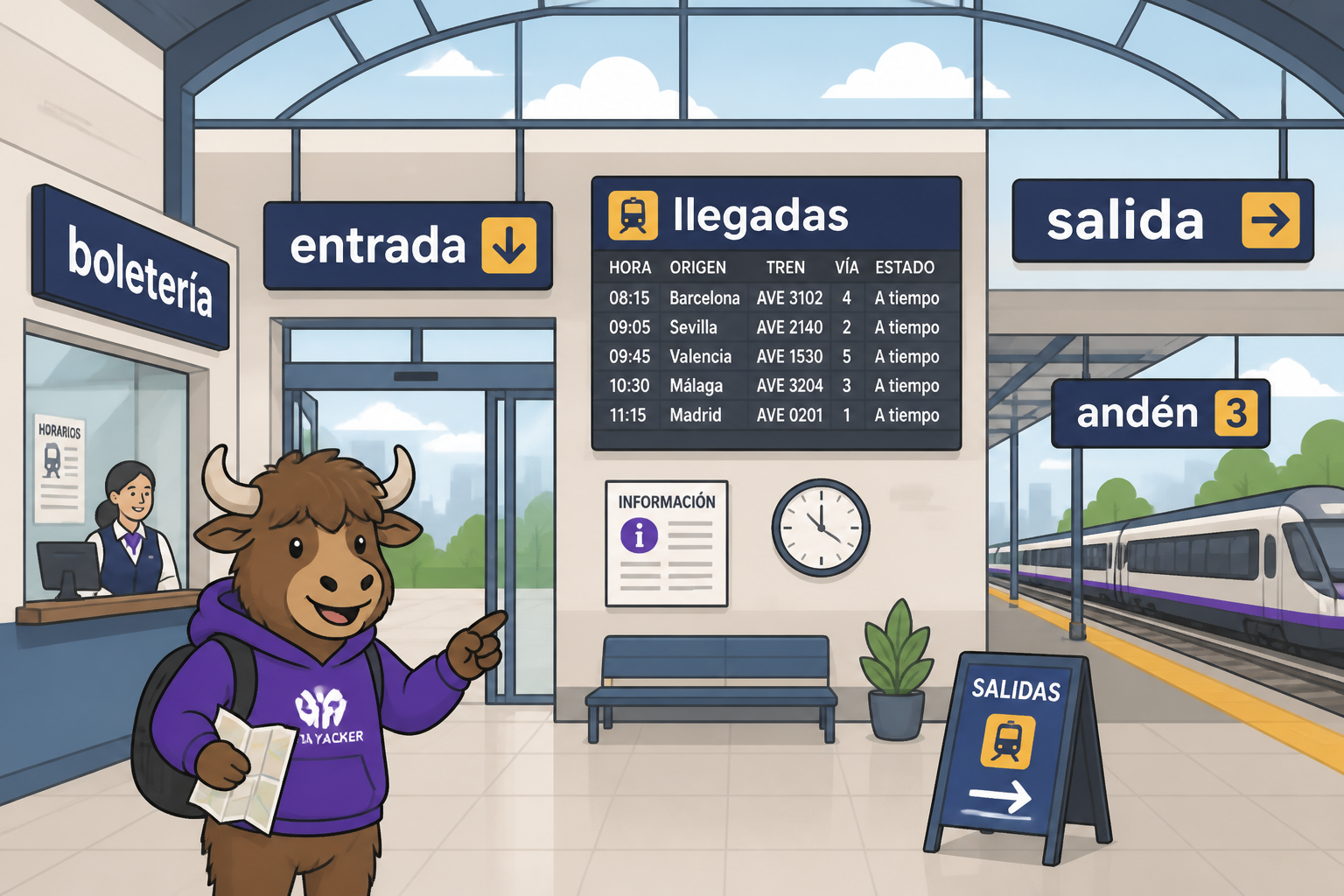
Train stations are full of signs, and signs love being short and bossy. Learning these words helps you move faster, ask better questions, and avoid reading the same board three times like it’s going to magically become easier.
| Spanish | Pronunciation | Meaning | Example Sentence | Translation | Learner Note |
|---|---|---|---|---|---|
| salida | sah-LEE-dah | exit, departure | La salida está por allá. | The exit is over there. | Can mean “departure” on tickets or “exit” as a sign. |
| entrada | ehn-TRAH-dah | entrance | La entrada principal está cerrada. | The main entrance is closed. | Also used for admission tickets in other contexts. |
| llegadas | yeh-GAH-dahs | arrivals | Las llegadas están en la pantalla de la derecha. | Arrivals are on the screen on the right. | Plural because it often appears on boards as a section name. |
| salidas | sah-LEE-dahs | departures | Las salidas cambian por la tarde. | Departures change in the afternoon. | Very common on station displays. |
| vía férrea | BEE-ah FEH-rreh-ah | railway line | La vía férrea conecta varias ciudades. | The railway line connects several cities. | More formal or technical. |
| tren de cercanías | trehn deh ser-KAH-nee-ahs | commuter train | Tomamos el tren de cercanías todos los días. | We take the commuter train every day. | Very useful in big cities. |
| tren de alta velocidad | trehn deh AHL-tah beh-loh-see-DAHD | high-speed train | El tren de alta velocidad es rápido y cómodo. | The high-speed train is fast and comfortable. | Think Spain’s AVE and similar systems. |
| vagón comedor | vah-GON koh-meh-DOR | dining car | Vamos al vagón comedor para almorzar. | Let’s go to the dining car to eat lunch. | Very travel-specific, but handy. |
| asiento reservado | ah-syEN-toh reh-ser-VAH-doh | reserved seat | Este asiento está reservado. | This seat is reserved. | Useful phrase if you accidentally sit in the wrong spot. Happens. |
| conductor | kohn-dook-TOR | train driver | El conductor anunció la próxima parada. | The train driver announced the next stop. | Not “the conductor” in the orchestra sense. |
| revisor | reh-bee-SOR | ticket inspector | El revisor pidió mi boleto. | The ticket inspector asked for my ticket. | A good word to know, especially when someone with authority appears suddenly. |
| pantalla de salidas | pan-TAH-yah deh sah-LEE-dahs | departure board | La pantalla de salidas no funciona bien. | The departure board is not working well. | Practical if your station likes drama. |
Train Ticket Words That Matter
Buying train tickets is where people meet the “I studied Spanish, but only for restaurant emergencies” problem. These words help you choose the right ticket, understand the type of service, and avoid paying for a fancy ride when you just wanted the regular one.
| Spanish | Pronunciation | Meaning | Example Sentence | Translation | Learner Note |
|---|---|---|---|---|---|
| clase turista | KLAH-seh too-REE-stah | economy class | Compré clase turista para ahorrar dinero. | I bought economy class to save money. | Useful for long-distance trains. |
| primera clase | pree-MEH-rah KLAH-seh | first class | La primera clase es más cómoda. | First class is more comfortable. | Clase is feminine, even in these fixed expressions. |
| asiento | ah-SYEN-toh | seat | Quiero un asiento junto a la ventana. | I want a seat by the window. | Very common and useful in transport. |
| ventana | ben-TAH-nah | window | Me gusta viajar junto a la ventana. | I like to travel by the window. | Junto a means “next to.” |
| pasillo | pah-SEE-yoh | aisle | Prefiero el asiento del pasillo. | I prefer the aisle seat. | Great if you like getting up often. |
| reservar | reh-ser-VAR | to reserve, to book | Quiero reservar dos boletos. | I want to reserve two tickets. | Very common verb. You’ll see it everywhere. |
| reserva | reh-SER-vah | reservation | Mi reserva está a nombre de Ana. | My reservation is under Ana’s name. | Same root as reservar. |
| cancelar | kan-seh-LAR | to cancel | Necesito cancelar mi reserva. | I need to cancel my reservation. | Watch the pronunciation: the second syllable gets the stress. |
| cambiar | kam-BYAHRMore Spanish to explore |