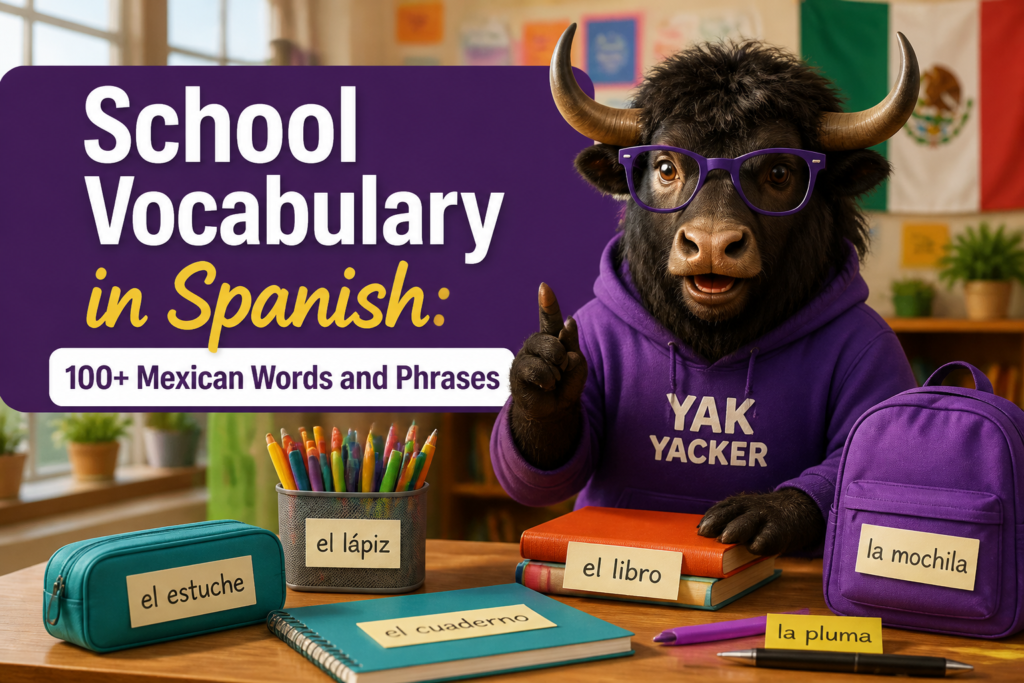
Mexican school Spanish is practical, fast, and full of words you’ll hear from the first bell to the last “ya se acabó la clase.” If you’ve ever wanted to ask where the classroom is, understand the homework panic, or survive a group project without looking completely lost, this guide has your back.
School language in Mexico is usually standard Latin American Spanish, but there are some everyday words and habits that feel especially local. And yes, students everywhere complain about exams with the same spiritual energy.
By the end, you’ll know the most useful Mexican school vocabulary, how to say common class phrases, and how to sound less like a textbook and more like a real person who has actually been to school.
School Spanish sits inside everyday life Spanish, so these words connect nicely with other topics like colors in Spanish, technology devices in Spanish, music vocabulary in Spanish, and even playground vocabulary in Spanish. Because apparently Spanish learners deserve a full school day, not just a pop quiz.
For a quick reality check on standard Spanish usage, the Real Academia Española is the boring-but-useful place to look when you want to verify forms, spelling, and meaning.
Essential School Words in Mexican Spanish
Let’s start with the core words you’ll hear all the time in school, from elementary class to university. Some are universal across Spanish, and a few are especially common in Mexico.
| Spanish | Pronunciation | Meaning | Example Sentence | Translation | Learner Note |
|---|---|---|---|---|---|
| la escuela | lah ehs-KWEH-lah | school | La escuela empieza a las siete. | School starts at seven. | Very common. In Mexico, this is the normal word for school. |
| el salón | ehl sah-LOHN | classroom | Mi salón está en el segundo piso. | My classroom is on the second floor. | Used a lot in Mexico. |
| la clase | lah KLAH-seh | class | Hoy tengo clase de historia. | Today I have history class. | Can also mean “lesson” or “course.” |
| el maestro / la maestra | ehl ma-EHS-troh / lah ma-EHS-trah | teacher | La maestra explicó la tarea. | The teacher explained the homework. | Very natural in Mexico. “Profesor/a” is also common, especially in higher levels. |
| el profesor / la profesora | ehl pro-feh-SOHR / lah pro-feh-SOH-rah | teacher, professor | El profesor llegó tarde. | The teacher arrived late. | More formal than maestro/a. |
| el alumno / la alumna | ehl ah-LOOM-noh / lah ah-LOOM-nah | student | La alumna participó mucho. | The student participated a lot. | Common in formal school language. |
| el estudiante | ehl ehs-too-dee-AHN-teh | student | Soy estudiante de medicina. | I’m a medical student. | Gender-neutral and very common. |
| el compañero / la compañera | ehl kom-pah-NYEH-roh / lah kom-pah-NYEH-rah | classmate, schoolmate | Mi compañera me prestó un lápiz. | My classmate lent me a pencil. | Good for talking about classmates or group partners. |
| la tarea | lah tah-REH-ah | homework, assignment | No hice la tarea. | I didn’t do the homework. | In Mexico, this is the everyday word for homework. |
| el examen | ehl ehs-AH-men | test, exam | El examen fue difícil. | The exam was difficult. | Watch the accent on the last syllable in pronunciation. |
| la nota | lah NOH-tah | grade, mark | Mi nota mejoró este semestre. | My grade improved this semester. | “Calificación” is also very common in Mexico. |
| la calificación | lah kah-lee-fee-kah-SYOHN | grade, score | La calificación final sale mañana. | The final grade comes out tomorrow. | Very common in schools in Mexico. |
| el libro | ehl LEE-broh | book | Abre el libro en la página diez. | Open the book to page ten. | Simple, basic, and extremely useful. |
| el cuaderno | ehl kwah-DEHR-noh | notebook | Escribí la respuesta en mi cuaderno. | I wrote the answer in my notebook. | A school essential. |
| el lápiz | ehl LAH-pees | pencil | ¿Me prestas un lápiz? | Can you lend me a pencil? | Notice the written accent. |
| la pluma | lah PLOO-mah | pen | Se me acabó la pluma. | My pen ran out of ink. | In Mexico, pluma often means pen. |
| la mochila | lah moh-CHEE-lah | backpack | Olvidé la mochila en casa. | I left my backpack at home. | Very common in Mexico and Latin America. |
| el escritorio | ehl ehs-kree-TOH-ryoh | desk | Mi escritorio está muy desordenado. | My desk is very messy. | Useful for classroom and home study. |
| la mesa | lah MEH-sah | table | Los libros están sobre la mesa. | The books are on the table. | Not just school, but handy in classrooms. |
| el pizarrón | ehl pee-sah-RROHN | blackboard, whiteboard | La tarea está en el pizarrón. | The homework is on the board. | Mexican Spanish often says pizarrón. |
One small pronunciation thing: Spanish vowels are clear and steady. So tarea is not “ta-ray-uh” and mochila is not “mo-chee-laaah.” Try to keep each vowel clean. Spanish is not interested in your dramatic English vowel habits.
Useful Classroom Phrases You’ll Actually Hear
These phrases are the ones that save you when class moves too fast, the teacher asks a question, or you need to borrow something with maximum politeness and minimum panic.
| Spanish | Pronunciation | Meaning | Example Sentence | Translation | Learner Note |
|---|---|---|---|---|---|
| ¿Puedo ir al baño? | PWEH-doh eer ahl BAH-nyoh | Can I go to the bathroom? | Profe, ¿puedo ir al baño? | Teacher, can I go to the bathroom? | Very common and polite. “Baño” is the normal word. |
| No entendí. | noh ehn-tehn-DEE | I didn’t understand. | No entendí la explicación. | I didn’t understand the explanation. | Super useful. Short, honest, no drama. |
| ¿Puede repetir, por favor? | PWEH-deh reh-pee-TEER pohr fah-VOR | Can you repeat, please? | ¿Puede repetir la pregunta, por favor? | Can you repeat the question, please? | Use usted form for politeness. |
| ¿Cómo se dice…? | KOH-moh seh DEE-seh | How do you say…? | ¿Cómo se dice “homework” en español? | How do you say “homework” in Spanish? | A classic learner phrase. |
| ¿Qué significa? | keh seeg-NEE-fee-kah | What does it mean? | ¿Qué significa “entregar”? | What does “entregar” mean? | Use for vocabulary questions. |
| ¿Me puede ayudar? | meh PWEH-deh ah-yoo-DAR | Can you help me? | ¿Me puede ayudar con la tarea? | Can you help me with the homework? | Polite and useful in class. |
| Voy a entregar la tarea. | voy ah ehn-treh-GAR lah tah-REH-ah | I’m going to turn in the homework. | Voy a entregar la tarea ahorita. | I’m going to hand in the homework right now. | “Entregar” is common for turning in work. |
| Se me olvidó. | seh meh ohl-vee-DOH | I forgot it. | Se me olvidó el cuaderno. | I forgot my notebook. | Very natural. Literally, “It forgot itself to me,” which is wonderfully weird. |
| Falta poco. | FAHL-tah POH-koh | There’s not much left / It’s almost over. | Falta poco para el recreo. | There’s not much left until recess. | Great when class is dragging on forever. |
| Ya llegó el profesor. | yah yeh-GOH ehl pro-feh-SOHR | The teacher already arrived. | Ya llegó la maestra. | The teacher already arrived. | Useful for talking to classmates. |
| Hay tarea para mañana. | eye tah-REH-ah pah-rah mah-NYAH-nah | There’s homework for tomorrow. | Hay tarea para mañana en matemáticas. | There’s homework for tomorrow in math. | Brace yourself. |
| ¿Quién sigue? | kyen SEE-geh | Who’s next? | ¿Quién sigue para leer? | Who’s next to read? | Very common in class. |
| Me toca a mí. | meh TOH-kah ah mee | It’s my turn. | Me toca a mí responder. | It’s my turn to answer. | “Tocar” is used a lot for turns. |
| ¿Nos podemos sentar aquí? | nohs poh-DEH-mohs sehn-TAR ah-KEE | Can we sit here? | ¿Nos podemos sentar aquí, profe? | Can we sit here, teacher? | Helpful in classrooms, buses, and life. |
Note: In Mexico, students often say profe as a friendly short form for teacher. It’s casual and very common. Just don’t use it in a super formal email if you can avoid it. Tiny social survival skill, unlocked.
“No entendí” is short, polite enough, and better than pretending you understood everything. Pretending is a dangerous hobby in language class.
People, Subjects, and School Roles
School vocabulary is not just objects. You also need people, roles, and subject names so you can talk about your schedule without pointing at a timetable like a confused raccoon.
| Spanish | Pronunciation | Meaning | Example Sentence | Translation | Learner Note |
|---|---|---|---|---|---|
| el director / la directora | ehl dee-rek-TOHR / lah dee-rek-TOH-rah | principal, school director | La directora habló con los padres. | The principal spoke with the parents. | Very common in schools. |
| la secretaria | lah seh-kreh-tah-REE-ah | secretary, office staff | La secretaria me dio un formulario. | The secretary gave me a form. | Useful for administrative situations. |
| el prefecto / la prefecta | ehl preh-FEHK-toh / lah preh-FEHK-tah | prefect, school supervisor | El prefecto revisó la entrada. | The school supervisor checked the entrance. | Common in some Mexican schools. |
| los padres | lohs PAH-drehs | parents | Mis padres fueron a la junta. | My parents went to the meeting. | Plural noun; use with plural verb forms. |
| las materias | lahs mah-teh-REE-ahs | subjects, courses | Me gustan más las materias de ciencias. | I like science subjects more. | “Materia” can mean school subject. |
| las matemáticas | lahs mah-theh-MAH-tee-kahs | math | Las matemáticas me cuestan. | Math is hard for me. | Plural form in Spanish, even though it’s one subject. |
| la historia | lah ees-TOH-ryah | history | Hoy estudiamos historia de México. | Today we studied Mexican history. | Very common subject name. |
| la ciencia | lah SYEN-syah | science | La ciencia me parece interesante. | Science seems interesting to me. | Can be used broadly. |
| la biología | lah byoh-loh-HEE-ah | biology | Estudio biología en la universidad. | I study biology at university. | Notice the accent mark. |
| la química | lah KEE-mee-kah | chemistry | La química tiene muchas fórmulas. | Chemistry has many formulas. | Useful in science classes. |
| la física | lah FEE-see-kah | physics | La física me parece difícil. | Physics seems difficult to me. | Common subject name. |
| el inglés | ehl een-GLAYS | English | Tengo clase de inglés el lunes. | I have English class on Monday. | Subject names often use the article. |
| el español | ehl ehs-pah-NYOHL | Spanish | Estudio español todos los días. | I study Spanish every day. | Yes, you too. Don’t be shy. |
| la computación | lah kom-poo-tah-SYOHN | computing, computer class | Tenemos computación los viernes. | We have computer class on Fridays. | Very common in schools. |
| la educación física | lah eh-doo-kah-SYOHN FEE-see-kah | physical education | Hoy tenemos educación física. | We have PE today. | Often shortened to educación física or simply mate in some places, though that varies. |
Quick grammar note: las matemáticas and some other subjects are plural in Spanish, even when English treats them as singular. So say Las matemáticas son difíciles, not es difícil. Spanish likes consistency more than English likes making sense.
Actions In Class: Verbs You Need Fast
These verbs show up in instructions, homework, and teacher talk. Learn them early and your school life gets easier immediately.
| Spanish | Pronunciation | Meaning | Example Sentence | Translation | Learner Note |
|---|---|---|---|---|---|
| escuchar | ehs-koo-CHAR | to listen | Escucha con atención. | Listen carefully. | Often used as an instruction. |
| leer | leh-AIR | to read | Vamos a leer en voz alta. | We’re going to read out loud. | The double e is clear and separate. |
| escribir | ehs-kree-BEER | to write | Escribe tu nombre aquí. | Write your name here. | Very common classroom command. |
| copiar | koh-PYAR | to copy, to write down | Copien la fecha en el cuaderno. | Copy the date into your notebook. | In school, it often means copying from the board. |
| subrayar | soob-rah-YAR | to underline | Subraya las palabras importantes. | Underline the important words. | Very useful for study habits. |
| repasar | reh-pah-SAR | to review | Voy a repasar para el examen. | I’m going to review for the exam. | Excellent study verb. |
| estudiar | ehs-too-dee-AR | to study | Estudio por la noche. | I study at night. | One of the first verbs you should know. |
| preguntar | preh-goon-TAR | to ask | Voy a preguntar una duda. | I’m going to ask a question. | Useful when you need help. |
| responder | <