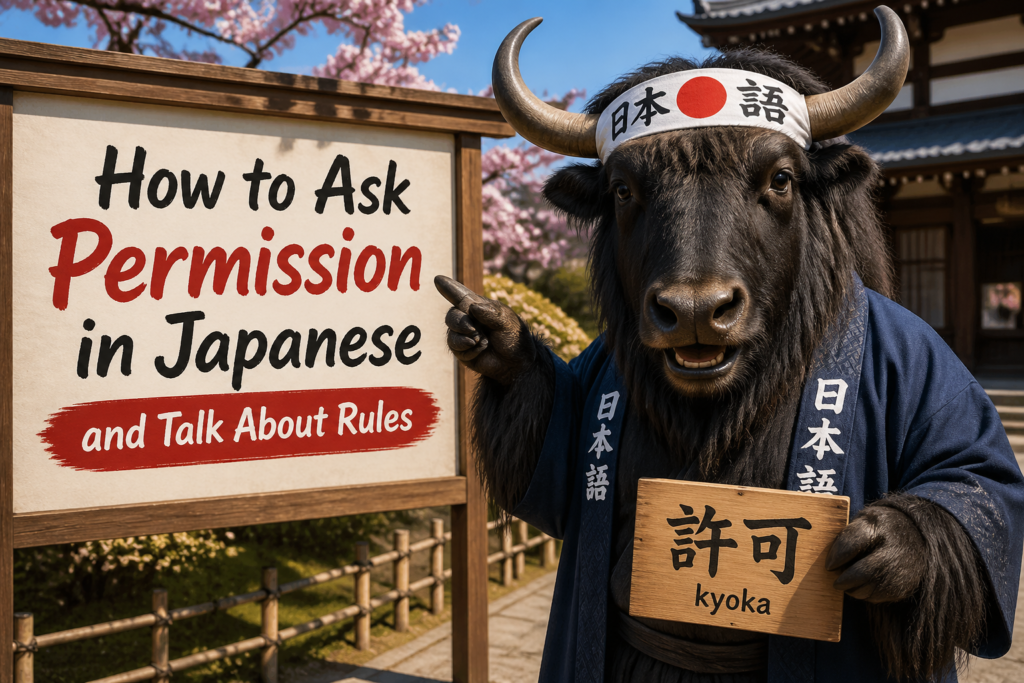
Permission language in Japanese is wonderfully practical. It is the language of borrowing a pen, taking a photo, entering a room, checking whether shoes are allowed, and surviving signs that quietly say, “No, human, not here.”
And yes, Japanese has several ways to say “Can I…?”, “You may…”, “You must not…”, and “You don’t have to…”. The good news: once you learn the core patterns, they repeat everywhere like a polite little grammar machine.
In this guide, you will learn how to ask permission, give permission, refuse permission, and explain rules in natural Japanese.
The Core Permission Pattern
The most useful permission pattern is:
動詞て形 + もいいですか
Dōshi te-kei + mo ii desu ka
May I…? / Is it okay if I…?
The verb changes into its て形 te-kei, the “te-form,” and then you add もいいですか mo ii desu ka. It literally feels like “even if I do this, is it good?” Very Japanese. Very useful. Slightly dramatic if you think about it too long.
| Pattern | Rōmaji | Meaning | Example | Example Rōmaji | Translation |
|---|---|---|---|---|---|
| 見てもいいですか | Mite mo ii desu ka | May I look? | この写真を見てもいいですか。 | Kono shashin o mite mo ii desu ka. | May I look at this photo? |
| 入ってもいいですか | Haitte mo ii desu ka | May I enter? | 部屋に入ってもいいですか。 | Heya ni haitte mo ii desu ka. | May I enter the room? |
| 使ってもいいですか | Tsukatte mo ii desu ka | May I use it? | このペンを使ってもいいですか。 | Kono pen o tsukatte mo ii desu ka. | May I use this pen? |
| 座ってもいいですか | Suwatte mo ii desu ka | May I sit? | ここに座ってもいいですか。 | Koko ni suwatte mo ii desu ka. | May I sit here? |
| 写真を撮ってもいいですか | Shashin o totte mo ii desu ka | May I take a photo? | ここで写真を撮ってもいいですか。 | Koko de shashin o totte mo ii desu ka. | May I take photos here? |
Useful Phrases For Asking Permission
Use these in shops, classrooms, offices, museums, temples, restaurants, and anywhere else where invisible rules are probably lurking behind a very neat sign.
| Japanese | Rōmaji | Meaning | Example | Example Rōmaji | Translation |
|---|---|---|---|---|---|
| 聞いてもいいですか | Kiite mo ii desu ka | May I ask? / May I listen? | 一つ聞いてもいいですか。 | Hitotsu kiite mo ii desu ka. | May I ask one thing? |
| 借りてもいいですか | Karite mo ii desu ka | May I borrow? | 傘を借りてもいいですか。 | Kasa o karite mo ii desu ka. | May I borrow an umbrella? |
| ここで待ってもいいですか | Koko de matte mo ii desu ka | May I wait here? | 友達をここで待ってもいいですか。 | Tomodachi o koko de matte mo ii desu ka. | May I wait for my friend here? |
| 電話してもいいですか | Denwa shite mo ii desu ka | May I make a phone call? | 外で電話してもいいですか。 | Soto de denwa shite mo ii desu ka. | May I make a phone call outside? |
| 食べてもいいですか | Tabete mo ii desu ka | May I eat? | この部屋で食べてもいいですか。 | Kono heya de tabete mo ii desu ka. | May I eat in this room? |
| 飲んでもいいですか | Nonde mo ii desu ka | May I drink? | ここで水を飲んでもいいですか。 | Koko de mizu o nonde mo ii desu ka. | May I drink water here? |
| 開けてもいいですか | Akete mo ii desu ka | May I open it? | 窓を開けてもいいですか。 | Mado o akete mo ii desu ka. | May I open the window? |
| 閉めてもいいですか | Shimete mo ii desu ka | May I close it? | ドアを閉めてもいいですか。 | Doa o shimete mo ii desu ka. | May I close the door? |
| 試着してもいいですか | Shichaku shite mo ii desu ka | May I try it on? | このシャツを試着してもいいですか。 | Kono shatsu o shichaku shite mo ii desu ka. | May I try on this shirt? |
| 持って帰ってもいいですか | Motte kaette mo ii desu ka | May I take it home? | この資料を持って帰ってもいいですか。 | Kono shiryō o motte kaette mo ii desu ka. | May I take this material home? |
| 予約してもいいですか | Yoyaku shite mo ii desu ka | May I make a reservation? | 明日の席を予約してもいいですか。 | Ashita no seki o yoyaku shite mo ii desu ka. | May I reserve a seat for tomorrow? |
| 少し休んでもいいですか | Sukoshi yasunde mo ii desu ka | May I rest a little? | ここで少し休んでもいいですか。 | Koko de sukoshi yasunde mo ii desu ka. | May I rest here for a little while? |
How To Say “Yes, You May”
When giving permission, the main phrase is いいです ii desu, meaning “It is okay.” You can also say 大丈夫です daijōbu desu, meaning “It is fine / It is okay.”
For extra politeness, especially with customers, guests, or people you do not know well, どうぞ dōzo is your friendly “please go ahead.”
| Japanese | Rōmaji | Meaning | Example | Example Rōmaji | Translation |
|---|---|---|---|---|---|
| いいです | Ii desu | It is okay | はい、使ってもいいです。 | Hai, tsukatte mo ii desu. | Yes, you may use it. |
| 大丈夫です | Daijōbu desu | It is fine / okay | はい、大丈夫です。 | Hai, daijōbu desu. | Yes, that is fine. |
| どうぞ | Dōzo | Please go ahead | どうぞ、入ってください。 | Dōzo, haitte kudasai. | Please go ahead and enter. |
| もちろんです | Mochiron desu | Of course | もちろんです。ここに座ってもいいです。 | Mochiron desu. Koko ni suwatte mo ii desu. | Of course. You may sit here. |
| かまいません | Kamaimasen | I do not mind / It is acceptable | ここで待ってもかまいません。 | Koko de matte mo kamaimasen. | You may wait here. |
How To Ask More Politely
てもいいですか te mo ii desu ka is already polite enough for most daily life. But if you want to sound more formal, use てもよろしいですか te mo yoroshii desu ka. This is common in business, service situations, and polite conversation.
| Japanese | Rōmaji | Meaning | Example | Example Rōmaji | Translation |
|---|---|---|---|---|---|
| 確認してもいいですか | Kakunin shite mo ii desu ka | May I check? | 名前を確認してもいいですか。 | Namae o kakunin shite mo ii desu ka. | May I check your name? |
| 確認してもよろしいですか | Kakunin shite mo yoroshii desu ka | May I check? / Is it acceptable if I check? | お名前を確認してもよろしいですか。 | Onamae o kakunin shite mo yoroshii desu ka. | May I check your name? |
| 少々お待ちいただいてもよろしいですか | Shōshō omachi itadaite mo yoroshii desu ka | May I have you wait a moment? | 少々お待ちいただいてもよろしいですか。 | Shōshō omachi itadaite mo yoroshii desu ka. | Could you please wait a moment? |
| こちらに記入してもよろしいですか | Kochira ni kinyū shite mo yoroshii desu ka | May I fill this in here? | こちらに住所を記入してもよろしいですか。 | Kochira ni jūsho o kinyū shite mo yoroshii desu ka. | May I write the address here? |
How To Say “You Must Not”
To say that something is not allowed, use:
動詞て形 + はいけません
Dōshi te-kei + wa ikemasen
You must not… / It is not allowed to…
In speech, てはいけません te wa ikemasen often sounds like ちゃいけません cha ikemasen. For example, 食べてはいけません tabete wa ikemasen can become 食べちゃいけません tabecha ikemasen. Same warning, smaller package. Japanese loves compact packaging.
| Japanese | Rōmaji | Meaning | Example | Example Rōmaji | Translation |
|---|---|---|---|---|---|
| 食べてはいけません | Tabete wa ikemasen | You must not eat | 図書館で食べてはいけません。 | Toshokan de tabete wa ikemasen. | You must not eat in the library. |
| 飲んではいけません | Nonde wa ikemasen | You must not drink | ここでお酒を飲んではいけません。 | Koko de osake o nonde wa ikemasen. | You must not drink alcohol here. |
| 入ってはいけません | Haitte wa ikemasen | You must not enter | この部屋に入ってはいけません。 | Kono heya ni haitte wa ikemasen. | You must not enter this room. |
| 触ってはいけません | Sawatte wa ikemasen | You must not touch | 展示品に触ってはいけません。 | Tenjihin ni sawatte wa ikemasen. | You must not touch the exhibit. |
| 写真を撮ってはいけません | Shashin o totte wa ikemasen | You must not take photos | 館内で写真を撮ってはいけません。 | Kannai de shashin o totte wa ikemasen. | You must not take photos inside the building. |
| 走ってはいけません | Hashitte wa ikemasen | You must not run | 廊下を走ってはいけません。 | Rōka o hashitte wa ikemasen. | You must not run in the hallway. |
Softer Ways To Say “No”
Japanese often avoids a blunt “No.” If someone asks permission, you may hear a soft refusal. The message is still no, but it arrives wearing slippers.
| Japanese | Rōmaji | Meaning | Example | Example Rōmaji | Translation |
|---|---|---|---|---|---|
| すみません、できません | Sumimasen, dekimasen | Sorry, you cannot | すみません、ここではできません。 | Sumimasen, koko de wa dekimasen. | Sorry, you cannot do that here. |
| ご遠慮ください | Goenryo kudasai | Please refrain | 館内での飲食はご遠慮ください。 | Kannai de no inshoku wa goenryo kudasai. | Please refrain from eating and drinking inside the building. |
| だめです | Dame desu | It is not okay | ここに車を止めてはだめです。 | Koko ni kuruma o tomete wa dame desu. | You must not park a car here. |
| 禁止です | Kinshi desu | It is prohibited | ここは喫煙禁止です。 | Koko wa kitsuen kinshi desu. | Smoking is prohibited here. |
| 申し訳ありません | Mōshiwake arimasen | I am very sorry | 申し訳ありません。今日は入れません。 | Mōshiwake arimasen. Kyō wa hairemasen. | I am very sorry. You cannot enter today. |
How To Say “You Have To”
Rules are not only about what is forbidden. Sometimes they tell you what is required. The common polite pattern is:
動詞ない形 + なければなりません
Dōshi nai-kei + nakereba narimasen
You must… / You have to…
This pattern is a bit long, because apparently “must” needed a full parade. In casual speech, people often use なきゃ nakya, but なければなりません nakereba narimasen is clear and polite.
| Japanese | Rōmaji | Meaning | Example | Example Rōmaji | Translation |
|---|---|---|---|---|---|
| 払わなければなりません | Harawanakereba narimasen | You must pay | 入る前に料金を払わなければなりません。 | Hairu mae ni ryōkin o harawanakereba narimasen. | You must pay the fee before entering. |
| 予約しなければなりません | Yoyaku shinakereba narimasen | You must reserve | このレストランは予約しなければなりません。 | Kono resutoran wa yoyaku shinakereba narimasen. | You must make a reservation at this restaurant. |
| 靴を脱がなければなりません | Kutsu o nuganakereba narimasen | You must take off your shoes | この部屋では靴を脱がなければなりません。 | Kono heya de wa kutsu o nuganakereba narimasen. | You must take off your shoes in this room. |
| 名前を書かなければなりません | Namae o kakanakereba narimasen | You must write your name | ここに名前を書かなければなりません。 | Koko ni namae o kakanakereba narimasen. | You must write your name here. |
| 時間を守らなければなりません | Jikan o mamoranakereba narimasen | You must be on time / obey the time | 学校では時間を守らなければなりません。 | Gakkō de wa jikan o mamoranakereba narimasen. | At school, you must be on time. |
How To Say “You Do Not Have To”
To say something is not necessary, use:
動詞ない形 + なくてもいいです
Dōshi nai-kei + nakute mo ii desu
You do not have to… / It is okay not to…
This is a very comforting pattern. It is the grammar equivalent of someone saying, “Relax, you can skip that.” Beautiful. We support it.
| Japanese | Rōmaji | Meaning | Example | Example Rōmaji | Translation |
|---|---|---|---|---|---|
| 行かなくてもいいです | Ikanakute mo ii desu | You do not have to go | 今日は学校に行かなくてもいいです。 | Kyō wa gakkō ni ikanakute mo ii desu. | You do not have to go to school today. |
| 払わなくてもいいです | Harawanakute mo ii desu | You do not have to pay | 子供は払わなくてもいいです。 | Kodomo wa harawanakute mo ii desu. | Children do not have to pay. |
| 予約しなくてもいいです | Yoyaku shinakute mo ii desu | You do not have to reserve | 平日は予約しなくてもいいです。 | Heijitsu wa yoyaku shinakute mo ii desu. | On weekdays, you do not have to make a reservation. |
| 持ってこなくてもいいです | Motte konakute mo ii desu | You do not have to bring it | 本を持ってこなくてもいいです。 | Hon o motte konakute mo ii desu. | You do not have to bring the book. |
| 書かなくてもいいです | Kakanakute mo ii desu | You do not have to write | 住所は書かなくてもいいです。 | Jūsho wa kakanakute mo ii desu. | You do not have to write your address. |
Common Rule Words You Will See On Signs
Japanese signs often use short noun phrases instead of full sentences. Once you know these words, signs become much less mysterious and much more bossy in a readable way.
| Kanji | Rōmaji | Meaning | Example | Example Rōmaji | Translation |
|---|---|---|---|---|---|
| 許可 | Kyoka | Permission | ここに入るには許可が必要です。 | Koko ni hairu ni wa kyoka ga hitsuyō desu. | Permission is needed to enter here. |
| 禁止 | Kinshi | Prohibition | この場所は撮影禁止です。 | Kono basho wa satsuei kinshi desu. | Photography is prohibited in this place. |
| 規則 | Kisoku | Rule | 学校の規則を守ってください。 | Gakkō no kisoku o mamotte kudasai. | Please follow the school rules. |
| 規定 | Kitei | Regulation | 会社の規定を確認してください。 | Kaisha no kitei o kakunin shite kudasai. | Please check the company regulations. |
| 必要 | Hitsuyō | Necessary | 予約が必要です。 | Yoyaku ga hitsuyō desu. | A reservation is necessary. |
| 不要 | Fuyō | Unnecessary | 会員登録は不要です。 | Kaiin tōroku wa fuyō desu. | Member registration is unnecessary. |
| 無料 | Muryō | Free of charge | 入場は無料です。 | Nyūjō wa muryō desu. | Admission is free. |
| 有料 | Yūryō | Paid / Fee required | このサービスは有料です。 | Kono sābisu wa yūryō desu. | This service requires a fee. |
| 立入禁止 | Tachiiri kinshi | No entry | 工事中なので立入禁止です。 | Kōjichū na node tachiiri kinshi desu. | No entry because construction is underway. |
| 撮影禁止 | Satsuei kinshi | No photography | 美術館では撮影禁止です。 | Bijutsukan de wa satsuei kinshi desu. | Photography is prohibited in the art museum. |
| 禁煙 | Kin’en | No smoking | このレストランは禁煙です。 | Kono resutoran wa kin’en desu. | This restaurant is non-smoking. |
| 飲食禁止 | Inshoku kinshi | No eating or drinking | 電車内では飲食禁止の場合があります。 | Densha-nai de wa inshoku kinshi no baai ga arimasu. | Eating and drinking may be prohibited inside trains. |
Talking About Rules In Full Sentences
When explaining a rule, you can use では de wa to mean “in / at / regarding this place or situation.” It often appears after a location or setting.
| Japanese | Rōmaji | Meaning | Example | Example Rōmaji | Translation |
|---|---|---|---|---|---|
| 学校では | Gakkō de wa | At school / In school | 学校では日本語を話さなければなりません。 | Gakkō de wa Nihongo o hanasanakereba narimasen. | At school, you must speak Japanese. |
| 図書館では | Toshokan de wa | At the library | 図書館では静かにしなければなりません。 | Toshokan de wa shizuka ni shinakereba narimasen. | At the library, you must be quiet. |
| 会社では | Kaisha de wa | At the company / At work | 会社では名札をつけなければなりません。 | Kaisha de wa nafuda o tsukenakereba narimasen. | At work, you must wear a name tag. |
| この店では | Kono mise de wa | At this shop | この店では現金を使わなくてもいいです。 | Kono mise de wa genkin o tsukawanakute mo ii desu. | At this shop, you do not have to use cash. |
| 日本では | Nihon de wa | In Japan | 日本では家に入る前に靴を脱ぐことが多いです。 | Nihon de wa ie ni hairu mae ni kutsu o nugu koto ga ōi desu. | In Japan, people often take off their shoes before entering a home. |
Permission Versus Ability
English “Can I…?” can mean two things: ability or permission. Japanese usually separates them. Handy, honestly. Less mind-reading.
| Japanese | Rōmaji | Meaning | Example | Example Rōmaji | Translation |
|---|---|---|---|---|---|
| 日本語を話せますか | Nihongo o hanasemasu ka | Can you speak Japanese? / Are you able to speak Japanese? | 田中さんは日本語を話せますか。 | Tanaka-san wa Nihongo o hanasemasu ka. | Can Mr. Tanaka speak Japanese? |
| 日本語を話してもいいですか | Nihongo o hanashite mo ii desu ka | May I speak Japanese? | ここで日本語を話してもいいですか。 | Koko de Nihongo o hanashite mo ii desu ka. | May I speak Japanese here? |
| 写真を撮れますか | Shashin o toremasu ka | Can you take a photo? / Are you able to take a photo? | このカメラで写真を撮れますか。 | Kono kamera de shashin o toremasu ka. | Can you take a photo with this camera? |
| 写真を撮ってもいいですか | Shashin o totte mo ii desu ka | May I take a photo? | 神社で写真を撮ってもいいですか。 | Jinja de shashin o totte mo ii desu ka. | May I take photos at the shrine? |
Casual Permission With Friends
With friends, family, or people close to you, Japanese can become shorter. Be careful: casual Japanese is friendly when the relationship is right, and rude when it is not. Grammar has social teeth. Tiny ones, but still.
| Japanese | Rōmaji | Meaning | Example | Example Rōmaji | Translation |
|---|---|---|---|---|---|
| 食べてもいい? | Tabete mo ii? | Can I eat it? | これ、食べてもいい? | Kore, tabete mo ii? | Can I eat this? |
| 借りてもいい? | Karite mo ii? | Can I borrow it? | この本、借りてもいい? | Kono hon, karite mo ii? | Can I borrow this book? |
| 入っていい? | Haitte ii? | Can I come in? | 今、入っていい? | Ima, haitte ii? | Can I come in now? |
| だめ | Dame | No / Not okay | 今はだめ。 | Ima wa dame. | Not now. |
| いいよ | Ii yo | Sure / It is okay | うん、いいよ。 | Un, ii yo. | Yeah, sure. |
Common Mistakes And Quick Fixes
These mistakes are common because English and Japanese organize permission differently. No shame. The grammar furniture is just in a different room.
| Mistake | Rōmaji | Why It Sounds Off | Better Japanese | Better Rōmaji | Translation |
|---|---|---|---|---|---|
| 私はここに座れますか。 | Watashi wa koko ni suwaremasu ka. | This asks if you are physically able to sit. | ここに座ってもいいですか。 | Koko ni suwatte mo ii desu ka. | May I sit here? |
| 写真を撮るいいですか。 | Shashin o toru ii desu ka. | The verb needs the て形 before もいいですか. | 写真を撮ってもいいですか。 | Shashin o totte mo ii desu ka. | May I take a photo? |
| 食べませんいいです。 | Tabemasen ii desu. | For “do not have to,” use ない形 + なくてもいいです. | 食べなくてもいいです。 | Tabenakute mo ii desu. | You do not have to eat. |
| ここで走るだめです。 | Koko de hashiru dame desu. | Use てはだめです or てはいけません after the verb. | ここで走ってはだめです。 | Koko de hashitte wa dame desu. | You must not run here. |
Mini Practice
Try changing the English idea into Japanese. The answers are included because surprise tests are rude before coffee.
| English Prompt | Japanese Answer | Rōmaji | Meaning |
|---|---|---|---|
| May I use this? | これを使ってもいいですか。 | Kore o tsukatte mo ii desu ka. | May I use this? |
| You must not enter here. | ここに入ってはいけません。 | Koko ni haitte wa ikemasen. | You must not enter here. |
| You do not have to pay. | 払わなくてもいいです。 | Harawanakute mo ii desu. | You do not have to pay. |
| You must make a reservation. | 予約しなければなりません。 | Yoyaku shinakereba narimasen. | You must make a reservation. |
| Please refrain from smoking. | 喫煙はご遠慮ください。 | Kitsuen wa goenryo kudasai. | Please refrain from smoking. |
| Sure, you may sit here. | はい、ここに座ってもいいです。 | Hai, koko ni suwatte mo ii desu. | Yes, you may sit here. |
Quick Reference Summary
| Function | Japanese Pattern | Rōmaji | Meaning | Example | Example Rōmaji |
|---|---|---|---|---|---|
| Ask permission | て形 + もいいですか | Te-kei + mo ii desu ka | May I…? | 入ってもいいですか。 | Haitte mo ii desu ka. |
| Give permission | てもいいです | Te mo ii desu | You may… | 入ってもいいです。 | Haitte mo ii desu. |
| Formal permission | てもよろしいですか | Te mo yoroshii desu ka | May I…? / Is it acceptable? | 確認してもよろしいですか。 | Kakunin shite mo yoroshii desu ka. |
| Prohibition | てはいけません | Te wa ikemasen | You must not… | 触ってはいけません。 | Sawatte wa ikemasen. |
| Requirement | ない形 + なければなりません | Nai-kei + nakereba narimasen | You must… | 予約しなければなりません。 | Yoyaku shinakereba narimasen. |
| Not necessary | ない形 + なくてもいいです | Nai-kei + nakute mo ii desu | You do not have to… | 行かなくてもいいです。 | Ikanakute mo ii desu. |
Yak Takeaway
If you remember only one phrase, make it てもいいですか te mo ii desu ka. It unlocks polite permission questions everywhere: shops, homes, schools, offices, museums, and awkward “Am I allowed to do this?” moments.
Then add てはいけません te wa ikemasen for “must not,” なければなりません nakereba narimasen for “must,” and なくてもいいです nakute mo ii desu for “do not have to.” With those four patterns, Japanese rules become much less scary and much more readable.
Permission in Japanese is polite, patterned, and surprisingly logical. The signs may still be bossy, but now at least they are bossy in words you understand.
More Japanese to explore
The Spider’s Thread: A2 Elementary Japanese Story with Audio

Golden Boy in Japanese: A1 Beginner Story with Audio, Tap-to-Translate Help & Free Lesson Notes

Learn Japanese with The Tale of the Bamboo Cutter – An A2 Graded Reader with Audio