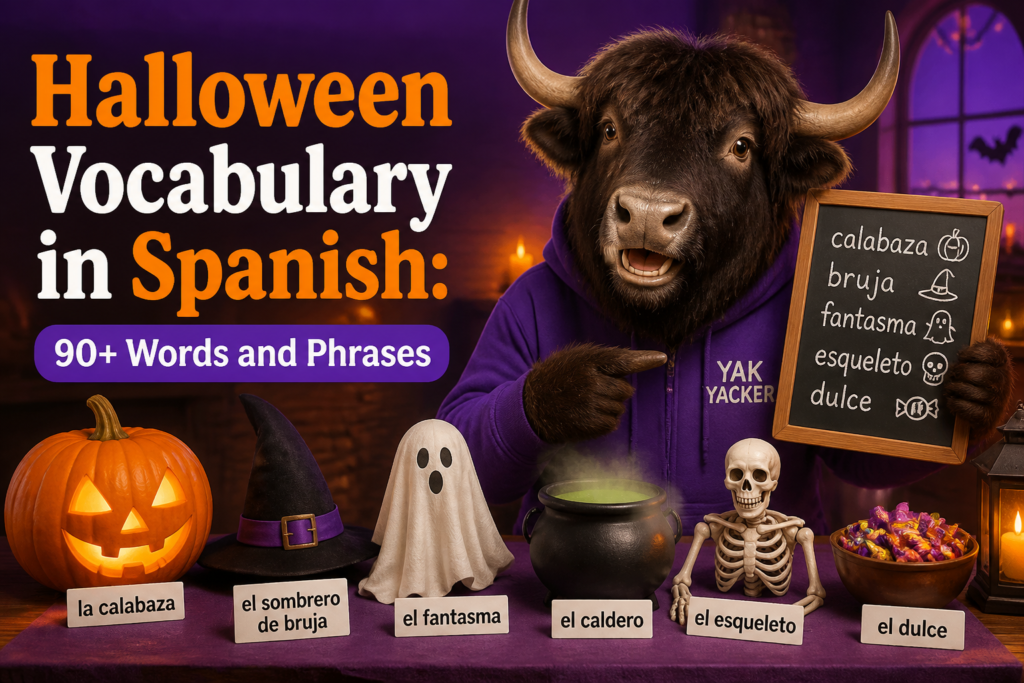
Halloween is one of those holidays that travels well. Costumes, candy, pumpkins, spooky music, and the occasional dramatic fake scream all make sense whether you’re in English or Spanish. The difference is that Spanish speakers may use a mix of local traditions, borrowed words, and very normal words that suddenly become creepy because, well, October.
For the broader learning path, visit our parent guide.
In Spanish, you’ll hear both Halloween and la Noche de Brujas in some places. And yes, people absolutely talk about disfraces, calabazas, dulces, and fantasmas without needing a translation committee.
This guide gives you practical Halloween vocabulary in Spanish: words, phrases, pronunciation help, example sentences, and a few useful cultural notes. For a general reference on Spanish usage, you can also peek at the very serious and very official Real Academia Española. Because nothing says “spooky season” like a reliable dictionary.
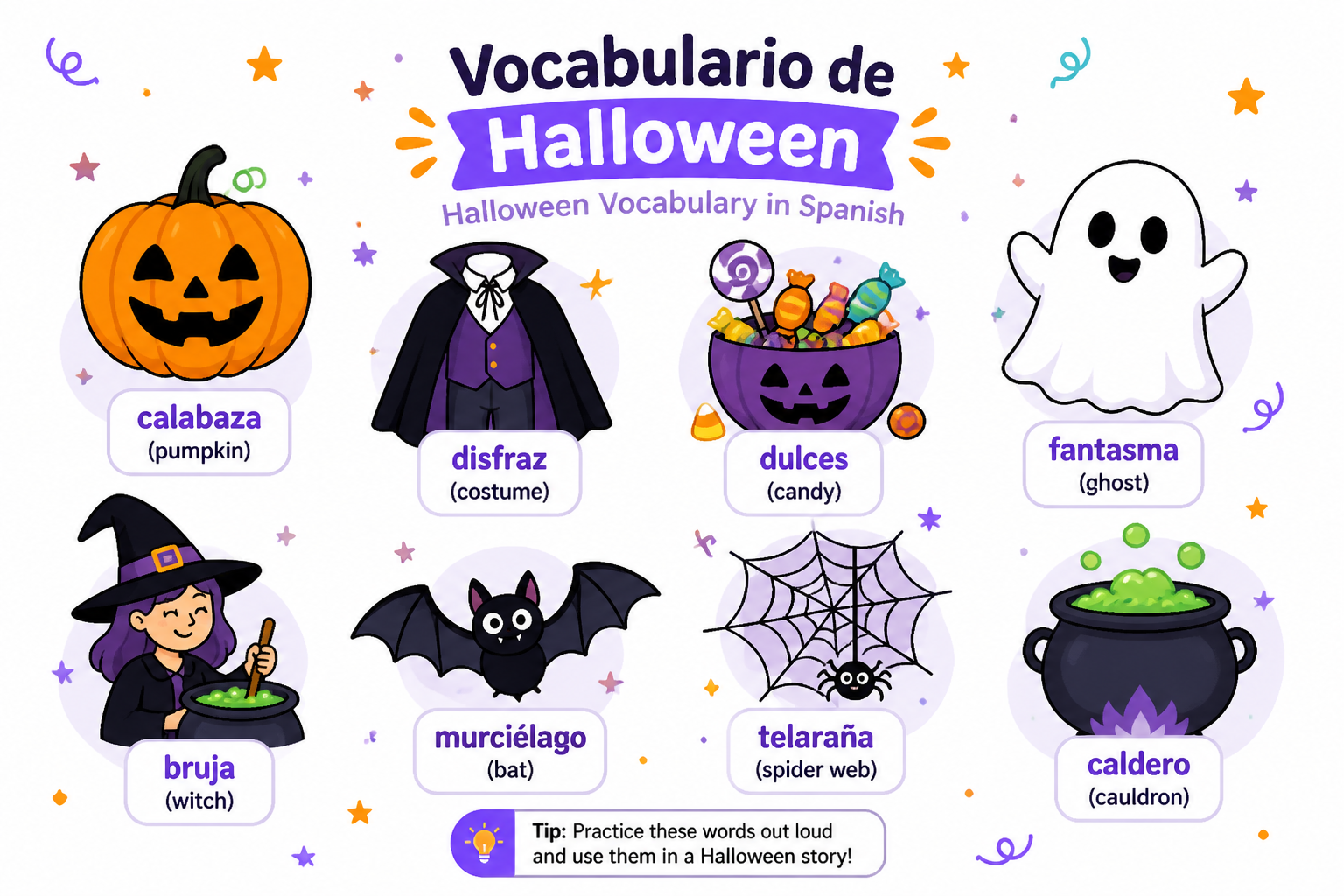
Quick Halloween Core Vocabulary
| Spanish | Pronunciation | Meaning | Example Sentence | Translation | Learner Note |
|---|---|---|---|---|---|
| Halloween | HAL-oh-ween | Halloween | En Halloween, los niños piden dulces. | At Halloween, kids ask for candy. | Common borrowed word. |
| la Noche de Brujas | LAH NOH-cheh deh BROO-hahs | Halloween; “Night of Witches” | En algunos países le dicen la Noche de Brujas. | In some countries they call it Night of Witches. | Natural, but less universal than Halloween. |
| el disfraz | dees-FRAHS | costume | Mi disfraz es de vampiro. | My costume is a vampire costume. | Masculine noun: el disfraz. |
| vestirse de | bees-TEER-seh deh | to dress up as | Nos vamos a vestir de zombis. | We’re going to dress up as zombies. | Very useful for costumes. |
| el truco o trato | TROO-koh oh TRAH-toh | trick or treat | Los niños gritan “¡truco o trato!” | The children shout “trick or treat!” | Common translation, but not used everywhere. |
| los dulces | DOOL-ses | candies, sweets | Reparten dulces en la fiesta. | They hand out candy at the party. | Also means “sweets” in general. |
| la calabaza | kah-lah-BAH-sah | pumpkin | Compramos una calabaza para decorar. | We bought a pumpkin to decorate. | Feminine noun: la calabaza. |
| el fantasma | fahn-TAHS-mah | ghost | Dicen que hay un fantasma en la casa. | They say there is a ghost in the house. | The h is silent. |
| la bruja | BROO-hah | witch | La bruja tiene una escoba. | The witch has a broom. | “J” sounds like a strong breathy H. |
| el monstruo | MON-stroo | monster | El monstruo se esconde debajo de la cama. | The monster hides under the bed. | Great for kids’ stories and jokes. |
| el vampiro | bahn-PEE-roh | vampire | Mi amigo va de vampiro este año. | My friend is going as a vampire this year. | Easy cognate for English speakers. |
| el zombi | SOHM-bee | zombie | El zombi camina muy lento. | The zombie walks very slowly. | In many places, zombie is also heard. |
Useful Halloween Phrases
These are the phrases you’re most likely to actually hear or use. No dusty dictionary goblins here.
| Spanish | Pronunciation | Meaning | Example Sentence | Translation | Learner Note |
|---|---|---|---|---|---|
| ¿Te gustan los sustos? | teh GOOS-tahn lohs SOOS-tohs | Do you like scares? | ¿Te gustan los sustos o prefieres algo tranquilo? | Do you like scares, or do you prefer something calm? | susto = scare, fright. |
| ¡Qué miedo! | keh MYEH-doh | How scary! / So scary! | ¡Qué miedo, esa película! | How scary, that movie! | Very common reaction phrase. |
| dar miedo | dahr MYEH-doh | to be scary; to frighten | Ese sonido me da miedo. | That sound scares me. | Literally “to give fear.” |
| asustarse | ah-soos-TAHR-seh | to get scared | Mi hermana se asusta fácilmente. | My sister gets scared easily. | Reflexive verb; keep the se. |
| espeluznante | ehs-peh-looths-NAHN-teh | spine-chilling, creepy | La historia es espeluznante. | The story is spine-chilling. | Formal-ish, dramatic, fun. |
| terrorífico | teh-rroh-REE-fee-koh | terrifying | Fue una noche terrorífica. | It was a terrifying night. | Good for strong horror vibes. |
| aterrador | ah-teh-rrah-DOR | frightening | El ruido fue aterrador. | The noise was frightening. | Useful adjective in everyday speech. |
| sin miedo | seen MYEH-doh | without fear | Los niños fueron sin miedo a la casa embrujada. | The children went fearlessly to the haunted house. | Simple and natural. |
| la casa embrujada | KAH-sah ehm-broo-HAH-dah | haunted house | Visitamos la casa embrujada del barrio. | We visited the neighborhood haunted house. | embrujado/a = haunted, bewitched. |
| la fiesta de disfraces | FYEHS-tah deh dees-FRAH-ses | costume party | Vamos a una fiesta de disfraces el sábado. | We’re going to a costume party on Saturday. | Very useful around Halloween. |
| pedir dulces | peh-DEER DOOL-ses | to go trick-or-treating | Los niños salen a pedir dulces. | The children go out trick-or-treating. | Very common in Latin America. |
| decorar la casa | deh-koh-RAHR lah KAH-sah | to decorate the house | Vamos a decorar la casa con calabazas. | We’re going to decorate the house with pumpkins. | Practical family vocabulary. |
| encender una vela | en-sehn-DEHR oo-nah VEH-lah | to light a candle | Encendimos una vela por la noche. | We lit a candle at night. | Useful in spooky stories and decorations. |
| la linterna | leen-TER-nah | flashlight | Necesitamos una linterna para la excursión. | We need a flashlight for the outing. | Handy for Halloween walks. |
| la máscara | MAHS-kah-rah | mask | Se puso una máscara de esqueleto. | He put on a skeleton mask. | Accent mark matters: máscara. |
| el maquillaje | mah-kee-YAH-heh | makeup; face paint | Su maquillaje de zombie quedó genial. | Her zombie makeup looked great. | Spanish speakers often use this for costume makeup too. |
| la sangre falsa | sahn-GREH FAHL-sah | fake blood | Compraron sangre falsa para el disfraz. | They bought fake blood for the costume. | Exactly what it sounds like. Delightful. |
| la telaraña | teh-lah-RAH-nyah | spider web | La telaraña estaba en la esquina. | The spider web was in the corner. | The ñ sounds like “ny.” |
| la araña | ah-RAH-nyah | spider | Vimos una araña enorme en el techo. | We saw a huge spider on the ceiling. | Yes, spiders show up every October like they pay rent. |
| el cementerio | seh-mehn-TEHR-yoh | cemetery | La película empieza en el cementerio. | The movie starts in the cemetery. | Common in horror stories. |
Spooky People, Creatures, and Characters
Halloween vocabulary gets more fun when you can name the creepy cast of characters. Here’s your little monster roll call.
| Spanish | Pronunciation | Meaning | Example Sentence | Translation | Learner Note |
|---|---|---|---|---|---|
| el esqueleto | ehs-keh-LEH-toh | skeleton | El esqueleto baila en la fiesta. | The skeleton dances at the party. | Great Halloween image word. |
| el hombre lobo | OM-breh LOH-boh | werewolf | La leyenda del hombre lobo es famosa. | The werewolf legend is famous. | Literally “wolf man.” |
| la momia | MOH-mee-ah | mummy | La momia sale de la tumba. | The mummy comes out of the tomb. | Easy to remember. |
| el demonio | deh-MOH-nyoh | demon | La historia habla de un demonio. | The story talks about a demon. | Also used figuratively sometimes. |
| el muerto viviente | MWER-toh bee-BYEN-teh | living dead, zombie-like creature | En la serie aparece un muerto viviente. | A living dead creature appears in the series. | A descriptive phrase, not just one noun. |
| el duende | DWEN-deh | goblin, elf, sprite | Dicen que el duende vive en el bosque. | They say the goblin lives in the forest. | Meaning can vary by region. |
| el espíritu | ehs-PEE-ree-too | spirit | Creen que hay un espíritu en la escuela. | They think there is a spirit in the school. | Accent on -pi-. |
| la criatura | kree-ah-TOO-rah | creature | La criatura salió del lago. | The creature came out of the lake. | Very common in stories. |
| el asesino | ah-seh-SEE-noh | killer; murderer | La novela trata sobre un asesino misterioso. | The novel is about a mysterious killer. | Strong word; use carefully. |
| el villano | bee-YAH-noh | villain | El villano de la película es muy inteligente. | The villain in the movie is very smart. | Useful beyond Halloween too. |
| la hechicera | eh-chee-SEH-rah | sorceress; enchantress | La hechicera lanzó un hechizo. | The sorceress cast a spell. | More literary than everyday. |
| el hechicero | eh-chee-SEH-roh | sorcerer; wizard | El hechicero conoce muchas pociones. | The sorcerer knows many potions. | Pairs with hechicera. |
| la víctima | BEEK-tee-mah | victim | La víctima escapó de la casa. | The victim escaped from the house. | Common in mystery and horror stories. |
| el cuervo | KWER-voh | raven, crow | Un cuervo negro estaba en el árbol. | A black raven/crow was in the tree. | Nice spooky bird vocabulary. |
| el murciélago | moor-thee-EH-lah-goh | bat | Vimos un murciélago volando de noche. | We saw a bat flying at night. | In many Latin American regions, c before i/e sounds like s. |
| la serpiente | sehr-PYEN-teh | snake | La serpiente está en el jardín. | The snake is in the garden. | Good general animal word too. |
| el lobo | LOH-boh | wolf | El lobo aúlla en la noche. | The wolf howls at night. | Useful in Halloween stories and legends. |
| la calavera | kah-lah-BEH-rah | skull | La calavera aparece en la decoración. | The skull appears in the decoration. | Very common in festive imagery. |
Halloween Objects, Decorations, And Food
Because Halloween is not just monsters running around like they own the place. You also need props, decorations, and snacks. Mostly snacks.
| Spanish | Pronunciation | Meaning | Example Sentence | Translation | Learner Note |
|---|---|---|---|---|---|
| la linterna de calabaza | leen-TER-nah deh kah-lah-BAH-sah | jack-o’-lantern | Hicimos una linterna de calabaza. | We made a jack-o’-lantern. | Also called calabaza tallada in some contexts. |
| la vela | BEH-lah | candle | Encendieron velas en la mesa. | They lit candles on the table. | Feminine noun. |
| la escoba | ehs-KOH-bah | broom | La bruja vuela en una escoba. | The witch flies on a broom. | Classic witch word. |
| la capa | KAH-pah | cape | Su disfraz lleva una capa negra. | Her costume has a black cape. | Useful with superhero and vampire costumes too. |
| el sombrero de bruja | sohm-BREH-roh deh BROO-hah | witch hat | Compré un sombrero de bruja para la fiesta. | I bought a witch hat for the party. | Great shopping phrase. |
| la máscara | MAHS-kah-rah | mask | La máscara es de plástico. | The mask is plastic. | Useful for costume talk generally. |
| el maquillaje de cara | mah-kee-YAH-heh deh KAH-rah | face paint | Necesito maquillaje de cara para mi disfraz. | I need face paintMore Spanish to explore |