


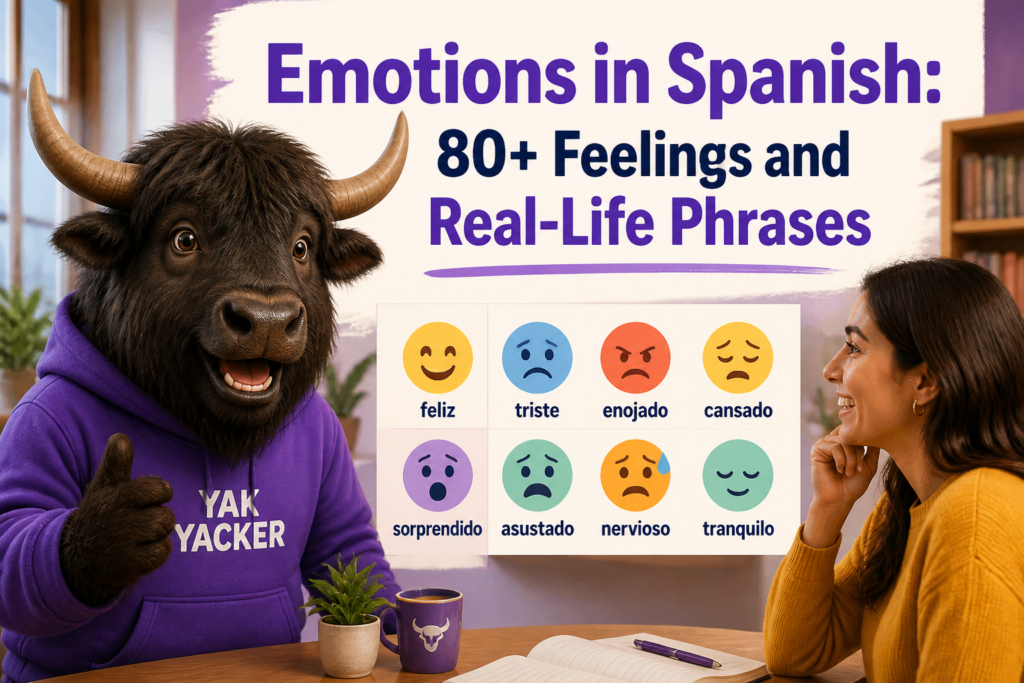
Emotions in Spanish show up everywhere: at work, in texts, in family drama, and in those tiny moments when your coffee is perfect and suddenly life feels manageable again. If you can talk about feelings in Spanish, you can talk like a real person — not just someone reciting textbook lines with a brave little smile.
In this guide, you’ll learn beginner-friendly vocabulary for feelings, useful phrases for real life, and a few grammar tips so you can say things like “Estoy cansado”, “Me alegra verte”, and “Estoy nervioso por la entrevista” without sounding like a robot in a bad mood.
We’ll mostly use standard Latin American Spanish, with notes when Spain Spanish differs. And yes, emotions in Spanish often use estar, because feelings are usually temporary. Spanish is annoyingly sensible like that.
Yak Yacker Spanish guides keep things practical, and this one is built for actual conversations — not decorative dictionary dust.
The Big Idea: Feelings in Spanish Usually Use Estar
For emotions, Spanish usually uses estar + an adjective:
| Pattern | Meaning | Spanish Example | English Translation | Learner Note |
|---|---|---|---|---|
| Estoy feliz | I am happy | Estoy feliz hoy. | I’m happy today. | Temporary feeling, so estar fits. |
| Estás cansado | You are tired | Estás cansado después del trabajo. | You’re tired after work. | Change the ending: -o for masculine, -a for feminine. |
| Estamos nerviosos | We are nervous | Estamos nerviosos antes del examen. | We’re nervous before the exam. | Plural adjective agreement matters. Spanish will notice. |
For more on this classic ser vs. estar situation, see the simple explanation on WordReference or the clearer grammar notes from the Instituto Cervantes. Because sometimes you need a boring authority to remind Spanish to behave.
80+ Feelings in Spanish
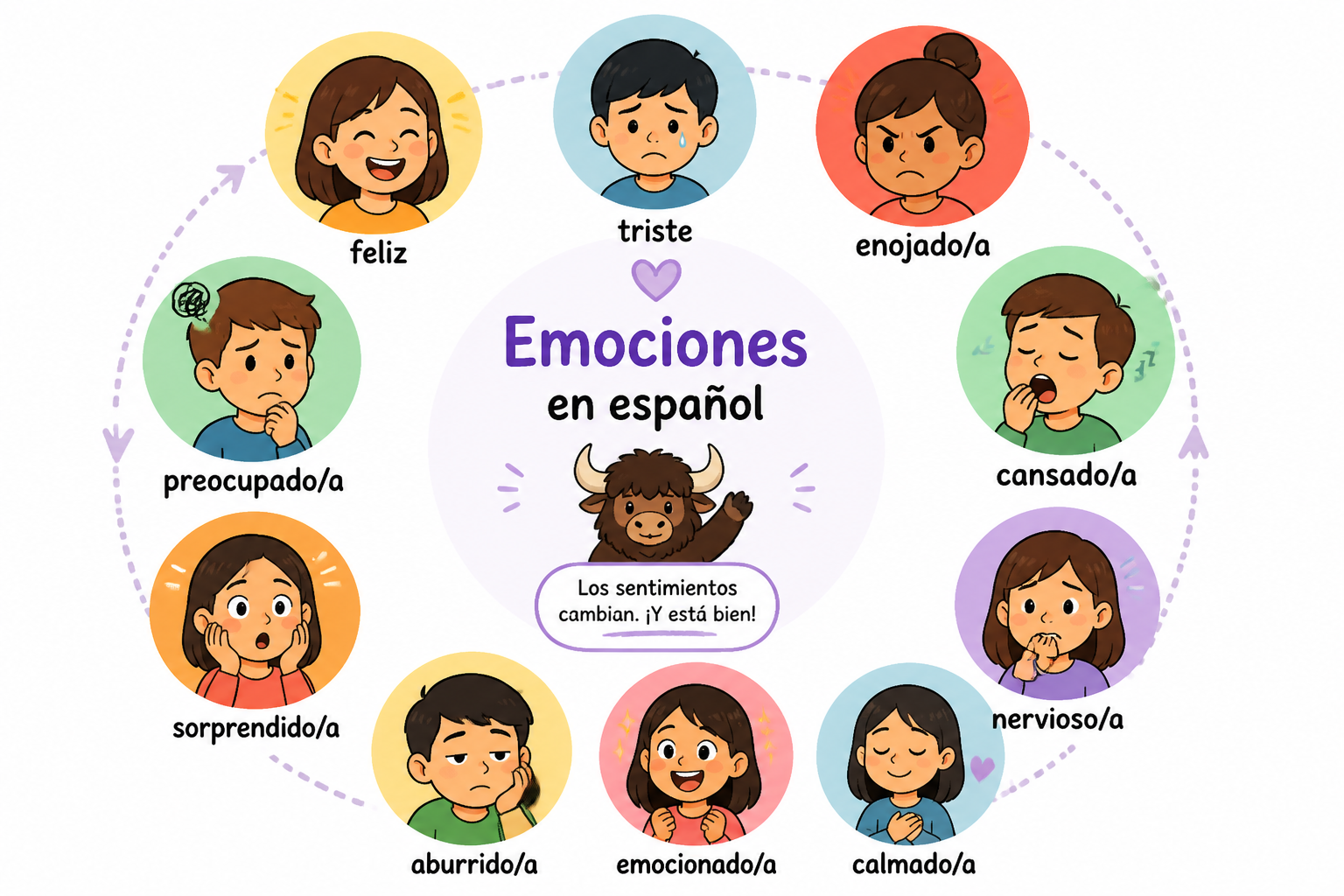
Here are useful emotions and feelings, starting with the ones you’ll actually say in real life.
| Spanish | Pronunciation | Meaning | Example Sentence | Translation | Learner Note |
|---|---|---|---|---|---|
| feliz | fay-LEES | happy | Estoy feliz de verte. | I’m happy to see you. | Common and neutral. |
| contento / contenta | con-TEN-to / con-TEN-ta | happy, pleased | Estoy contenta con el resultado. | I’m pleased with the result. | Often a little calmer than feliz. |
| triste | TREES-teh | sad | Está triste hoy. | He/She is sad today. | Works for people and moods. |
| enojado / enojada | eh-no-HA-do / eh-no-HA-da | angry | Estoy enojado por eso. | I’m angry about that. | Common in Latin America. |
| enfadado / enfadada | ehn-fa-DA-do / ehn-fa-DA-da | angry | Mi mamá está enfadada. | My mom is angry. | Very common in Spain. |
| molesto / molesta | moh-LES-to / moh-LES-ta | annoyed, bothered | Estoy molesta con el ruido. | I’m annoyed by the noise. | Useful for mild irritation. |
| frustrado / frustrada | froo-STRA-do / froo-STRA-da | frustrated | Me siento frustrado con esta tarea. | I feel frustrated with this task. | Often used with me siento. |
| cansado / cansada | kan-SA-do / kan-SA-da | tired | Estoy cansada hoy. | I’m tired today. | Very common. Useful everywhere. |
| agotado / agotada | a-go-TA-do / a-go-TA-da | exhausted | Estoy agotado después del viaje. | I’m exhausted after the trip. | Stronger than cansado. |
| relajado / relajada | reh-la-HA-do / reh-la-HA-da | relaxed | Me siento relajado en la playa. | I feel relaxed at the beach. | Also used for a calm person or vibe. |
| estresado / estresada | ehs-treh-SA-do / ehs-treh-SA-da | stressed | Estoy estresada por el trabajo. | I’m stressed about work. | One of the most common feelings in modern life. |
| nervioso / nerviosa | ner-VYOH-so / ner-VYOH-sa | nervous | Estoy nervioso antes de hablar. | I’m nervous before speaking. | ll sounds like y in many places. |
| emocionado / emocionada | eh-mo-syo-NA-do / eh-mo-syo-NA-da | excited, emotional | Estoy emocionada por el concierto. | I’m excited for the concert. | Can mean excited or emotionally moved. |
| aburrido / aburrida | a-boo-REE-do / a-boo-REE-da | bored | Estoy aburrido en clase. | I’m bored in class. | Also used for something boring: una película aburrida. |
| asustado / asustada | a-soos-TA-do / a-soos-TA-da | scared | El niño está asustado. | The child is scared. | Often used with de for the cause. |
| preocupado / preocupada | preh-oh-koo-PA-do / preh-oh-koo-PA-da | worried | Estoy preocupada por mi amiga. | I’m worried about my friend. | Very useful in real conversations. |
| confundido / confundida | con-foon-DEE-do / con-foon-DEE-da | confused | Estoy confundido con la explicación. | I’m confused by the explanation. | Great for beginner honesty. Highly recommended. |
| perdido / perdida | per-DEE-do / per-DEE-da | lost | Estoy perdido en la ciudad. | I’m lost in the city. | Also literal, not just emotionally lost. |
| solo / sola | SO-lo / SO-la | alone, lonely | Me siento sola hoy. | I feel lonely today. | Context tells you whether it’s neutral or sad. |
| decepcionado / decepcionada | deh-sep-syo-NA-do / deh-sep-syo-NA-da | disappointed | Estoy decepcionado con la noticia. | I’m disappointed with the news. | Long word, very useful. |
| sorprendido / sorprendida | sor-pren-DEE-do / sor-pren-DEE-da | surprised | Estoy sorprendida por tu mensaje. | I’m surprised by your message. | Often with por. |
| relajado / relajada | reh-la-HA-do / reh-la-HA-da | calm | Ahora estoy más relajado. | Now I’m calmer. | Can describe a feeling or atmosphere. |
| tranquilo / tranquila | tran-KEE-lo / tran-KEE-la | calm, peaceful | La tarde está tranquila. | The afternoon is peaceful. | Can describe people, places, or situations. |
| contento / contenta | con-TEN-to / con-TEN-ta | satisfied | Estoy contento con mi progreso. | I’m satisfied with my progress. | Overlap with happy. |
| orgulloso / orgullosa | or-goo-YO-so / or-goo-YO-sa | proud | Estoy orgullosa de ti. | I’m proud of you. | Very common in compliments and family talk. |
| vergonzoso / vergonzosa | ber-gon-SO-so / ber-gon-SO-sa | embarrassing | Fue una situación vergonzosa. | It was an embarrassing situation. | Often describes the situation, not the person. |
| avergonzado / avergonzada | a-ber-gon-ZA-do / a-ber-gon-ZA-da | embarrassed | Me siento avergonzado. | I feel embarrassed. | Use with me siento often. |
| con sueño | con SWEH-nyoh | sleepy | Estoy con sueño. | I’m sleepy. | Very natural everyday phrase. |
| hambriento / hambrienta | am-bryen-TO / am-bryen-TA | hungry | Estoy hambriento. | I’m hungry. | Literally “hungry”; also tengo hambre is more common. |
| sediento / sedienta | seh-dyen-TO / seh-dyen-TA | thirsty | Estoy sedienta después de correr. | I’m thirsty after running. | Also less common than tengo sed. |
| ansioso / ansiosa | an-syo-SO / an-syo-SA | anxious, eager | Estoy ansiosa por la respuesta. | I’m anxious for the reply. | Can mean eager too, depending on context. |
| apenado / apenada | a-pe-NA-do / a-pe-NA-da | sad, sorry | Estoy apenada por lo que pasó. | I’m sorry about what happened. | Polite, useful in apologies. |
| indiferente | in-dee-feh-REN-teh | indifferent | Estoy indiferente ante el cambio. | I’m indifferent to the change. | Not emotional, but still a feeling state. |
| desilusionado / desilusionada | deh-see-loo-syo-NA-do / deh-see-loo-syo-NA-da | disillusioned | Está desilusionado con el sistema. | He’s disillusioned with the system. | More advanced, but useful. |
| aliviado / aliviada | a-lee-VYA-do / a-lee-VYA-da | relieved | Me siento aliviada. | I feel relieved. | Great after stress or bad news. |
| tenso / tensa | TEN-so / TEN-sa | tense | El ambiente está tenso. | The atmosphere is tense. | Often used for situations, not just people. |
| lleno / llena de alegría | YE-no / YE-na deh a-le-GREE-a | full of joy | Está llena de alegría. | She is full of joy. | A bit more expressive and literary. |
That’s already a lot of emotional baggage, and we’re not done yet.
Here are more useful feelings and emotional descriptions:
| Spanish | Pronunciation | Meaning | Example Sentence | Translation | Learner Note |
|---|---|---|---|---|---|
| alegre | a-LEH-greh | cheerful | Es una persona alegre. | She’s a cheerful person. | Can describe people, music, or a mood. |
| deprimido / deprimida | deh-preh-MEE-do / deh-preh-MEE-da | depressed, down | Se siente deprimido hoy. | He feels down today. | More serious than “sad.” Use carefully. |
| desanimado / desanimada | deh-sa-nee-MA-do / deh-sa-nee-MA-da | discouraged | Estoy desanimada con el proceso. | I’m discouraged with the process. | Common in study or work contexts. |
| motivado / motivada | mo-tee-VA-do / mo-tee-VA-da | motivated | Me siento motivado para estudiar. | I feel motivated to study. | Useful for goals and self-talk. |
| orgulloso / orgullosa | or-goo-YO-so / or-goo-YO-sa | proud | Mi familia está orgullosa de mí. | My family is proud of me. | Very common with de. |
| agradecido / agradecida | a-gra-deh-SEE-do / a-gra-deh-SEE-da | grateful | Estoy agradecido por tu ayuda. | I’m grateful for your help. | Polite and warm. |
| satisfecho / satisfecha | sa-tis-FE-cho / sa-tis-FECH-a | satisfied | Estoy satisfecha con la comida. | I’m satisfied with the food. | Formal-ish, useful in reviews and work. |
| complacido / complacida | com-pla-SEE-do / com-pla-SEE-da | pleased | El profesor está complacido. | The teacher is pleased. | More formal and less common. |
| impaciente | im-pa-SYEN-teh | impatient | Estoy impaciente por empezar. | I’m eager to start. | Can mean impatient or excitedly waiting. |
| tímido / tímida | TEE-mee-do / TEE-mee-da | shy | Era tímida de niña. | She was shy as a child. | Good for personality descriptions. |
| intimidado / intimidada | in-tee-mee-DA-do / in-tee-mee-DA-da | intimidated | Me siento intimidado en esa clase. | I feel intimidated in that class. | Useful for school or work. |
| abrumado / abrumada | a-broo-MA-do / a-broo-MA-da | overwhelmed | Estoy abrumada con tanto trabajo. | I’m overwhelmed with so much work. | Very real-life, very common. |
| solo / sola | SO-lo / SO-la | lonely | Se siente sola en la ciudad. | She feels lonely in the city. | Not always the same as “alone.” |
| acomplejado / acomplejada | a-com-ple-HA-do / a-com-ple-HA-da | self-conscious, insecure | Está acomplejado por su voz. | He’s insecure about his voice. | More advanced, but handy. |
| celoso / celosa | theh-LO-so / theh-LO-sa | jealous | Está celosa de su hermana. | She is jealous of her sister. | Also can mean protective, depending on context. |
| afectuoso / afectuosa | a-fek-TWO-so / a-fek-TWO-sa | affectionate | Es muy afectuosa con sus hijos. | She is very affectionate with her children. | Describes warm behavior. |
| amoroso / amorosa | a-mo-RO-so / a-mo-RO-sa | loving | Tu mensaje fue muy amoroso. | Your message was very loving. | Sweet, but not overly cheesy. |
| romántico / romántica | ro-MAN-tee-ko / ro-MAN-tee-ka | romantic | Es una persona romántica. | He/She is a romantic person. | Good for dates and relationships. |
| atento / atenta | a-TEN-to / a-TEN-ta | attentive, considerate | Fue muy atento conmigo. | He was very considerate with me. | Often a compliment. |
| desesperado / desesperada | deh-seh-peh-RA-do / deh-seh-peh-RA-da | desperate | Estoy desesperada por una respuesta. | I’m desperate for an answer. | Strong emotion; don’t use casually if you mean “a bit worried.” |
| sereno / serena | seh-REH-no / seh-REH-na | serene, calm | Se ve sereno hoy. | He looks serene today. | More poetic or descriptive. |
| sensible | sen-SEE-bleh | sensitive | Es muy sensible a las críticas. | He/She is very sensitive to criticism. | Can be emotional or physically sensitive. |
raro / raraMore Spanish to explore Best graded readers for Spanish The Boy and the Sheep: A1 Beginner Spanish Story with Audio Martina the Little Cockroach: A1 Beginner Spanish Story with Audio Marianela: A B1 Intermediate Spanish Story with Audio |