


Spanish daily routine vocabulary is one of those topics that looks boring on paper and then quietly runs your whole life. Getting up, showering, eating, commuting, working, studying, sleeping—congratulations, you now need language for absolutely everything before lunch.
For the broader learning path, visit our parent guide.
The good news: once you learn a solid set of routine words, you can talk about your day, ask other people about theirs, and sound much more natural in normal conversation. You do not need fancy poetry here. You need the stuff people actually say before coffee has fully arrived.
By the end of this guide, you’ll know useful Spanish words and phrases for morning, daytime, evening, and common routine actions, plus pronunciation help and example sentences you can actually copy into real life.
For a related warm-up, you can also check the basic greeting patterns in How Are You in Spanish.
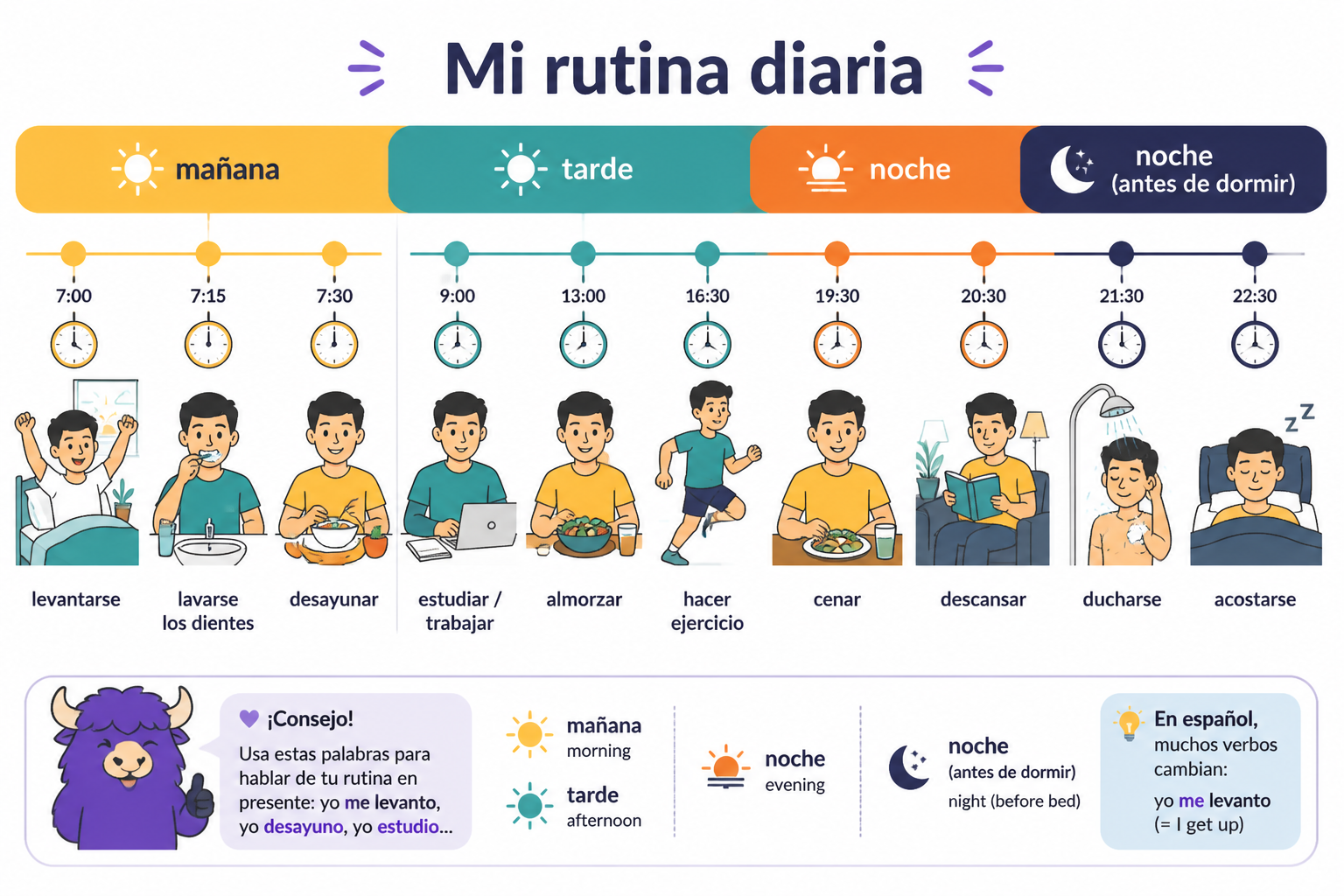
Core Daily Routine Words and Phrases
Here are the most useful routine words first. The pronunciation is simple and practical, not a tiny phonetics hostage situation.
| Spanish | Pronunciation | Meaning | Example Sentence | Translation | Learner Note |
|---|---|---|---|---|---|
| la rutina diaria | lah roo-TEE-nah dee-AH-ree-ah | daily routine | Mi rutina diaria empieza temprano. | My daily routine starts early. | “Rutina” is feminine: la rutina. |
| levantarse | leh-bahn-TAHR-seh | to get up | Me levanto a las seis. | I get up at six. | Reflexive verb: me levanto. |
| despertarse | dehs-pehr-TAHR-seh | to wake up | Me despierto con la alarma. | I wake up with the alarm. | Often used for “wake up,” while levantarse is “get up.” |
| la alarma | lah ah-LAHR-mah | alarm clock / alarm | La alarma suena muy fuerte. | The alarm is very loud. | Common in phones too. |
| apagar | ah-pah-GAHR | to turn off | Apago la alarma y me quedo cinco minutos más. | I turn off the alarm and stay five more minutes. | Very common with phones, lights, and alarms. |
| ducharse | doo-CHAR-seh | to shower | Me ducho por la mañana. | I shower in the morning. | In many places in Latin America, ducharse is more common than bañarse for showering. |
| lavarse la cara | lah-BAHR-seh lah KAH-rah | to wash one’s face | Me lavo la cara después de despertarme. | I wash my face after waking up. | Useful daily-care phrase. |
| cepillarse los dientes | seh-pee-YAHR-seh los DYEHN-tehs | to brush one’s teeth | Me cepillo los dientes después de desayunar. | I brush my teeth after breakfast. | Don’t forget the article: los dientes. |
| vestirse | behs-TEER-seh | to get dressed | Me visto rápido antes de salir. | I get dressed quickly before leaving. | Reflexive and very common. |
| prepararse | preh-pah-RAHR-seh | to get ready / prepare oneself | Me preparo para ir al trabajo. | I get ready to go to work. | Very flexible; works for school, work, trips, and events. |
| desayunar | deh-sah-yoo-NAHR | to have breakfast | Desayuno café y pan tostado. | I have coffee and toast for breakfast. | You can use it as a verb or noun context. |
| el desayuno | el deh-sah-YOO-noh | breakfast | El desayuno está listo. | Breakfast is ready. | Masculine noun: el desayuno. |
A tiny cultural note: in many Spanish-speaking places, people talk about routines with a lot of reflexive verbs: me levanto, me ducho, me acuesto. English often drops that extra idea, but Spanish likes to remind you that the subject is doing something to themselves. Helpful. Slightly bossy. Very Spanish.
Morning Routine Vocabulary
Morning words show up constantly in everyday Spanish. If you can describe your morning, you can already survive a surprising number of conversations.
| Spanish | Pronunciation | Meaning | Example Sentence | Translation | Learner Note |
|---|---|---|---|---|---|
| por la mañana | pohr lah mah-NYAH-nah | in the morning | Trabajo por la mañana. | I work in the morning. | Use por la mañana for “in the morning.” |
| temprano | tehm-PRAH-noh | early | Me levanto temprano. | I get up early. | Common with routines, schedules, and work. |
| tarde | TAHR-deh | late; afternoon | Siempre llego tarde. | I’m always late. | Can mean “late” or “afternoon,” depending on context. |
| la cama | lah KAH-mah | bed | Salgo de la cama a las siete. | I get out of bed at seven. | Literal, natural, and useful. |
| hacer la cama | ah-SEHR lah KAH-mah | to make the bed | Hago la cama antes de salir. | I make the bed before leaving. | One of those everyday chores people always pretend not to forget. |
| lavarse las manos | lah-BAHR-seh las MAHN-os | to wash one’s hands | Me lavo las manos antes de comer. | I wash my hands before eating. | Useful in home, school, and restaurant contexts. |
| arreglarse | ah-reh-GLAHR-seh | to get ready / fix oneself up | Me arreglo antes de salir. | I get ready before going out. | Can suggest grooming or dressing nicely. |
| maquillarse | mah-kee-YAHR-seh | to put on makeup | Ella se maquilla antes de trabajar. | She puts on makeup before working. | Common daily routine verb. |
| peinarse | peh-EEN-ahr-seh | to comb one’s hair / do one’s hair | Me peino rápido y salgo. | I comb my hair quickly and leave. | Very normal in morning talk. |
| el espejo | el ehs-PEH-hoh | mirror | Me miro en el espejo. | I look at myself in the mirror. | Good for grooming and bathroom vocabulary. |
| el baño | el BAH-nyoh | bathroom / bathroom break | Voy al baño antes de salir. | I go to the bathroom before leaving. | In Latin America, el baño is standard; in Spain, el baño is also common. |
| tomar café | toh-MAHR kah-FEH | to drink coffee | Siempre tomo café por la mañana. | I always drink coffee in the morning. | Tomar is very common for drinks. |
Small pronunciation note: Spanish vowels are clean and steady. mañana is not “man-yana” with an English-style mess in the middle. The ñ sounds like “ny” in canyon.
Eating And Meal Time Phrases
Meals are a huge part of routine vocabulary because people love asking what you ate, when you ate, and whether you’re hungry now. Humanity is consistent that way.
| Spanish | Pronunciation | Meaning | Example Sentence | Translation | Learner Note |
|---|---|---|---|---|---|
| desayunar | deh-sah-yoo-NAHR | to have breakfast | Desayuno fruta y yogur. | I have fruit and yogurt for breakfast. | Daily routine verb, not just a noun. |
| almorzar | ahl-mohr-SAHR | to have lunch | Almuerzo a la una. | I have lunch at one. | Common in Latin America. In Spain, comer often means “to have lunch.” |
| cenar | seh-NAHR | to have dinner | Ceno temprano entre semana. | I have dinner early during the week. | Very useful and very common. |
| la comida | lah koh-MEE-dah | lunch / meal / food | La comida está en la mesa. | Lunch/food is on the table. | In many places, la comida can mean the main meal of the day. |
| la cena | lah SEH-nah | dinner | La cena está lista. | Dinner is ready. | Feminine noun. |
| tener hambre | teh-NEHR AHM-breh | to be hungry | Tengo hambre otra vez. | I’m hungry again. | Uses tener, not “to be.” |
| tener sed | teh-NEHR sehd | to be thirsty | Tengo sed después de correr. | I’m thirsty after running. | Same pattern as tener hambre. |
| preparar el desayuno | preh-pah-RAHR el deh-sah-YOO-noh | to prepare breakfast | Mi papá prepara el desayuno. | My dad prepares breakfast. | Useful household phrase. |
| poner la mesa | POH-nehR lah MEH-sah | to set the table | Yo pongo la mesa antes de comer. | I set the table before eating. | Common family and home vocabulary. |
| lavar los platos | lah-VAHR los PLAH-tohs | to wash the dishes | Después de cenar, lavo los platos. | After dinner, I wash the dishes. | Great everyday chore phrase. |
Regional note: in much of Latin America, almorzar is the standard verb for lunch, while in Spain people often say comer for the midday meal. Both are normal, but context matters. Spanish loves making one word do two jobs when it feels like it.
Work, School, And Study Routine Words
These are the phrases that help you talk about ordinary days, schedules, classes, and getting things done. You know, the glamorous stuff.
| Spanish | Pronunciation | Meaning | Example Sentence | Translation | Learner Note |
|---|---|---|---|---|---|
| trabajar | trah-bah-HAHR | to work | Trabajo de lunes a viernes. | I work Monday to Friday. | Very common routine verb. |
| estudiar | ehs-too-dee-AHR | to study | Estudio por la noche. | I study at night. | Can mean school study or general studying. |
| ir al trabajo | eer al trah-BAH-hoh | to go to work | Voy al trabajo en metro. | I go to work by subway. | Use ir a + place. |
| ir a clase | eer ah KLAH-seh | to go to class | Voy a clase a las ocho. | I go to class at eight. | For school schedules and routine talk. |
| hacer tarea | ah-SEHR tah-REH-ah | to do homework | Hago tarea después de cenar. | I do homework after dinner. | In many countries, tarea is the normal word for homework. |
| revisar correos | reh-bee-SAHR koh-REH-ohs | to check emails | Reviso correos antes de empezar. | I check emails before starting. | Useful for work and office language. |
| tomar apuntes | toh-MAHR ah-POON-tehs | to take notes | Tomamos apuntes en clase. | We take notes in class. | Very common student phrase. |
| hacer una pausa | ah-SEHR oo-nah POW-sah | to take a break | Hago una pausa para tomar agua. | I take a break to drink water. | Natural in work and study settings. |
| terminar | tehr-mee-NAHR | to finish | Termino a las cinco. | I finish at five. | Useful with schedules and daily tasks. |
| empezar | ehm-peh-SAHR | to start | Empiezo a trabajar a las nueve. | I start working at nine. | Stem-changing verb: empiezo, not empezó here. |
| volver a casa | bohl-VEHR ah KAH-sah | to return home | Vuelvo a casa por la tarde. | I return home in the afternoon. | Useful in everyday narration. |
| descansar | dehs-kahn-SAHR | to rest | Descanso un rato después del trabajo. | I rest for a while after work. | Very natural in routine descriptions. |
If you want more action-style words for routine descriptions, the related guide on Actions and Gestures in Spanish fits nicely with this topic.
Afternoon And Evening Routine Words
Once the day gets later, Spanish routine vocabulary shifts into commuting, errands, relaxing, and getting ready for bed. The usual human fade-out sequence.
| Spanish | Pronunciation | Meaning | Example Sentence | Translation | Learner Note |
|---|---|---|---|---|---|
| por la tarde | pohr lah TAHR-deh | in the afternoon | Trabajo por la tarde. | I work in the afternoon. | Very common time expression. |
| por la noche | pohr lah NOH-cheh | at night / in the evening | Estudio por la noche. | I study at night. | Can mean evening or nighttime, depending on context. |
| volver a casa | bohl-VEHR ah KAH-sah | to go back home | Vuelvo a casa a las siete. | I go back home at seven. | One of the most useful everyday phrases. |
| relajarse | reh-lah-KAHR-seh | to relax | Me relajo con música. | I relax with music. | Great for evening routines. |
| ver televisión | behr tehl-eh-vee-see-OHN | to watch TV | Veo televisión un rato. | I watch TV for a while. | Also common: ver la tele in casual speech. |
| usar el teléfono | oo-SAHR el teh-LEH-foh-noh | to use the phone | Uso el teléfono antes de dormir. | I use my phone before sleeping. | Very common routine phrase. |
| salir a caminar | sah-LEER ah kah-mee-NAHR | to go out for a walk | Salgo a caminar después de cenar. | I go outMore Spanish to explore Best graded readers for Spanish The Boy and the Sheep: A1 Beginner Spanish Story with Audio Martina the Little Cockroach: A1 Beginner Spanish Story with Audio Marianela: A B1 Intermediate Spanish Story with Audio |