Spanish adjectives are the little words that do a lot of heavy lifting. They describe people, places, food, moods, and all the random stuff you need when you want to say more than sí and no. Very useful. Mildly bossy. Very Spanish.
For the broader learning path, visit our parent guide.
By the end of this guide, you’ll know a big set of everyday Spanish adjectives, how to use them naturally, and how to make them agree with nouns without accidentally offending the grammar gods.
If you need a quick refresher on adjective agreement, gender, and plural endings, this pairs nicely with Spanish Gender Rules for Nouns and Adjectives. And if you want the bigger survival kit, the 100 Essential Spanish Words & Phrases guide is waiting patiently.
Spanish adjectives usually come after the noun: una casa grande means “a big house.” English learners often want to put the adjective first, because English is like that. Spanish mostly is not.
| Spanish | Pronunciation | Meaning | Example Sentence | Translation | Learner Note |
|---|---|---|---|---|---|
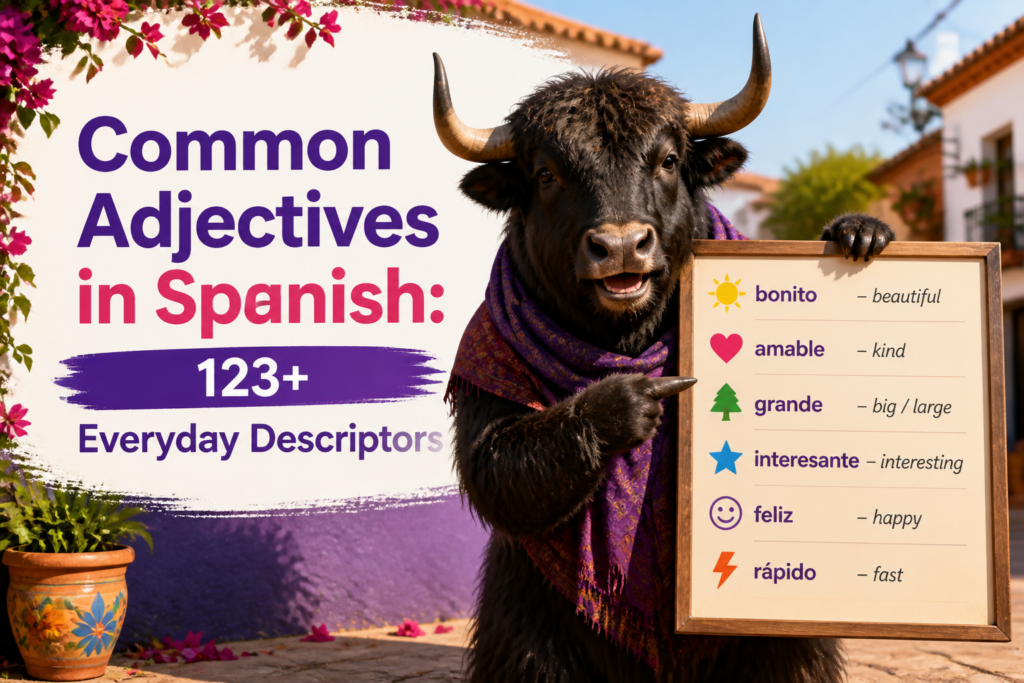
| grande | GRAHN-deh | big, large | Mi casa es grande. | My house is big. | Usually comes after the noun. |
| pequeño / pequeña | peh-KEH-nyoh / peh-KEH-nyah | small, little | Tenemos una mesa pequeña. | We have a small table. | The ñ sounds like “ny” in “canyon.” |
| nuevo / nueva | NWEH-voh / NWEH-vah | new | Compré una mochila nueva. | I bought a new backpack. | Adjective changes with gender. |
| viejo / vieja | VYEH-hoh / VYEH-hah | old | Es una casa vieja. | It’s an old house. | Can mean “old” or, in some contexts, “former.” |
| bonito / bonita | boh-NEE-toh / boh-NEE-tah | pretty, nice | Qué vestido tan bonito. | What a pretty dress. | Common, friendly, neutral. |
| feo / fea | FEH-oh / FEH-ah | ugly | Ese sofá es feo. | That sofa is ugly. | Direct; use carefully with people. |
| alto / alta | AHL-toh / AHL-tah | tall, high | Mi hermano es muy alto. | My brother is very tall. | Can describe height or physical position. |
| bajo / baja | BAH-hoh / BAH-hah | short, low | La mesa es baja. | The table is low. | Can mean “short” in height or “low.” |
| largo / larga | LAR-goh / LAR-gah | long | La película es muy larga. | The movie is very long. | Great for time, hair, roads, and speeches you wish were shorter. |
| corto / corta | KOR-toh / KOR-tah | short | Necesito un corte corto. | I need a short haircut. | Useful for hair, sleeves, and length. |
Here’s a tiny but important thing: adjectives in Spanish usually match the noun in gender and number. So it’s un libro interesante, una película interesante, unos libros interesantes, and unas películas interesantes. Yes, Spanish makes the adjective work too. Rude, but fair.
Real Academia Española is the boring-but-reliable place to check word usage when you want the official answer and not just a cousin’s confident guess.
| Spanish | Pronunciation | Meaning | Example Sentence | Translation | Learner Note |
|---|---|---|---|---|---|
| bueno / buena | BWEH-noh / BWEH-nah | good | Es una buena idea. | It’s a good idea. | Very common. Also used before masculine singular nouns: buen amigo. |
| malo / mala | MAH-loh / MAH-lah | bad | Tengo un día malo. | I’m having a bad day. | Before masculine singular nouns, it often becomes mal: mal ejemplo. |
| mejor | meh-HOR | better | Este café es mejor. | This coffee is better. | Irregular comparative; no need for más bueno in most cases. |
| peor | peh-OR | worse | Hoy el tráfico está peor. | Today traffic is worse. | Useful in complaints. So, very useful. |
| fácil | FAH-seel | easy | Esta tarea es fácil. | This task is easy. | Accent stays on the first syllable. |
| difícil | dee-FEE-seel | hard, difficult | El examen fue difícil. | The exam was difficult. | Does not change in gender; plural is difíciles. |
| rápido / rápida | RAH-pee-doh / RAH-pee-dah | fast, quick | Necesito una respuesta rápida. | I need a quick answer. | Can also describe a person: Habla rápido. |
| lento / lenta | LEN-toh / LEN-tah | slow | La conexión está lenta. | The connection is slow. | Very handy for internet complaints, naturally. |
| temprano / temprana | tem-PRAH-noh / tem-PRAH-nah | early | Salimos temprano. | We left early. | Often used with time, not just people. |
| tarde | TAR-deh | late | Llegué tarde al trabajo. | I arrived late to work. | Also a noun: la tarde = afternoon. |
One common pronunciation tip: the Spanish r in adjectives like rápido or perro is not the same as English r. The rolled or tapped sound matters. Don’t panic. Just make the sound and keep moving.
| Spanish | Pronunciation | Meaning | Example Sentence | Translation | Learner Note |
|---|---|---|---|---|---|
| tranquilo / tranquila | trahn-KEE-loh / trahn-KEE-lah | calm, quiet | Hoy estoy muy tranquilo. | Today I’m very calm. | Can describe people, places, or situations. |
| ocupado / ocupada | oh-koo-PAH-doh / oh-koo-PAH-dah | busy | Estoy ocupado ahora. | I’m busy now. | Very common in texts and phone calls. |
| libre | LEE-breh | free, available | ¿Estás libre esta tarde? | Are you free this afternoon? | Doesn’t change for gender. |
| cansado / cansada | kahn-SAH-doh / kahn-SAH-dah | tired | Estoy cansada después del viaje. | I’m tired after the trip. | Works with estar, not usually ser. |
| contento / contenta | kohn-TEN-toh / kohn-TEN-tah | happy, pleased | Estoy contento con la noticia. | I’m happy with the news. | Neutral and common in many regions. |
| feliz | feh-LEES | happy | Mi familia está feliz hoy. | My family is happy today. | Doesn’t change in gender; plural is felices. |
| serio / seria | SEH-ryoh / SEH-ryah | serious | Es una persona seria. | He’s a serious person. | Can also mean “grave” or “not joking.” |
| divertido / divertida | dee-behr-TEE-doh / dee-behr-TEE-dah | fun, funny | La fiesta fue divertida. | The party was fun. | Great for events, people, and situations. |
| aburrido / aburrida | ah-boo-RREE-doh / ah-boo-RREE-dah | bored, boring | La clase estuvo aburrida. | The class was boring. | Can describe what causes boredom or who feels bored. |
| interesante | in-teh-reh-SAHN-teh | interesting | Es un libro interesante. | It’s an interesting book. | No gender change; plural is interesantes. |
Small but useful note: ser and estar often change the meaning of adjectives. Es aburrido can mean “he is boring” or “it is boring” as a general trait. Está aburrido means “he is bored” right now. Same adjective, different vibe, very different result.
| Spanish | Pronunciation | Meaning | Example Sentence | Translation | Learner Note |
|---|---|---|---|---|---|
| fuerte | FWEHR-teh | strong, loud | Tiene una voz fuerte. | He has a loud voice. | Common for people, smells, winds, and flavors. |
| débil | DEH-beel | weak | Me siento débil hoy. | I feel weak today. | Useful in health and describing weak signals too. |
| duro / dura | DOO-roh / DOO-rah | hard, tough | El suelo está duro. | The floor is hard. | Can also mean “strict” or “tough.” |
| suave | SWAH-veh | soft, smooth | La tela es suave. | The fabric is soft. | Works well for texture, voice, and taste. |
| limpio / limpia | LEEM-pyoh / LEEM-pyah | clean | El baño está limpio. | The bathroom is clean. | Often used with estar for state. |
| sucio / sucia | SOO-syoh / SOO-syah | dirty | Mis zapatos están sucios. | My shoes are dirty. | Plural changes to sucios/sucias. |
| claro / clara | KLAH-roh / KLAH-rah | clear, light | Quiero una explicación clara. | I want a clear explanation. | Also means “of course” in conversation. |
| oscuro / oscura | oh-SKOO-roh / oh-SKOO-rah | dark | La habitación está oscura. | The room is dark. | Useful for colors, places, and mood. |
| rico / rica | REE-koh / REE-kah | tasty, rich, nice | La sopa está rica. | The soup is tasty. | Very common for food in Latin America. |
| delicioso / deliciosa | deh-lee-SYOH-soh / deh-lee-SYOH-sah | delicious | ¡Qué postre tan delicioso! | What a delicious dessert! | Strong praise; use it generously. |
In many places, rico is the everyday “delicious.” In Spain, people also say rico, of course, but you’ll hear plenty of está muy bueno too. Same job, different flavor. Like language with seasoning.
| Spanish | Pronunciation | Meaning | Example Sentence | Translation | Learner Note |
|---|---|---|---|---|---|
| caro / cara | KAH-roh / KAH-rah | expensive | Esa chaqueta es cara. | That jacket is expensive. | Handy for shopping complaints. |
| barato / barata | bah-RAH-toh / bah-RAH-tah | cheap, inexpensive | Busco un hotel barato. | I’m looking for a cheap hotel. | Good for travel and budgeting. |
| nuevo / nueva | NWEH-voh / NWEH-vah | new, new to | Es mi trabajo nuevo. | It’s my new job. | Also used in de nuevo = again. |
| usado / usada | oo-SAH-doh / oo-SAH-dah | used | Compré un coche usado. | I bought a used car. | Useful at stores and markets. |
| moderno / moderna | moh-DEHR-noh / moh-DEHR-nah | modern | El edificio es moderno. | The building is modern. | Common in design, tech, and style. |
| antiguo / antigua | ahn-TEE-gwoh / ahn-TEE-gwah | old, ancient, former | Vivimos en un barrio antiguo. | We live in an old neighborhood. | Can mean “former” in some contexts. |
| tradicional | trah-dee-syoh-NAHL | traditional | Es una receta tradicional. | It’s a traditional recipe. | Doesn’t change for gender. |
| popular | poh-poo-LAHR | popular | Es un lugar muy popular. | It’s a very popular place. | Works like English, which is refreshing for once. |
| común | koh-MOON | common, usual | Es una palabra común. | It’s a common word. | Plural: comunes. |
| raro / rara | RAH-roh / RAH-rah | strange, odd | Ese ruido es raro. | That noise is strange. | Very common in everyday speech. |
Spanish also has lots of adjectives that double as useful opinion words. Qué raro can mean “How strange.” Qué bueno can mean “How great.” Tiny phrase, big emotional range.
| Spanish | Pronunciation | Meaning | Example Sentence | Translation | Learner Note |
|---|---|---|---|---|---|
| amable | ah-MAH-bleh | kind, friendly | La profesora es muy amable. | The teacher is very kind. | Polite and common in formal or neutral speech. |
| simpático / simpática | seem-PAH-tee-koh / seem-PAH-tee-kah | nice, likable | Tu vecino es simpático. | Your neighbor is nice. | Not exactly “sympathetic.” |
| educado / educada | eh-doo-KAH-doh / eh-doo-KAH-dah | polite, well-mannered | Es un chico muy educado. | He’s a very polite boy. | Good for behavior, manners, style. |
| educado / educada | eh-doo-KAH-doh / eh-doo-KAH-dah | educated | Es una persona muy educada. | She is a very educated person. | In many contexts, “educated” is better expressed by culto/a or con estudios. |
| inteligente | een-teh-lee-HEN-teh | smart, intelligent | Mi hermana es inteligente. | My sister is smart. | No gender change. |
| tonto / tonta | TON-toh / TON-tah | silly, stupid | Fue una pregunta tonta. | It was a silly question. | Can be playful or rude depending on tone. |
| honesto / honesta | oh-NES-toh / oh-NES-tah | honest | Prefiero una respuesta honesta. | I prefer an honest answer. | The h is silent. |
| amigable | ah-mee-GAH-bleh | friendly | Es un ambiente amigable. | It’s a friendly environment. | Common in work and customer-service contexts. |
| cariñoso / cariñosa |