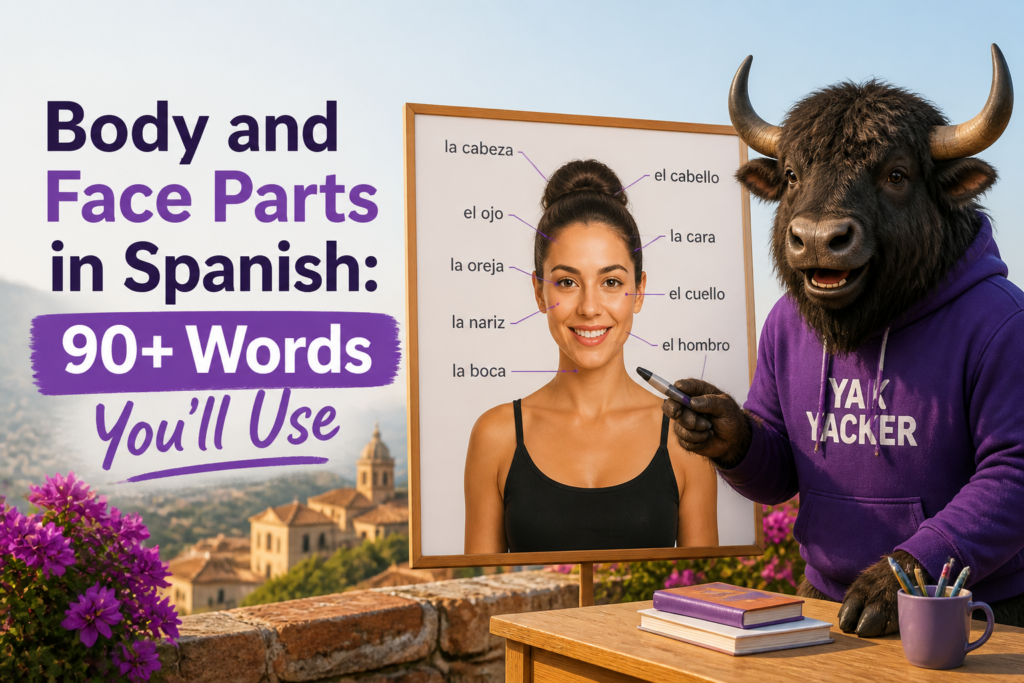
Learning body and face words in Spanish is one of those things that seems basic until you actually need it. Then suddenly you’re at a pharmacy, a doctor’s office, or trying to explain that your left shoulder is being dramatic again. Fun times.
For the broader learning path, visit our parent guide.
This guide gives you practical, everyday Spanish for body parts and face parts that real people actually use. You’ll also get pronunciation help, example sentences, and a few useful phrases for describing pain, appearance, and everyday conversations.
Most Spanish-speaking countries use standard, neutral vocabulary for these words, and that’s what we’ll focus on here. When a regional difference matters, we’ll point it out clearly instead of pretending every country says things exactly the same way. Spoiler: they don’t. Language is rude like that.
If you want to connect this topic with greetings and everyday check-ins, see How Are You in Spanish. For related practical vocabulary, you can also explore Body Care & Hygiene in Spanish, Actions & Gestures in Spanish, and Clothing & Accessories in Spanish.
For a boring but trustworthy reference, the Diccionario de la lengua española is always there, quietly doing its job like a grammar librarian with very strong opinions.
Essential Body Parts in Spanish
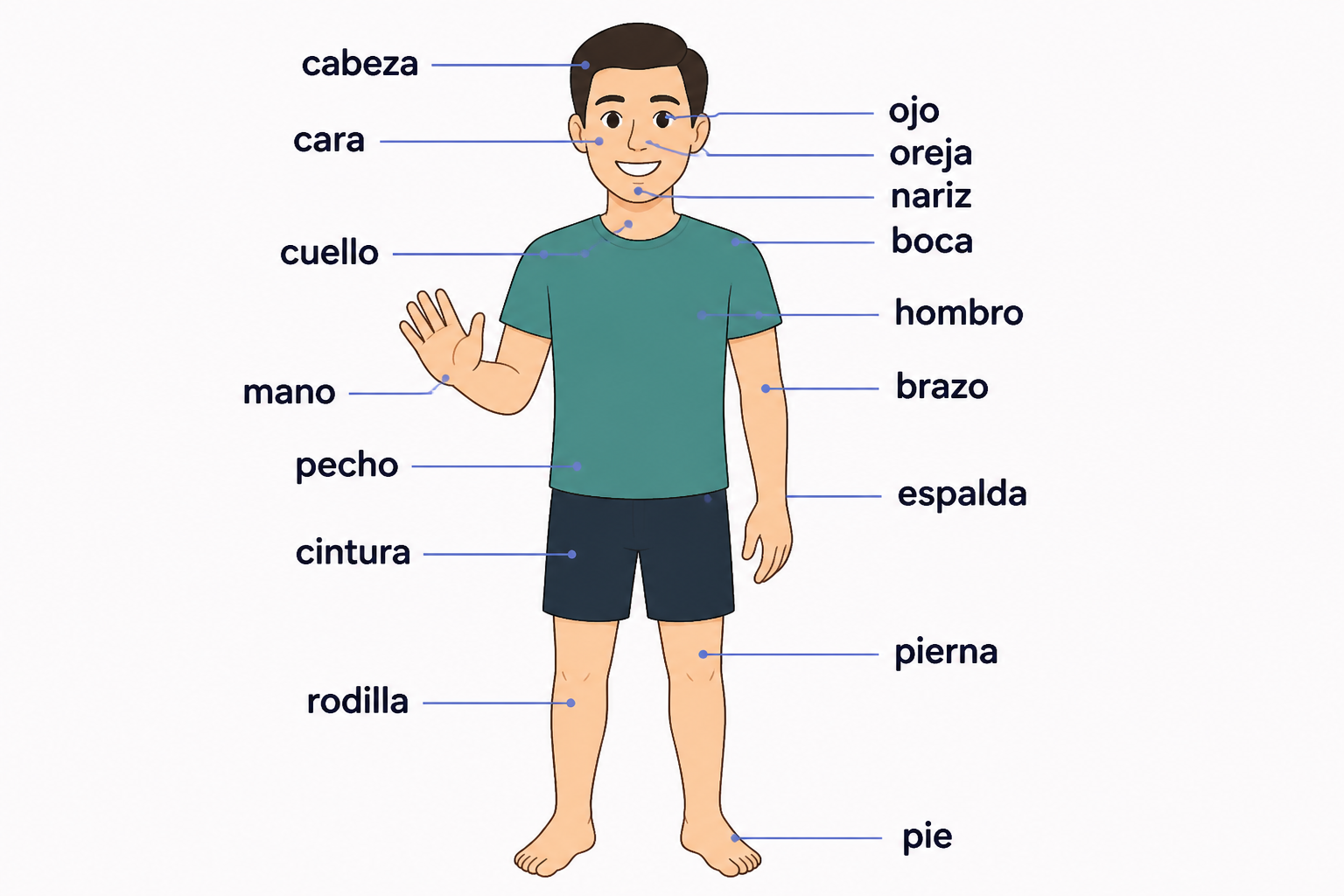
These are the body words you’ll hear and use constantly. A lot of them are masculine or feminine nouns, so notice the article too: el brazo, la mano, la pierna.
| Spanish | Pronunciation | Meaning | Example Sentence | Translation | Learner Note |
|---|---|---|---|---|---|
| la cabeza | kah-BEH-sah | head | Me duele la cabeza. | My head hurts. | Very common for pain and medical talk. |
| el cuello | KWYEH-yoh | neck | Tengo el cuello rígido. | My neck is stiff. | Cuello can also mean “collar” on clothing. |
| el hombro | OM-broh | shoulder | Me lastimé el hombro. | I hurt my shoulder. | The h is silent. |
| el brazo | BRAH-soh | arm | Levanta el brazo. | Raise your arm. | Use for one arm; brazos for both arms. |
| la mano | MAH-noh | hand | Lávate las manos. | Wash your hands. | Plural is las manos, not las manoes. Spanish is allergic to that kind of mistake. |
| el dedo | DEH-doh | finger / toe | Me corté el dedo. | I cut my finger. | In Spanish, dedo can mean finger or toe depending on context. |
| el pecho | PEH-choh | chest | Siento presión en el pecho. | I feel pressure in my chest. | Important in health situations. |
| la espalda | es-PAHL-dah | back | Me duele la espalda. | My back hurts. | Very useful in everyday complaints. |
| la cintura | seen-TOO-rah | waist | El cinturón me aprieta en la cintura. | The belt is tight at my waist. | Related to cinturón = belt. |
| la pierna | PYEHR-nah | leg | Se me durmió la pierna. | My leg fell asleep. | Common in casual conversation. |
| la rodilla | roh-DEE-yah | knee | Me doblé la rodilla. | I twisted my knee. | The double ll sounds like a soft “y” in most Latin American Spanish. |
| el tobillo | toh-BEE-yoh | ankle | Se hinchó el tobillo. | The ankle swelled up. | Useful for sports injuries. |
| el pie | pyeh | foot | Me duele el pie derecho. | My right foot hurts. | Plural: los pies. |
| los dedos de los pies | DEH-dohs deh los pyes | toes | Me pinté los dedos de los pies. | I painted my toenails. | Literally “toes” as “fingers of the feet.” |
| el estómago | es-TOH-mah-goh | stomach | Me cayó mal la comida y me duele el estómago. | The food didn’t sit well and my stomach hurts. | The h is silent in related forms too, but here there is no h. |
| la barriga | bah-REE-gah | belly, tummy | Me duele la barriga. | My tummy hurts. | More casual than estómago. Common in many countries. |
| el abdomen | ab-doh-MEN | abdomen | El doctor revisó el abdomen. | The doctor examined the abdomen. | More medical or formal. |
| la cadera | kah-DEH-rah | hip | Me duele la cadera. | My hip hurts. | Very common in medical conversations. |
| el codo | KOH-doh | elbow | Golpeé el codo contra la mesa. | I hit my elbow against the table. | A classic painful little life event. |
| la muñeca | moon-YEH-kah | wrist | Me torcí la muñeca. | I sprained my wrist. | Also means “doll,” so context matters. |
| la pantorrilla | pan-toh-REE-yah | calf | Me tiró la pantorrilla al correr. | I pulled my calf while running. | Useful for exercise and sports. |
| el talón | tah-LOHN | heel | Me rozó el talón el zapato. | The shoe rubbed my heel. | Often used when talking about shoes or pain. |
Quick pronunciation note: Spanish vowels stay clean and steady. So mano is “MAH-noh,” not “may-no” or “mah-noo.” The language does not appreciate vowel improvisation.
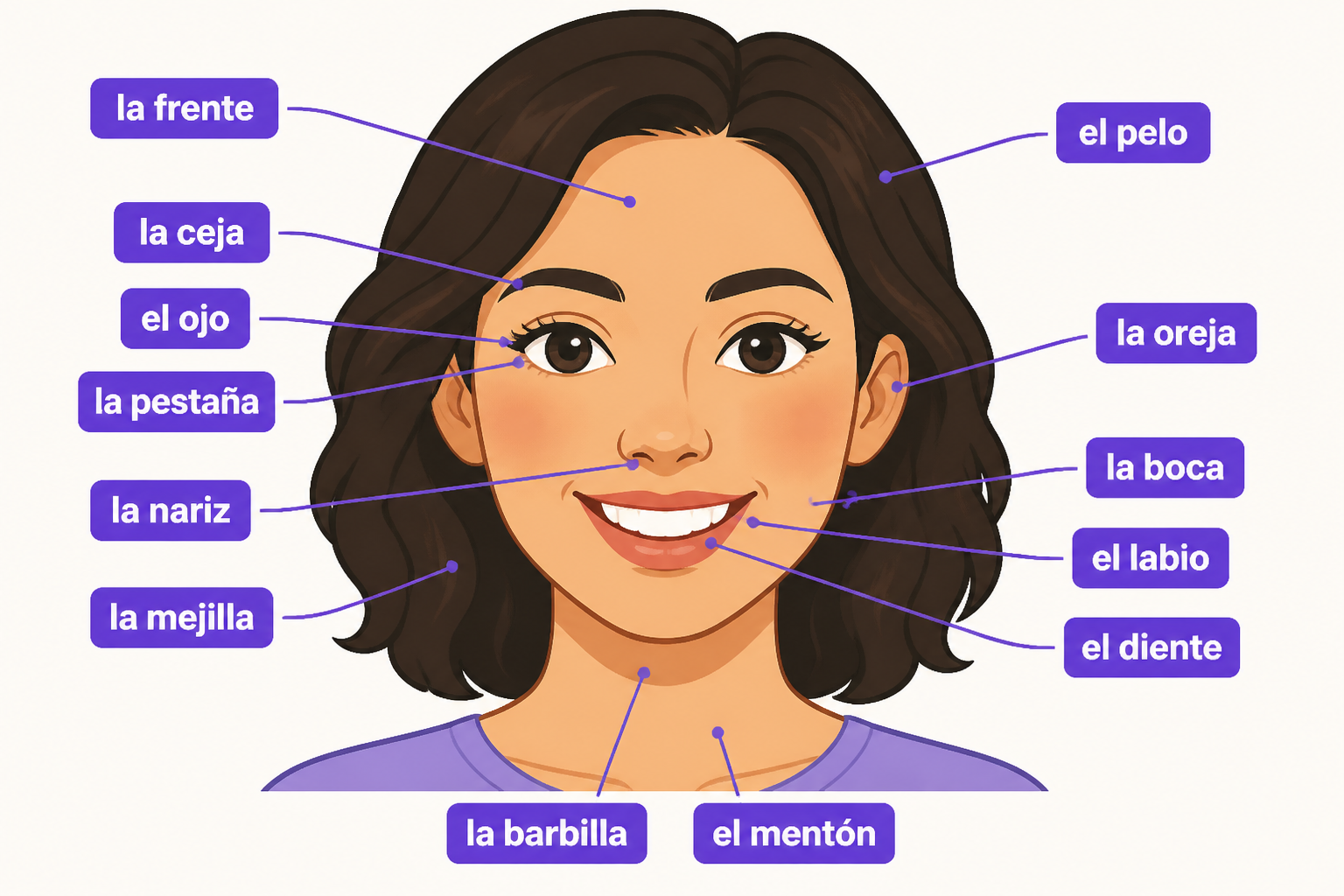
Face Parts in Spanish
Face vocabulary is especially useful for describing appearance, makeup, skin problems, pain, or someone’s expression. Also, yes, Spanish has a lot of face words. Your face is busy.
| Spanish | Pronunciation | Meaning | Example Sentence | Translation | Learner Note |
|---|---|---|---|---|---|
| la cara | KAH-rah | face | Tienes la cara roja. | Your face is red. | Very common, neutral, everyday word. |
| el rostro | ROHS-troh | face, countenance | El rostro del paciente estaba pálido. | The patient’s face was pale. | More formal, literary, or medical. |
| la frente | FREN-teh | forehead | Se golpeó la frente. | He hit his forehead. | The accent is not written, but stress stays on frente. |
| el ojo | OH-hoh | eye | Me pica el ojo izquierdo. | My left eye is itchy. | Plural: los ojos. |
| la ceja | SEH-hah | eyebrow | Me depilé las cejas. | I waxed my eyebrows. | The j sounds like a strong breathy “h.” |
| la pestaña | pes-TAH-nyah | eyelash | Se me cayó una pestaña. | An eyelash fell out. | Also means “tab” on a computer. |
| la nariz | nah-REES | nose | Se me tapó la nariz. | My nose got blocked. | Stress falls on the last syllable. |
| la mejilla | meh-HEE-yah | cheek | Le di un beso en la mejilla. | I gave her a kiss on the cheek. | Common in many greetings and family contexts. |
| la oreja | oh-REH-hah | ear | Me arde la oreja. | My ear burns. | Can also mean the outer ear. |
| el oído | oh-EE-doh | ear, hearing | Me duele el oído. | My ear hurts. | Often used for the inner ear or hearing. |
| la boca | BOH-kah | mouth | Cierra la boca. | Close your mouth. | Very common in instructions. |
| el labio | LAH-byoh | lip | Se me resecaron los labios. | My lips got dry. | Plural is common: los labios. |
| el diente | DYEN-teh | tooth | Me duele un diente. | A tooth hurts. | Plural: los dientes. |
| la lengua | LEHNG-gwah | tongue / language | Me mordí la lengua. | I bit my tongue. | Also means “language,” so context matters. |
| la mandíbula | man-DEE-boo-lah | jaw | Se me tensó la mandíbula. | My jaw tightened. | Useful in stress and medical contexts. |
| el mentón | men-TOHN | chin | Se tocó el mentón al pensar. | He touched his chin while thinking. | More formal than barbilla. |
| la barbilla | bar-BEE-yah | chin | Tiene barba en la barbilla. | He has a beard on his chin. | Very natural in everyday speech. |
| la piel | pyel | skin | Mi piel es sensible. | My skin is sensitive. | Important in beauty, health, and skincare talk. |
| el cuello | KWYEH-yoh | neck | Lleva una cadena en el cuello. | He wears a chain around his neck. | Also used for clothing and jewelry contexts. |
Notice a few tricky ones: ceja has a soft “h” sound for j, ll in many places sounds like “y,” and ñ in words like muñeca sounds like “ny” in canyon. Tiny letters, big personality.
Useful Descriptions For Pain, Injury, And Health
Body vocabulary becomes much more useful when you can build real sentences with it. These phrases help you explain what hurts, where, and how badly.
| Spanish | Pronunciation | Meaning | Example Sentence | Translation | Learner Note |
|---|---|---|---|---|---|
| Me duele… | meh DWEH-leh | It hurts… | Me duele la espalda. | My back hurts. | Use me duele for one thing; me duelen for plural things. |
| Me duelen… | meh DWEH-len | They hurt… | Me duelen los pies. | My feet hurt. | The verb agrees with plural nouns. |
| Me lastimé… | meh las-tee-MEH | I injured myself… | Me lastimé el hombro. | I injured my shoulder. | Very common in sports or accidents. |
| Me corté… | meh kor-TEH | I cut myself… | Me corté el dedo. | I cut my finger. | Reflexive form is natural here. |
| Se me torció… | seh meh tor-SYOH | I twisted… | Se me torció el tobillo. | I twisted my ankle. | Useful in everyday accident talk. |
| Se me hinchó… | seh meh een-CHOH | It swelled up… | Se me hinchó la rodilla. | My knee swelled up. | hinchar means swell. |
| Tengo fiebre. | TEN-goh FYEH-breh | I have a fever. | Tengo fiebre y dolor de cabeza. | I have a fever and a headache. | Very common medical phrase. |
| Tengo náuseas. | TEN-goh NOW-seh-ahs | I feel nauseous. | Tengo náuseas después de comer. | I feel nauseous after eating. | Plural noun in Spanish. |
| Me pica… | meh PEE-kah | It itches… | Me pica el ojo. | My eye itches. | Also used for a bug bite or rash. |
| Me arde… | meh AR-deh | It burns… | Me arde la garganta. | My throat burns. | Good for irritation or acid reflux-type discomfort. |
| Estoy mareado/a. | es-TOY mah-reh-AH-doh / -dah | I’m dizzy. | Estoy mareado después del viaje. | I’m dizzy after the trip. | Change ending by gender: mareado / mareada. |
| Estoy cansado/a. | es-TOY kan-SAH-doh / -dah | I’m tired. | Estoy cansada y me duele la espalda. | I’m tired and my back hurts. | Very common state with estar. |
| Estoy congestionado/a. | es-TOY con-jes-tee-oh-NAH-doh / -dah | I’m congested. | Estoy congestionado y no respiro bien. | I’m congested and I can’t breathe well. | Useful at the doctor’s office. |
| Me sangra la nariz. | meh SAN-grah lah nah-REES | My nose is bleeding. | Me sangra la nariz por el calor. | My nose is bleeding because of the heat. | Very practical emergency phrase. |
Small but important note: in Spanish, you often say me duele la cabeza rather than “yo tengo dolor de cabeza,” especially in everyday speech. Both work, but the first one sounds more natural and more immediately human.
Face And Body Words For Appearance
These words help you describe hair, skin, size, shape, and general appearance. They’re useful in daily conversation, shopping, hairstyling, and making observations without sounding like you’re reading a medical chart.
| Spanish | Pronunciation | Meaning | Example Sentence | Translation | Learner Note |
|---|---|---|---|---|---|
| el pelo | PEH-loh | hair | Tiene el pelo largo. | He has long hair. | Very common in Latin America. |
| el cabello | kah-BYEH-yoh | hair | Se cortó el cabello. | She cut her hair. | Often more formal or more common in some regions; both pelo and cabello are correct. |
| la barba | BAR-bah | beard | Lleva barba desde hace años. | He has worn a beard for years. | Can also refer to facial hair generally. |
| el bigote | bee-GOH-teh | mustache | Se dejó bigote. | He grew a mustache. | Watch the stress: bi-GO-te. |
| la calva | KAL-vah | bald spot / bald head | Se le nota la calva. | You can see his bald spot. | Can sound direct; use carefully. | More Spanish to explore