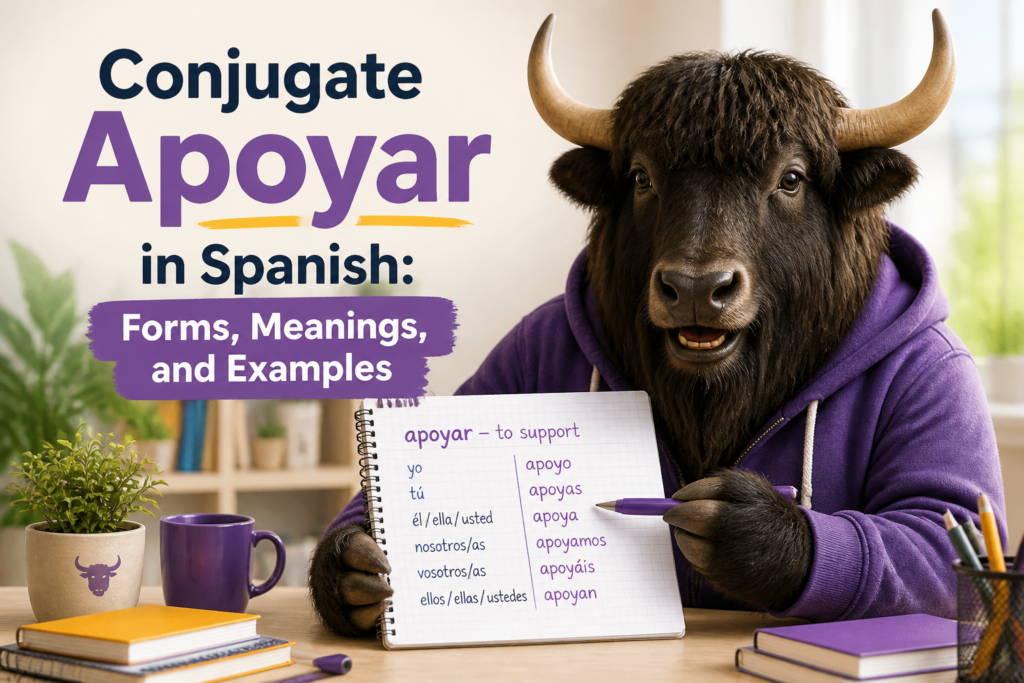
Apoyar is one of those Spanish verbs that looks friendly, behaves mostly normally, and then casually slips in a spelling change when you least want it to. Charming. It means to support, to back, to help, or to lean on, depending on the context.
By the end of this guide, you’ll know how to conjugate apoyar in the most useful tenses, how to use it in real sentences, and when it means emotional support versus physical leaning. You’ll also see why yo apoyo is correct, but yo apio would be a very bad idea.
If you want a broader look at related verbs, you can also compare this with agregar, consultar, confirmar, and guardar.
What Apoyar Means
Apoyar has two main meanings in everyday Spanish:
- To support / back / help someone, an idea, a team, or a cause.
- To lean on / rest on something physically.
In most learner situations, you’ll hear it as support:
| Spanish | Pronunciation | Meaning | Example Sentence | Translation | Learner Note |
|---|---|---|---|---|---|
| apoyar | ah-poh-YAR | to support, back, lean on | Apoyo tu idea porque me parece buena. | I support your idea because it seems good to me. | Very common in conversations, work, and politics. |
| apoyarse | ah-poh-YAR-seh | to lean on, rest on oneself | Ella se apoya en la pared. | She leans on the wall. | Reflexive form is common for physical leaning. |
For a useful dictionary reference, the Real Academia Española gives the standard meanings. Boring? Yes. Useful? Also yes.
Quick Pronunciation Guide
Apoyar is pronounced ah-poh-YAR. The stress falls on the last syllable: -yar.
- a = “ah”
- po = “poh”
- yar = “yahr”
The letter y sounds like a soft English y in yes. Nothing dramatic. Spanish is refreshingly not trying to sabotage your throat here.
Because apoyar ends in -ar, it follows the regular -ar verb pattern, with one important spelling twist in some forms: yo apoyo, tú apoyas, él apoya. The y stays to protect the sound.
Present Tense Conjugation of Apoyar
Here’s the present tense, the form you’ll use most often in daily conversation.
| Subject | Spanish | Pronunciation | Meaning | Example Sentence | Translation | Learner Note |
|---|---|---|---|---|---|---|
| yo | apoyo | ah-POH-yoh | I support | Apoyo a mi hermana en su decisión. | I support my sister in her decision. | Notice the spelling change: not apayo. |
| tú | apoyas | ah-POH-yahs | you support | ¿Tú apoyas este plan? | Do you support this plan? | Very common in neutral conversation. |
| él / ella / usted | apoya | ah-POH-yah | he / she / you support(s) | La empresa apoya el proyecto. | The company supports the project. | Usted takes the same form as él/ella. |
| nosotros / nosotras | apoyamos | ah-poh-YAH-mos | we support | Apoyamos la iniciativa. | We support the initiative. | No spelling change here. |
| vosotros / vosotras | apoyáis | ah-poh-YAH-ees | you all support | ¿Apoyáis la propuesta? | Do you all support the proposal? | Mostly Spain Spanish. |
| ellos / ellas / ustedes | apoyan | ah-POH-yahn | they / you all support | Ellos apoyan la campaña. | They support the campaign. | Ustedes uses this form in Latin America and many parts of Spain. |
Rule: verbs ending in -iar often have a spelling change in the present tense when the stress lands on the stem, so apoyar becomes apoyo, apoyas, apoya, apoyan. That little y is there to keep pronunciation smooth.
Yak wisdom: If the verb looks simple and friendly, Spanish may still sneak in one tiny spelling change. Just enough to keep you humble.
Conjugation Table: Main Tenses
These are the forms you’ll see most often in real life. Not every tense in the universe, because nobody needs to marry a verb chart on the first date.
| Tense | yo | tú | él / ella / usted | nosotros | ellos / ustedes |
|---|---|---|---|---|---|
| Present | apoyo | apoyas | apoya | apoyamos | apoyan |
| Preterite | apoyé | apoyaste | apoyó | apoyamos | apoyaron |
| Imperfect | apoyaba | apoyabas | apoyaba | apoyábamos | apoyaban |
| Future | apoyaré | apoyarás | apoyará | apoyaremos | apoyarán |
| Conditional | apoyaría | apoyarías | apoyaría | apoyaríamos | apoyarían |
Learner note: the preterite is for completed actions in the past. The imperfect is for repeated actions, background situations, or “used to” meanings.
How To Use Apoyar In Real Life
In conversation, apoyar often shows agreement, encouragement, or practical help.
- Apoyo tu idea. — I support your idea.
- ¿Me apoyas? — Will you back me / help me?
- La familia lo apoya. — The family supports him.
- Apoyamos esta causa. — We support this cause.
- Ella apoyó el proyecto. — She supported the project.
- El gobierno apoya la educación. — The government supports education.
- Los vecinos apoyaron la iniciativa. — The neighbors supported the initiative.
- Siempre te apoyaré. — I will always support you.
- Te apoyo completamente. — I support you completely.
- No apoyo esa decisión. — I don’t support that decision.
Notice how often Spanish drops the subject pronoun. Instead of saying yo apoyo, native speakers usually just say apoyo. The verb already tells you who’s doing it. Efficient, unlike my printer.
Past Tenses: Preterite and Imperfect
These two past tenses are especially useful with apoyar.
| Pattern | Meaning | Spanish Example | English Translation | Learner Note |
|---|---|---|---|---|
| apoyé | I supported, I backed | Ayer apoyé su propuesta. | Yesterday I supported his proposal. | Single completed action. |
| apoyaba | I used to support, I was supporting | Cuando vivía allí, siempre apoyaba a mi equipo. | When I lived there, I always supported my team. | Repeated or ongoing past habit. |
| apoyaron | they supported | Mis amigos me apoyaron mucho. | My friends supported me a lot. | Very common in personal stories. |
| apoyábamos | we used to support | Antes apoyábamos esa idea. | We used to support that idea. | Background or repeated past action. |
Rule: use apoyé for a finished event. Use apoyaba for habits, repeated actions, or background context.
Future And Conditional Forms
The future and conditional are regular and easy with apoyar. Spanish is being generous for once.
| Form | Spanish | Meaning | Example Sentence | Translation | Learner Note |
|---|---|---|---|---|---|
| Future | apoyaré | I will support | Apoyaré tu decisión. | I will support your decision. | Use for future plans or promises. |
| Future | apoyarán | they will support | Los expertos apoyarán la medida. | The experts will support the measure. | Common in formal news language. |
| Conditional | apoyaría | I would support | Yo apoyaría esa idea, pero necesito más información. | I would support that idea, but I need more information. | Useful for polite opinions. |
| Conditional | apoyaríamos | we would support | Apoyaríamos el plan si fuera más claro. | We would support the plan if it were clearer. | Great for hypothetical situations. |
Reflexive Form: Apoyarse
Sometimes apoyar becomes apoyarse. This reflexive form usually means to lean on or to rest against something.
Examples:
- Me apoyo en la mesa. — I lean on the table.
- Se apoya contra la pared. — He/she leans against the wall.
- Nos apoyamos en la barandilla. — We lean on the railing.
- Apóyate aquí. — Lean here / Rest here.
Learner note: the reflexive pronoun changes with the subject: me, te, se, nos, os, se. If you’re talking about physical leaning, apoyarse is often the form you want.
Common Grammar Patterns With Apoyar
Here are the patterns you’ll meet again and again.
| Pattern | Meaning | Spanish Example | English Translation | Learner Note |
|---|---|---|---|---|
| apoyar a + person | to support someone | Apoyo a mi madre. | I support my mother. | The a personal often appears before people. |
| apoyar + idea / plan / causa | to support an idea or cause | Apoyamos la propuesta. | We support the proposal. | Common in work, politics, and debates. |
| apoyarse en + thing/person | to lean on | Se apoya en la mesa. | She leans on the table. | Usually physical support. |
| apoyar en | to support with help or assistance | Te apoyo en tu trabajo. | I support you in your work. | Can sound more like “help you with.” |
Spanish prepositions matter here. Apoyar a alguien and apoyar algo are both common, but the structure changes with the object and meaning. Tiny prepositions, enormous chaos. Classic.
Useful Example Sentences
| Spanish | Pronunciation | Meaning | Example Sentence | Translation | Learner Note |
|---|---|---|---|---|---|
| Apoyo tu opinión. | ah-POH-yoh tooh oh-pee-NYON | I support your opinion. | Apoyo tu opinión porque tiene sentido. | I support your opinion because it makes sense. | Neutral, very useful in discussion. |
| ¿Me apoyas? | meh ah-POH-yahs | Do you support me? | ¿Me apoyas en esta decisión? | Do you support me in this decision? | Common in personal and emotional contexts. |
| Siempre te apoyaré. | SYM-preh teh ah-poh-yah-RÉ | I will always support you. | Siempre te apoyaré, pase lo que pase. | I will always support you, no matter what happens. | Warm and reassuring. |
| La comunidad apoya el proyecto. | lah koh-moo-nee-DAHD ah-POH-yah el proh-YEK-toh | The community supports the project. | La comunidad apoya el proyecto desde el inicio. | The community has supported the project from the beginning. | Useful in formal and civic contexts. |
| Apóyate en mí. | ah-POH-yah-teh en mee | Lean on me / rely on me. | Apóyate en mí si lo necesitas. | Lean on me if you need it. | Friendly and emotional. |
| No lo apoyo. | noh loh ah-POH-yoh | I don’t support it. | No lo apoyo por esas razones. | I don’t support it for those reasons. | Good for disagreement. |
Common Mistakes And Fixes
| Mistake | Why It’s Wrong | Correct Form | Example | Translation |
|---|---|---|---|---|
| yo apayo | The spelling change is wrong. The y stays. | yo apoyo | Yo apoyo esa idea. | I support that idea. |
| apoyar a idea | Needs an article or a different structure. | apoyar la idea | Apoyo la idea. | I support the idea. |
| apoyarme en el idea | Idea is feminine, so use la. | apoyarme en la idea | Me apoyo en la idea del profesor. | I rely on the teacher’s idea. |
| apoya a mí | Use me, not a mí, for the direct object in this meaning. | me apoya | Mi familia me apoya. | My family supports me. |
| apoyé for “I used to support” | That is completed past, not habitual past. | apoyaba | Cuando era joven, apoyaba ese movimiento. | When I was young, I used to support that movement. |
Learner note: In Spanish, direct object pronouns like me, te, lo, la are very common with verbs like apoyar. So me apoyas usually sounds better than repeating the person’s name over and over. Less robotic, more human.
Practice Section
Try these quick drills. No need to panic. Just answer, check, and move on like a civilized language learner.
| Exercise | Prompt | Answer | Note |
|---|---|---|---|
| 1 | Conjugate for yo in present tense: yo ____ | apoyo | Spelling change happens here. |
| 2 | Translate: “We support the proposal.” | Apoyamos la propuesta. | Use present tense. |
| 3 | Choose the correct past form: “Yesterday I supported her.” | Ayer la apoyé. | Completed action = preterite. |
| 4 | Choose the correct meaning: apoyarse | to lean on / rest on | Reflexive form. |
| 5 | Translate: “I would support you.” | Te apoyaría. | Conditional for polite or hypothetical situations. |
| 6 | Fill in the blank: Ella se ____ en la pared. | apoya | Reflexive present form. |
Swap practice: change yo to él, nosotros, and ustedes.
- Yo apoyo la idea. → Él apoya la idea.
- Yo apoyo la idea. → Nosotros apoyamos la idea.
- Yo apoyo la idea. → Ustedes apoyan la idea.
Pronunciation practice: say these aloud slowly:
- apoyo — ah-POH-yoh
- apoya — ah-POH-yah
- apoyamos — ah-poh-YAH-mos
- apoyaron — ah-poh-YAH-rohn
Regional Notes And Usage
Apoyar is standard across the Spanish-speaking world. You’ll hear it in Latin America, Spain, and everywhere Spanish people have strong opinions about absolutely everything.
The main regional difference is not the verb itself, but the pronouns around it:
- Latin America: ustedes apoyan for plural “you support.”
- Spain: vosotros apoyáis is common in informal speech.
- Both: ustedes apoyan works in many parts of Spain too, especially in formal settings.
If you’re learning standard international Spanish, focus on apoyo, apoyas, apoya, apoyamos, apoyan. That set will carry you very far without drama.
Quick Reference Summary
- Apoyar = to support, back, help, or lean on.
- Present tense: apoyo, apoyas, apoya, apoyamos, apoyan.
- Reflexive form apoyarse = to lean on.
- Preterite: apoyé, apoyaste, apoyó, apoyamos, apoyaron.
- Imperfect: apoyaba, apoyabas, apoyaba, apoyábamos, apoyaban.
- Future: apoyaré, apoyarás, apoyará, apoyaremos, apoyarán.
- Conditional: apoyaría, apoyarías, apoyaría, apoyaríamos, apoyarían.
- Use apoyo a + person or apoyo + idea/cause depending on meaning.
- Watch the spelling: yo apoyo, not yo apayo.
For more grammar and verb patterns, the Yak Yacker Spanish hub is a tidy place to keep digging without getting buried in conjugation dust.
Yak Takeaway: Apoyar is a very useful regular -ar verb with one tiny spelling twist in the present tense. Learn the core forms, use apoyar for support and apoyarse for leaning, and you’ll be able to talk about opinions, help, and actual walls like a pro.