This A2 Elementary retelling of The Cowherd and the Weaver Girl keeps the plot clear for learners while still giving the story some atmosphere and momentum.
This version teaches Simplified Chinese through English and includes clickable word help inside the story, full story audio, and lesson notes after the reading. It is free to use on Yak Yacker and is designed to feel natural, readable, and manageable for learners.
很久很久以前,有一个年轻人叫牛郎。他和一头老牛一起生活。牛郎很善良,老牛是他的好朋友。
一天,老牛突然说话了:"牛郎,明天去河边。有七个仙女在洗澡。你拿走,那个仙女会成为你的妻子。" 牛郎很惊讶,但听了老牛的话。
第二天,牛郎在河边看到了仙女。他拿走了。仙女找不到衣服,很着急。牛郎对她说:"如果你做我的妻子,我就把衣服还给你。" 仙女笑了,她叫。他们,生活很幸福。后来有了两个孩子。
但是,天上的知道了。她很生气:"织女是仙女,不能和凡人一起!" 她带走了织女。牛郎带着孩子,穿上老牛的皮去追织女。
牛郎快要。王母娘娘用在天空画了一条大河。牛郎过不去,织女在那一边哭。这就是。
喜鹊们很他们。每年七月初七,很多喜鹊飞来,用身体一座桥。牛郎和织女在桥上见面。
即使只能一年见一次,他们的爱永远不变。今夜,如果你看,也许能听到他们的笑声。
Long, long ago, there was a young man named Cowherd. He lived with an old ox. Cowherd was kind-hearted, and the old ox was his good friend.
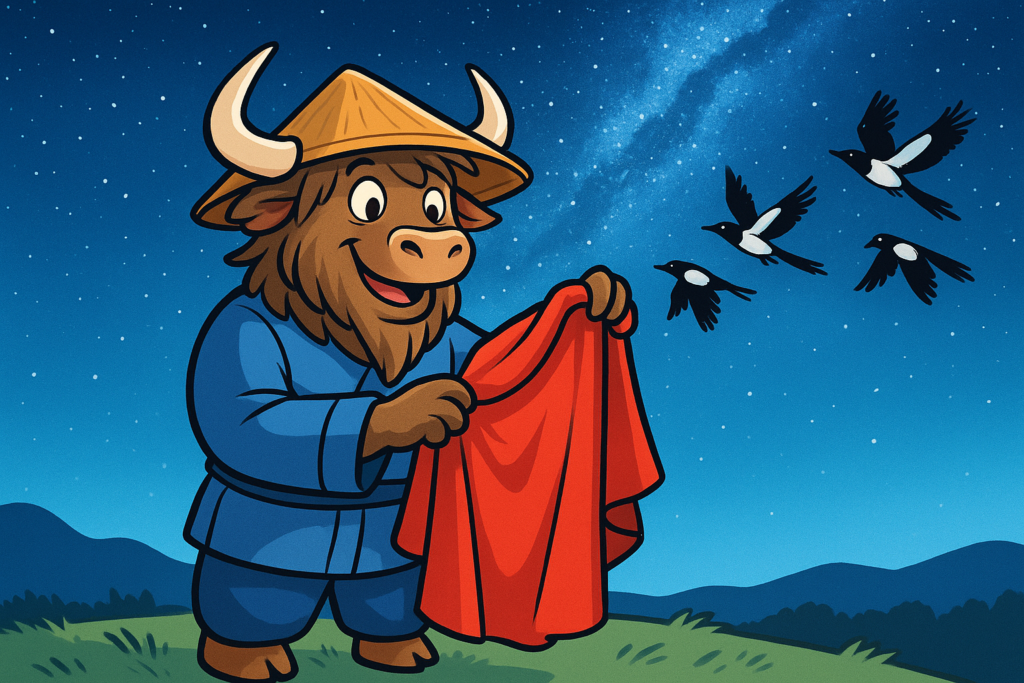
One day, the old ox suddenly spoke: "Cowherd, go to the river tomorrow. There will be seven fairies bathing. Take the red clothes, and that fairy will become your wife." Cowherd was surprised but listened to the ox.
The next day, Cowherd saw the fairies by the river. He took the red clothes. The fairy couldn't find her clothes and was very anxious. Cowherd said to her, "If you become my wife, I will return your clothes." The fairy smiled. Her name was Weaver Girl. They got married and lived happily. Later, they had two children.
But the Heavenly Queen Mother found out. She was furious: "Weaver Girl is a fairy, she cannot be with a mortal!" She took Weaver Girl away. Cowherd, carrying the children and wearing the ox's hide, flew up to chase Weaver Girl.
Cowherd was about to catch up. The Queen Mother drew a great river in the sky with her hairpin. Cowherd couldn't cross, and Weaver Girl cried on the other side. This is the Milky Way.
The magpies sympathized with them. Every year on the seventh day of the seventh lunar month, many magpies fly and form a bridge with their bodies. Cowherd and Weaver Girl meet on the bridge.
Even though they can only meet once a year, their love never changes. Tonight, if you look at the night sky, you might hear their laughter.
This classic love story introduces several important words. Let's get to know the main characters and objects you'll meet again in Chinese tales.
Here are the keywords from the story, with pinyin and simple meanings to help you remember them.
- 牛郎 (niúláng) - Cowherd
- 织女 (zhīnǚ) - Weaver Girl
- 老牛 (lǎo niú) - old ox
- 仙女 (xiānnǚ) - fairy / celestial maiden
- 银河 (yínhé) - Milky Way (literally "Silver River")
- 喜鹊 (xǐquè) - magpie (the bird that builds the bridge)
Notice how the story uses 突然 (tūrán, "suddenly") when the old ox speaks. In Chinese, time adverbs often come right before the verb, just like in "老牛突然说话了" (The old ox suddenly spoke).
You can use 突然 for any unexpected event. Other useful time words in the story are 快要 (kuàiyào, "about to") and 也许 (yěxǔ, "perhaps"), which add suspense and soften statements.
- 突然 (tūrán) + verb: 他突然哭了。(He suddenly cried.)
- 快要 (kuàiyào) + verb/adjective: 我们快要到了。(We're almost there.)
- 也许 (yěxǔ) at the beginning of a sentence: 也许他是对的。(Perhaps he is right.)
The story uses 如果…就… (rúguǒ… jiù…) to express a condition: "如果你做我的妻子,我就把衣服还给你" (If you become my wife, I will return your clothes). This pattern is very common in daily Chinese.
Structure: 如果 + condition, 就 + result. The "就" links the condition to its outcome. You can drop "如果" in casual speech, but keep "就".
- 如果明天下雨,我们就不去公园。(If it rains tomorrow, we won't go to the park.)
- 你如果累了,就休息一下。(If you are tired, just rest a bit.)
- 不喜欢的话,就可以不吃。(If you don't like it, you can just not eat it - casual, "如果" omitted.)
Now that you've learned the keywords and patterns, try retelling the story to a friend. Use 突然 to add drama and 如果…就 to explain why the cowherd took the clothes!
This tale is celebrated every year on Qixi Festival (七夕节, the seventh day of the seventh lunar month). Look up "七夕" online and you'll find even more romantic vocabulary to explore.
- Challenge: Write three sentences about the story using 突然, 如果, and 也许.
- Next step: Search for "牛郎织女 story" in Chinese for a version with fewer new words.
- Cultural note: On Qixi, people pray for love and skill, just like the Weaver Girl's talent.
The Cowherd and the Weaver Girl comes from the Chinese / legend tradition and is best known as a romantic legend. This Yak Yacker article is an original learner retelling based on Traditional Qixi legend; public domain, so the wording here is simplified for modern learners rather than copied from one old edition.
Older printings, translations, and retellings of this story can vary quite a bit. The original audience was usually general/kids, but this version is adapted for A2 Elementary learners studying Simplified Chinese. Sad romantic myth; keep simple for A2.
If you want to look into the source tradition, start with Wikipedia.
If you want to keep going, browse more in our Simplified Chinese section and review the HSK Level 2 Chinese Vocabulary. After that, try Essential Chinese Grammar Words for another useful next step.
More Simplified Chinese to explore
The Legend of the White Snake: B1 Intermediate Simplified Chinese Story with Audio
Learn Chinese with ‘Waiting by a Tree Stump’: A1 Beginner Story, Audio & Lesson
The Battle of Red Cliffs: B1 Intermediate Simplified Chinese Story with Audio