This B1 Intermediate retelling of 赤壁之战 keeps the plot clear for learners while still giving the story some atmosphere and momentum.
This version teaches Simplified Chinese through English and includes clickable word help inside the story, full story audio, and lesson notes after the reading. It is free to use on Yak Yacker and is designed to feel natural, readable, and manageable for learners.
公元208年,的曹操率领
他站在船上,望着的长江,脸上带着的微笑。"只要江南,天下就是我的了。"
此时,南方的孙权和刘备都感到了
刘备刚刚在长坂坡被,军队。他对诸葛亮说:"我们该怎么办?"
诸葛亮轻轻摇着扇子,说:"我有一个。我去江东孙权,对抗曹操。"
诸葛亮来到孙权的,大臣们正在
诸葛亮微笑着对孙权说:"曹操,士兵,又水战。如果你我,必胜无疑。"
孙权沉默了。他看了看手中父亲的宝剑,然后猛地站起来。"好,我们联合!"
孙权的部下周瑜是一位将军。他站在江边,思考着。"曹操的船只用连在一起……如果放火……"
老将黄盖主动说:"我愿意假装投降,靠近曹军,然后点火!"
夜晚,东南风起。黄盖的船满载着和,悄悄驶向曹军。
曹兵大喊:"黄盖来投降了!"话还没说完,火船突然,撞进了曹操的船队。
大火一下子了江面。曹操的船只被锁住,无法,火焰迅速。
喊声、哭声、风声响成一片。曹操在中逃命,脸上满是。
他回头望着的长江,低声说:"我从未想到会这样……"
赤壁之战后,的局面渐渐形成。长江的水依旧,诉说着那个英雄与烈火的时代。
In 208 AD, Cao Cao of the north led a large army southward.
He stood on a ship, gazing at the vast Yangtze River, a confident smile on his face. "Once I take Jiangnan, the world will be mine."
At that time, Sun Quan and Liu Bei in the south both felt a huge threat.
Liu Bei had just been defeated at Changban Slope, his army exhausted. He said to Zhuge Liang, "What should we do?"
Zhuge Liang gently fanned himself and said, "I have a plan. I will go to Jiangdong to persuade Sun Quan to resist Cao Cao together."
Zhuge Liang arrived at Sun Quan's palace, where ministers were arguing whether to fight or surrender.
Zhuge Liang smiled at Sun Quan and said, "Cao Cao has come a long way, his soldiers are tired, and they are not skilled in naval warfare. If we join forces, victory is certain."
Sun Quan was silent. He looked at his father's sword in his hand, then suddenly stood up. "Good! We will unite!"
Sun Quan's subordinate Zhou Yu was an outstanding general. He stood by the river, pondering tactics. "Cao Cao's ships are chained together... If we use fire..."
Veteran general Huang Gai volunteered, "I am willing to pretend to surrender, get close to Cao's army, then set fire!"
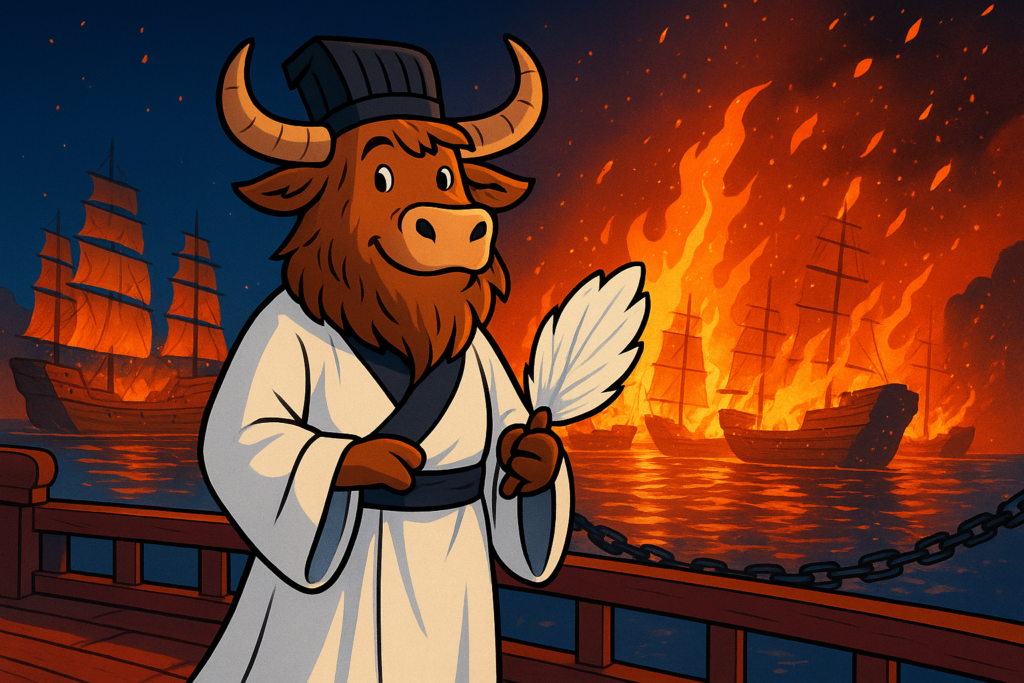
At night, a southeast wind rose. Huang Gai's ships, loaded with dry grass and oil, quietly sailed toward Cao's naval camp.
Cao's soldiers shouted, "Huang Gai has come to surrender!" Before they finished speaking, dozens of fire ships suddenly ignited and crashed into Cao's fleet.
The fire instantly engulfed the river. Cao Cao's ships were locked with iron chains and could not separate; the flames spread rapidly.
Shouts, cries, and the sound of wind merged. Cao Cao fled in panic through the smoke, his face covered in ash.
He looked back at the burning Yangtze and murmured, "I never imagined it would come to this..."
After the Battle of Red Cliffs, the situation of the Three Kingdoms gradually took shape. The waters of the Yangtze still flow, telling the tale of that era of heroes and fire.
Let's pick out some vivid words from the battle. These will help you talk about history, strategy, and dramatic events.
Each word is given in Simplified Chinese with pinyin and a short note. Try reading the example sentences aloud.
- 率领 (shuài lǐng) - to lead (an army or group). Example: 曹操率领大军南下。Cao Cao led his great army south.
- 辽阔 (liáo kuò) - vast, wide. Used for landscapes. Example: 他望着辽阔的长江。He gazed at the vast Yangtze River.
- 威胁 (wēi xié) - threat, to threaten. Example: 刘备和孙权感到了巨大的威胁。Liu Bei and Sun Quan felt a huge threat.
- 疲惫不堪 (pí bèi bù kān) - exhausted, worn out. A four-character phrase. Example: 刘备的军队疲惫不堪。Liu Bei's troops were exhausted.
In the story, Cao Cao says: "只要拿下江南,天下就是我的了。" Here, 只要…就… means "as long as… then…". It expresses a condition that, if met, guarantees a result.
Compare with 如果…就… ("if… then…"), which is more neutral and hypothetical. For example: "如果你我联手,必胜无疑。" (If you and I join hands, victory is certain.)
- 只要 (zhǐ yào) = as long as / provided that - the condition is enough to make the result happen.
- 如果 (rú guǒ) = if - a simple conditional, often used with 就 (jiù) in the second part.
- In speech, 如果 can be followed by 的话 (de huà) for extra emphasis: 如果你同意的话, … (If you agree, …).
The story uses strong visual language. For example, "大火一下子吞没了江面" (The fire suddenly swallowed up the river surface) - the verb 吞没 (tūn mò) literally means "to swallow," making the fire feel alive.
Another gem is "他脸上带着自信的微笑" (He wore a confident smile on his face). Notice 带着…微笑 (to carry/wear a smile) - a more literary way to describe facial expressions.
- 吞没 (tūn mò) - to swallow, engulf. Often used for fire, water, or darkness.
- 带着…微笑 - "to wear a … smile"; a nice alternative to 笑着.
- 低声说 (dī shēng shuō) - "to say in a low voice"; adds atmosphere. Try using it in storytelling.
Now that you've explored the language, try retelling the Battle of Red Cliffs in your own words. Use at least three new vocabulary items and one conditional structure.
You could work with a partner, record yourself, or even write a short diary entry from the perspective of Cao Cao or Zhou Yu. The key is to make the story yours!
- Pick 5-8 keywords from the vocabulary list and build sentences around them.
- Practice saying "只要…就…" and "如果…就…" sentences out loud.
- For extra fun, find a movie clip about 赤壁之战 and listen for the words you now know.
赤壁之战 comes from the Chinese / Romance of Three Kingdoms tradition and is best known as a historical novel episode. This Yak Yacker article is an original learner retelling based on Romance of the Three Kingdoms; public domain, so the wording here is simplified for modern learners rather than copied from one old edition.
Older printings, translations, and retellings of this story can vary quite a bit. The original audience was usually general/adult, but this version is adapted for B1 Intermediate learners studying Simplified Chinese. War story; use clean strategic retelling.
If you want to look into the source tradition, start with Project Gutenberg.
If you want to keep going, browse more in our Simplified Chinese section and review the HSK Level 1 Chinese Vocabulary. After that, try 1,000 Chinese Phrases and Expressions for another useful next step.
More Simplified Chinese to explore
Learn Chinese with ‘Waiting by a Tree Stump’: A1 Beginner Story, Audio & Lesson
The Oath of the Peach Garden: A Sworn Brotherhood Tale with Audio for Intermediate Chinese Learners
Nezha Conquers the Dragon King – An A2 Elementary Chinese Graded Reader with Audio & Word Help