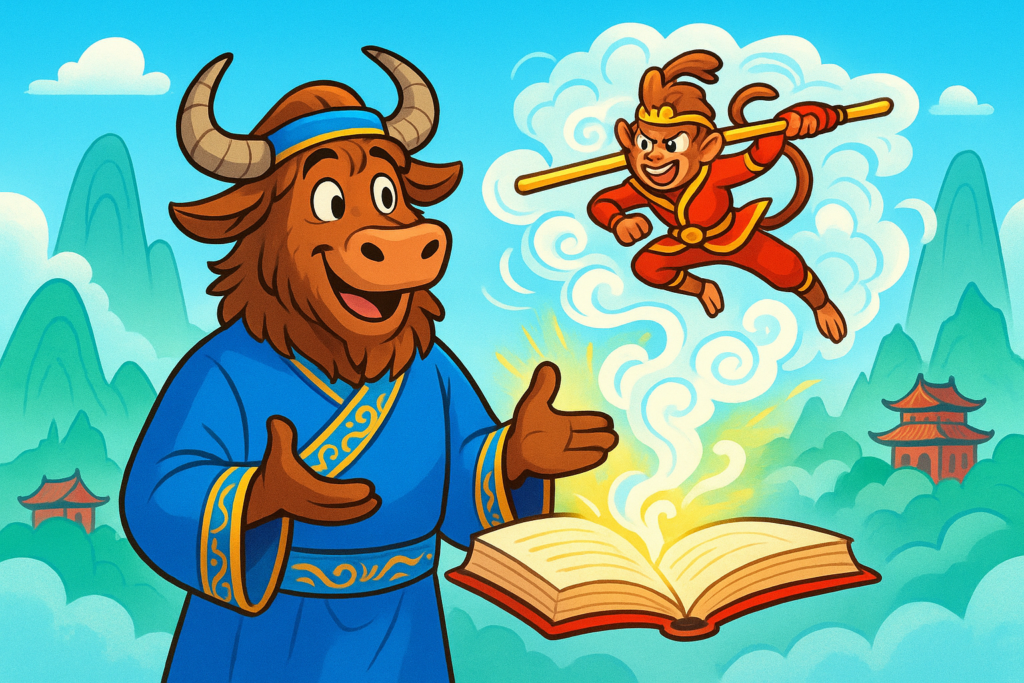
Meet the Monkey King, Sun Wukong-a mischievous yet powerful immortal who wreaks havoc in heaven before joining the monk Xuanzang on a perilous pilgrimage to India for sacred Buddhist scriptures. Along the way, you'll encounter the gluttonous Pigsy, the loyal Sandy, and a host of demons, monsters, and divine tests that challenge their quest. This beloved classic is packed with magic, humor, and timeless adventure.
This B1 intermediate graded reader brings Journey to the West to life in simplified Chinese, designed for learners ready to tackle longer narratives. Tap any word for an instant English translation, listen to the story audio to perfect your pronunciation, and explore free lesson notes for grammar tips and cultural insights. Enjoy a free, interactive reading experience that turns one of China's greatest novels into your personal language classroom.
在很久很久以前,东胜神洲的海边有一块仙石。这块石头吸收日月精华,有一天突然裂开,跳出一只石猴。
他很快学会了走路和说话,和山里的猴子们成了朋友。
瀑布后面有一个山洞,洞里有石锅、石碗,还有一块石碑,上面刻着"花果山福地,水帘洞洞天"。猴子们高兴极了,都拜石猴为王。从此,他自称美猴王。
This story is packed with names, titles, and objects that are central to the Journey to the West universe. Learning them will not only help you follow the tale but also unlock a world of Chinese mythology.
Many terms are combinations of characters you might already know, like 美 (měi, beautiful) + 猴 (hóu, monkey) = 美猴王 (Měi Hóu Wáng, Handsome Monkey King). Pay attention to how new words are built!
- 石猴 (shí hóu) - stone monkey (the very first form of Sun Wukong)
- 齐天大圣 (Qí Tiān Dà Shèng) - Great Sage Equal to Heaven (his self-proclaimed title)
- 金箍棒 (jīn gū bàng) - golden-banded staff (his magical weapon that changes size)
- 筋斗云 (jīn dǒu yún) - somersault cloud (lets him travel 108,000 li in one leap)
- 七十二变 (qī shí èr biàn) - 72 transformations (shape-shifting skill)
- 紧箍咒 (jǐn gū zhòu) - the tightening-band spell (used by the monk to control Monkey)
- 长生不老 (cháng shēng bù lǎo) - immortality (literally 'long life, no aging')
Chinese often adds a result or direction after a verb to show what happened - these are called complements. They make descriptions vivid and precise, like watching a movie. For example, 跳进 (tiào jìn) means 'jump into,' combining the verb 'jump' with the result 'in.'
You'll see this pattern everywhere in the story: 跳出来 (tiào chūlái) - 'jump out,' 看见 (kànjiàn) - 'see' (literally 'look and perceive'), 打翻 (dǎ fān) - 'knock over,' and 救出 (jiù chū) - 'rescue out.' The structure 学得飞快 (xué de fēikuài) - 'learned incredibly fast' - uses 得 to link the verb and the result 'fast.'
- Verb + 进/出 (jìn/chū) - into/out (e.g., 跳进瀑布)
- Verb + 见 (jiàn) - successfully perceive (e.g., 看见 - saw)
- Verb + 得 + adjective - to do something to a certain degree (e.g., 学得飞快 - learned so fast)
- Verb + 起来 (qǐlái) - to start doing (e.g., 舞动起来 - starting to brandish, 哭了起来 - started crying)
Journey to the West blends classical Chinese flavour with lively, colloquial speech. You'll notice four-character idioms like 山崩石裂 (shān bēng shí liè) - 'mountains crumble, rocks split' - which add dramatic punch. The characters' dialogues are full of personality: Sun Wukong calls himself 俺老孙 (ǎn lǎo sūn) - 'I, old Sun' - sounding tough and folksy, while the monk scolds him with 你这猴头 (nǐ zhè hóu tóu) - 'you monkey-head!'
Exclamations like 大声喊道 (dà shēng hǎn dào) - 'shouted loudly' - and 厉声说 (lì shēng shuō) - 'said sternly' - follow a pattern: manner of speaking + 说/道. This mix of high and low register gives the story its unique rhythm, making it both epic and relatable.
- Four-character phrases: 火眼金睛 (huǒ yǎn jīn jīng) - 'fiery eyes, golden pupils' (after the furnace incident)
- Colloquial insults: 你这个呆子 (nǐ zhè ge dāizi) - 'you fool!' (said to Pigsy)
- Direct speech tags: 笑着说 (xiào zhe shuō) - 'said with a smile,' 求饶道 (qiú ráo dào) - 'pleaded'
You've now met the main heroes, unlocked some magical terms, and seen how grammar brings their adventures to life. The world of 西游记 (Xī Yóu Jì) is vast - each chapter introduces new demons, battles, and clever wordplay.
Try retelling a short episode in your own words, using complements to describe action and a few idioms for colour. Watch an episode of the classic TV series with Chinese subtitles, or read a graded reader version. Every step you take is like a somersault cloud leap in your Chinese journey. 加油 (jiā yóu) - keep it up!
Journey to the West comes from the Chinese / Journey to the West tradition and is best known as a classic fantasy novel. This Yak Yacker article is an original learner retelling based on Wu Cheng’en, 16th century; public domain, so the wording here is simplified for modern learners rather than copied from one old edition.
Older printings, translations, and retellings of this story can vary quite a bit. The original audience was usually general, but this version is adapted for B1 Intermediate learners studying Simplified Chinese. Best as episode series, not single summary.
If you want to look into the source tradition, start with Project Gutenberg.
If you want to keep going, browse more in our Simplified Chinese section and review the HSK Level 1 Chinese Vocabulary. After that, try How to Ask Questions in Chinese for another useful next step.