This B1 Intermediate retelling of 白蛇传 keeps the plot clear for learners while still giving the story some atmosphere and momentum.
This version teaches Simplified Chinese through English and includes clickable word help inside the story, full story audio, and lesson notes after the reading. It is free to use on Yak Yacker and is designed to feel natural, readable, and manageable for learners.
春天的一个早晨,西湖上下起了小雨。,一个年轻的,站在上。
他看到湖上有一条。船上有两个女子。一个穿着,非常。另一个穿着。
小船岸边。许仙问:"我可以和你们一起坐船吗?雨下得很大。"白衣女子说:"当然可以,。"
船上,许仙和白衣女子。她叫白素贞。她又又。
船到了岸边,雨还没停。许仙说:"请用我的伞。"白素贞说:"我怎么你呢?"许仙回答:"我住在湖边。明天请你来我家吧。"
第二天,白素贞来到许仙的家。他们一起,聊了很久。他们感觉很。
不久,他们了,并。许仙开了一家,白素贞帮助他。他们生活得非常幸福。
但是有一天,一个名叫法海的来了。他对许仙说:"你的妻子是一个!她会你的!"
许仙不。他爱他的妻子。他对法海说:"她很善良。你!"
法海很。他用想白素贞的。但是白素贞也很强大,她保护着家。
一场来了。许仙站在白素贞身边。他们一起法海。
最后,法海他们的爱。他了。夫妻俩从此过上了的生活。他们的故事成了真爱的。
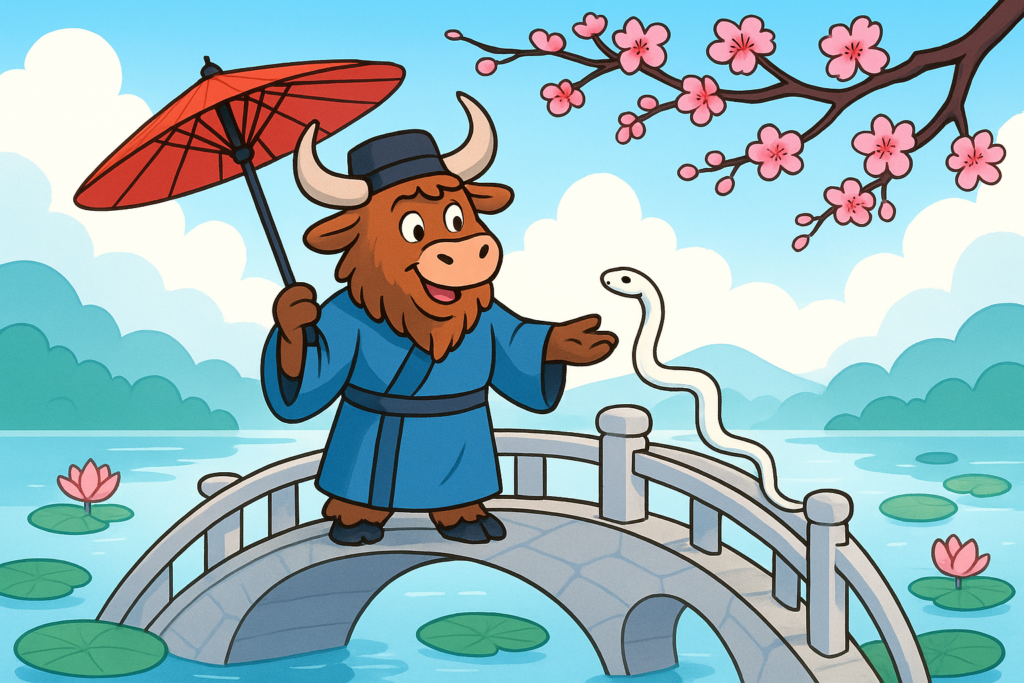
One spring morning, a light rain fell over West Lake. Xu Xian, a young scholar, stood on Broken Bridge.
He saw a small boat on the lake. There were two women on it. One dressed in white, very beautiful. The other in green.
The boat neared the shore. Xu Xian called out, "May I ride with you? The rain is heavy." The woman in white smiled, "Of course, come aboard."
On the boat, Xu Xian chatted with the woman in white. Her name was Bai Suzhen. She was kind and clever.
The boat reached the shore, but the rain hadn't stopped. Xu Xian said, "Please use my umbrella." Bai Suzhen asked, "How can I return it?" Xu Xian replied, "I live by the lake. Please come to my home tomorrow."
The next day, Bai Suzhen came to Xu Xian's home. They drank tea together and talked for a long time. They felt very close.
Soon, they fell in love and got married. Xu Xian opened a medicine shop, and Bai Suzhen helped him. They lived very happily.
But one day, a monk named Fahai came. He told Xu Xian, "Your wife is a white snake spirit! She will harm you!"
Xu Xian didn't believe it. He loved his wife. He said to Fahai, "She is kind. Go away!"
Fahai was angry. He used magic to try to reveal Bai Suzhen's true form. But Bai Suzhen was also powerful, and she protected her home.
A great storm came. Xu Xian stood by Bai Suzhen's side. Together they faced Fahai.
In the end, Fahai could not defeat their love. He left. The couple lived a peaceful life from then on. Their story became a legend of true love.
Here are some useful words and phrases you met in the tale. Read them aloud and try using them in your own sentences.
Notice how many words combine two characters to make a new meaning, like 读书人 (dúshūrén) for 'scholar' - literally 'read-book-person'.
- 读书人 dúshūrén - scholar
- 断桥 Duàn Qiáo - Broken Bridge (a famous spot in Hangzhou)
- 和尚 héshang - Buddhist monk
- 蛇精 shéjīng - snake spirit/demon
- 原形 yuánxíng - true/original form
- 真爱 zhēn'ài - true love
You saw 了 throughout the story. At B1, it's time to see it not just as 'past tense', but as marking completed actions or changes.
In the opening line, '下起了小雨' uses 起...了 to show the rain started. Later, '他们结婚了' marks the change from not married to married. Pay attention to where 了 appears and what it signals.
- Action completion: 船到了岸边 (the boat reached the shore).
- Change of state: 他们相爱了 (they fell in love - a new state).
- Sequence: 他用法术想显出白素贞的原形 (he used magic, then tried to reveal...).
- Notice 了 often comes after the verb, but sometimes at the end of a sentence for a new situation.
The storyteller uses simple but effective techniques to make us care about Xu Xian and Bai Suzhen.
Dialogue tags like 大声问 (asked loudly) and 笑着说 (said with a smile) add emotion. Descriptive words such as 美丽 (beautiful), 善良 (kind), and 聪明 (intelligent) build character quickly. When you tell your own stories, try sprinkling in these little details.
- Use of 问/说/回答 + descriptive phrase: 他大声问, 白衣女子笑着说.
- Repetition for effect: the rain (雨) appears several times, linking scenes.
- Contrast between 善良 and 强大 to show Bai Suzhen's dual nature.
You've just read a classic Chinese legend in simplified characters. That's a real achievement!
Try retelling the story to yourself, using the new words. Better yet, find a friend and share the tale. The more you use these patterns, the more natural they'll feel.
白蛇传 comes from the Chinese / folklore/literature tradition and is best known as a romantic legend. This Yak Yacker article is an original learner retelling based on Traditional legend; public-domain versions, so the wording here is simplified for modern learners rather than copied from one old edition.
Older printings, translations, and retellings of this story can vary quite a bit. The original audience was usually general/adult, but this version is adapted for B1 Intermediate learners studying Simplified Chinese. Romance/religion/magic; use public folk versions only.
If you want to look into the source tradition, start with Wikipedia.
If you want to keep going, browse more in our Simplified Chinese section and review the HSK Level 1 Chinese Vocabulary. After that, try 1,000 Chinese Phrases and Expressions for another useful next step.
More Simplified Chinese to explore
The Cowherd and the Weaver Girl: A2 Elementary Simplified Chinese Story with Audio
Learn Chinese with ‘Waiting by a Tree Stump’: A1 Beginner Story, Audio & Lesson
The Battle of Red Cliffs: B1 Intermediate Simplified Chinese Story with Audio