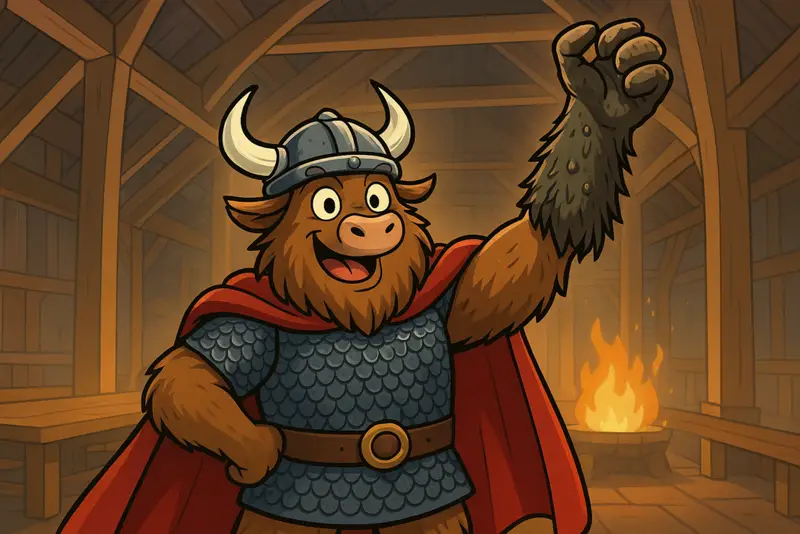
This A2 Elementary retelling of Beowulf and Grendel keeps the plot clear for learners while still giving the story some atmosphere and momentum. Long ago in Denmark, King Hrothgar built a wonderful hall called Heorot. Every night, the people sang, ate, and laughed together.
This version is written for English-speaking learners and includes clickable word help inside the story, full story audio, and lesson notes after the reading. It is free to use on Yak Yacker and is designed to feel natural, readable, and manageable in English.
Long ago in , King Hrothgar built a hall called . Every night, the people sang, ate, and laughed together. They were very happy.
But not everyone liked the happy noise. Deep in a lake lived a monster named Grendel. The singing made him . One night, he came to Heorot and took thirty sleeping men.
After that, Heorot was at night. The people were . King Hrothgar was very sad. 'Who can save us?' he asked.
Far away, the hero Beowulf the monster. He to Denmark with fourteen men. He walked into the hall and spoke loudly. 'I am Beowulf! I will fight your monster. I will fight him with my bare hands.'
King Hrothgar looked at the hero and smiled. 'Welcome, Beowulf! You are brave. But Grendel is very . Be careful!' 'I am not afraid,' Beowulf answered.
That night, Beowulf and his men in the dark hall. They lay down and closed their eyes. All was . Then, the door opened slowly. Grendel, huge and hairy, came inside. His eyes burned like red fire.
Grendel a giant hand to a warrior. But Beowulf was ready. He jumped up and caught the monster's arm. 'No! You cannot hurt us!' he shouted. The fight was . Beowulf pulled and pulled. Then-CRACK!-he tore off Grendel's arm.
Grendel and ran away into the night. The monster went back to his lake and died. The next morning, King Hrothgar saw the giant arm. He laughed with joy. 'Beowulf, you are our hero!' Everyone cheered. Heorot was happy again.
A long time ago in Denmark, King Hrothgar built a great hall named Heorot. Every night, people sang, ate, and laughed there. They were very happy.
But a monster named Grendel, who lived in a dark lake, hated the joyful sounds. One night, he entered Heorot and seized thirty sleeping men.
After that, Heorot became quiet at night because people were scared. King Hrothgar was sad and asked, "Who will save us?"
Far away, the hero Beowulf learned about the monster. He sailed to Denmark with fourteen brave men. He entered the hall and announced loudly, "I am Beowulf! I will fight your monster with my bare hands."
King Hrothgar saw the strong hero and smiled. "Welcome, Beowulf! You are brave, but Grendel is dangerous. Be careful!" Beowulf replied, "I am not afraid."
That night, Beowulf and his men waited in the dark hall, pretending to sleep. Suddenly, the door opened and Grendel, a huge, hairy monster with eyes like fire, came in.
Grendel reached out to grab a warrior, but Beowulf jumped up and grabbed Grendel's arm. They fought fiercely, and Beowulf pulled hard until he ripped off Grendel's arm.
Grendel screamed, ran away, and died in his lake. The next morning, King Hrothgar saw the arm and joyfully declared, "Beowulf, you are our hero!" Everyone cheered, and Heorot was happy again.
Let's learn some important words from the Beowulf story. These words describe people, places, and feelings.
You can use them when you talk about heroes, monsters, and adventures.
- hall - a large room or building for meetings or parties. Example: "The king built a wonderful hall."
- monster - a big, scary creature in stories. Example: "Grendel was a terrible monster."
- brave - not afraid of danger. Example: "Beowulf is very brave."
- cheer - to shout with happiness. Example: "Everyone cheered for the hero."
The story uses the past simple because the events happened long ago. We often use this tense to tell stories.
For regular verbs, add -ed (like walk -> walked, shout -> shouted). But many common verbs are irregular (like run -> ran, see -> saw).
- Try these from the story: "King Hrothgar built a hall." (build -> built)
- "Beowulf and his men waited in the hall." (wait -> waited)
- "Grendel came inside and took thirty men." (come -> came, take -> took)
- Be careful! "He went back to his lake and died." (go -> went)
When you tell a story, time words help the listener follow the order of events. The Beowulf story uses many of them.
Look at how these words move the story forward from the happy nights to the fight and the happy ending.
- Long ago… (start of the story, in the past)
- One night… (a specific night when the monster came)
- After that… (what happened next?)
- The next morning… (the morning after the fight)
Now you know some words, past tense verbs, and time phrases from the story. Practice makes you confident.
Try to retell the story of Beowulf to a friend. Or imagine you are a hero-what monster would you fight? Write a short story using past simple and time words.
Beowulf and Grendel comes from the English / Old English epic tradition and is best known as a epic/legend. This Yak Yacker article is an original learner retelling based on Old English epic/public-domain translations, so the wording here is simplified for modern learners rather than copied from one old edition.
Older printings, translations, and retellings of this story can vary quite a bit. The original audience was usually general, but this version is adapted for A2 Elementary learners studying English. Use public-domain translation or own retelling.
If you want to look into the source tradition, start with Project Gutenberg.
If you want to keep going, browse more in our English section and review the A2 English Vocabulary List. After that, try English Root Words and Prefixes for another useful next step.