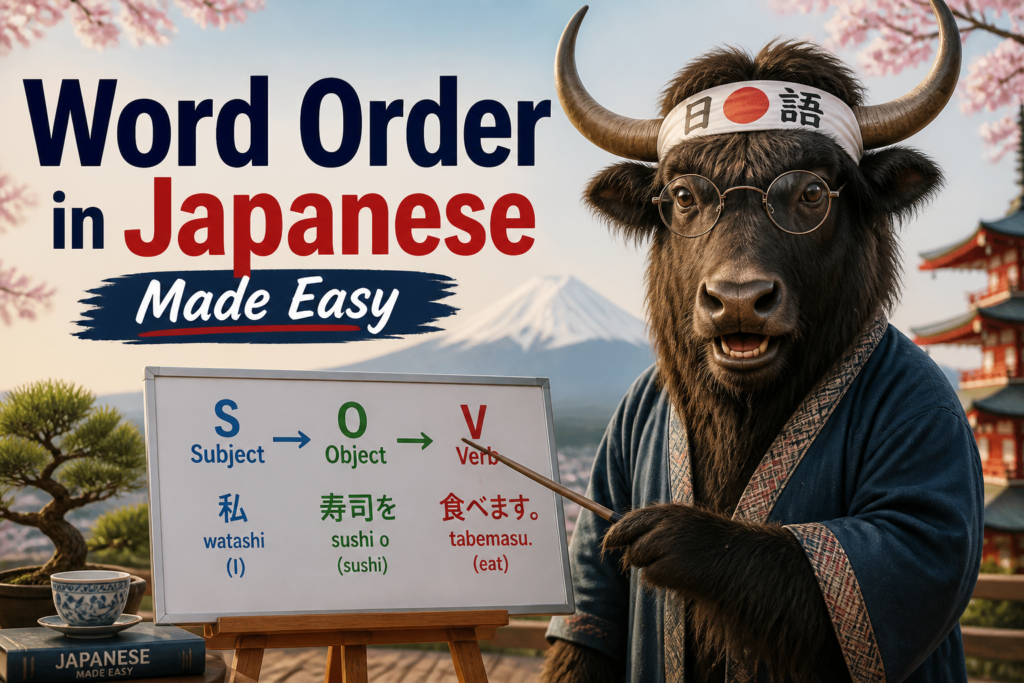
Japanese Word Order 101 can feel backwards at first. English likes to say who did what, then the action, then the extras. Japanese often waits until the end to reveal the verb. Very dramatic. Very Japanese.
The good news? Japanese word order is actually simpler than it looks. Once you understand the basic pattern, sentences stop feeling like puzzles and start feeling like a system. A neat system, thankfully — not one of those “why is this word here?” situations that make learners stare into the middle distance.
If you want a broader study path, the main learning hub is here: Learn Japanese. For a quick challenge after this lesson, try the Japanese Placement Test JLPT or the Japanese Vocabulary Test.
The Basic Japanese Sentence Shape
The most common Japanese sentence order is:
Topic / Subject + Object + Verb
In simple form:
- 私はりんごを食べます。 — Watashi wa ringo o tabemasu. — I eat an apple.
- 彼は本を読みます。 — Kare wa hon o yomimasu. — He reads a book.
- 私は日本語を勉強します。 — Watashi wa Nihongo o benkyō shimasu. — I study Japanese.
The last word is usually the verb. That is the big thing to remember. In Japanese, the end of the sentence is where the action lives.
Japanese loves to save the verb for last. It is a little suspenseful, and yes, your brain may protest at first.
Why Word Order Feels Flexible
Japanese word order is not random. It is flexible because particles show the role of each word. That means the sentence can move parts around more freely than English can.
For example, these two sentences are both correct:
- 私はパンを食べます。 — Watashi wa pan o tabemasu. — I eat bread.
- パンを私は食べます。 — Pan o watashi wa tabemasu. — Bread, I eat.
The meaning stays mostly the same because は (wa) and を (o) mark the job of each word. So yes, the order can move. But no, that does not mean “anything goes.” Japanese is flexible, not chaotic.
Important Word Order Pattern Words
| Kanji | Rōmaji | Meaning | Example | Rōmaji Example | Translation |
|---|---|---|---|---|---|
| 私は | watashi wa | As for me / I | 私は学生です。 | Watashi wa gakusei desu. | I am a student. |
| 彼は | kare wa | As for him / he | 彼は先生です。 | Kare wa sensei desu. | He is a teacher. |
| りんごを | ringo o | apple as object | りんごを食べます。 | Ringo o tabemasu. | I eat an apple. |
| 本を | hon o | book as object | 本を読みます。 | Hon o yomimasu. | I read a book. |
| 学校で | gakkō de | at school | 学校で勉強します。 | Gakkō de benkyō shimasu. | I study at school. |
| 東京に | Tōkyō ni | to Tokyo / in Tokyo | 東京に行きます。 | Tōkyō ni ikimasu. | I go to Tokyo. |
| 毎日 | mainichi | every day | 毎日走ります。 | Mainichi hashirimasu. | I run every day. |
| 昨日 | kinō | yesterday | 昨日映画を見ました。 | Kinō eiga o mimashita. | I watched a movie yesterday. |
The Most Common Sentence Parts
Here is the usual order in a simple Japanese sentence:
- Time
- Topic / Subject
- Place
- Object
- Verb
Example:
- 昨日、私は図書館で日本語を勉強しました。 — Kinō, watashi wa toshokan de Nihongo o benkyō shimashita. — Yesterday, I studied Japanese at the library.
You do not always need every piece. Japanese often leaves out what is already clear from context. That is normal, not missing information. English learners sometimes panic here for no reason.
Useful Word Order Phrases
These phrases show how Japanese sentence order works in real life. Keep an eye on the particles and the verb at the end.
| Kanji | Rōmaji | English Meaning | Example | Rōmaji Example | Translation |
|---|---|---|---|---|---|
| 私は行きます。 | watashi wa ikimasu | I go. | 私は駅に行きます。 | Watashi wa eki ni ikimasu. | I go to the station. |
| 彼は来ます。 | kare wa kimasu | He comes. | 彼は明日来ます。 | Kare wa ashita kimasu. | He comes tomorrow. |
| 日本語を話します。 | Nihongo o hanashimasu | speak Japanese | 私は日本語を話します。 | Watashi wa Nihongo o hanashimasu. | I speak Japanese. |
| 水を飲みます。 | mizu o nomimasu | drink water | 毎朝、水を飲みます。 | Maiasa, mizu o nomimasu. | I drink water every morning. |
| 車で行きます。 | kuruma de ikimasu | go by car | 車で会社に行きます。 | Kuruma de kaisha ni ikimasu. | I go to work by car. |
| 図書館で勉強します。 | toshokan de benkyō shimasu | study at the library | 図書館で勉強します。 | Toshokan de benkyō shimasu. | I study at the library. |
| 友達と会います。 | tomodachi to aimasu | meet with a friend | 友達と駅で会います。 | Tomodachi to eki de aimasu. | I meet a friend at the station. |
| 映画を見ます。 | eiga o mimasu | watch a movie | 夜に映画を見ます。 | Yoru ni eiga o mimasu. | I watch a movie at night. |
| 朝ご飯を食べます。 | asagohan o tabemasu | eat breakfast | 毎朝、朝ご飯を食べます。 | Maiasa, asagohan o tabemasu. | I eat breakfast every morning. |
| 宿題をします。 | shukudai o shimasu | do homework | 家で宿題をします。 | Ie de shukudai o shimasu. | I do homework at home. |
| 公園で遊びます。 | kōen de asobimasu | play at the park | 子どもは公園で遊びます。 | Kodomo wa kōen de asobimasu. | The child plays at the park. |
| 先生に聞きます。 | sensei ni kikimasu | ask the teacher | 先生に日本語を聞きます。 | Sensei ni Nihongo o kikimasu. | I ask the teacher about Japanese. |
How Particles Control Word Order
Particles are the tiny markers that show each word’s role. They are the quiet heroes of Japanese grammar. No cape, all power.
These three are especially important for word order:
- は (wa) marks the topic
- を (o) marks the object
- に (ni) often marks direction, time, or target
Compare these:
- 私は本を読みます。 — Watashi wa hon o yomimasu. — I read a book.
- 本を私は読みます。 — Hon o watashi wa yomimasu. — As for the book, I read it.
The particle tells you what the word is doing, so the order becomes less fragile. If you want a focused particle lesson, these guides help a lot: は vs が, に vs で, and を vs が.
Word Order With Time Words
Time words often come near the front of the sentence. That includes words like 昨日 (kinō, yesterday), 今日 (kyō, today), 明日 (ashita, tomorrow), and 毎日 (mainichi, every day).
- 明日、友達に会います。 — Ashita, tomodachi ni aimasu. — Tomorrow, I meet a friend.
- 毎日、日本語を勉強します。 — Mainichi, Nihongo o benkyō shimasu. — I study Japanese every day.
- 昨日、映画を見ました。 — Kinō, eiga o mimashita. — Yesterday, I watched a movie.
Japanese does not force time words into one exact spot every time, but putting them early sounds natural and clear. Convenient, right? Almost as if the language wants to help.
Word Order With Questions
Questions are also pretty calm in Japanese. Often, you just add か (ka) at the end.
- あなたは学生ですか。 — Anata wa gakusei desu ka. — Are you a student?
- 何を食べますか。 — Nani o tabemasu ka. — What will you eat?
- どこに行きますか。 — Doko ni ikimasu ka. — Where are you going?
The question word usually appears before the verb, but the verb still stays at the end. So the structure remains polite and tidy, even when you are asking something simple.
Word Order With Adjectives And Adverbs
Adjectives usually come before the noun they describe. Adverbs often come before the verb they modify.
- 大きい犬 — ōkii inu — big dog
- 速く走ります。 — hayaku hashirimasu. — run quickly
- とても好きです。 — totemo suki desu. — like very much
Example in a full sentence:
- 大きい犬が速く走ります。 — Ōkii inu ga hayaku hashirimasu. — The big dog runs quickly.
So the sentence still ends with the verb. Adjectives and adverbs just dress up the sentence along the way. Fancy, but not fussy.
Common Word Order Patterns To Remember
| Pattern | Meaning | Example | Rōmaji | English |
|---|---|---|---|---|
| Topic + Object + Verb | Basic sentence | 私は水を飲みます。 | Watashi wa mizu o nomimasu. | I drink water. |
| Time + Topic + Place + Object + Verb | More detailed sentence | 昨日、私は家で本を読みました。 | Kinō, watashi wa ie de hon o yomimashita. | Yesterday, I read a book at home. |
| Place + Verb | Location-only sentence | 学校で勉強します。 | Gakkō de benkyō shimasu. | I study at school. |
| Question word + Verb | Question at the end | 何を買いますか。 | Nani o kaimasu ka. | What do you buy? |
| Adjective + Noun | Describing a noun | 赤い車 | akai kuruma | red car |
| Adverb + Verb | Describing the action | ゆっくり歩きます。 | yukkuri arukimasu. | I walk slowly. |
Practice: Put The Sentence In Order
Try to notice the particles and move the pieces into a natural Japanese order. The verb should still end up at the end. Yes, again. That is the point.
- “I / apple / eat” → 私はりんごを食べます。 — Watashi wa ringo o tabemasu.
- “Yesterday / I / at school / studied Japanese” → 昨日、私は学校で日本語を勉強しました。 — Kinō, watashi wa gakkō de Nihongo o benkyō shimashita.
- “What / buy / you?” → 何を買いますか。 — Nani o kaimasu ka.
- “My friend / in Tokyo / lives” → 友達は東京に住んでいます。 — Tomodachi wa Tōkyō ni sunde imasu.
- “Every day / I / book / read” → 毎日、私は本を読みます。 — Mainichi, watashi wa hon o yomimasu.
Common Mistakes And Easy Fixes
| Common Mistake | Why It Happens | Better Version | Why It Works |
|---|---|---|---|
| 私は食べますりんご。 | English order sneaks in | 私はりんごを食べます。 | Object comes before the verb |
| 東京私は行きます。 | Words are in the wrong order without particles | 私は東京に行きます。 | Particles show the role clearly |
| 本読みます私は。 | The verb is not at the end | 私は本を読みます。 | Verb ends the sentence |
| 学校で私は勉強。 | Missing verb form | 学校で私は勉強します。 | Complete verb makes the sentence work |
When a sentence feels weird, check three things: particles, verb position, and whether the sentence is complete. Those three checks solve a lot of beginner trouble. More than people expect, honestly.
Quick Reference Summary
- Japanese usually ends with the verb.
- Particles are more important than strict word order.
- Basic pattern: topic + object + verb.
- Time words often appear near the front.
- Questions keep the verb at the end and often add か (ka).
- Adjectives go before nouns.
- Adverbs usually go before verbs.
If you want to test how well this idea is sticking, try the vocabulary and placement practice at Japanese Vocabulary Test and the Japanese Placement Test JLPT. Word order gets much easier once your brain has seen it a few times in the wild.
Yak takeaway: Japanese word order is not about copying English in a new costume. It is about learning how particles guide the sentence and how the verb calmly waits at the end. Once that clicks, Japanese starts looking less like chaos and more like a very organized system that just happens to enjoy a little suspense.