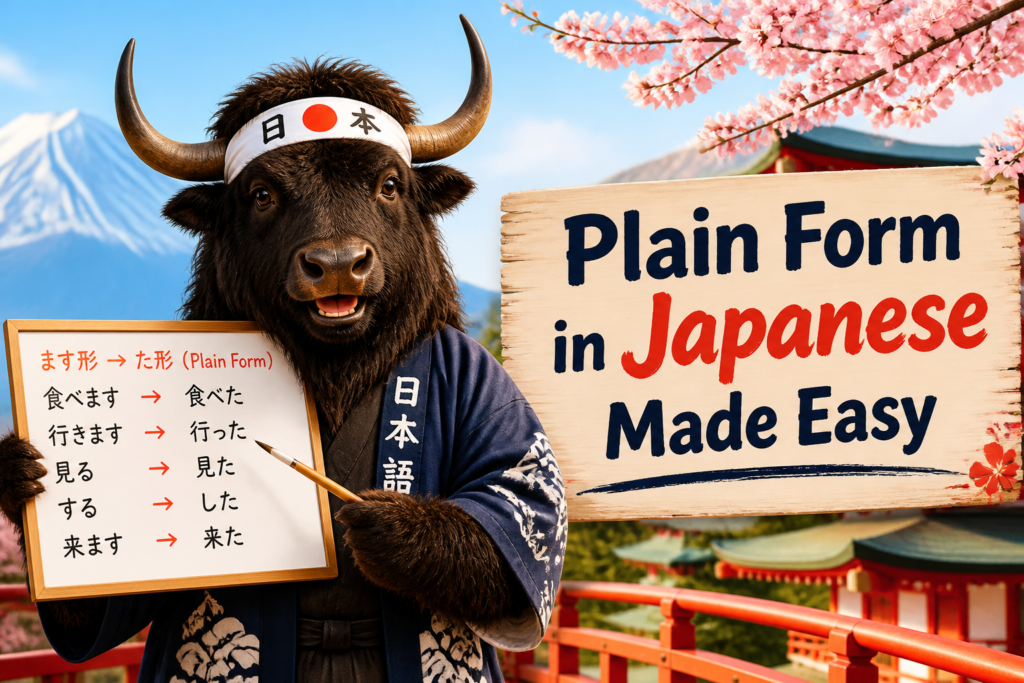
Plain Form in Japanese is the version of a verb you use when Japanese gets relaxed, real, and a little less formally dressed. It shows up in conversation, writing, quotes, dictionaries, and basically anywhere Japanese decides it does not feel like being extra polite today.
For the broader learning path, visit our parent guide.
If polite form is the “I’m being careful and respectful” version, plain form is the “I’m talking normally” version. That does not mean rude. It just means normal. Japanese loves this contrast, because apparently one verb form was not enough drama.
For a bigger picture of how Japanese changes between styles, see Plain vs Polite Japanese. And if you want to compare this with another super common form, you will also want Te-Form in Japanese.
What Plain Form Is
Plain Form is the casual dictionary-style way to say verbs, adjectives, and some sentence endings in Japanese.
In simple terms, it is the form you use with friends, family, diary entries, internal thoughts, and lots of everyday speech. You will also see it in grammar patterns like 〜と思う (~to omou, “I think that…”), 〜から (~kara, “because…”), and 〜ので (~node, “since…”).
Plain form is not “baby Japanese.” It is the engine room. You use it all the time, even when the sentence ends politely.
Quick Plain Form Reference
| Type | Plain Form | Rōmaji | Meaning |
|---|---|---|---|
| Verb | 食べる | taberu | to eat |
| Verb | 行く | iku | to go |
| Verb | する | suru | to do |
| Verb | 来る | kuru | to come |
| い-adjective | 高い | takai | high; expensive |
| な-adjective | 静かだ | shizuka da | is quiet |
| Noun + Copula | 学生だ | gakusei da | is a student |
Plain Form Verbs: The Big Four Patterns
Japanese verbs are easier when you stop treating them like a puzzle from a tiny, emotionally intense escape room. The main plain forms come from the verb group.
| Verb Type | Polite Form | Plain Form | Rōmaji | Meaning |
|---|---|---|---|---|
| Ru-verb | 食べます | 食べる | tabemasu → taberu | to eat |
| U-verb | 行きます | 行く | ikimasu → iku | to go |
| Irregular | します | する | shimasu → suru | to do |
| Irregular | 来ます | 来る | kimasu → kuru | to come |
Ru-Verbs
食べます (tabemasu) becomes 食べる (taberu).
見ます (mimasu) becomes 見る (miru).
寝ます (nemasu) becomes 寝る (neru).
Example: 寿司を食べる。 Sushi o taberu. I eat sushi.
U-Verbs
U-verbs change their final sound.
書きます (kakimasu) becomes 書く (kaku).
話します (hanashimasu) becomes 話す (hanasu).
買います (kaimasu) becomes 買う (kau).
Example: 毎日日本語を書く。 Mainichi Nihongo o kaku. I write Japanese every day.
Irregular Verbs
する (suru) means “to do.”
来る (kuru) means “to come.”
Example: 宿題をする。 Shukudai o suru. I do homework.
Example: 友達が来る。 Tomodachi ga kuru. My friend is coming.
Plain Form Adjectives And Nouns
Plain form is not just for verbs. Adjectives and nouns also have plain-style endings.
| Type | Plain Form | Rōmaji | English Meaning | Example |
|---|---|---|---|---|
| い-adjective | 高い | takai | high; expensive | この本は高い。 Kono hon wa takai. This book is expensive. |
| い-adjective | 楽しい | tanoshii | fun | 日本語は楽しい。 Nihongo wa tanoshii. Japanese is fun. |
| な-adjective | 静かだ | shizuka da | is quiet | この町は静かだ。 Kono machi wa shizuka da. This town is quiet. |
| Noun | 学生だ | gakusei da | is a student | 私は学生だ。 Watashi wa gakusei da. I am a student. |
Useful Plain Form Phrases
These are the kinds of phrases that show up everywhere. The plain form is doing a lot of work here, quietly, like that one reliable person in a group project.
| Japanese | Rōmaji | English Meaning | Example Sentence | Rōmaji | Translation |
|---|---|---|---|---|---|
| 食べる | tagger? taberu | to eat | 朝ごはんを食べる。 | Asagohan o taberu. | I eat breakfast. |
| 飲む | nomu | to drink | 水を飲む。 | Mizu o nomu. | I drink water. |
| 行く | iku | to go | 学校へ行く。 | Gakkō e iku. | I go to school. |
| 来る | kuru | to come | 先生が来る。 | Sensei ga kuru. | The teacher is coming. |
| する | suru | to do | 勉強をする。 | Benkyō o suru. | I study. |
| 見る | miru | to see; watch | 映画を見る。 | Eiga o miru. | I watch a movie. |
| 読む | yomu | to read | 本を読む。 | Hon o yomu. | I read a book. |
| 書く | kaku | to write | 手紙を書く。 | Tegami o kaku. | I write a letter. |
| 話す | hanasu | to speak | 日本語で話す。 | Nihongo de hanasu. | I speak in Japanese. |
| 買う | kau | to buy | パンを買う。 | Pan o kau. | I buy bread. |
| 高い | takai | expensive; high | このカメラは高い。 | Kono kamera wa takai. | This camera is expensive. |
| 静かだ | shizuka da | is quiet | 図書館は静かだ。 | Toshokan wa shizuka da. | The library is quiet. |
| 学生だ | gakusei da | is a student | 彼は学生だ。 | Kare wa gakusei da. | He is a student. |
| 元気だ | genki da | is healthy; fine | 今日は元気だ。 | Kyō wa genki da. | I feel fine today. |
| 好きだ | suki da | to like | 私は猫が好きだ。 | Watashi wa neko ga suki da. | I like cats. |
Plain Form In Common Grammar Patterns
Plain form becomes especially useful when it joins other words. This is where Japanese starts building meaning like a very efficient Lego set.
〜と思う
〜と思う (~to omou) means “I think that…”
明日は雨が降ると思う。 Ashita wa ame ga furu to omou. I think it will rain tomorrow.
〜から
〜から (~kara) means “because…”
疲れたから、早く寝る。 Tsukareta kara, hayaku neru. Because I am tired, I will sleep early.
〜ので
〜ので (~node) also means “because / since,” and it sounds a little softer than 〜から.
道が混んでいるので、遅れる。 Michi ga konde iru node, okureru. Because the roads are crowded, I will be late.
〜たい
〜たい (~tai) means “want to do.” It attaches to the plain stem of a verb.
日本へ行きたい。 Nihon e ikitai. I want to go to Japan.
〜たり〜たりする
〜たり〜たりする (~tari ~tari suru) lists actions in a casual way.
週末は映画を見たり、本を読んだりする。 Shūmatsu wa eiga o mitari, hon o yondari suru. On weekends, I watch movies and read books.
Plain Form Compared With Polite Form
This is where many learners pause and say, “Wait, which one do I use?” Fair question. The answer is: both, depending on the situation.
| Polite | Plain | Rōmaji | Use |
|---|---|---|---|
| 食べます | 食べる | tabemasu / taberu | polite / casual |
| 行きます | 行く | ikimasu / iku | polite / casual |
| 静かです | 静かだ | shizuka desu / shizuka da | polite / casual |
| 学生です | 学生だ | gakusei desu / gakusei da | polite / casual |
For a focused comparison, open Plain vs Polite Japanese. If you want to know when casual speech is appropriate, see Casual and Polite Japanese.
Common Mistakes And Fixes
- Mistake: Using plain form with everyone, everywhere. Fix: Use polite form in formal situations, then switch to plain form where the setting allows it.
- Mistake: Forgetting that だ is the plain form of です. Fix: Remember: 学生です → 学生だ.
- Mistake: Thinking plain form is rude by default. Fix: Plain form is casual, not automatically rude.
- Mistake: Mixing plain and polite forms in one sentence without a reason. Fix: Pick one style and stay with it unless grammar requires a change.
- Mistake: Assuming every verb ending becomes the same pattern. Fix: Group verbs first: ru-verbs, u-verbs, and irregular verbs.
Practice: Switch To Plain Form
Try changing these from polite to plain form. Small wins count. Japanese loves consistency more than panic.
- 食べます → 食べる tabemasu → taberu
- 行きます → 行く ikimasu → iku
- 読みます → 読む yomimasu → yomu
- します → する shimasu → suru
- 来ます → 来る kimasu → kuru
- 静かです → 静かだ shizuka desu → shizuka da
- 学生です → 学生だ gakusei desu → gakusei da
- 高いです → 高い takai desu → takai
When You Will See Plain Form Most Often
- In conversation with friends and family
- In casual texting and chat
- In dictionaries and vocabulary lists
- In quotes and reported thoughts
- In grammar patterns like 〜と思う, 〜から, and 〜たい
- In fiction, manga dialogue, and narration
If you are preparing for tests, plain form matters a lot. A good next step is a quick check with Japanese Placement Test JLPT or Japanese Vocabulary Test. Handy little reality checks. Mildly annoying, very useful.
Quick Reference Summary
| Item | Plain Form | Rōmaji | Meaning |
|---|---|---|---|
| Eat | 食べる | taberu | to eat |
| Go | 行く | iku | to go |
| Do | する | suru | to do |
| Come | 来る | kuru | to come |
| Quiet | 静かだ | shizuka da | is quiet |
| Student | 学生だ | gakusei da | is a student |
Plain form in Japanese is one of those things that looks small at first and then quietly appears everywhere. Once it clicks, a lot of grammar becomes easier, and a lot of conversation stops sounding like a formal announcement from a train station.
Keep practicing the pattern, listen for it in real Japanese, and compare it with polite style whenever you can. That combination builds fast understanding. And yes, your future self will be pleased. Possibly even impressed.