Kanji can look like a tiny army marched across the page and refused to explain itself. Rude, honestly. But here is the good news: you do not need to “master” all of it first. You only need a calm start, a smart order, and a little patience.
Many beginners think kanji is one giant wall. It is not. It is more like a staircase with a few annoying steps. Start with the most useful characters, learn how they work with Hiragana and Katakana, and suddenly Japanese text stops looking like secret wizard paperwork.
If you want the bigger map first, the main study path lives here: Learn Japanese. For a gentle comparison of writing systems, the related guides for Hiragana and Katakana are worth a look too.
What Kanji Actually Is
漢字 / Kanji / Chinese characters used in Japanese
Kanji are characters that carry meaning. One character can often suggest an idea, a thing, a person, a place, or a concept. That is why Japanese can pack a lot of meaning into a small space. Efficient? Very. Slightly dramatic? Also yes.
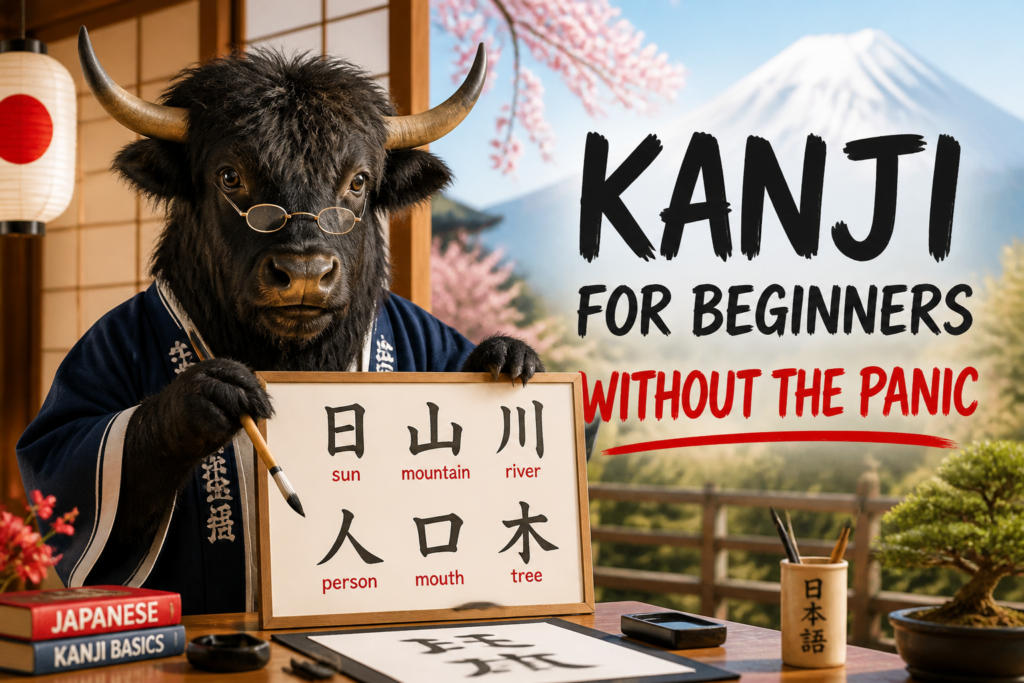
For example, 山 means “mountain,” 川 means “river,” and 日 can mean “sun” or “day.” You are not expected to instantly know every reading. At the beginning, focus on recognition, meaning, and the simplest common readings.
Japanese uses three writing systems together: 漢字 / Kanji, ひらがな / Hiragana, and カタカナ / Katakana. Hiragana handles grammar and native Japanese words. Katakana often handles foreign words and sound effects. Kanji gives the sentence structure more shape, like the bones under the outfit.
Useful Kanji Basics And Starter Phrases
| Kanji | Rōmaji | English Meaning | Example Sentence | Example Rōmaji | Translation |
|---|---|---|---|---|---|
| 日 | hi / nichi | sun, day | 今日は日が出ています。 | Kyou wa hi ga dete imasu. | The sun is out today. |
| 月 | tsuki / getsu | moon, month | 月がきれいです。 | Tsuki ga kirei desu. | The moon is beautiful. |
| 人 | hito / nin | person | あの人はやさしいです。 | Ano hito wa yasashii desu. | That person is kind. |
| 山 | yama | mountain | 山が高いです。 | Yama ga takai desu. | The mountain is tall. |
| 川 | kawa | river | 川の音がします。 | Kawa no oto ga shimasu. | I can hear the river. |
| 水 | mizu / sui | water | 水をください。 | Mizu o kudasai. | Please give me water. |
| 火 | hi / ka | fire | 火はあぶないです。 | Hi wa abunai desu. | Fire is dangerous. |
| 木 | ki / moku | tree, wood | 木の下にいます。 | Ki no shita ni imasu. | I am under the tree. |
| 口 | kuchi / kou | mouth, opening | 口をあけてください。 | Kuchi o akete kudasai. | Please open your mouth. |
| 手 | te / shu | hand | 手をあげます。 | Te o agemasu. | I raise my hand. |
| 目 | me / moku | eye | 目がいたいです。 | Me ga itai desu. | My eyes hurt. |
| 力 | chikara / ryoku | power, strength | 力が必要です。 | Chikara ga hitsuyou desu. | Power is needed. |
These are beginner-friendly because they show up everywhere. If you learn them early, you stop feeling like every sentence is a locked door. It is more like opening the first few drawers in a kitchen and finally finding the spoons.
Common Beginner Kanji Phrases
- 日本 / Nihon / Japan
- 日本語 / Nihongo / Japanese language
- 学生 / gakusei / student
- 学校 / gakkou / school
- 先生 / sensei / teacher
- 名前 / namae / name
- 時間 / jikan / time
- 今日 / kyou / today
- 明日 / ashita / tomorrow
- 昨日 / kinou / yesterday
- 本 / hon / book
- 友達 / tomodachi / friend
- 電車 / densha / train
- 駅 / eki / station
- 行く / iku / to go
Some of these are written with kanji plus hiragana, which is very normal. Japanese often mixes scripts inside the same word or sentence. That is not a trick. That is just how the system works.
How Kanji Readings Work Without Losing Your Mind
One kanji can have more than one reading. That is the part that scares people, but it becomes manageable fast if you learn the pattern instead of memorizing random chaos.
There are two big reading types:
- Onyomi / Chinese-based reading, often used in compound words
- Kunyomi / Japanese native reading, often used when the kanji stands alone or with hiragana
| Kanji | Rōmaji | Meaning | Common Reading Pattern | Example | Translation |
|---|---|---|---|---|---|
| 山 | yama / san | mountain | Kunyomi: yama | 山 / yama | mountain |
| 人 | hito / jin / nin | person | Kunyomi: hito | 人 / hito | person |
| 学校 | gakkou | school | Onyomi in a compound | 学 + 校 | school |
| 日本語 | nihongo | Japanese language | Compound word | 日本語 | Japanese language |
A useful beginner rule: if a kanji word has several kanji together, the reading is often more “onyomi-like.” If a kanji stands alone with hiragana, it is often “kunyomi-like.” Not always. Japanese enjoys exceptions the way cats enjoy knocking things off tables. But this rule helps a lot.
Mini Rules That Make Kanji Easier
Rule: Learn meaning first, reading second. That way you can recognize words in context, even if you do not remember every possible pronunciation on day one.
Rule: Study kanji in words, not only as isolated characters. 日 is useful, but 今日 / kyou / today is more useful in actual life. Language wants company.
Rule: Review little and often. Ten minutes daily beats one heroic weekend session followed by total forgetting and mild emotional collapse.
Rule: Use writing to remember shape. Even tracing a kanji a few times helps your brain connect form, meaning, and reading.
Important Beginner Kanji Shapes
| Kanji | Rōmaji | Meaning | Example Sentence | Example Rōmaji | Translation |
|---|---|---|---|---|---|
| 一 | ichi / hito | one, first stroke | 一つください。 | Hitotsu kudasai. | Please give me one. |
| 二 | ni | two | 二人で行きます。 | Futari de ikimasu. | We will go as two people. |
| 三 | san | three | 三本あります。 | Sanbon arimasu. | There are three long objects. |
| 大 | oo / dai | big | 大きいです。 | Ookii desu. | It is big. |
| 小 | shou / chiisai | small | 小さい犬がいます。 | Chiisai inu ga imasu. | There is a small dog. |
| 上 | ue / jou | up, above | 上にあります。 | Ue ni arimasu. | It is above. |
| 下 | shita / ka | down, below | 机の下です。 | Tsukue no shita desu. | It is under the desk. |
| 中 | naka / chuu | inside, middle | 中に入ります。 | Naka ni hairimasu. | I go inside. |
| 外 | soto / gai | outside | 外は寒いです。 | Soto wa samui desu. | It is cold outside. |
| 左 | hidari / sa | left | 左に曲がります。 | Hidari ni magarimasu. | Turn left. |
| 右 | migi / u | right | 右にあります。 | Migi ni arimasu. | It is on the right. |
| 先 | saki / sen | ahead, previous, before | 先生は先に来ます。 | Sensei wa saki ni kimasu. | The teacher comes first. |
These characters are helpful because they also appear inside bigger words. Once you know 大, you start seeing it in words like 大丈夫 / daijoubu / all right, and that is a lovely little confidence boost.
Learn Kanji With Hiragana And Katakana, Not In Isolation
Kanji is easier when you see how it shares the page. ひらがな / Hiragana often attaches to kanji to show grammar, endings, and pronunciation details. カタカナ / Katakana is used for loanwords, names, and sound-like words. This mix is why Japanese text can feel dense at first, but it is also why the language is so efficient.
Take a word like 食べる / taberu / to eat. The kanji 食 carries the meaning, and the hiragana べる shows the grammar and pronunciation. That tiny tail is doing real work. No freeloaders allowed.
Another example is 学校 / gakkou / school. Both characters are kanji, and the word is read as a compound. Knowing each character separately helps, but learning the full word helps even more.
Common Beginner Mistakes
Mistake: Trying to memorize 1,000 kanji before learning any words.
Fix: Start with high-frequency kanji and common words. You need the useful stuff first, not a trophy collection.
Mistake: Ignoring stroke order completely.
Fix: Learn basic stroke order for new kanji. It helps with reading, writing, and memory.
Mistake: Believing every kanji has one fixed reading.
Fix: Learn readings through words and examples. Context is your best friend here.
Mistake: Studying only flashcards and never seeing full sentences.
Fix: Read simple sentences with each new word. The brain remembers better when the word has a job.
Quick Practice
- Read this word: 日本語 / nihongo / Japanese language
- Read this word: 学校 / gakkou / school
- Read this word: 先生 / sensei / teacher
- Read this word: 今日 / kyou / today
- Read this word: 友達 / tomodachi / friend
- Find the kanji for “water”: 水 / mizu / water
- Find the kanji for “mountain”: 山 / yama / mountain
- Find the kanji for “person”: 人 / hito / person
Try covering the English meaning first, then say the Rōmaji, then check the kanji. That little sequence helps your brain build a stronger connection instead of doing the usual “I saw it once, so surely I know it forever” routine.
Simple Summary For Your First Kanji Steps
- Kanji carries meaning.
- Hiragana carries grammar and native endings.
- Katakana often handles loanwords and special emphasis.
- Learn kanji in real words, not just alone.
- Focus on common characters first.
- Use examples to remember both meaning and reading.
- Do a little every day.
If you want to check how far you have come, try the Japanese Vocabulary Test or the Japanese Placement Test JLPT. They are useful reality checks, which is a polite way of saying they will tell you what you actually know instead of what your notes wish you knew.
When you are ready for the next step, keep going with Learn Kanji Japanese. The panic fades faster than you think, especially once a few characters start showing up everywhere like familiar faces in a crowded station.
Kanji is not a monster. It is a system. Learn the system patiently, and the page starts making sense.