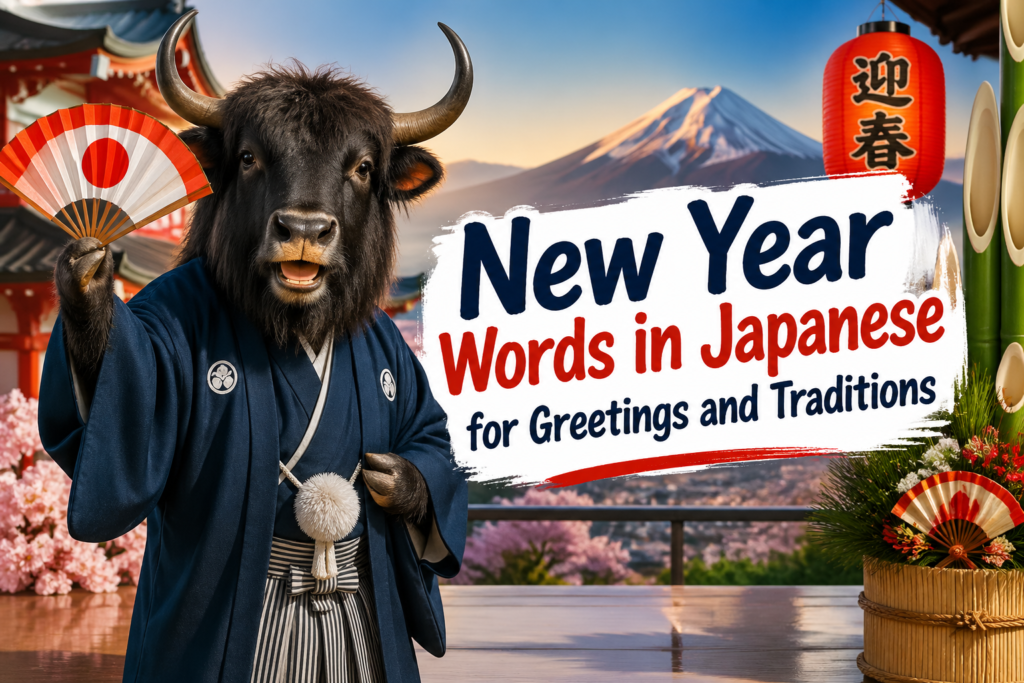
New Year in Japan is not just one party night with fireworks and a questionable hangover. It is a whole season of greetings, food, family visits, and small traditions that carry a lot of meaning. If you want to talk about it in Japanese, you need the right words. The good news: Japanese New Year language is very useful, and a lot of it shows up every January. The even better news: once you learn the basics, the rest starts to feel pretty friendly.
In Japanese, New Year is お正月 (Oshōgatsu), and people use special phrases for cards, visits, meals, and first traditions of the year. If you already know the greeting Happy New Year in Japanese, this article goes deeper into the words behind the holiday. For a broader language path, the Learn Japanese page is a useful stop too. Nobody needs to learn all of this at once, of course. Your brain is not a vending machine.
One fun thing: New Year is such an important event in Japan that even ordinary words can become holiday-specific. A simple “first” can turn into a whole cultural concept. Japanese loves that kind of thing. Efficient and dramatic. Honestly, impressive behavior.
Core New Year Words in Japanese
| Kanji / Kana | Rōmaji | English Meaning | Example Sentence | Rōmaji | Translation |
|---|---|---|---|---|---|
| お正月 | Oshōgatsu | New Year; New Year holiday season | お正月は家族と過ごします。 | Oshōgatsu wa kazoku to sugoshimasu. | I spend New Year with my family. |
| 新年 | Shinnen | New Year; new year period | 新年のお祝いをします。 | Shinnen no oiwai o shimasu. | We celebrate the New Year. |
| 元日 | Ganjitsu | January 1; New Year’s Day | 元日に初詣へ行きます。 | Ganjitsu ni hatsumōde e ikimasu. | We go to the shrine on New Year’s Day. |
| 年末 | Nenmatsu | Year-end | 年末はとても忙しいです。 | Nenmatsu wa totemo isogashii desu. | The year-end is very busy. |
| 年始 | Nenshi | Beginning of the year | 年始のあいさつをします。 | Nenshi no aisatsu o shimasu. | We make New Year greetings. |
| 初詣 | Hatsumōde | First shrine or temple visit of the year | 初詣でお守りを買います。 | Hatsumōde de omamori o kaimasu. | I buy a good-luck charm at the first shrine visit. |
| 年賀状 | Nengajō | New Year’s card | 年賀状を書きます。 | Nengajō o kakimasu. | I write New Year’s cards. |
| 干支 | Eto | Chinese zodiac sign | 今年の干支は何ですか。 | Kotoshi no eto wa nan desu ka. | What is this year’s zodiac sign? |
Useful Greetings For New Year
New Year greetings in Japanese are often polite, warm, and a little formulaic. That is not a flaw. It is tradition wearing a nice coat.
| Kanji / Kana | Rōmaji | English Meaning | Example Sentence | Rōmaji | Translation |
|---|---|---|---|---|---|
| あけましておめでとうございます | Akemashite omedetō gozaimasu | Happy New Year | あけましておめでとうございます。今年もよろしくお願いします。 | Akemashite omedetō gozaimasu. Kotoshi mo yoroshiku onegaishimasu. | Happy New Year. Please treat me well again this year. |
| 今年もよろしくお願いします | Kotoshi mo yoroshiku onegaishimasu | Please treat me well this year too | 今年もよろしくお願いします。 | Kotoshi mo yoroshiku onegaishimasu. | Please treat me well this year too. |
| 新年おめでとうございます | Shinnen omedetō gozaimasu | Happy New Year | 新年おめでとうございます。よい一年を。 | Shinnen omedetō gozaimasu. Yoi ichinen o. | Happy New Year. Have a good year. |
| よいお年を | Yoi otoshi o | Have a good New Year; have a good year-end | よいお年をお迎えください。 | Yoi otoshi o omukae kudasai. | Please welcome the New Year well. |
| 謹賀新年 | Kinga shinnen | Respectful New Year greeting | 謹賀新年と書いてあります。 | Kinga shinnen to kaite arimasu. | It says “Respectful New Year greeting.” |
| 迎春 | Geishun | Welcoming spring; New Year greeting | 迎春の飾りを見ました。 | Geishun no kazari o mimashita. | I saw New Year decorations. |
Tradition Words You Will Hear Every January
| Kanji / Kana | Rōmaji | English Meaning | Example Sentence | Rōmaji | Translation |
|---|---|---|---|---|---|
| おせち料理 | Osechi ryōri | Traditional New Year dishes | おせち料理を食べます。 | Osechi ryōri o tabemasu. | I eat traditional New Year dishes. |
| お雑煮 | Ozōni | New Year soup with mochi | お雑煮は地域で違います。 | Ozōni wa chiiki de chigaimasu. | Ozōni differs by region. |
| 鏡餅 | Kagami mochi | Decorative stacked rice cakes | 鏡餅を飾ります。 | Kagami mochi o kakazarimasu. | We display kagami mochi. |
| 門松 | Kadomatsu | Pine decoration placed at entrances | 門松が玄関にあります。 | Kadomatsu ga genkan ni arimasu. | There is a kadomatsu at the entrance. |
| しめ飾り | Shimekazari | New Year rope decoration | しめ飾りをドアに付けます。 | Shimekazari o doa ni tsukemasu. | I put shimekazari on the door. |
| お年玉 | Otoshidama | New Year gift money | 子どもはお年玉をもらいます。 | Kodomo wa otoshidama o moraimasu. | Children receive New Year money. |
| 初日の出 | Hatsuhinode | First sunrise of the year | 初日の出を見に行きます。 | Hatsuhinode o mi ni ikimasu. | We go to see the first sunrise. |
| 初売り | Hatsuuri | First sales of the year | 初売りで買い物をします。 | Hatsuuri de kaimono o shimasu. | I shop at the first sales of the year. |
Extra Words That Make Your Japanese Sound More Natural
| Kanji / Kana | Rōmaji | English Meaning | Example Sentence | Rōmaji | Translation |
|---|---|---|---|---|---|
| 年越し | Toshikoshi | Year-crossing; passing into the new year | 年越しそばを食べます。 | Toshikoshi soba o tabemasu. | I eat year-crossing soba noodles. |
| 年越しそば | Toshikoshi soba | New Year’s Eve soba noodles | 年越しそばは長生きの願いです。 | Toshikoshi soba wa chōiki no negai desu. | Toshikoshi soba is a wish for long life. |
| 大晦日 | Ōmisoka | New Year’s Eve | 大晦日に家で過ごします。 | Ōmisoka ni ie de sugoshimasu. | I spend New Year’s Eve at home. |
| 除夜の鐘 | Joyanokane | New Year’s Eve temple bells | 除夜の鐘を聞きます。 | Joyanokane o kikimasu. | I listen to the New Year’s Eve bells. |
| 初夢 | Hatsuyume | First dream of the year | 初夢に富士山が出ました。 | Hatsuyume ni Fujisan ga demashita. | Mt. Fuji appeared in my first dream. |
| 七福神 | Shichifukujin | Seven gods of fortune | 七福神は縁起がいいです。 | Shichifukujin wa engi ga ii desu. | The Seven Gods of Fortune are lucky. |
| お守り | Omamori | Good-luck charm | お守りを買いました。 | Omamori o kaimashita. | I bought a good-luck charm. |
| おみくじ | Omikuji | Fortune slip | おみくじを引きました。 | Omikuji o hikimashita. | I drew a fortune slip. |
Common Phrases At Shrine Visits And Holiday Meals
- 参拝 (Sampai) — shrine or temple visit
- 祈る (Inoru) — to pray
- 願う (Negau) — to wish for
- 健康 (Kenkō) — health
- 幸運 (Kōun) — good luck
- 家族 (Kazoku) — family
- 帰省 (Kisei) — returning to one’s hometown
- 休暇 (Kyūka) — vacation
- 祝い (Iwai) — celebration
- 新しい一年 (Atarashii ichinen) — a new year
Here are a few real-life sentences you can actually use. Simple, practical, and less awkward than staring at your shoes at a shrine.
| Kanji / Kana | Rōmaji | English Meaning | Example Sentence | Rōmaji | Translation |
|---|---|---|---|---|---|
| 初詣 | Hatsumōde | First shrine visit | 初詣で家族の健康を願います。 | Hatsumōde de kazoku no kenkō o negaimasu. | At the first shrine visit, I wish for my family’s health. |
| おみくじ | Omikuji | Fortune slip | おみくじは大吉でした。 | Omikuji wa daikichi deshita. | My fortune slip was great luck. |
| おせち料理 | Osechi ryōri | New Year dishes | おせち料理を少しずつ食べます。 | Osechi ryōri o sukoshi zutsu tabemasu. | I eat osechi dishes a little at a time. |
| お年玉 | Otoshidama | New Year money | お年玉をもらってうれしいです。 | Otoshidama o moratte ureshii desu. | I’m happy to receive New Year money. |
| 年賀状 | Nengajō | New Year card | 年賀状を友だちに出します。 | Nengajō o tomodachi ni dashimasu. | I send New Year cards to friends. |
| 元日 | Ganjitsu | January 1 | 元日は静かに過ごします。 | Ganjitsu wa shizuka ni sugoshimasu. | I spend New Year’s Day quietly. |
| 大晦日 | Ōmisoka | New Year’s Eve | 大晦日はそばを食べます。 | Ōmisoka wa soba o tabemasu. | On New Year’s Eve, I eat soba. |
| 初日の出 | Hatsuhinode | First sunrise | 初日の出を見るために早起きしました。 | Hatsuhinode o miru tame ni hayaoki shimashita. | I woke up early to see the first sunrise. |
Word Differences Worth Knowing
A few New Year words look similar, but they do not always mean the same thing. Japanese likes subtle differences. Very considerate. Very inconvenient.
| Word | Rōmaji | When To Use It | Quick Note |
|---|---|---|---|
| お正月 | Oshōgatsu | Holiday season around New Year | This is the broadest and most common word. |
| 元日 | Ganjitsu | January 1 only | Use this for the first day of the year. |
| 新年 | Shinnen | Formal “New Year” wording | Common in greetings and written language. |
| 年始 | Nenshi | Beginning of the year | Useful for business or formal New Year language. |
| 年末 | Nenmatsu | End of the year | This is the year-end period before New Year. |
Practice Time
Try swapping the words. Yes, it is mildly annoying. Yes, it works.
- Translate: “I eat New Year’s Eve soba.” → 大晦日に年越しそばを食べます。 (Ōmisoka ni toshikoshi soba o tabemasu.)
- Translate: “We visit a shrine on New Year’s Day.” → 元日に初詣に行きます。 (Ganjitsu ni hatsumōde ni ikimasu.)
- Translate: “I write New Year cards.” → 年賀状を書きます。 (Nengajō o kakimasu.)
- Translate: “I wish for health and happiness.” → 健康と幸運を願います。 (Kenkō to kōun o negaimasu.)
- Choose the best word: January 1 = 元日 / お正月 / 年末
- Choose the best word: New Year holiday season = お正月 / 年始 / 初売り
- Choose the best word: First shrine visit = 初詣 / お守り / お雑煮
Common Mistakes And Easy Fixes
| Common Mistake | Better Choice | Why |
|---|---|---|
| Using 元日 for the whole holiday season | Use お正月 | 元日 means January 1 only. |
| Using casual greetings in formal cards | Use あけましておめでとうございます | This is the safe, standard New Year greeting. |
| Forgetting 今年もよろしくお願いします | Add it after the greeting | It is extremely common in Japanese New Year speech. |
| Thinking お年玉 means a gift for adults too | Mostly for children | Adults do not usually expect it. |
| Mixing up 初詣 and 初日の出 | One is a shrine visit, one is a sunrise | They are both New Year traditions, but not the same one. |
If you want to read more about the holiday itself, the Japanese New Year has a detailed overview on Wikipedia. A little dry, sure, but useful in the way a well-made dictionary is useful.
New Year Japanese is not just vocabulary. It is a little map of how people greet, celebrate, and wish each other luck.
Quick Reference Summary
- お正月 (Oshōgatsu) = New Year holiday season
- 新年 (Shinnen) = New Year, formal
- 元日 (Ganjitsu) = January 1
- 初詣 (Hatsumōde) = first shrine visit
- 年賀状 (Nengajō) = New Year card
- お年玉 (Otoshidama) = New Year money for children
- おせち料理 (Osechi ryōri) = traditional New Year food
- お雑煮 (Ozōni) = mochi soup
- 大晦日 (Ōmisoka) = New Year’s Eve
- よいお年を (Yoi otoshi o) = have a good New Year / year-end
- 今年もよろしくお願いします (Kotoshi mo yoroshiku onegaishimasu) = please treat me well this year too
Once these New Year words in Japanese start clicking, the holiday stops feeling like a mystery and starts feeling like a very welcoming routine. That is the magic of learning real words in real context: you get the language and the culture at the same time, without having to pretend every textbook example is exciting. A rare win.
For a deeper next step, review the greeting page on Happy New Year in Japanese and then come back to these words until they feel familiar. After that, January vocabulary will not look so scary. It will just look seasonal.