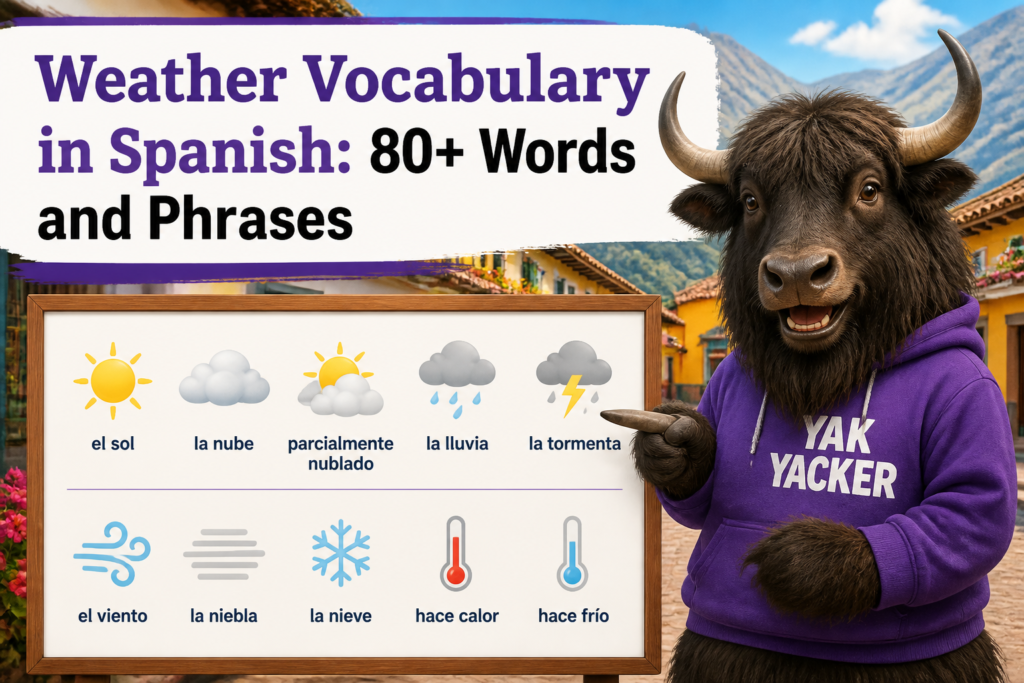
Weather vocabulary in Spanish is one of those topics that looks easy until the forecast starts throwing around words like está nublado, hay brisa, and se espera lluvia like everyone was born reading weather maps. This guide focuses on Mexican Spanish, with natural, everyday expressions you can actually use when talking about the sky, temperature, storms, and the general emotional instability of the weather.
For the broader learning path, visit our parent guide.
By the end, you’ll know how to say what the weather is doing, describe how it feels, and understand the most common forecast language without panicking at every cloudy sentence.
Quick note: in Spanish, weather often uses hacer and estar, and sometimes hay. That’s the trio. Tiny trio. Big attitude.
Weather Basics In Spanish
| Spanish | Pronunciation | Meaning | Example Sentence | Translation | Learner Note |
|---|---|---|---|---|---|
| Hace sol | AH-seh sohl | It’s sunny | Hoy hace sol y hace calor. | Today it’s sunny and hot. | Very common in Latin America. |
| Está nublado | ehs-TAH noo-BLAH-doh | It’s cloudy | Está nublado, pero no va a llover. | It’s cloudy, but it’s not going to rain. | Nublado describes the sky. |
| Está despejado | ehs-TAH dehs-peh-HAH-doh | It’s clear | Esta mañana está despejado. | This morning it’s clear. | Good for skies without clouds. |
| Hace frío | AH-seh FREE-oh | It’s cold | En la noche hace frío. | At night it’s cold. | Use hacer, not ser. |
| Hace calor | AH-seh kah-LOHR | It’s hot | En verano hace mucho calor. | In summer it’s very hot. | Very natural in Mexico and beyond. |
| Hace fresco | AH-seh FRES-koh | It’s cool / chilly | En la tarde hace fresco. | In the afternoon it’s cool. | Useful for mild weather. |
| Hay viento | AI YEN-toh | It’s windy / there is wind | Hoy hay mucho viento. | Today there’s a lot of wind. | Hay = there is/are. |
| Está lloviendo | ehs-TAH yoh-VYEN-doh | It’s raining | Está lloviendo fuerte. | It’s raining hard. | Use the present progressive. |
| Está nevando | ehs-TAH neh-VAHN-doh | It’s snowing | Está nevando en el norte. | It’s snowing in the north. | Less common in much of Mexico, but useful. |
| Está granizando | ehs-TAH grah-nee-ZAHN-doh | It’s hailing | Está granizando otra vez. | It’s hailing again. | Yes, weather can be dramatic. |
In Spanish, weather is often impersonal, which means the sentence does not need a specific subject. So instead of “the weather is hot,” you usually say Hace calor. Spanish keeps things efficient. English likes making weather sound like a small philosophy essay.
80+ Weather Words And Phrases You’ll Actually Use
Here’s the useful stuff: forecast words, sky words, storm words, and common phrases people say in real life in Mexico and other Spanish-speaking places.
Sunny, Cloudy, And Sky Words
| Spanish | Pronunciation | Meaning | Example Sentence | Translation | Learner Note |
|---|---|---|---|---|---|
| sol | sohl | sun | Hay mucho sol hoy. | There’s a lot of sun today. | Also means “sunny weather.” |
| soleado | soh-leh-AH-doh | sunny | El día está soleado. | The day is sunny. | Common in forecasts. |
| nube | NOO-beh | cloud | Veo una nube grande. | I see a big cloud. | Plural: nubes. |
| nublado | noo-BLAH-doh | cloudy | El cielo está nublado. | The sky is cloudy. | Very common adjective. |
| cielo | SYEH-loh | sky | El cielo está gris. | The sky is gray. | Also useful for talking about weather moods. |
| despejado | dehs-peh-HAH-doh | clear, cloudless | El cielo está despejado. | The sky is clear. | Common opposite of nublado. |
| gris | grees | gray | Hoy el cielo está gris. | Today the sky is gray. | Useful in forecasts and descriptions. |
| azul | ah-SOOL | blue | El cielo está azul y limpio. | The sky is blue and clear. | Nice simple description. |
| brillante | bree-YAHN-teh | bright, shining | El sol está muy brillante. | The sun is very bright. | Common with sunlight. |
| claridad | klah-ree-DAHD | brightness, clarity | Hay mucha claridad en la mañana. | There is a lot of brightness in the morning. | More descriptive, a bit literary. |
Heat, Cold, And Temperature Words
| Spanish | Pronunciation | Meaning | Example Sentence | Translation | Learner Note |
|---|---|---|---|---|---|
| calor | kah-LOHR | heat, hot weather | El calor está fuerte hoy. | The heat is intense today. | Very common noun. |
| frío | FREE-oh | cold | El frío llegó en la noche. | The cold arrived at night. | Also used in Hace frío. |
| fresco | FRES-koh | cool, fresh | La mañana está fresca. | The morning is cool. | Sounds mild, not freezing. |
| templado | tehm-PLAH-doh | mild, moderate | Hoy está templado. | It’s mild today. | Great word for in-between weather. |
| cálido | KAH-lee-doh | warm | El clima está cálido. | The weather is warm. | More formal than calientito. |
| caliente | kah-LYEN-teh | hot, warm | El agua está caliente. | The water is hot. | Often for objects, not weather. |
| helado | eh-LAH-doh | freezing, icy | Está helado afuera. | It’s freezing outside. | Strong cold. |
| temperatura | tehm-peh-rah-TOO-rah | temperature | La temperatura bajó mucho. | The temperature dropped a lot. | Forecast staple. |
| grado | GRAH-doh | degree | Hace 30 grados hoy. | It’s 30 degrees today. | In Mexico, degrees are usually Celsius. |
| bajo cero | BAH-ho SEH-roh | below zero | En las montañas está bajo cero. | In the mountains it’s below zero. | Handy for colder regions. |
Mexicans usually talk about temperature in grados Celsius, not Fahrenheit. So if someone says Hace 28 grados, they are not casually trying to roast you. That’s just normal weather talk.
Rain, Storms, And Moisture Words
| Spanish | Pronunciation | Meaning | Example Sentence | Translation | Learner Note |
|---|---|---|---|---|---|
| lluvia | YOO-vyah | rain | La lluvia comenzó temprano. | The rain started early. | The ll sound is often like “y” in Mexico. |
| llover | yoh-VEHR | to rain | Va a llover en la tarde. | It’s going to rain in the afternoon. | Very common verb. |
| llovizna | yoh-BEES-nah | drizzle | Hay una llovizna ligera. | There is a light drizzle. | Great forecast word. |
| chaparrón | chah-pah-RROHN | downpour, shower | Hubo un chaparrón fuerte. | There was a strong downpour. | Often short and sudden. |
| tormenta | tohr-MEHN-tah | storm | Se acerca una tormenta. | A storm is coming. | Formal enough for news and forecasts. |
| tormenta eléctrica | tohr-MEHN-tah eh-lehk-TREE-kah | thunderstorm | Hay tormenta eléctrica esta noche. | There is a thunderstorm tonight. | Very useful weather phrase. |
| trueno | TROO-eh-noh | thunder | Escuché un trueno fuerte. | I heard a loud thunderclap. | Rumble is a good mental image. |
| relámpago | reh-LAHM-pah-goh | lightning flash | Vi un relámpago en el cielo. | I saw lightning in the sky. | Different from trueno. |
| rayo | RAH-yoh | lightning bolt | Un rayo cayó cerca de la casa. | A lightning bolt struck near the house. | Can mean “bolt” in other contexts too. |
| humedad | oo-meh-DAHD | humidity, dampness | La humedad está muy alta. | The humidity is very high. | Important in tropical climates. |
Wind, Air, And Movement Words
| Spanish | Pronunciation | Meaning | Example Sentence | Translation | Learner Note |
|---|---|---|---|---|---|
| viento | BYEN-toh | wind | El viento está fuerte. | The wind is strong. | The v sounds like soft b. |
| brisa | BREE-sah | breeze | Hay una brisa agradable. | There is a pleasant breeze. | Light wind, nice for describing weather. |
| ráfaga | RAH-fah-gah | gust | Una ráfaga movió la puerta. | A gust moved the door. | Common in storms and forecasts. |
| corriente de aire | koh-ryEHN-teh deh AH-ee-reh | draft, air current | Hay una corriente de aire en la ventana. | There is a draft by the window. | Useful indoors too. |
| ventoso | behn-TOH-soh | windy | Está muy ventoso hoy. | It’s very windy today. | Adjective form of windy. |
| silbido del viento | seel-BEE-doh dehl BYEN-toh | whistling of the wind | Se escucha el silbido del viento. | You can hear the whistling of the wind. | More descriptive, a bit poetic. |
| corriente | koh-RYEN-teh | current, flow | La corriente de aire es fría. | The air current is cold. | Useful in weather and water talk. |
| moverse | moh-BEHR-seh | to move | Las ramas se mueven con el viento. | The branches move with the wind. | Reflexive verb, common in descriptions. |
| agitarse | ah-hee-TAR-seh | to shake, sway | Los árboles se agitan con la tormenta. | The trees sway in the storm. | More dramatic than moverse. |
| calma | KAL-mah | calm, calmness | Después de la lluvia, volvió la calma. | After the rain, calm returned. | Nice contrast with storms. |
Weather Conditions And Forecast Words
| Spanish | Pronunciation | Meaning | Example Sentence | Translation | Learner Note |
|---|---|---|---|---|---|
| clima | KLEE-mah | climate, weather | El clima está raro hoy. | The weather is weird today. | In daily speech, it often means “weather.” |
| pronóstico | prohn-NOHS-tee-koh | forecast | Vi el pronóstico del tiempo. | I saw the weather forecast. | Very useful news word. |
| tiempo | TYEM-poh | weather | ¿Cómo va a estar el tiempo mañana? | What will the weather be like tomorrow? | One of the most common words. |
| cambio de clima | KAHM-byoh deh KLEE-mah | change in weather | Hubo un cambio de clima en la tarde. | There was a change in the weather in the afternoon. | Natural in conversation. |
| frente frío | FREHN-teh FREE-oh | cold front | Llegó un frente frío al norte. | A cold front arrived in the north. | Common in Mexican weather reports. |
| baja presión | BAH-hah preh-SYOHN | low pressure | Hay baja presión en la zona. | There is low pressure in the area. | More meteorology vocabulary. |
| alta presión | AHL-tah preh-SYOHN | high pressure | La alta presión trae buen clima. | High pressure brings good weather. | Good for understanding forecasts. |
| se espera | seh ehs-PEH-rah | it is expected | Se espera lluvia por la tarde. | Rain is expected in the afternoon. | Very common forecast phrase. |
| va a haber | vah ah ah-BEHR | there will be / it’s going to be | Va a haber viento fuerte. | There’s going to be strong wind. | Built from haber. |
| alerta | ah-LER-tah | alert, warning | Hay alerta por tormenta. | There is a storm warning. | Important in news and safety info. |
Useful Weather Phrases For Real Life
These are the phrases people actually say when they’re looking out the window, checking their phone, or complaining in a very normal and not-at-all-theatrical way.
| Spanish | Pronunciation | Meaning | Example Sentence | Translation | Learner Note | More Spanish to explore
|---|