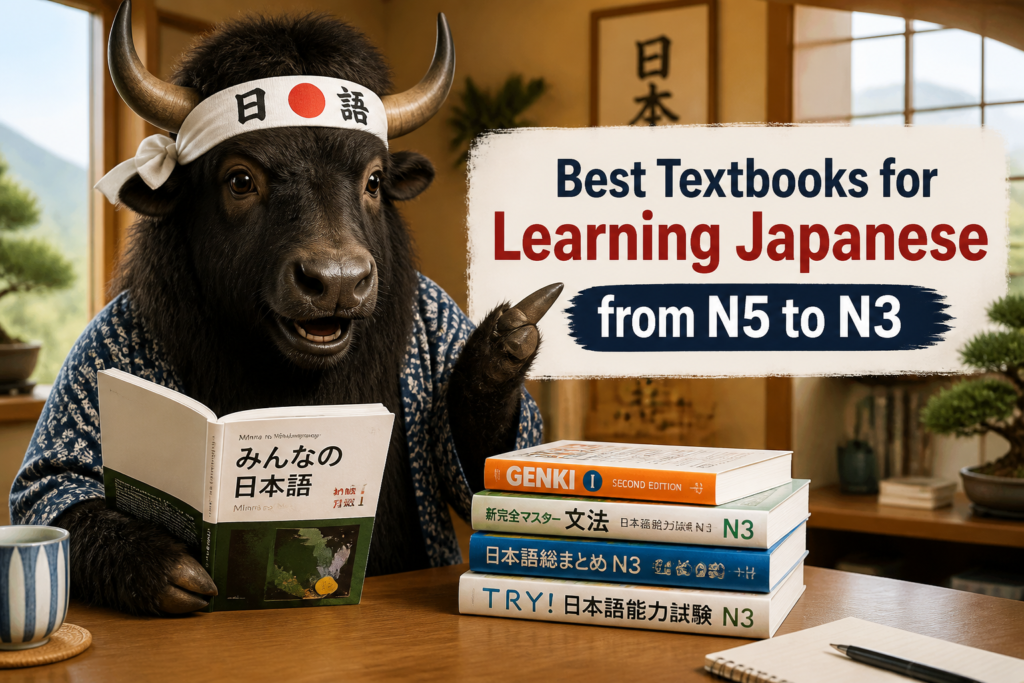
Choosing a Japanese textbook can feel like standing in front of a vending machine in Tokyo with 47 buttons, three blinking lights, and one tiny label you can almost read. Exciting? Yes. Mildly suspicious? Also yes.
This guide keeps it practical. We’ll look at the best textbooks for learning Japanese from beginner to intermediate, roughly from JLPT N5 to N3, and how to use them without collecting books like decorative guilt trophies.
If you are not sure where you sit yet, take the Japanese placement test for JLPT levels first. If vocabulary is your main fog machine, try the Japanese vocabulary test too.
Yak wisdom: the best textbook is not the one with the prettiest cover. It is the one you will actually open after work when your brain has become soup.
Quick Answer: Best Japanese Textbooks By Level
Here is the short version before we lovingly overthink everything. For most learners, Genki is the easiest beginner path, Minna no Nihongo is the strongest classroom-style path, Tobira Beginning Japanese is a newer and nicely structured option, and Quartet or Tobira Gateway are strong bridges into intermediate Japanese.
| Level | Best Main Textbook | Best For | Yak Notes |
|---|---|---|---|
| N5 Beginner | Genki I | Self-study, university-style learning, balanced skills | Friendly explanations, good exercises, not terrifying. A rare textbook miracle. |
| N5 Beginner | Minna no Nihongo I | Classroom learning, serious grammar drilling | Excellent, but you need the translation and grammar notes book unless you enjoy mystery as a lifestyle. |
| N5 to N4 | Tobira Beginning Japanese I | Modern structure, culture, communication | A polished newer series with a clear path and less dusty energy. |
| N4 | Genki II | Continuing from Genki I | The obvious next step if Genki I worked for you. |
| N4 to N3 | Quartet I | Intermediate reading, writing, grammar, speaking | Great after Genki II or similar. It starts asking you to actually use Japanese. Rude, but helpful. |
| N3 | Tobira: Gateway To Advanced Japanese | Reading-heavy intermediate growth | A classic bridge into real Japanese articles, essays, and longer texts. |
| N3 Exam Prep | Shin Kanzen Master N3 | JLPT-focused grammar, reading, listening, vocabulary | Excellent for test prep, but not a warm hug. More like a disciplined auntie. |
| N3 Exam Prep | Try! N3 | Grammar review with reading context | Gentler than Kanzen Master and useful if you want explanations plus practice. |
Before Buying: Learn These Japanese Study Words
Japanese textbooks throw around words like grammar, vocabulary, kanji, listening, and review constantly. Knowing these terms helps you understand book covers, chapter titles, and study plans without feeling personally attacked by the index.
| Kanji | Rōmaji | Meaning | Example Japanese | Example Rōmaji | English Translation |
|---|---|---|---|---|---|
| 日本語 | Nihongo | Japanese language | 私は日本語を勉強しています。 | Watashi wa Nihongo o benkyō shite imasu. | I am studying Japanese. |
| 教科書 | Kyōkasho | Textbook | この教科書は初心者にやさしいです。 | Kono kyōkasho wa shoshinsha ni yasashii desu. | This textbook is friendly for beginners. |
| 文法 | Bunpō | Grammar | 文法を毎日少し復習します。 | Bunpō o mainichi sukoshi fukushū shimasu. | I review a little grammar every day. |
| 単語 | Tango | Vocabulary word | 新しい単語をノートに書きます。 | Atarashii tango o nōto ni kakimasu. | I write new vocabulary words in a notebook. |
| 漢字 | Kanji | Chinese characters used in Japanese | 漢字は難しいですが、おもしろいです。 | Kanji wa muzukashii desu ga, omoshiroi desu. | Kanji is difficult, but interesting. |
| 読解 | Dokkai | Reading comprehension | 読解の練習をすると、長い文章に慣れます。 | Dokkai no renshū o suru to, nagai bunshō ni naremasu. | When you practice reading comprehension, you get used to long passages. |
| 聴解 | Chōkai | Listening comprehension | 聴解は毎日聞くことが大切です。 | Chōkai wa mainichi kiku koto ga taisetsu desu. | For listening comprehension, listening every day is important. |
| 会話 | Kaiwa | Conversation | 会話の練習で自然な日本語を覚えます。 | Kaiwa no renshū de shizen na Nihongo o oboemasu. | I learn natural Japanese through conversation practice. |
| 復習 | Fukushū | Review | 復習しないと、単語が逃げます。 | Fukushū shinai to, tango ga nigemasu. | If I do not review, vocabulary runs away. |
| 練習 | Renshū | Practice | 短い練習を毎日続けます。 | Mijikai renshū o mainichi tsuzukemasu. | I continue short practice every day. |
| 初心者 | Shoshinsha | Beginner | 初心者でもこの本は使いやすいです。 | Shoshinsha demo kono hon wa tsukaiyasui desu. | Even beginners can use this book easily. |
| 中級 | Chūkyū | Intermediate level | 中級になると、読む量が増えます。 | Chūkyū ni naru to, yomu ryō ga fuemasu. | When you reach intermediate level, the amount you read increases. |
What Makes A Good Japanese Textbook?
A good Japanese textbook does three things well: it explains clearly, gives enough practice, and builds skills in the right order. That sounds obvious, but some books behave like they were designed by a grammar goblin with a stopwatch.
For N5 to N3, you want a book that teaches grammar, vocabulary, kanji, reading, listening, and speaking in a balanced way. You do not need perfection. You need momentum.
| Feature | Why It Matters | Best Textbook Match |
|---|---|---|
| Clear English explanations | Helpful for self-study and fast understanding | Genki, Japanese From Zero!, Try! N3 |
| Lots of drills | Builds automatic grammar response | Minna no Nihongo, Shin Kanzen Master |
| Natural conversations | Prepares you for real speaking and listening | Genki, Tobira Beginning Japanese |
| Reading passages | Essential for moving from N4 to N3 | Quartet, Tobira Gateway, Try! N3 |
| Kanji support | Prevents kanji from becoming a haunted forest | Genki, Tobira, Basic Kanji Book |
| Audio access | Listening cannot be learned from paper alone, because paper is quiet and unhelpful | Genki, Minna no Nihongo, Tobira, Quartet |
Best Beginner Textbook: Genki I And Genki II
Genki I and Genki II are probably the safest recommendation for most beginners. They are widely used in universities, easy to self-study with, and balanced enough that you do not accidentally become a person who can conjugate verbs but cannot order lunch.
Genki I roughly covers N5 material. Genki II pushes into N4. Together, they give you a strong base in sentence patterns, everyday conversation, kanji, listening, and reading.
Use Genki if you like structure, friendly explanations, and exercises that feel manageable. It is especially good if you are learning alone and want a clear path from zero to early intermediate.
| Book | Level | Strengths | Possible Weakness |
|---|---|---|---|
| Genki I | N5 | Excellent beginner explanations, useful dialogues, good workbook | Some classroom-style pair activities need adapting for solo learners |
| Genki II | N4 | Continues smoothly, more kanji and complex grammar | Still not enough reading volume by itself for N3 |
If you are starting from absolute zero, it also helps to build a small survival base before diving into textbook chapters. Try 100 Japanese words and phrases to start learning and essential Japanese phrases alongside your first few lessons.
Best Serious Beginner Textbook: Minna No Nihongo
Minna no Nihongo is a classic. It is rigorous, practical, and very popular in language schools. It also has one famous little trick: the main textbook is mostly in Japanese. Surprise. The book has chosen violence.
That is why many learners also need the translation and grammar notes book. With that companion volume, Minna no Nihongo becomes much more approachable and very effective.
Use Minna no Nihongo if you like repetition, strong grammar drills, and a classroom-style method. It is less chatty than Genki, but it builds a sturdy foundation. Think concrete, not cushions.
| Book | Level | Strengths | Possible Weakness |
|---|---|---|---|
| Minna no Nihongo I | N5 | Excellent drilling, practical grammar, strong classroom use | Needs companion translation book for most self-learners |
| Minna no Nihongo II | N4 | Solid continuation, lots of pattern practice | Can feel dry without speaking practice or extra reading |
Best Modern Beginner Path: Tobira Beginning Japanese
Tobira Beginning Japanese is a newer beginner series from the same broad family of learning as the well-known intermediate Tobira book. It has a modern feel, clear design, and strong support for communication and culture.
This series is good if Genki feels a little too classroom-traditional but you still want a serious structure. It is not a shortcut. It is more like a cleaner map with fewer coffee stains.
| Book | Level | Strengths | Best Learner Type |
|---|---|---|---|
| Tobira Beginning Japanese I | N5 | Modern layout, integrated skills, culture notes | Learners who want a fresh beginner course |
| Tobira Beginning Japanese II | N4 | Good bridge toward intermediate reading and communication | Learners planning to continue into Tobira or Quartet |
Best Gentle Beginner Option: Japanese From Zero!
Japanese From Zero! is friendly, slow, and beginner-focused. It introduces Japanese gradually, which can be wonderful if hiragana, particles, and basic sentence order are all arriving at your brain at the same time like uninvited guests.
It may feel too slow for ambitious learners, but that is not always a bad thing. Slow and consistent beats fast and mysteriously absent after three weeks.
Use it if you want hand-holding at the beginning. If you already know hiragana, katakana, and basic sentence patterns, Genki or Tobira may be more efficient.
Best Bridge To Intermediate: Quartet I
Quartet I is one of the best choices after Genki II, Minna no Nihongo II, or another N4-level foundation. It is designed for intermediate learners and focuses on reading, writing, speaking, and listening together.
The jump from beginner to intermediate Japanese is real. Beginner books often give you neat sentences. Intermediate books start handing you longer paragraphs and asking, “So, what do you think?” Very bold.
Quartet helps with that jump because it gives structure. You get grammar, readings, exercises, and communication tasks without being thrown straight into a newspaper article about tax reform. Thank goodness.
| Book | Level | Strengths | Use It When |
|---|---|---|---|
| Quartet I | N3 foundation | Balanced intermediate skills, good writing and reading support | You finished Genki II or similar N4 material |
| Quartet II | Upper N3 to N2 direction | More advanced texts and expression practice | You want to keep moving beyond N3 |
Best Classic Intermediate Book: Tobira Gateway To Advanced Japanese
Tobira: Gateway to Advanced Japanese has been a popular intermediate textbook for years. It is reading-heavy, content-rich, and excellent for learners who want to move beyond textbook dialogues into longer, more natural Japanese.
It is best after you already know the basics well. If you still feel shaky with particles, verb forms, and common N4 grammar, Tobira may feel like being asked to jog uphill while carrying groceries.
Use Tobira when you are ready for longer readings, culture topics, more kanji, and a stronger N3-level challenge. It pairs nicely with grammar review and vocabulary drilling.
Best JLPT N3 Prep Books
Once you are targeting N3, a general textbook may not be enough. The JLPT rewards speed, recognition, reading stamina, and listening accuracy. In other words, it rewards the exact skills that disappear when you say, “I’ll just review later.”
For N3 exam prep, the big names are Shin Kanzen Master, Try! N3, and So-Matome N3. Each has a different personality.
| Series | Best For | Strengths | Watch Out For |
|---|---|---|---|
| Shin Kanzen Master N3 | Serious JLPT prep | Strong drills, exam-style questions, excellent reading and grammar practice | Can feel intense if your foundation is weak |
| Try! N3 | Grammar with context | Clearer explanations, readings built around grammar points | Less drill-heavy than Kanzen Master |
| So-Matome N3 | Light review and daily study | Easy schedule, approachable layout | May be too light as your only N3 prep source |
If the test is your goal, mix one general intermediate book with one JLPT prep series. For example: Quartet I plus Shin Kanzen Master Grammar and Reading. That combination is not cute, but it works.
Useful Japanese Phrases For Textbook Study
These phrases will help you talk about studying, ask questions, and understand instructions. They are also the kind of everyday study Japanese that quietly appears everywhere.
| Kanji | Rōmaji | Meaning | Example Japanese | Example Rōmaji | English Translation |
|---|---|---|---|---|---|
| 勉強します | Benkyō shimasu | To study | 毎晩三十分日本語を勉強します。 | Maiban sanjuppun Nihongo o benkyō shimasu. | I study Japanese for thirty minutes every night. |
| 読みます | Yomimasu | To read | 新しい課を読む前に単語を見ます。 | Atarashii ka o yomu mae ni tango o mimasu. | I look at the vocabulary before reading the new lesson. |
| 書きます | Kakimasu | To write | 漢字を十回書きます。 | Kanji o jikkai kakimasu. | I write the kanji ten times. |
| 聞きます | Kikimasu | To listen; to ask | 音声を聞いて、会話をまねします。 | Onsei o kiite, kaiwa o mane shimasu. | I listen to the audio and imitate the conversation. |
| 話します | Hanashimasu | To speak | 友達と日本語で話します。 | Tomodachi to Nihongo de hanashimasu. | I speak Japanese with a friend. |
| 覚えます | Oboemasu | To memorize; to remember | 今日、二十個の単語を覚えます。 | Kyō, nijukko no tango o oboemasu. | Today, I will memorize twenty vocabulary words. |
| 忘れます | Wasuremasu | To forget | 復習しないと、文法を忘れます。 | Fukushū shinai to, bunpō o wasuremasu. | If I do not review, I forget grammar. |
| 質問があります | Shitsumon ga arimasu | I have a question | 先生、質問があります。 | Sensei, shitsumon ga arimasu. | Teacher, I have a question. |
| もう一度お願いします | Mō ichido onegai shimasu | One more time, please | すみません、もう一度お願いします。 | Sumimasen, mō ichido onegai shimasu. | Excuse me, one more time, please. |
| 分かりません | Wakarimasen | I do not understand | この文法がまだ分かりません。 | Kono bunpō ga mada wakarimasen. | I still do not understand this grammar. |
| 分かりました | Wakarimashita | I understood; got it | 説明を聞いて、分かりました。 | Setsumei o kiite, wakarimashita. | I listened to the explanation and understood. |
| 例文を作ります | Reibun o tsukurimasu | To make an example sentence | 新しい文法で例文を作ります。 | Atarashii bunpō de reibun o tsukurimasu. | I make an example sentence with the new grammar. |
Best Textbook Path From N5 To N3
You do not need every book. Please do not build a shrine of untouched Japanese textbooks. A clean path beats a giant pile.
Here are three simple routes depending on your learning style.
| Learning Style | N5 | N4 | N3 | Best Add-On |
|---|---|---|---|---|
| Balanced self-study | Genki I | Genki II | Quartet I | Shin Kanzen Master N3 Grammar or Reading |
| Serious classroom-style study | Minna no Nihongo I | Minna no Nihongo II | Tobira Gateway | Basic Kanji Book or JLPT drill books |
| Modern structured path | Tobira Beginning Japanese I | Tobira Beginning Japanese II | Quartet I or Tobira Gateway | Try! N3 |
| Gentle start | Japanese From Zero! 1–2 | Genki I–II or Tobira Beginning | Quartet I | Extra kanji and reading practice |
How To Use A Japanese Textbook Without Burning Out
A textbook is a tool, not a personality test. You do not have to do every exercise perfectly before moving on. You need enough understanding to keep building.
- Read the dialogue or passage once without panicking. Panicking is not a reading strategy, despite its popularity.
- Learn the core vocabulary before attacking the grammar notes.
- Study one or two grammar points at a time and make your own sentences.
- Use the audio. Listening practice is not optional unless your goal is silent Japanese, which is mostly useful for menus.
- Review old lessons weekly. Japanese rewards review more than heroic one-day study marathons.
- Add real-world input slowly: graded readers, easy podcasts, short videos, and simple articles.
If you want a broader learning route with guides and beginner resources, visit the main Learn Japanese hub. It is a much better plan than shouting “kanji!” into the void and hoping the void teaches stroke order.
Common Mistakes When Choosing Japanese Textbooks
Most textbook mistakes are not dramatic. They are small, sneaky, and usually involve buying one more book instead of finishing chapter six.
| Mistake | Why It Hurts | Better Move |
|---|---|---|
| Buying too many beginner books | You repeat introductions but never reach intermediate grammar | Choose one main course and finish it |
| Skipping audio | Your reading improves, but listening stays frozen | Listen before and after reading each dialogue |
| Only studying grammar | You understand rules but cannot use them quickly | Make example sentences and speak out loud |
| Ignoring kanji until later | Intermediate reading becomes painfully slow | Learn kanji gradually from N5 onward |
| Jumping into N3 too early | You waste time fighting material you are not ready for | Review N4 grammar and vocabulary first |
| Using JLPT prep as your only textbook | You may pass drills but lack communication practice | Combine JLPT books with a general course book |
What About Kanji Textbooks?
For N5 to N3, kanji needs its own attention. Main textbooks include kanji, but many learners benefit from a dedicated kanji book or system. Good options include Basic Kanji Book, Kanji Look and Learn, and kanji sections inside Genki or Tobira.
The key is not to learn kanji as lonely museum artifacts. Learn them inside words. For example, 学 means study or learning, but it becomes useful faster when you learn words like 学生 and 学校.
| Kanji Word | Rōmaji | Meaning | Example Japanese | Example Rōmaji | English Translation |
|---|---|---|---|---|---|
| 学生 | Gakusei | Student | 私は日本語の学生です。 | Watashi wa Nihongo no gakusei desu. | I am a student of Japanese. |
| 学校 | Gakkō | School | 学校で日本語を勉強しました。 | Gakkō de Nihongo o benkyō shimashita. | I studied Japanese at school. |
| 先生 | Sensei | Teacher | 先生に文法を聞きました。 | Sensei ni bunpō o kikimashita. | I asked the teacher about grammar. |
| 毎日 | Mainichi | Every day | 毎日少し漢字を読みます。 | Mainichi sukoshi kanji o yomimasu. | I read a little kanji every day. |
| 問題 | Mondai | Question; problem | この問題は少し難しいです。 | Kono mondai wa sukoshi muzukashii desu. | This question is a little difficult. |
When Are You Ready To Move From N4 To N3?
You are probably ready to begin N3 material when you can read basic passages without translating every single word, understand common verb forms, recognize a few hundred kanji, and survive everyday conversations if people speak clearly.
You do not need to feel “ready-ready.” Nobody feels ready for intermediate Japanese. Intermediate Japanese arrives wearing boots and carrying longer sentences.
- You can understand most N5 and N4 grammar when you see it.
- You know common particles like は, が, を, に, で, と, から, and まで in basic sentences.
- You can read short textbook passages with a dictionary nearby, not glued to your face.
- You can listen to beginner dialogues and catch the main idea.
- You are willing to review. This one is annoyingly powerful.
Quick Reference: Which Japanese Textbook Should You Buy?
| If You Want… | Choose… | Why |
|---|---|---|
| The safest beginner choice | Genki I and Genki II | Clear, balanced, self-study friendly |
| A rigorous classroom-style course | Minna no Nihongo I and II | Strong drills and serious structure |
| A modern beginner series | Tobira Beginning Japanese | Fresh design and integrated skills |
| A gentle first step | Japanese From Zero! | Slow, friendly, and beginner-safe |
| A bridge into intermediate Japanese | Quartet I | Excellent after N4-level textbooks |
| A classic intermediate challenge | Tobira Gateway | Strong reading and culture content |
| Focused N3 exam prep | Shin Kanzen Master N3 | Deep JLPT-style practice |
| Gentler N3 grammar review | Try! N3 | Context-based grammar explanations |
Yak Takeaway
The best textbooks for learning Japanese from beginner to intermediate are the ones that match your study style and keep you moving. For most learners, start with Genki I, continue with Genki II, then move into Quartet I or Tobira Gateway. If your goal is the JLPT N3, add Try! N3 or Shin Kanzen Master N3 once your foundation is solid.
One textbook path. Daily review. Audio practice. Example sentences. That is the unglamorous formula. Sadly, it works.
Start small, keep going, and let the textbook become a ladder instead of a very expensive coaster.