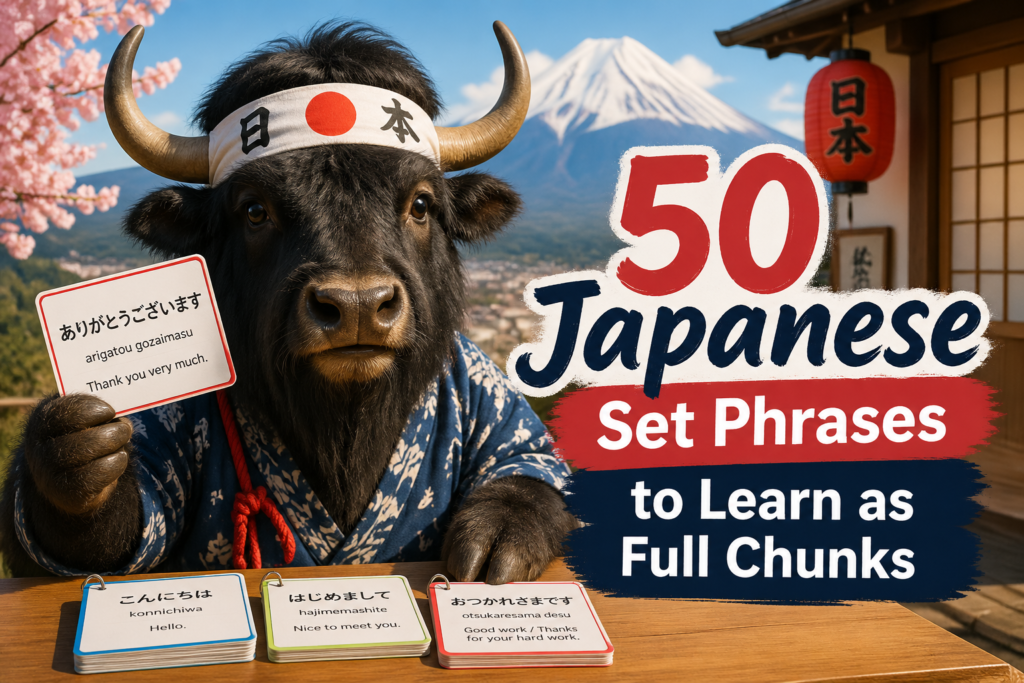
50 Common Japanese Set Phrases You Should Learn as Full Chunks are the kind of expressions that make Japanese feel less like a pile of words and more like, well, actual Japanese. Handy. Slightly magical. Much less painful than translating every single piece in your head.
If you have ever frozen mid-conversation because your brain was busy doing grammar Sudoku, set phrases are your rescue rope. Japanese speakers use these chunks all the time, and learning them whole makes your speech faster, smoother, and much more natural. Tiny win, big payoff.
For a bigger map of the language, this lesson fits nicely with the main Japanese learning guide. And if you want to compare sentence patterns later, the page on questions in Japanese is a very good next stop.
Useful Set Phrases You Will Hear All The Time
| Japanese | Rōmaji | English Meaning | Example Sentence |
|---|---|---|---|
| おはようございます | Ohayō gozaimasu | Good morning | おはようございます。 Ohayō gozaimasu. Good morning. |
| こんにちは | Konnichiwa | Hello / Good afternoon | こんにちは。 Konnichiwa. Hello. |
| こんばんは | Konbanwa | Good evening | こんばんは。 Konbanwa. Good evening. |
| ありがとうございます | Arigatō gozaimasu | Thank you very much | ありがとうございます。 Arigatō gozaimasu. Thank you very much. |
| すみません | Sumimasen | Excuse me / Sorry / Thank you for helping me | すみません、駅はどこですか。 Sumimasen, eki wa doko desu ka. Excuse me, where is the station? |
| よろしくお願いします | Yoroshiku onegaishimasu | Please be kind to me / Nice to meet you / I’m counting on you | はじめまして。よろしくお願いします。 Hajimemashite. Yoroshiku onegaishimasu. Nice to meet you. Please be kind to me. |
| お疲れ様です | Otsukaresama desu | Thanks for your hard work | お疲れ様です。 Otsukaresama desu. Thanks for your hard work. |
| いただきます | Itadakimasu | Let’s eat / I gratefully receive this meal | いただきます。 Itadakimasu. Let’s eat. |
| ごちそうさまでした | Gochisōsama deshita | Thanks for the meal | ごちそうさまでした。 Gochisōsama deshita. Thanks for the meal. |
| 大丈夫です | Daijōbu desu | I’m okay / It’s fine / No thanks | 水はいりますか。— 大丈夫です。 Mizu wa irimasu ka. — Daijōbu desu. Do you want water? — No thanks. |
That first batch already does a lot of heavy lifting. Japanese is full of these “whole piece” expressions, and they often mean more than the literal words suggest. Annoying? A little. Useful? Extremely.
More Everyday Phrases For Real Life
| Japanese | Rōmaji | English Meaning | Example Sentence |
|---|---|---|---|
| お願いします | Onegaishimasu | Please | 水をお願いします。 Mizu o onegaishimasu. Water, please. |
| どうぞ | Dōzo | Please go ahead / Here you are | どうぞ、座ってください。 Dōzo, suwatte kudasai. Please, have a seat. |
| どういたしまして | Dōitashimashite | You’re welcome | ありがとう。— どういたしまして。 Arigatō. — Dōitashimashite. Thanks. — You’re welcome. |
| ちょっと待ってください | Chotto matte kudasai | Please wait a moment | ちょっと待ってください。 Chotto matte kudasai. Please wait a moment. |
| わかりました | Wakarimashita | Understood / I understand | はい、わかりました。 Hai, wakarimashita. Yes, I understand. |
| わかりません | Wakarimasen | I don’t understand | すみません、わかりません。 Sumimasen, wakarimasen. Sorry, I don’t understand. |
| もう一度お願いします | Mō ichido onegaishimasu | One more time, please | もう一度お願いします。 Mō ichido onegaishimasu. One more time, please. |
| 大丈夫ですか | Daijōbu desu ka | Are you okay? | 大丈夫ですか。 Daijōbu desu ka. Are you okay? |
| 問題ありません | Mondai arimasen | No problem | 問題ありません。 Mondai arimasen. No problem. |
| 気をつけて | Ki o tsukete | Take care / Be careful | 気をつけて帰ってください。 Ki o tsukete kaette kudasai. Please go home safely. |
Useful Survival Phrases
| Japanese | Rōmaji | English Meaning | Example Sentence |
|---|---|---|---|
| 〜はどこですか | ~ wa doko desu ka | Where is ~? | トイレはどこですか。 Toire wa doko desu ka. Where is the toilet? |
| 〜がありますか | ~ ga arimasu ka | Do you have ~? / Is there ~? | メニューがありますか。 Menyū ga arimasu ka. Do you have a menu? |
| これをください | Kore o kudasai | I’ll take this / Please give me this | これをください。 Kore o kudasai. I’ll take this. |
| 〜してもいいですか | ~ shite mo ii desu ka | May I ~? | 写真を撮ってもいいですか。 Shashin o totte mo ii desu ka. May I take a photo? |
| 英語を話せますか | Eigo o hanasemasu ka | Do you speak English? | すみません、英語を話せますか。 Sumimasen, eigo o hanasemasu ka. Excuse me, do you speak English? |
| 助けてください | Tasukete kudasai | Please help me | 助けてください。 Tasukete kudasai. Please help me. |
| 急いでいます | Isoide imasu | I’m in a hurry | すみません、急いでいます。 Sumimasen, isoide imasu. Sorry, I’m in a hurry. |
| ここで待っています | Koko de matte imasu | I’m waiting here | ここで待っています。 Koko de matte imasu. I’m waiting here. |
| お名前は何ですか | Onamae wa nan desu ka | What is your name? | お名前は何ですか。 Onamae wa nan desu ka. What is your name? |
| はじめまして | Hajimemashite | Nice to meet you | はじめまして。山田です。 Hajimemashite. Yamada desu. Nice to meet you. I’m Yamada. |
Small But Important Nuances
Some Japanese set phrases are not “literal” in the English sense. That is normal. Japanese likes context, and context likes to hide in plain sight.
すみません
Sumimasen
means more than “sorry.” It can also mean “excuse me” or even “thank you for going out of your way.” Yes, one phrase can do three jobs. Very efficient. Very rude to your beginner brain.
よろしくお願いします
Yoroshiku onegaishimasu
is another famous chunky phrase. It is used when meeting someone, making a request, joining a group, or asking for help. There is no perfect one-word English equivalent, which is exactly why it is worth learning as a full piece.
In Japanese, learning whole chunks is not lazy. It is smart. The language has plenty of fixed expressions, and native speakers use them without breaking them into little grammar crumbs every time.
50 Phrase Starter Pack
Here is a bigger list of common set phrases you will keep meeting. Learn them as chunks first, then worry about the fine print later.
| Japanese | Rōmaji | Meaning | Example |
|---|---|---|---|
| おはようございます | Ohayō gozaimasu | Good morning | おはようございます。 Ohayō gozaimasu. Good morning. |
| こんにちは | Konnichiwa | Hello | こんにちは。 Konnichiwa. Hello. |
| こんばんは | Konbanwa | Good evening | こんばんは。 Konbanwa. Good evening. |
| おやすみなさい | Oyasumi nasai | Good night | おやすみなさい。 Oyasumi nasai. Good night. |
| ありがとうございます | Arigatō gozaimasu | Thank you very much | ありがとうございます。 Arigatō gozaimasu. Thank you very much. |
| すみません | Sumimasen | Excuse me / Sorry | すみません。 Sumimasen. Excuse me. |
| よろしくお願いします | Yoroshiku onegaishimasu | Please treat me well / Nice to meet you | よろしくお願いします。 Yoroshiku onegaishimasu. Nice to meet you. |
| お疲れ様です | Otsukaresama desu | Thanks for your hard work | お疲れ様です。 Otsukaresama desu. Thanks for your hard work. |
| いただきます | Itadakimasu | Let’s eat | いただきます。 Itadakimasu. Let’s eat. |
| ごちそうさまでした | Gochisōsama deshita | Thanks for the meal | ごちそうさまでした。 Gochisōsama deshita. Thanks for the meal. |
| 大丈夫です | Daijōbu desu | I’m okay / No thanks | 大丈夫です。 Daijōbu desu. I’m okay. |
| お願いします | Onegaishimasu | Please | 水をお願いします。 Mizu o onegaishimasu. Water, please. |
| どうぞ | Dōzo | Please go ahead | どうぞ。 Dōzo. Please go ahead. |
| どういたしまして | Dōitashimashite | You’re welcome | どういたしまして。 Dōitashimashite. You’re welcome. |
| ちょっと待ってください | Chotto matte kudasai | Please wait a moment | ちょっと待ってください。 Chotto matte kudasai. Please wait a moment. |
| わかりました | Wakarimashita | I understand | わかりました。 Wakarimashita. I understand. |
| わかりません | Wakarimasen | I don’t understand | わかりません。 Wakarimasen. I don’t understand. |
| もう一度お願いします | Mō ichido onegaishimasu | Once more, please | もう一度お願いします。 Mō ichido onegaishimasu. Once more, please. |
| 大丈夫ですか | Daijōbu desu ka | Are you okay? | 大丈夫ですか。 Daijōbu desu ka. Are you okay? |
| 問題ありません | Mondai arimasen | No problem | 問題ありません。 Mondai arimasen. No problem. |
| 気をつけて | Ki o tsukete | Take care | 気をつけて。 Ki o tsukete. Take care. |
| トイレはどこですか | Toire wa doko desu ka | Where is the toilet? | トイレはどこですか。 Toire wa doko desu ka. Where is the toilet? |
| 駅はどこですか | Eki wa doko desu ka | Where is the station? | 駅はどこですか。 Eki wa doko desu ka. Where is the station? |
| これをください | Kore o kudasai | I’ll take this | これをください。 Kore o kudasai. I’ll take this. |
| 英語を話せますか | Eigo o hanasemasu ka | Do you speak English? | 英語を話せますか。 Eigo o hanasemasu ka. Do you speak English? |
| 助けてください | Tasukete kudasai | Please help me | 助けてください。 Tasukete kudasai. Please help me. |
| 急いでいます | Isoide imasu | I’m in a hurry | 急いでいます。 Isoide imasu. I’m in a hurry. |
| もう少しゆっくりお願いします | Mō sukoshi yukkuri onegaishimasu | Please speak a little more slowly | もう少しゆっくりお願いします。 Mō sukoshi yukkuri onegaishimasu. Please speak a little more slowly. |
| 写真を撮ってもいいですか | Shashin o totte mo ii desu ka | May I take a photo? | 写真を撮ってもいいですか。 Shashin o totte mo ii desu ka. May I take a photo? |
| 何時ですか | Nanji desu ka | What time is it? | 今、何時ですか。 Ima, nanji desu ka. What time is it now? |
| もう一回言ってください | Mō ikkai itte kudasai | Please say it again | もう一回言ってください。 Mō ikkai itte kudasai. Please say it again. |
| お名前は何ですか | Onamae wa nan desu ka | What is your name? | お名前は何ですか。 Onamae wa nan desu ka. What is your name? |
| はじめまして | Hajimemashite | Nice to meet you | はじめまして。 Hajimemashite. Nice to meet you. |
| ここで待っています | Koko de matte imasu | I’m waiting here | ここで待っています。 Koko de matte imasu. I’m waiting here. |
| 少々お待ちください | Shōshō omachi kudasai | Please wait a moment | 少々お待ちください。 Shōshō omachi kudasai. Please wait a moment. |
| 失礼します | Shitsurei shimasu | Excuse me / Pardon me | 失礼します。 Shitsurei shimasu. Excuse me. |
| お先に失礼します | Osaki ni shitsurei shimasu | I’ll leave before you | お先に失礼します。 Osaki ni shitsurei shimasu. I’ll leave first. |
| 行ってきます | Ittekimasu | I’m off / I’ll go and come back | 行ってきます。 Ittekimasu. I’m off. |
| 行ってらっしゃい | Itterasshai | Take care, go and come back | 行ってらっしゃい。 Itterasshai. Take care, go and come back. |
| ただいま | Tadaima | I’m home | ただいま。 Tadaima. I’m home. |
| おかえりなさい | Okaerinasai | Welcome home | おかえりなさい。 Okaerinasai. Welcome home. |
| 頑張ってください | Ganbatte kudasai | Please do your best | 試験、頑張ってください。 Shiken, ganbatte kudasai. Good luck on the exam. |
| おめでとうございます | Omedetō gozaimasu | Congratulations | おめでとうございます。 Omedetō gozaimasu. Congratulations. |
| 気にしないでください | Ki ni shinaide kudasai | Please don’t worry about it | 気にしないでください。 Ki ni shinaide kudasai. Please don’t worry about it. |
| またね | Mata ne | See you later | またね。 Mata ne. See you later. |
Quick Practice
- Say “good morning” out loud: おはようございます
Ohayō gozaimasu - Ask for something politely: 〜をお願いします
~ o onegaishimasu - Ask where something is: 〜はどこですか
~ wa doko desu ka - Say you do not understand: わかりません
Wakarimasen - Thank someone for a meal: ごちそうさまでした
Gochisōsama deshita - Ask someone to repeat: もう一度お願いします
Mō ichido onegaishimasu
Try this trick: do not learn just the dictionary meaning. Learn the situation too. That is how a phrase like 大丈夫です
Daijōbu desu
can mean “I’m fine,” “No thanks,” or “It’s okay” without breaking a sweat.
Common Mistakes And Easy Fixes
| Common Mistake | Better Version | Why It Helps |
|---|---|---|
| Learning よろしくお願いします word by word | Learn it as one fixed phrase | The meaning changes with context, so chunk learning works better |
| Using すみません only as “sorry” | Use it for “excuse me” too | It is often the most natural way to get attention politely |
| Saying only ありがとう in formal situations | Use ありがとうございます Arigatō gozaimasu | It sounds more polite and more appropriate in many settings |
| Trying to translate every phrase literally | Learn the function of the phrase | Function is usually the real meaning in daily Japanese |
| Forgetting Rōmaji pronunciation | Practice the whole chunk aloud | Memory sticks better when your mouth joins the lesson |
Quick Reference Summary
Here is the short version, in case your brain is already politely asking for a snack.
- Greetings: おはようございます
Ohayō gozaimasu, こんにちは
Konnichiwa, こんばんは
Konbanwa - Polite basics: ありがとうございます
Arigatō gozaimasu, すみません
Sumimasen, お願いします
Onegaishimasu - Useful responses: わかりました
Wakarimashita, わかりません
Wakarimasen, 大丈夫です
Daijōbu desu - Travel and survival: 〜はどこですか
~ wa doko desu ka, 英語を話せますか
Eigo o hanasemasu ka, 助けてください
Tasukete kudasai - Everyday manners: いただきます
Itadakimasu, ごちそうさまでした
Gochisōsama deshita, お疲れ様です
Otsukaresama desu
The real trick is simple: collect these phrases as whole chunks, use them in real situations, and let your brain build the grammar behind the scenes. Japanese gets a lot less scary when you stop trying to assemble every sentence like flat-pack furniture with missing screws.