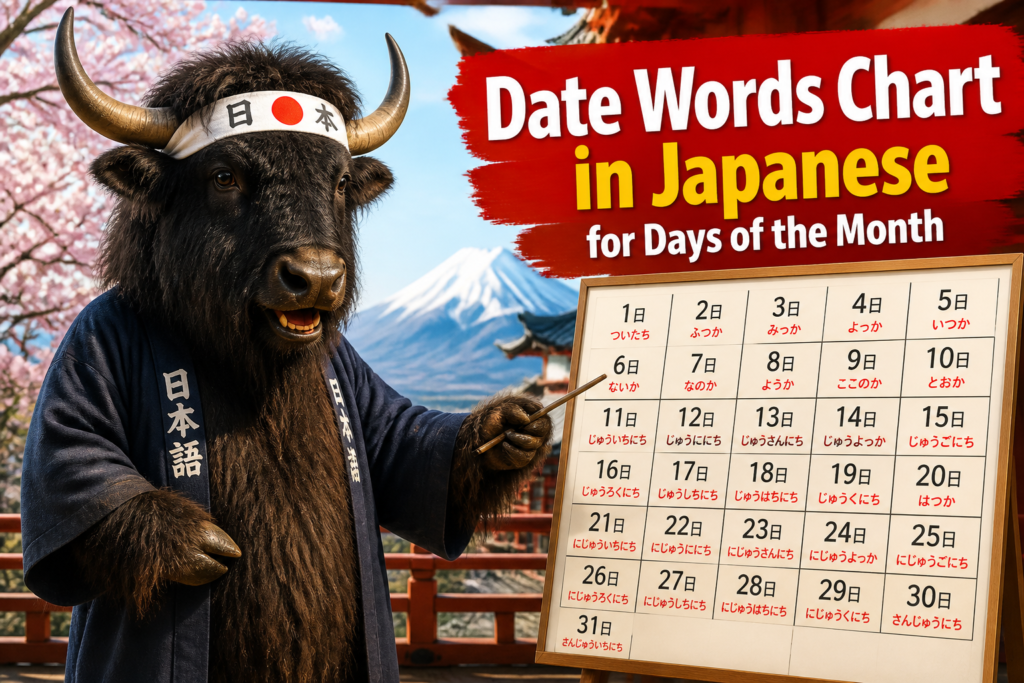
Japanese date words are one of those topics that look simple for about three seconds, and then the readings start doing tiny acrobatics. Cute. Very polite, very inconvenient.
For the broader learning path, visit our parent guide.
The good news is that the calendar system in Japanese follows patterns once you know what to watch for. A few dates are regular, a few are famously odd, and a few are the kind of “special guest appearances” that make learners squint. This guide gives you a clean chart, the common reading patterns, and the most useful date words you will actually meet in real life. For a related time-vocabulary lesson, see Japanese Time Words.
If you want the big picture first, the Japanese date system is built from simple blocks: day, month, year, and the special names for certain days of the month. A helpful reference for the broader idea of dates in Japanese is this basic overview on Japanese time and date vocabulary.
Core Date Words You Need First
| Kanji | Rōmaji | English Meaning | Example |
|---|---|---|---|
| 日付 | hizuke | date | 日付を確認します。 Hizuke o kakunin shimasu. I check the date. |
| 日 | nichi / hi / bi | day, sun | 日が変わります。 Hi ga kawarimasu. The day changes. |
| 月 | tsuki / getsu / gatsu | month, moon | 一月は寒いです。 Ichigatsu wa samui desu. January is cold. |
| 年 | nen | year | 一年は早いです。 Ichinen wa hayai desu. A year passes quickly. |
| 今日 | kyō | today | 今日は忙しいです。 Kyō wa isogashii desu. Today is busy. |
| 明日 | ashita / asu | tomorrow | 明日会います。 Ashita aimasu. I will meet you tomorrow. |
| 昨日 | kinō | yesterday | 昨日は雨でした。 Kinō wa ame deshita. It rained yesterday. |
| 先月 | sengetsu | last month | 先月旅行しました。 Sengetsu ryokō shimashita. I traveled last month. |
| 来月 | raigetsu | next month | 来月が楽しみです。 Raigetsu ga tanoshimi desu. I’m looking forward to next month. |
| 今年 | kotoshi | this year | 今年は静かです。 Kotoshi wa shizuka desu. This year is quiet. |
How Japanese Dates Work
In Japanese, the most common date pattern is month + day + year. But when people speak casually, they often leave out the year if it is obvious. That means you may hear just the month and day, or even only the day if the context is already clear.
The big thing to remember is that the “day of the month” is not always read with a simple number + 日. Some dates have special readings. Yes, Japanese looked at the calendar and said, “Let’s make a few of these interesting.”
| Pattern | Meaning | Example | Rōmaji | English |
|---|---|---|---|---|
| 月 + 日 | month + day | 五月一日 | gogatsu tsuitachi | May 1st |
| 年 + 月 + 日 | year + month + day | 2026年3月14日 | nisen nijū roku nen san-gatsu jū yokka | March 14, 2026 |
| 〜日 | day of the month | 10日 | tōka | 10th day of the month |
Days Of The Month Chart
This chart gives you the common readings from 1 to 31. The special forms are the ones to memorize first, because those show up constantly in speaking and reading.
| Kanji | Rōmaji | English Meaning | Example |
|---|---|---|---|
| 1日 | tsuitachi | 1st | 1日は休みです。 Tsuitachi wa yasumi desu. The 1st is a day off. |
| 2日 | futsuka | 2nd | 2日に行きます。 Futsuka ni ikimasu. I will go on the 2nd. |
| 3日 | mikka | 3rd | 3日は忙しいです。 Mikka wa isogashii desu. The 3rd is busy. |
| 4日 | yokka | 4th | 4日に会いましょう。 Yokka ni aimashō. Let’s meet on the 4th. |
| 5日 | itsuka | 5th | 5日まで待ちます。 Itsuka made machimasu. I will wait until the 5th. |
| 6日 | muika | 6th | 6日に出発します。 Muika ni shuppatsu shimasu. I leave on the 6th. |
| 7日 | nanoka | 7th | 7日が締め切りです。 Nanoka ga shimekiri desu. The 7th is the deadline. |
| 8日 | yōka | 8th | 8日に戻ります。 Yōka ni modorimasu. I will return on the 8th. |
| 9日 | kokonoka | 9th | 9日は大事です。 Kokonoka wa daiji desu. The 9th is important. |
| 10日 | tōka | 10th | 10日に予約しました。 Tōka ni yoyaku shimashita. I made a reservation for the 10th. |
| 11日 | jūichinichi | 11th | 11日は月曜日です。 Jūichinichi wa getsuyōbi desu. The 11th is Monday. |
| 12日 | jūnichi | 12th | 12日に会議があります。 Jūnichi ni kaigi ga arimasu. There is a meeting on the 12th. |
| 13日 | jūsan-nichi | 13th | 13日までです。 Jūsan-nichi made desu. It is until the 13th. |
| 14日 | jūyokka | 14th | 14日は木曜日です。 Jūyokka wa mokuyōbi desu. The 14th is Thursday. |
| 15日 | jūgonichi | 15th | 15日に始まります。 Jūgonichi ni hajimarimasu. It starts on the 15th. |
| 16日 | jūrokunichi | 16th | 16日に出ます。 Jūrokunichi ni demasu. I will leave on the 16th. |
| 17日 | jūshichinichi | 17th | 17日が締め切りです。 Jūshichinichi ga shimekiri desu. The deadline is the 17th. |
| 18日 | jūhachinichi | 18th | 18日に行きます。 Jūhachinichi ni ikimasu. I will go on the 18th. |
| 19日 | jūkunichi | 19th | 19日は忙しいです。 Jūkunichi wa isogashii desu. The 19th is busy. |
| 20日 | hatsuka | 20th | 20日に試験があります。 Hatsuka ni shiken ga arimasu. There is an exam on the 20th. |
| 21日 | nijūichinichi | 21st | 21日に始まります。 Nijūichinichi ni hajimarimasu. It starts on the 21st. |
| 22日 | nijūnichi | 22nd | 22日に会います。 Nijūnichi ni aimasu. I will meet you on the 22nd. |
| 23日 | nijūsan-nichi | 23rd | 23日は土曜日です。 Nijūsan-nichi wa doyōbi desu. The 23rd is Saturday. |
| 24日 | nijūyokka | 24th | 24日に帰ります。 Nijūyokka ni kaerimasu. I will go home on the 24th. |
| 25日 | nijūgonichi | 25th | 25日までです。 Nijūgonichi made desu. It is until the 25th. |
| 26日 | nijūrokunichi | 26th | 26日に始まります。 Nijūrokunichi ni hajimarimasu. It starts on the 26th. |
| 27日 | nijūshichinichi | 27th | 27日に行きます。 Nijūshichinichi ni ikimasu. I will go on the 27th. |
| 28日 | nijūhachinichi | 28th | 28日が発表日です。 Nijūhachinichi ga happyōbi desu. The 28th is the announcement day. |
| 29日 | nijūkunichi | 29th | 29日に予約しました。 Nijūkunichi ni yoyaku shimashita. I made a reservation for the 29th. |
| 30日 | sanjūnichi | 30th | 30日に終わります。 Sanjūnichi ni owarimasu. It ends on the 30th. |
| 31日 | sanjūichinichi | 31st | 31日は月末です。 Sanjūichinichi wa getsumatsu desu. The 31st is the end of the month. |
The Special Reading Patterns
Here is the part that saves you from guessing. The first ten days and a few other dates have special readings. After that, many dates are more regular, built from the number plus 日.
| Type | Pattern | Examples | What To Notice |
|---|---|---|---|
| Special early dates | 1–10 with unique readings | 1日 tsuitachi, 2日 futsuka, 3日 mikka | Memorize these first |
| 4th, 7th, 8th, 9th, 10th, 14th, 20th, 24th | Mixed special readings | 4日 yokka, 7日 nanoka, 8日 yōka | These are common and important |
| Regular pattern | Number + nichi | 11日 jūichinichi, 13日 jūsan-nichi | Most dates follow this style |
A simple memory trick: if the day is 1–10, assume it may have a special reading. If it is 11 or higher, the reading is often more straightforward. Not always, of course. Japanese likes to keep one eyebrow raised.
Month Names In Japanese
| Kanji | Rōmaji | English Meaning | Example |
|---|---|---|---|
| 一月 | ichigatsu | January | 一月は寒いです。 Ichigatsu wa samui desu. January is cold. |
| 二月 | nigatsu | February | 二月に雪が降ります。 Nigatsu ni yuki ga furimasu. It snows in February. |
| 三月 | sangatsu | March | 三月は春です。 Sangatsu wa haru desu. March is spring. |
| 四月 | shigatsu | April | 四月に始まります。 Shigatsu ni hajimarimasu. It starts in April. |
| 五月 | gogatsu | May | 五月はさわやかです。 Gogatsu wa sawayaka desu. May is refreshing. |
| 六月 | rokugatsu | June | 六月は雨が多いです。 Rokugatsu wa ame ga ōi desu. June has a lot of rain. |
| 七月 | shichigatsu | July | 七月に旅行します。 Shichigatsu ni ryokō shimasu. I travel in July. |
| 八月 | hachigatsu | August | 八月は暑いです。 Hachigatsu wa atsui desu. August is hot. |
| 九月 | kugatsu | September | 九月に学校が始まります。 Kugatsu ni gakkō ga hajimarimasu. School starts in September. |
| 十月 | jūgatsu | October | 十月はすごしやすいです。 Jūgatsu wa sugoshiyasui desu. October is comfortable. |
| 十一月 | jūichigatsu | November | 十一月に寒くなります。 Jūichigatsu ni samuku narimasu. It gets cold in November. |
| 十二月 | jūnigatsu | December | 十二月は忙しいです。 Jūnigatsu wa isogashii desu. December is busy. |
Common Reading Patterns
Dates are usually read with month + day. In the real world, you will also hear dates in phrases like appointments, deadlines, schedules, and birthdays. The structure stays the same, but the context changes the words around it.
| Kanji | Rōmaji | Meaning | Example |
|---|---|---|---|
| 〜月 | ~gatsu | month of the year | 三月です。 Sangatsu desu. It is March. |
| 〜日 | ~nichi / special reading | day of the month | 15日です。 Jūgonichi desu. It is the 15th. |
| 〜年 | ~nen | year | 2026年です。 Nisen nijū roku nen desu. It is 2026. |
| 曜日 | yōbi | day of the week | 金曜日です。 Kinyōbi desu. It is Friday. |
Useful Date Phrases
| Kanji | Rōmaji | English Meaning | Example |
|---|---|---|---|
| いつですか | itsu desu ka | When is it? | いつですか。 Itsu desu ka. When is it? |
| 何日 | nan-nichi / nannichi | what day of the month | 何日ですか。 Nan-nichi desu ka. What day is it? |
| 何月 | nan-gatsu | what month | 何月ですか。 Nan-gatsu desu ka. What month is it? |
| 誕生日 | tanjōbi | birthday | 誕生日はいつですか。 Tanjōbi wa itsu desu ka. When is your birthday? |
| 締め切り | shimekiri | deadline | 締め切りは10日です。 Shimekiri wa tōka desu. The deadline is the 10th. |
| 予約 | yoyaku | reservation | 予約は20日です。 Yoyaku wa hatsuka desu. The reservation is for the 20th. |
| 開始日 | kaishibi | start date | 開始日は5日です。 Kaishibi wa itsuka desu. The start date is the 5th. |
| 終了日 | shūryōbi | end date | 終了日は30日です。 Shūryōbi wa sanjūnichi desu. The end date is the 30th. |
Practice Sentences
Read these out loud. Japanese date words get much easier when your mouth stops treating them like strangers.
- 会議は3日です。
Kaigi wa mikka desu.
The meeting is on the 3rd. - 予約は7日です。
Yoyaku wa nanoka desu.
The reservation is on the 7th. - 締め切りは10日です。
Shimekiri wa tōka desu.
The deadline is the 10th. - 出発日は14日です。
Shuppatsubi wa jūyokka desu.
The departure date is the 14th. - 誕生日は20日です。
Tanjōbi wa hatsuka desu.
The birthday is on the 20th. - 会う日は24日です。
Au hi wa nijūyokka desu.
The day to meet is the 24th. - 支払いは31日です。
Shiharai wa sanjūichinichi desu.
The payment is on the 31st.
Common Mistakes And Fixes
| Mistake | Better Form | Why |
|---|---|---|
| 1日 = ichinichi | 1日 = tsuitachi | The 1st has a special reading |
| 4日 = yonnichi | 4日 = yokka | Also special, not regular |
| 20日 = nijūnichi | 20日 = hatsuka | Another special form |
| 13日 = jūnichi | 13日 = jūsan-nichi | Keep the number clear |
| 月 read as tsuki in dates | 月 read as gatsu in dates | Month names usually use gatsu |
Quick Reference Summary
- 1–10 often have special readings.
- 11 and up are usually number + 日.
- Month names usually end in 〜月 and are read as ~gatsu.
- Use 何日 to ask “what day of the month?”
- Use 何月 to ask “what month?”
- Read dates with enough context to know whether the year is needed.
Yak wisdom: Japanese date words are less about memorizing everything at once and more about recognizing the handful of special forms that keep showing up like they own the place.
Once the special dates settle in, the rest becomes very manageable. Learn the odd readings first, then practice the regular ones in real sentences. After that, dates stop looking like a puzzle and start behaving like normal language. Finally. About time.