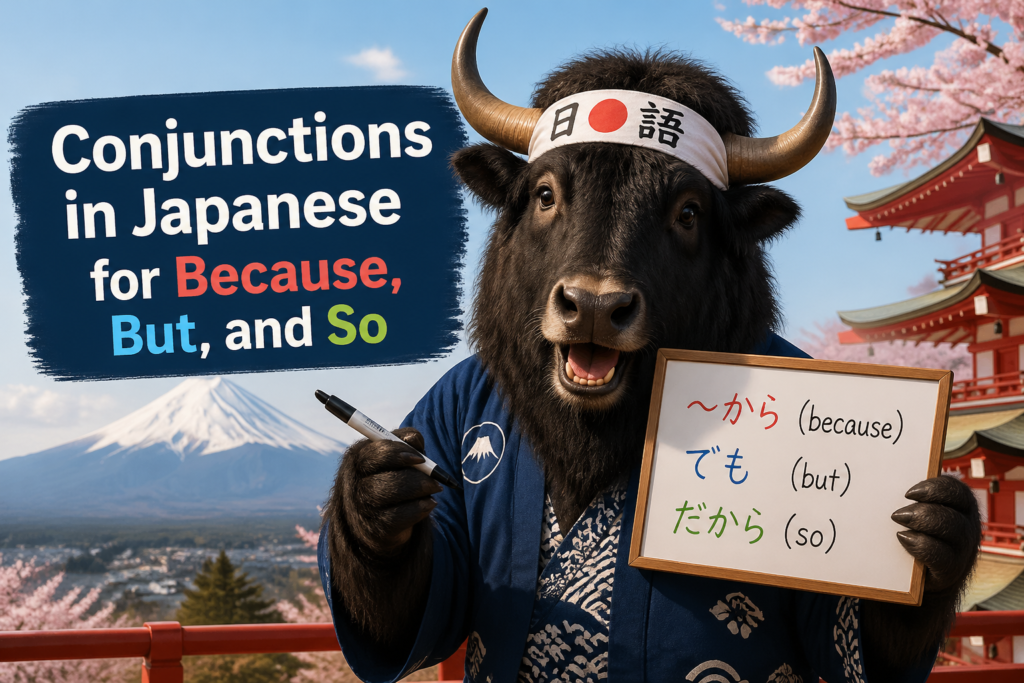
Japanese Conjunctions Chart for Because, But, So, Although, and Then
Japanese connectors can look tiny, but they do a lot of work. They hold sentences together, show cause and effect, soften opinions, and keep your Japanese from sounding like a robot with a dictionary. Handy, right?
If you have ever stared at a sentence and thought, “Wait, where does the because part go?” welcome to the club. Japanese often puts the reason first, the result later, and the connector in a place that feels perfectly normal once you stop expecting English to run the show.
This guide gives you a clear chart for because, but, so, although, and then, plus real examples you can actually use. For a broader overview of Japanese sentence structure, see Learn Japanese.
Quick Chart Of Core Conjunctions
Keep building your Japanese
Choose a practical next step when you are ready.
| Japanese | Rōmaji | Meaning | Example | Translation |
|---|---|---|---|---|
| だから | dakara | so; therefore; that’s why | 雨です。だから、家にいます。 Ame desu. Dakara, ie ni imasu. | It’s raining. So I’m staying home. |
| ので | node | because; since; due to | 疲れたので、早く寝ます。 Tsukareta node, hayaku nemasu. | Because I’m tired, I will sleep early. |
| けど | kedo | but; though; however | 行きたいけど、お金がない。 Ikitai kedo, okane ga nai. | I want to go, but I don’t have money. |
| でも | demo | but; however | 高いです。でも、きれいです。 Takai desu. Demo, kirei desu. | It’s expensive. But it’s beautiful. |
| それで | sorede | so; and then; as a result | 道に迷いました。それで、遅れました。 Michi ni mayoimashita. Sorede, okuremashita. | I got lost. So I was late. |
| それから | sorekara | then; after that; and then | 朝ごはんを食べました。それから、出かけました。 Asagohan o tabemashita. Sorekara, dekakemashita. | I ate breakfast. Then I went out. |
| しかし | shikashi | however; but | 安いです。しかし、使いにくいです。 Yasui desu. Shikashi, tsukai nikui desu. | It’s cheap. However, it’s hard to use. |
| ただし | tadashi | however; provided that; but note | 入れます。ただし、予約が必要です。 Iremasu. Tadashi, yoyaku ga hitsuyō desu. | You can enter. However, a reservation is required. |
| けれども | keredomo | although; though; but | 知っていますけれども、言いません。 Shitte imasu keredomo, iimasen. | I know, although I won’t say it. |
| でもそのあと | demo sono ato | but after that; then after that | 失敗しました。でもそのあと、もう一回やりました。 Shippai shimashita. Demo sono ato, mō ikkai yarimashita. | I failed. But after that, I tried once more. |
Yes, Japanese has more than one way to say “but.” Language likes options. Apparently one “but” was not enough drama.
Because: Reason First, Result Second
In Japanese, the reason often comes before the result. That means the “because” idea can appear at the start of the sentence, or attached to the reason clause.
ので is a polite and natural connector. It sounds softer than a direct “because.” It is great for explanations, excuses, and calm statements.
| Pattern | Meaning | Example | Rōmaji | Translation |
|---|---|---|---|---|
| V-た + ので | because I did / because it happened | 遅くなったので、先に行ってください。 Rokunatta node, saki ni itte kudasai. | Rokunatta node, saki ni itte kudasai. | Because I became late, please go ahead. |
| い-adj + ので | because it is… | 寒いので、コートを着ます。 Samui node, kōto o kimasu. | Samui node, kōto o kimasu. | Because it’s cold, I wear a coat. |
| な-adj / noun + なので | because it is… | 静かなので、勉強しやすいです。 Shizuka na node, benkyō shi yasui desu. | Shizuka na node, benkyō shi yasui desu. | Because it’s quiet, it’s easy to study. |
だから also means “so” or “that’s why,” and it is often used as a sentence starter in casual speech.
雨です。だから、行きません。
Ame desu. Dakara, ikimasen.
It’s raining. So I’m not going.
That sounds simple because it is simple. Japanese is nice like that sometimes. Don’t get used to it.
But: Contrast Without Making A Scene
Japanese has several ways to say “but.” The most common casual one is けど. It can mean “but,” “though,” or even just soften a sentence. Very useful. Very sneaky.
でも is also common. It is often used at the start of a sentence, especially in casual speech.
| Japanese | Rōmaji | Meaning | Example | Translation |
|---|---|---|---|---|
| けど | kedo | but; though | 行きたいけど、時間がない。 Ikitai kedo, jikan ga nai. | I want to go, but I don’t have time. |
| でも | demo | but; however | 疲れました。でも、まだ働きます。 Tsukaremashita. Demo, mada hatarakimasu. | I’m tired. But I will keep working. |
| しかし | shikashi | however | 簡単です。しかし、大切です。 Kantan desu. Shikashi, taisetsu desu. | It’s easy. However, it is important. |
| けれども | keredomo | although; though; but | 行けますけれども、行きません。 Ikemasu keredomo, ikimasen. | I can go, though I won’t. |
| ただし | tadashi | however; but note | 入場できます。ただし、午後5時までです。 Nyūjō dekimasu. Tadashi, gogo go-ji made desu. | You can enter. However, only until 5 p.m. |
けど is so common that it can also work as a sentence-ending softener:
ちょっと忙しいけど。
Chotto isogashii kedo.
I’m a little busy, you know.
That unfinished feeling is intentional. Japanese often leaves things gently hanging in the air instead of smashing the conversation with a full stop.
So: Result, Conclusion, Or Next Step
When something happens and then a result follows, Japanese often uses それで or だから. Both can mean “so,” but the tone is slightly different.
| Japanese | Rōmaji | Meaning | Example | Translation |
|---|---|---|---|---|
| だから | dakara | so; that’s why | 眠いです。だから、早く帰ります。 Nemui desu. Dakara, hayaku kaerimasu. | I’m sleepy. So I’m going home early. |
| それで | sorede | so; and then; as a result | 電車が止まりました。それで、遅れました。 Densha ga tomarimashita. Sorede, okuremashita. | The train stopped. So I was late. |
| そのため | sono tame | therefore; for that reason | 雨が強いです。そのため、試合は中止です。 Ame ga tsuyoi desu. Sono tame, shiai wa chūshi desu. | The rain is heavy. Therefore, the game is cancelled. |
| そこで | sokode | so then; therefore; at that point | 道に迷いました。そこで、地図を見ました。 Michi ni mayoimashita. Sokode, chizu o mimashita. | I got lost. So then, I looked at a map. |
それで often feels like “and as a result,” while だから can feel more like a direct conclusion. In everyday conversation, both are useful. The good news is that native speakers will not file a complaint if you mix them up a little.
Although: Soft Contrast And Polite Pushback
Although in Japanese often appears as けれども, けれど, or が in more formal or subtle styles. These forms show contrast without sounding too harsh.
| Japanese | Rōmaji | Meaning | Example | Translation |
|---|---|---|---|---|
| けれども | keredomo | although; though; but | 高いけれども、とても人気です。 Takai keredomo, totemo ninki desu. | Although it’s expensive, it is very popular. |
| けれど | keredo | though; but | 行きたいけれど、仕事があります。 Ikitai keredo, shigoto ga arimasu. | Although I want to go, I have work. |
| が | ga | but; although | 少し難しいが、面白いです。 Sukoshi muzukashii ga, omoshiroi desu. | It is a little difficult, but interesting. |
| 一方で | ippō de | on the other hand | 安い一方で、品質は低いです。 Yasui ippō de, hinshitsu wa hikui desu. | On the one hand it’s cheap, but the quality is low. |
が is especially useful in writing and formal speech. It can sound softer than でも or けど. Think of it as the polite little cousin of “but.”
Then: Sequence And Order
If you want to say “then” or “after that,” Japanese often uses それから. For a result-based “then,” それで can also work. The choice depends on whether you mean sequence or consequence.
| Japanese | Rōmaji | Meaning | Example | Translation |
|---|---|---|---|---|
| それから | sorekara | then; after that | 宿題をしました。それから、ゲームをしました。 Shukudai o shimashita. Sorekara, gēmu o shimashita. | I did my homework. Then I played a game. |
| その後で | sono ato de | after that | 会議があります。その後で、昼ごはんを食べます。 Kaigi ga arimasu. Sono ato de, hirugohan o tabemasu. | There is a meeting. After that, I will eat lunch. |
| 次に | tsugi ni | next; then | まず洗います。次に、切ります。 Mazu araimasu. Tsugi ni, kirimasu. | First wash it. Then cut it. |
| 続いて | tsuzuite | next; following that | 開会のあいさつです。続いて、社長の話です。 Kaikai no aisatsu desu. Tsuzuite, shachō no hanashi desu. | First, the opening greeting. Next, the president’s speech. |
When you need a clean timeline, それから and 次に are your friends. English “then” is a one-size-fits-all word. Japanese says, “Cute. Let’s be more specific.”
Useful Real-Life Phrases
| Japanese | Rōmaji | English Meaning | Example Sentence | Translation |
|---|---|---|---|---|
| 忙しいので | isogashii node | because I’m busy | 忙しいので、あとで電話します。 Isogashii node, ato de denwa shimasu. | Because I’m busy, I’ll call later. |
| お金がないので | okane ga nai node | because I don’t have money | お金がないので、買いません。 Okane ga nai node, kaimasen. | Because I don’t have money, I won’t buy it. |
| 行きたいけど | ikitai kedo | I want to go, but | 行きたいけど、今日は無理です。 Ikitai kedo, kyō wa muri desu. | I want to go, but today is impossible. |
| でも大丈夫です | demo daijōbu desu | but it’s okay | 遅れました。でも大丈夫です。 Okuremashita. Demo daijōbu desu. | I was late. But it’s okay. |
| それで終わりです | sorede owari desu | and then it’s over; that’s it | 説明は短いです。それで終わりです。 Setsumei wa mijikai desu. Sorede owari desu. | The explanation is short. And then it’s over. |
| それから | sorekara | then; after that | 買い物をしました。それから、帰りました。 Kaimono o shimashita. Sorekara, kaerimashita. | I went shopping. Then I went home. |
| 雨だから | ame dakara | because it’s raining | 雨だから、散歩しません。 Ame dakara, sanpo shimasen. | Because it’s raining, I won’t take a walk. |
| 時間があるけれど | jikan ga aru keredo | although I have time | 時間があるけれど、急ぎません。 Jikan ga aru keredo, isogimasen. | Although I have time, I’m not in a rush. |
| そのため | sono tame | therefore | 雪です。そのため、電車が止まりました。 Yuki desu. Sono tame, densha ga tomarimashita. | It’s snowing. Therefore, the train stopped. |
| 次に | tsugi ni | next; then | 次に、名前を書いてください。 Tsugi ni, namae o kaite kudasai. | Next, please write your name. |
| しかし重要です | shikashi jūyō desu | however, it is important | 簡単ではありません。しかし重要です。 Kantan de wa arimasen. Shikashi jūyō desu. | It is not easy. However, it is important. |
| もちろん、けど | mochiron, kedo | of course, but | もちろん行きたいけど、予定があります。 Mochiron ikitai kedo, yotei ga arimasu. | Of course I want to go, but I have plans. |
Common Mistakes And Easy Fixes
- Using だから inside every sentence. It is natural, but not the only option. Try ので for a softer, more polite reason.
- Using でも when you need sequence. “But” and “then” are not the same job. Use それから or 次に for order.
- Forgetting that けど can soften speech. It does not always need a strong “but” meaning. Sometimes it just sounds gentler.
- Mixing up それで and それから. それで is more about result. それから is more about what happens next.
- Using English sentence order too rigidly. Japanese often puts the reason first. Let the sentence breathe a little.
Mini Practice
Swap the connector and see how the meaning changes. Tiny word, big consequences. Japanese loves that sort of thing.
- 雨です。____、家にいます。
Hint: “so” - 行きたい____、お金がありません。
Hint: “but” - 疲れた____、早く寝ます。
Hint: “because” - 朝ごはんを食べました。____、出かけました。
Hint: “then” - 高い____、便利です。
Hint: “although” or “but”
Possible answers: だから, けど, ので, それから, けれども.
Quick Reference Summary
| Function | Common Japanese | Simple Note |
|---|---|---|
| Because | ので, だから | ので is softer and polite; だから is direct and common. |
| But | けど, でも, が | けど is very common; でも starts sentences well; が is more formal. |
| So | だから, それで, そのため | だから is casual; それで shows result; そのため is formal. |
| Although | けれども, けれど, が | These soften contrast and keep the sentence polite or natural. |
| Then | それから, 次に, その後で | Use these for order, sequence, and what happens next. |
If you remember only one thing, remember this: Japanese connectors are about relationship. Cause, contrast, result, and sequence all have different flavors. Choose the one that matches the feeling, and your sentences will sound much more natural.
For more Japanese learning support, the main guide starts at this Japanese lesson. And yes, once you get these connectors under control, Japanese sentences stop feeling like spaghetti and start looking like actual sentences. A nice upgrade.
Reference List
Browse the full Yak Yacker reference list below. If a PDF is available for this page, the download button will appear under the table.
The original guide stays below, and now you can review the topic more actively with a quiz, the full reference table, and a free PDF download under the list.
Want more than one list? Browse our Japanese section for more Yak Yacker study pages, printable lists, and quiz-friendly review material.
Quick Quiz
Think you can link these conjunctions to their meanings without peeking? The quick quiz below gives you a friendly nudge-no pressure, just a check on where you stand.
Browse the Full List
The Yak Yacker reference table below gives you meanings, examples where available for this list, and a free PDF download button below the table.
| Word | Type | Meaning | Example | Translation |
|---|---|---|---|---|
| Although | conjunction | although; even though | 高いけれど、買いました。 | Although it was expensive, I bought it. |
| Because | conjunction | because | 雨なので、出かけません。 | Because it's raining, I'm not going out. |
| But | conjunction | but | 行きたいけど、時間がありません。 | I want to go, but I don't have time. |
| Function | connector | common Japanese | これはよく使う表現です。 | This is a commonly used expression. |
| So | connector | so | 雨が降りました。だから、家にいました。 | It rained. So I stayed home. |
| Then | connector | then; next | まず宿題をします。それから、テレビを見ます。 | First I do my homework. Then I watch TV. |
| V-た + ので | conjunction | because | 遅れたので、電車に乗れませんでした。 | Because I was late, I couldn’t catch the train. |
| い-adj + ので | conjunction | because | 今日は暑いので、窓を開けましょう。 | Because it’s hot today, let’s open the window. |
| お金がないので | conjunction | because I don't have money | お金がないので、行けません。 | Because I don't have money, I can't go. |
| が | conjunction | but | 行きたいですが、今日は忙しいです。 | I want to go, but I’m busy today. |
| けど | conjunction | but | 行きたいけど、時間がない。 | I want to go, but I don’t have time. |
| けれど | conjunction | but | 行きたいけれど、今日はだめです。 | I want to go, but today is not possible. |
| けれども | conjunction | although | 高いけれども、いいです。 | Although it’s expensive, it’s good. |
| しかし | connector | however | 行きたいです。しかし、今日は忙しいです。 | I want to go. However, I’m busy today. |
| しかし重要です | connector | however; but | しかし、重要です。 | However, it is important. |
| すると | conjunction | then | ドアを開けた。すると、猫が飛び出した。 | I opened the door, and then a cat jumped out. |
| そこで | connector | so then | 道に迷いました。そこで、駅で聞きました。 | I got lost. So then, I asked at the station. |
| そして | conjunction | and then | 朝ごはんを食べました。そして、学校へ行きました。 | I ate breakfast, and then I went to school. |
| そのため | connector | therefore | 電車が止まりました。そのため、遅れました。 | The train stopped. Therefore, I was late. |
| その後で | connector | after that | その後で、宿題をします。 | After that, I do my homework. |
| それから | connector | after that | 学校へ行きました。それから、図書館へ行きました。 | I went to school. After that, I went to the library. |
| それで | connector | and then | 宿題をして、それで寝ました。 | I did my homework, and then I went to bed. |
| それで終わりです | connector | and then; that finishes it | これで終わりです。 | And that's the end. |
| それとも | conjunction | or | コーヒーがいいですか?それとも、紅茶がいいですか? | Would you like coffee, or would you like tea? |
| それなら | conjunction | if so | 明日は休みですか?それなら、一緒に映画を見ませんか? | Are you off tomorrow? If so, why don't we watch a movie together? |