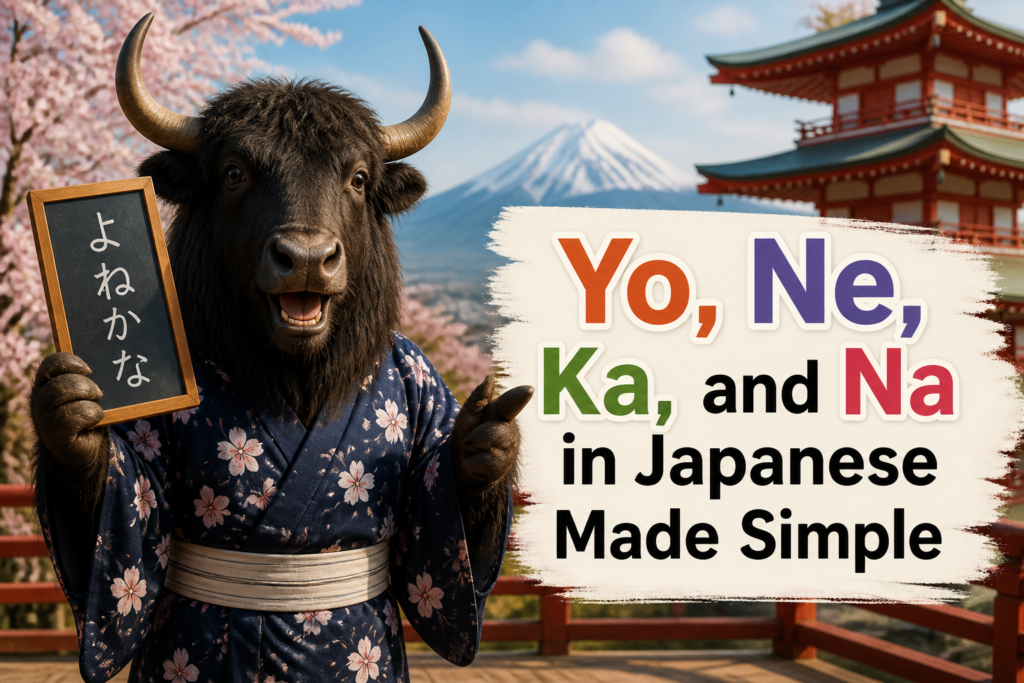
Japanese sentence endings can look tiny, but they carry a lot of attitude. A little よ can sound helpful, a little ね can sound friendly, and か can turn a statement into a question without any drama. な adds feeling, casual reflection, or a soft “hmm” energy. Small endings. Big personality. Naturally.
For the broader learning path, visit our parent guide.
If you have ever heard Japanese speakers sound warm, direct, uncertain, or simply more “alive,” these endings are probably doing the work. They are common in daily speech, anime, texting, and plain conversation. For a quick language checkpoint, the Japanese placement test JLPT can help you see where you are, and the Japanese vocabulary test is handy too, because sentence endings become much easier when your core words are not doing all the heavy lifting alone.
This guide keeps things simple: what each ending means, when to use it, and how not to accidentally sound like you are auditioning for a robot drama club.
Quick Meaning Overview
| Ending | Rōmaji | Core Meaning | Typical Feeling |
|---|---|---|---|
| よ | yo | emphasis, new information, reassurance | confident, helpful, strongly stated |
| ね | ne | seeking agreement, shared feeling | friendly, soft, “right?” |
| か | ka | question marker | neutral, direct, formal or plain |
| な | na | reflection, casual emotion, emphasis in masculine/plain speech | thoughtful, nostalgic, soft, casual |
All four are sentence-ending particles, which means they usually come at the end of a sentence. That sounds easy because it is easy. The tricky part is the nuance. Japanese loves nuance the way some people love overpriced coffee.
よ Yo: Strong, Helpful, Or A Little “FYI”
よ adds emphasis. It often tells the listener that the information is new, important, or worth noticing. It can also sound reassuring.
- 行きますよ — Ikimasu yo — I’m going, you know / I’m telling you I’m going.
- 大丈夫ですよ — Daijōbu desu yo — It’s okay / Don’t worry.
- それは高いですよ — Sore wa takai desu yo — That is expensive, you know.
よ often feels like “I am adding information” or “please pay attention.” It is not rude by itself. In fact, it can be kind. If someone looks worried, 大丈夫ですよ sounds warm and reassuring.
| Kanji | Rōmaji | Meaning | Example | Rōmaji Example | English Translation |
|---|---|---|---|---|---|
| 行きますよ | Ikimasu yo | I’m going / I’m telling you I’m going | 行きますよ。 | Ikimasu yo. | I’m going, you know. |
| 大丈夫ですよ | Daijōbu desu yo | It’s okay | 大丈夫ですよ。 | Daijōbu desu yo. | It’s okay, really. |
| ありますよ | Arimasu yo | There is / It exists | 駅はここにありますよ。 | Eki wa koko ni arimasu yo. | The station is here. |
Small warning: if you use よ too much, every sentence can start sounding like a friendly announcement. Useful? Yes. Subtle? Not especially.
ね Ne: Shared Feeling And Friendly Agreement
ね is the “we are on the same page” ending. It often invites agreement, shows shared emotion, or softens the sentence.
- いいですね — Ii desu ne — Nice, isn’t it?
- 寒いですね — Samui desu ne — It’s cold, isn’t it?
- きれいですね — Kirei desu ne — It’s beautiful, isn’t it?
ね sounds naturally social. It is often used when you want the listener to nod along. It can also make a statement feel less sharp. In real conversation, it is everywhere, which is annoying only if you enjoy learning things the hard way.
| Kanji | Rōmaji | Meaning | Example | Rōmaji Example | English Translation |
|---|---|---|---|---|---|
| いいですね | Ii desu ne | Nice, isn’t it? | この店はいいですね。 | Kono mise wa ii desu ne. | This shop is nice, isn’t it? |
| 寒いですね | Samui desu ne | It’s cold, isn’t it? | 今日は寒いですね。 | Kyō wa samui desu ne. | It’s cold today, isn’t it? |
| そうですね | Sō desu ne | That’s right / I agree | そうですね。 | Sō desu ne. | That’s right. |
A useful memory trick: よ pushes information toward the listener, while ね pulls the listener closer for agreement. One says “here’s the thing.” The other says “you feel it too, right?”
か Ka: The Question Ending
か is the standard sentence-ending question marker. It turns a statement into a question, especially in polite Japanese and formal speech.
- 行きますか — Ikimasu ka — Are you going?
- 何ですか — Nandesu ka — What is it?
- これは本ですか — Kore wa hon desu ka — Is this a book?
か is very useful because it is clean and clear. No extra drama. No interpretive dance. Just a question.
| Kanji | Rōmaji | Meaning | Example | Rōmaji Example | English Translation |
|---|---|---|---|---|---|
| 行きますか | Ikimasu ka | Are you going? | 学校へ行きますか。 | Gakkō e ikimasu ka. | Are you going to school? |
| 何ですか | Nandesu ka | What is it? | これは何ですか。 | Kore wa nan desu ka. | What is this? |
| 来ますか | Kimasu ka | Are you coming? | 明日来ますか。 | Ashita kimasu ka. | Are you coming tomorrow? |
In casual speech, a plain question often drops the か and uses rising intonation instead. But in polite Japanese, か stays. For a broader look at casual sentence endings, the guide to casual Japanese endings is a useful next stop.
な Na: Feeling, Reflection, And Casual Emphasis
な is a bit more slippery. In casual speech, it can show reflection, emotion, or a soft personal reaction. It can also work like a sentence-ending particle in male or plain-style speech, depending on the context.
- いいな — Ii na — Nice… / I wish I had that.
- 静かだな — Shizuka da na — It’s quiet, huh.
- すごいな — Sugoi na — Wow, impressive.
な can be gentle, thoughtful, or slightly masculine depending on the sentence. In many cases, it feels like a private reaction spoken out loud. Someone sees a beautiful view and says きれいだな. They are not asking a question. They are reacting.
| Kanji | Rōmaji | Meaning | Example | Rōmaji Example | English Translation |
|---|---|---|---|---|---|
| いいな | Ii na | Nice / I wish I had that | それ、いいな。 | Sore, ii na. | That’s nice. |
| 静かだな | Shizuka da na | It’s quiet, huh | ここは静かだな。 | Koko wa shizuka da na. | This place is quiet. |
| すごいな | Sugoi na | Wow / That’s amazing | ほんとうにすごいな。 | Hontō ni sugoi na. | That is really amazing. |
If ね is social and よ is informative, then な is often reflective. It can feel like your thoughts are talking to themselves. Very polite of them.
How These Endings Change The Tone
| Sentence | Rōmaji | Tone | What It Feels Like |
|---|---|---|---|
| 行きます。 | Ikimasu. | Plain statement | Neutral and direct |
| 行きますよ。 | Ikimasu yo. | Emphasis | “I’m going, just so you know.” |
| 行きますね。 | Ikimasu ne. | Agreement / softening | “We’re going, right?” or gentle confirmation |
| 行きますか。 | Ikimasu ka. | Question | “Are you going?” |
| 行くな。 | Iku na. | Command / prohibition in casual speech | “Don’t go.” |
Yes, な can also be used in command-like expressions such as 行くな (Iku na), meaning “Don’t go.” Context matters a lot. Japanese loves one tiny ending doing three jobs and leaving you to sort it out like a detective.
Simple Rules You Can Actually Use
- よ = add information, reassurance, or emphasis.
- ね = ask for agreement, share a feeling, soften the tone.
- か = make a question, especially in polite or formal speech.
- な = express reflection, emotion, or casual emphasis; sometimes command-like in casual speech.
Want a simple test? If you are telling someone something they may not know, try よ. If you want them to agree, try ね. If you want a clean question, use か. If you are reacting to a thought or scene, な may fit.
More Real-Life Examples
| Kanji | Rōmaji | Meaning | Example | Rōmaji Example | English Translation |
|---|---|---|---|---|---|
| 遅いですよ | Osoi desu yo | You’re late / It’s late, you know | もう遅いですよ。 | Mō osoi desu yo. | It’s already late, you know. |
| そうですよね | Sō desu yo ne | Right, isn’t it | 今日は忙しいですよね。 | Kyō wa isogashii desu yo ne. | Today is busy, right? |
| どこですか | Doko desu ka | Where is it? | 駅はどこですか。 | Eki wa doko desu ka. | Where is the station? |
| わからないな | Wakaranai na | I don’t know, hmm | 理由がわからないな。 | Riyū ga wakaranai na. | I don’t understand the reason. |
| 行きたいな | Ikitai na | I want to go / I wish I could go | 京都へ行きたいな。 | Kyōto e ikitai na. | I want to go to Kyoto. |
| 本当ですか | Hontō desu ka | Really? | それは本当ですか。 | Sore wa hontō desu ka. | Is that true? |
Watch Out For These Common Confusions
1. Don’t confuse よ and ね. よ gives information or emphasis. ね seeks shared feeling. If you mix them up, the sentence may still be understandable, but the tone can wobble a little.
2. か is not the only way to ask a question. In casual speech, a rising intonation can be enough. But for polite Japanese, か is still the classic choice.
3. な is flexible. It can be reflective, emotional, masculine in some contexts, or even prohibitive in casual commands. That is why context matters so much. Tiny ending, big mood swing.
4. Not every sentence needs an ending particle. Japanese can be perfectly natural without one. Sentence endings add nuance, but they are not a rule you must slam onto every line like a final stamp of doom.
Mini Practice
Choose the best ending: よ, ね, か, or な.
- これは高い___。 — “This is expensive, ___.”
- 今日は寒い___。 — “It’s cold today, ___.”
- 行きます___。 — “Are you going?” / “I’m going, ___.”
- きれいだ___。 — “It’s beautiful, ___.”
- 本当です___。 — “Is it true?”
Suggested answers: よ, ね, か, な, か.
Now try changing the tone of one sentence three ways:
- 寒い。 — Samui. — It’s cold.
- 寒いよ。 — Samui yo. — It’s cold, you know.
- 寒いね。 — Samui ne. — It’s cold, isn’t it?
Fast Reference Summary
| Ending | Use It When You Want To… | Example |
|---|---|---|
| よ | add emphasis, new info, or reassurance | 大丈夫ですよ。 — It’s okay. |
| ね | seek agreement or share a feeling | いいですね。 — Nice, isn’t it? |
| か | ask a question clearly | 行きますか。 — Are you going? |
| な | reflect, react, or add casual emotional nuance | すごいな。 — Wow, amazing. |
If you want to keep going, compare these endings with other common sentence particles in Japanese ending particles and the broader guide to Japanese list particles. For a more casual, chatty feel, casual Japanese endings is the next natural step.
Yak takeaway: these endings are tiny, but they shape the whole mood of a sentence. よ tells, ね connects, か questions, and な reacts. Learn the feeling behind the ending, and your Japanese starts sounding less like a textbook and more like actual human speech. Fancy that.