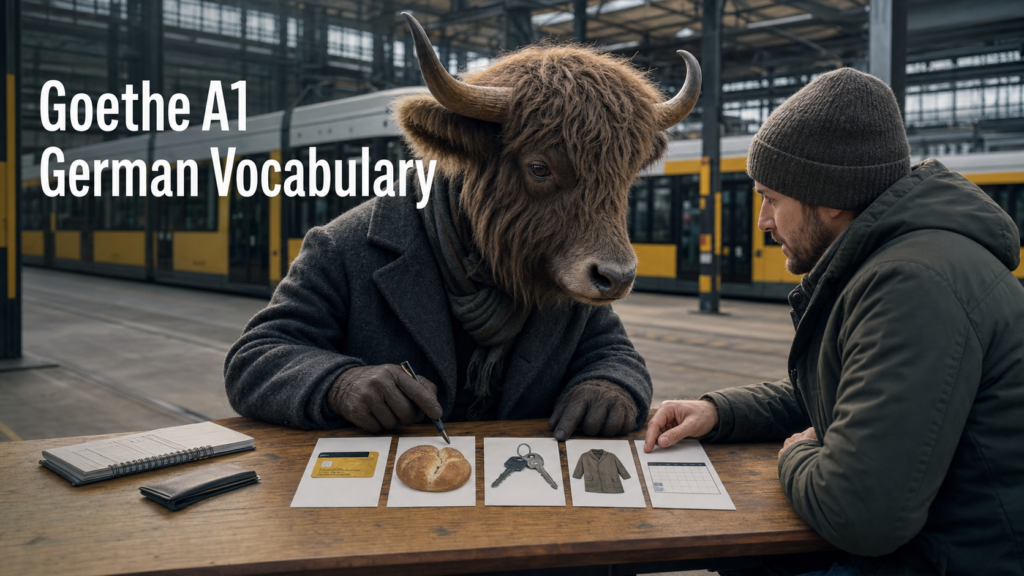
This Goethe A1 German vocabulary list is for learners who want a cleaner way to review the words that actually matter at beginner level. It focuses on practical everyday German you can use for introductions, transport, food, daily routines, simple questions, and first conversations.
As a CEFR-aligned A1 list, this is not about sounding advanced. It is about building the core vocabulary that helps you understand beginner lessons, fill out simple forms, and say useful things clearly and confidently.
Pack your Wörter and bring your best pencil—this A1 set is here to make beginner German feel a little less wobbly and a lot more doable. Scroll to the bottom for the free printable Goethe A1 German vocabulary list PDF PDF and the free downloadable printable Goethe A1 German PDF flashcards.
When you finish this list, keep going in the Yak Yacker German section for more beginner-friendly vocabulary, phrases, and grammar reference pages.
Making the Most of Goethe A1 Vocabulary
A CEFR-aligned A1 list should give you the words that carry everyday beginner German, not a pile of impressive extras you are unlikely to use soon. That means greetings, numbers, family, food, transport, daily routines, basic verbs, question words, and the kind of vocabulary that shows up in first conversations, simple forms, and beginner exams.
The most useful way to study a list like this is not as random flashcards, but as building material for short real sentences. When you learn a word like arbeiten, heute, or Bahnhof, connect it to a plain example you can actually picture or reuse. That helps you move from passive recognition into active use much faster.
This table works best when you use the meaning, example sentence, and audio together. Listen, repeat, and then try writing or saying a few simple sentences of your own. That turns the list into something practical, and it gets you closer to the kind of German you need for real A1 situations rather than just list-memorizing.
Goethe A1 German Vocabulary Quiz
Try the quiz first if you want a quick confidence check, or use it after the list as a simple review round.
Keep building your German
Choose a practical next step when you are ready.
Goethe A1 German Vocabulary List
| Word | Type | Meaning | Example | Audio |
|---|---|---|---|---|
| der Fußball | Noun | football | Spielt ihr gerne Fußball? | |
| der Garten | Noun | garden | Wir haben leider keinen Garten. | |
| der Gast, -ä, e | Noun | guest | Am Wochenende haben wir mehrere Gäste. | |
| der Geburtsort | Noun | birthplace | Bitte schreiben Sie Ihren Geburtsort auf das Formular. | |
| der Geburtstag | Noun | birthday | Herzlichen Glückwunsch zum Geburtstag! | |
| der Glückwunsch | Noun | congratulations | Herzlichen Glückwunsch zum Geburtstag. | |
| der Großvater | Noun | grandfather | Mein Großvater ist schon 80. | |
| der Gruß, -ü, e | Noun | regards | Viele Grüße an Ihre Frau. | |
| der Hausmann | Noun | househusband | Der Hausmann wäscht, kocht und kauft ein. | |
| der Herd | Noun | stove | In der neuen Küche fehlt noch der Herd. | |
| der Herr, -en | Noun | Mister | Guten Tag, Herr Sommer! | |
| der Hund, -e | Noun | dog | Der Hund ist noch jung. | |
| der Hunger | Noun | hunger | Ich habe Hunger! Wann ist das Essen fertig? | |
| der Job, -s | Noun | job | Jenny hat einen neuen Job bei der Post. | |
| der Jugendliche, -n | Noun | youth/young person | Viele Jugendliche kaufen gern ein. | |
| der Junge, -n | Noun | boy | Ich habe zwei Kinder. Einen Jungen und ein Mädchen. | |
| der Kaffee | Noun | coffee | Zum Frühstück trinke ich immer Kaffee. | |
| der Kindergarten | Noun | kindergarten | Die kleine Laura geht schon in den Kindergarten. | |
| der Kiosk | Noun | kiosk | Am Kiosk bekommen Sie Getränke, Zigaretten und Zeitungen. | |
| der Koffer, – | Noun | suitcase | Ist das Ihr Koffer? | |
| der Kollege, -n | Noun | colleague | ßt die neue Kollegin? | |
| der Kopf | Noun | head | Mein Kopf tut weh! | |
| der Kuchen | Noun | cake | Ich nehme ein Stück Kuchen. | |
| der Kugelschreiber | Noun | ball-point pen | Hast du einen Kugelschreiber für mich? | |
| der Kühlschrank | Noun | fridge | Haben wir noch Milch? / Ja, im Kühlschrank. |