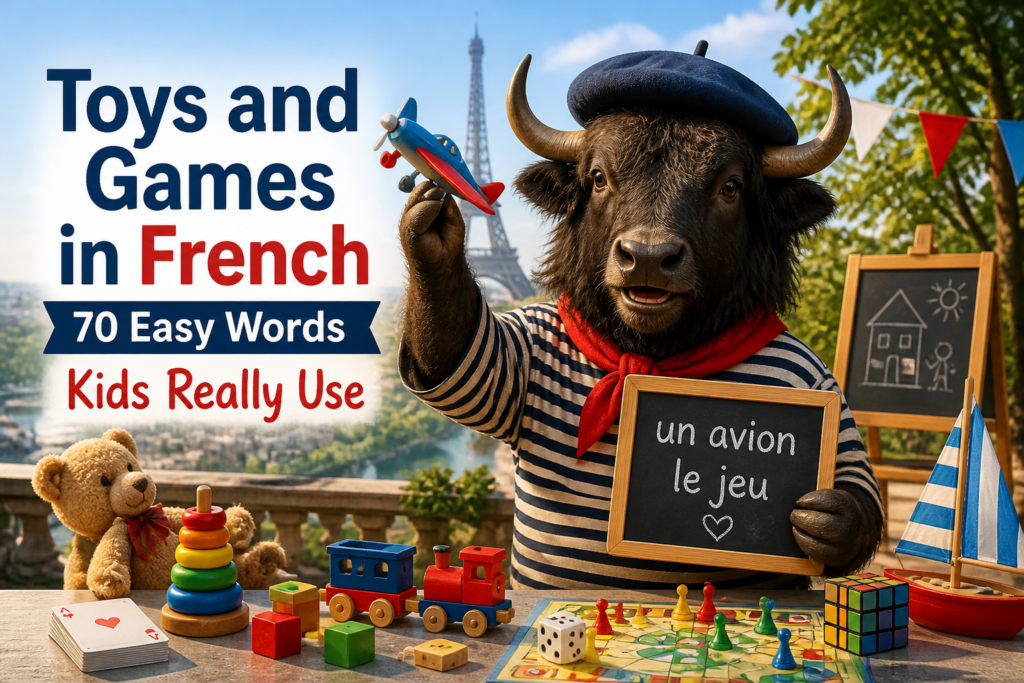
French toy vocabulary gets useful fast. The second a child spots a teddy bear, loses a puzzle piece, or demands “just five more minutes” of a game, you suddenly need words that textbooks somehow forgot to make exciting.
This guide teaches practical French words and phrases for toys, games, playtime, and the things kids actually say. You’ll get simple pronunciation help, clear meanings, and real example sentences so you can use the vocabulary instead of just politely staring at it.
And yes, jouer shows up a lot, because children are deeply committed to the art of playing at inconvenient times.
If you want more core French learning after this, see the full French learning hub.
The Core Words For Toys And Games
Start with the most useful basics. These are the words you’ll hear all the time at home, at school, at the park, or while stepping on a plastic brick with the emotional intensity of a Greek tragedy.
| French | Pronunciation | Meaning | Example Sentence | Translation | Learner Note |
|---|---|---|---|---|---|
| un jouet | uhn zhoo-eh | a toy | C’est mon jouet préféré. | It’s my favorite toy. | Masculine noun. |
| un jeu | uhn zhuh | a game | On commence un nouveau jeu ? | Shall we start a new game? | Also means “play” in some contexts. |
| jouer | zhoo-ay | to play | Les enfants aiment jouer dehors. | Children like to play outside. | Use jouer à with games and activities. |
| le jeu vidéo | luh zhuh vee-day-oh | video game | Mon frère adore les jeux vidéo. | My brother loves video games. | Plural: les jeux vidéo. |
| l’enfant | lahn-fahn | child | L’enfant joue avec ses voitures. | The child is playing with his cars. | Starts with a vowel, so use l’. |
| les enfants | lay zahn-fahn | children | Les enfants jouent dans le salon. | The children are playing in the living room. | You hear the liaison in les enfants. |
| jouer à | zhoo-ay ah | to play a game / activity | On joue au football après l’école. | We play soccer after school. | à + le = au, à + les = aux. |
| jouer avec | zhoo-ay ah-vek | to play with | Elle joue avec sa poupée. | She’s playing with her doll. | Use for toys or people. |
| s’amuser | sah-mew-zay | to have fun | Les enfants s’amusent beaucoup. | The children are having lots of fun. | Very common in family contexts. |
| la récréation | lah ray-kray-ah-syon | recess / break time | Ils jouent à la marelle pendant la récréation. | They play hopscotch during recess. | Common school word. |
Toy Words Kids Use All The Time
These are the everyday toy words that come up constantly. If you only memorize one section, make it this one.
| French | Pronunciation | Meaning | Example Sentence | Translation | Learner Note |
|---|---|---|---|---|---|
| la poupée | lah poo-pay | doll | Ma sœur a une grande poupée. | My sister has a big doll. | Feminine noun. |
| le nounours | luh noo-noors | teddy bear | Il dort avec son nounours. | He sleeps with his teddy bear. | Cute, very common word for kids. |
| la peluche | lah puh-loosh | stuffed toy / plushie | Cette peluche est toute douce. | This plush toy is really soft. | Broader than nounours. |
| la voiture | lah vwah-tewr | toy car / car | Il fait rouler sa voiture rouge. | He rolls his red car. | Context tells you whether it is toy or real car. |
| le camion | luh kah-myon | truck | Le camion est sous la table. | The truck is under the table. | Often a toy truck in play contexts. |
| le train | luh trahn | train | Le train tourne en rond. | The train goes around in circles. | Nasal vowel, but don’t panic. |
| l’avion | lah-vyon | plane | Elle lance son petit avion. | She throws her little plane. | l’ because it starts with a vowel. |
| le robot | luh roh-boh | robot | Le robot marche et parle. | The robot walks and talks. | Final t is silent. |
| les briques | lay breek | bricks / building blocks | Ils construisent une tour avec des briques. | They are building a tower with blocks. | Useful general term for building toys. |
| les cubes | lay kewb | blocks / cubes | Le bébé joue avec des cubes en bois. | The baby is playing with wooden blocks. | b is clearly heard. |
| la balle | lah bal | ball | Attrape la balle ! | Catch the ball! | Very common in child speech. |
| le ballon | luh bah-lyon | balloon / ball | Le ballon bleu est dans le jardin. | The blue ball is in the garden. | Can mean balloon too, depending on context. |
| la corde à sauter | lah kord ah soh-tay | jump rope | Elle cherche sa corde à sauter. | She’s looking for her jump rope. | Literally “rope for jumping.” |
| la trottinette | lah trot-tee-net | scooter | Mon fils adore sa trottinette. | My son loves his scooter. | Not the same as a motorcycle. |
| la marionnette | lah mah-ree-oh-net | puppet | La marionnette raconte une histoire. | The puppet tells a story. | Feminine noun. |
Board Games And Indoor Games
When the weather is awful or everyone is pretending to enjoy a “quiet afternoon,” these words suddenly become very handy.
| French | Pronunciation | Meaning | Example Sentence | Translation | Learner Note |
|---|---|---|---|---|---|
| le jeu de société | luh zhuh duh soh-see-ay-tay | board game | On sort un jeu de société ce soir ? | Shall we get out a board game tonight? | Very common family phrase. |
| les cartes | lay kart | cards | Il mélange les cartes. | He shuffles the cards. | Plural used often. |
| un jeu de cartes | uhn zhuh duh kart | a card game / deck of cards | Nous avons un jeu de cartes dans le sac. | We have a deck of cards in the bag. | Context decides whether it means deck or game. |
| le puzzle | luh pew-zul | puzzle | Le puzzle a mille pièces. | The puzzle has a thousand pieces. | Borrowed word, common in French. |
| une pièce | ewn pyess | a piece | Il manque une pièce du puzzle. | One puzzle piece is missing. | Also means room or coin. |
| les dés | lay day | dice | Lance les dés. | Roll the dice. | Plural form used for one or more dice in many contexts. |
| un pion | uhn pyon | game piece / token | Mon pion est vert. | My token is green. | Useful for board games. |
| le plateau | luh plah-toh | board / tray | Pose le pion sur le plateau. | Put the token on the board. | In games, often the game board. |
| le tour | luh toor | turn | C’est ton tour. | It’s your turn. | Extremely useful phrase. |
| gagner | gah-nyay | to win | Je veux gagner cette fois. | I want to win this time. | gn sounds like “ny.” |
| perdre | pehrdr | to lose | Il n’aime pas perdre. | He doesn’t like losing. | Very common with games. |
| tricher | tree-shay | to cheat | Tu triches ! | You’re cheating! | A classic family game accusation. |
Outdoor Play And Playground Words
French kids do not magically stop moving just because you ran out of energy. These words cover common outdoor toys, games, and playground basics.
| French | Pronunciation | Meaning | Example Sentence | Translation | Learner Note |
|---|---|---|---|---|---|
| le vélo | luh vay-loh | bicycle | Elle apprend à faire du vélo. | She is learning to ride a bike. | Use faire du vélo for “to bike.” |
| le tricycle | luh tree-see-kluh | tricycle | Le petit roule en tricycle. | The little one rides a tricycle. | Masculine noun. |
| la balançoire | lah bah-lahn-swar | swing | Les enfants attendent la balançoire. | The children are waiting for the swing. | Playground word. |
| le toboggan | luh toh-boh-gahn | slide | Il descend vite du toboggan. | He goes down the slide fast. | In Canada, toboggan can mean sled in English contexts, but in France French it commonly means slide. |
| le bac à sable | luh bak ah sabl | sandbox | Le seau est dans le bac à sable. | The bucket is in the sandbox. | Very common with small children. |
| le seau | luh soh | bucket | Prends le seau rouge. | Take the red bucket. | Useful at the beach too. |
| la pelle | lah pel | shovel / spade | Où est ta pelle ? | Where is your shovel? | Small toy shovel in play contexts. |
| le râteau | luh rah-toh | rake | Il joue avec un râteau en plastique. | He’s playing with a plastic rake. | Beach and sandbox vocabulary. |
| le cerf-volant | luh sehr-voh-lahn | kite | Le cerf-volant monte très haut. | The kite goes very high. | Looks weird, yes. Means kite. |
| jouer dehors | zhoo-ay duh-or | to play outside | On peut jouer dehors après le goûter. | We can play outside after the snack. | Very natural phrase. |
Common Kids’ Games In French
Some game names are useful because they come up in schoolyards, family chats, and children’s books. A few are close to English, and a few are gloriously not.
| French | Pronunciation | Meaning | Example Sentence | Translation | Learner Note |
|---|---|---|---|---|---|
| cache-cache | kash-kash | hide-and-seek | On joue à cache-cache ? | Do you want to play hide-and-seek? | Very common children’s game. |
| la marelle | lah mah-rel | hopscotch | Elle dessine une marelle à la craie. | She draws a hopscotch grid with chalk. | Feminine noun. |
| le chat | luh shah | tag | On joue au chat dans la cour. | We play tag in the playground. | Literally “the cat.” Kids’ game name. |
| le loup | luh loo | wolf / a chasing game role | C’est toi le loup ! | You’re the wolf! | Used in many children’s games. |
| les billes | lay beey | marbles | Mon grand-père jouait aux billes. | My grandfather used to play marbles. | Classic game word. |
| la corde | lah kord | rope | Ils sautent à la corde dans la cour. | They’re jumping rope in the playground. | Phrase: sauter à la corde. |
| le ballon prisonnier | luh bah-lyon pree-zoh-nyee-ay | dodgeball | Les élèves jouent au ballon prisonnier. | The students are playing dodgeball. | School sports vocabulary. |
| le jeu de rôle | luh zhuh duh rohl | role-playing game | Ils inventent un jeu de rôle avec des dragons. | They’re inventing a role-playing game with dragons. | Useful for older kids too. |
| faire semblant | fehr sahm-blahn | to pretend | Elle fait semblant d’être docteure. | She is pretending to be a doctor. | Very natural for pretend play. |
| inventer une histoire | ahn-vahn-tay ewn ees-twar | to make up a story | Ils inventent une histoire avec leurs figurines. | They’re making up a story with their figures. | Useful for imaginative play. |
Figurines, Costumes, And Pretend Play
Pretend play is where vocabulary gets fun, dramatic, and slightly chaotic. Basically, tiny humans become bakers, dragons, firefighters, or all three at once.
| French | Pronunciation | Meaning | Example Sentence | Translation | Learner Note |
|---|---|---|---|---|---|
| la figurine | lah fee-gew-reen | figurine / action figure | Il collectionne les figurines. | He collects action figures. | Good all-purpose word. |
| le costume | luh kos-tewm | costume | Elle met son costume de pirate. | She puts on her pirate costume. | Not just formal clothes. |
| le déguisement | luh day-geez-mahn | dress-up outfit / disguise | Ton déguisement est génial. | Your costume is great. | Very common for kids. |
| la dînette | lah dee-net | toy kitchen set / pretend dishes | Les enfants jouent à la dînette. | The children are playing tea party / kitchen. | Classic pretend-play term. |
| la maison de poupée | lah meh-zon duh poo-pay | dollhouse | La maison de poupée est dans sa chambre. | The dollhouse is in her room. | Literal and easy to remember. |
| le château | luh shah-toh | castle | Ils construisent un château en carton. | They are building a cardboard castle. | Useful in play vocabulary. |
| l’épée | lay-pay | sword | Le chevalier a une épée en plastique. | The knight has a plastic sword. | Feminine noun despite the look of it. |
| le bouclier | luh boo-klee-ay | shield | Il tient son bouclier devant lui. | He holds his shield in front of him. | Great for costume play. |
| le masque | luh mask | mask | Le masque du monstre fait peur. | The monster mask is scary. | Useful beyond play too. |
| la baguette magique | lah bah-get mah-zheek | magic wand | La fée cherche sa baguette magique. | The fairy is looking for her magic wand. | Another child favorite. |
Useful Phrases Parents, Teachers, And Kids Actually Say
Single words are nice, but full phrases are what you really need in real life. These are practical, natural, and immediately usable.
| French | Pronunciation | Meaning | Example Sentence | Translation | Learner Note |
|---|---|---|---|---|---|
| On joue ? | ohn zhoo | Shall we play? | Tu as fini tes devoirs. On joue ? | You finished your homework. Shall we play? | Very natural and friendly. |
| Tu veux jouer ? | tew vuh zhoo-ay | Do you want to play? | Tu veux jouer avec nous ? | Do you want to play with us? | Great beginner phrase. |
| C’est mon tour. | say mon toor | It’s my turn. | Attends, c’est mon tour maintenant. | Wait, it’s my turn now. | Kids say this constantly. |
| C’est ton tour. | say ton toor | It’s your turn. | Vas-y, c’est ton tour. | Go ahead, it’s your turn. | Useful in all games. |
| À toi ! | ah twah | Your turn! / Here you go! | Je lance les dés, puis à toi ! | I roll the dice, then your turn! | Short and very common. |
| À moi ! | ah mwah | My turn! | Non, à moi maintenant ! | No, my turn now! | Classic child phrase. |
| Tu triches ! | tew treesh | You’re cheating! | Tu regardes les cartes, tu triches ! | You’re looking at the cards, you’re cheating! | Playful or serious depending on tone. |
| J’ai gagné ! | zhay gah-nyay | I won! | J’ai gagné la partie ! | I won the game! | Common excited phrase. |
| J’ai perdu. | zhay pehr-dew | I lost. | J’ai perdu, mais c’était amusant. | I lost, but it was fun. | Nice phrase for sportsmanship too. |
| On recommence ? | ohn ruh-koh-mahns | Shall we do it again? | La partie est finie. On recommence ? | The game is over. Shall we do it again? | Very useful phrase. |
| Range tes jouets. | rahnzh tay zhoo-eh | Put away your toys. | Avant de dîner, range tes jouets. | Before dinner, put away your toys. | Parent-level essential. |
| On partage. | ohn par-tazh | We share. | Il n’y a qu’un ballon, alors on partage. | There’s only one ball, so we share. | Useful with children. |
Quick Grammar Notes That Help
A few French patterns show up again and again with toys and games.
- Jouer à is used for games and activities: jouer au chat, jouer aux cartes, jouer au football.
- Jouer avec is used for toys, objects, or people: jouer avec une poupée, jouer avec son frère.
- à + le = au: jouer au ballon.
- à + les = aux: jouer aux billes.
- French nouns have gender, so learn the article too: la balle, le puzzle, la trottinette.
- With words starting with a vowel, French uses elision: l’enfant, l’avion, l’épée.
Rule that saves headaches: play a game = jouer à; play with a toy = jouer avec.
Common Mistakes And Easy Fixes
- Wrong: jouer une poupée
Better: jouer avec une poupée
Use avec for toys. - Wrong: je joue les cartes
Better: je joue aux cartes
Use à with games. - Wrong: un poupée
Better: une poupée
poupée is feminine. - Wrong: le enfant
Better: l’enfant
Use elision before a vowel. - Wrong: pronouncing every final letter
Better: remember many final consonants are silent: robot, chat, jouet.
Mini Practice
Try these quick translations.
- She is playing with her teddy bear. → Elle joue avec son nounours.
- It’s your turn. → C’est ton tour.
- Do you want to play hide-and-seek? → Tu veux jouer à cache-cache ?
- Put away your toys. → Range tes jouets.
- They are building a castle with blocks. → Ils construisent un château avec des briques.
Related French Practice
If you want to keep building everyday vocabulary, try the French vocabulary test or check your overall level with the French placement test.
For more fun topic-based learning, you can also explore music vocabulary in French, French hobbies, and French songs for learning.
Yak Takeaway
If you learn just a few patterns like jouer à, jouer avec, c’est ton tour, and range tes jouets, you can suddenly handle a surprising amount of real-life French playtime. The rest is mostly toys, turns, and someone insisting they were absolutely not cheating.