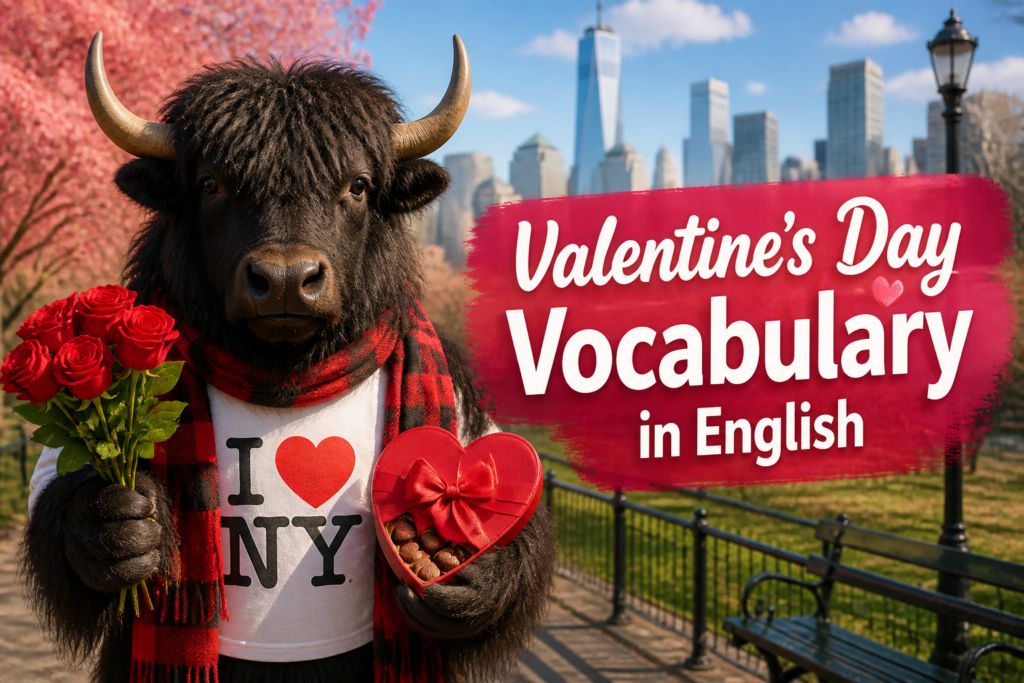
Valentine’s Day Vocabulary in English can be sweet, cheesy, romantic, and a little dramatic. In other words: perfect English practice. Whether you are texting a crush, writing a card, talking about plans, or just trying to understand why stores suddenly turn pink and red everywhere, this vocabulary will help.
Valentine’s Day is on February 14 in many countries. People may send cards, buy flowers, give chocolate, or go out for dinner. And yes, some people also pretend not to care while secretly caring a lot. Very on brand.
By the end of this lesson, you will understand useful Valentine’s Day words and phrases, plus how to use them in real English. For a quick warm-up, you can also try the English Vocabulary Test or check your level with the English Placement Test CEFR.
If you want the official boring version of what “valentine” can mean, Cambridge Dictionary has you covered. Emotionally thrilling? No. Useful? Absolutely.
Top Valentine’s Day Words
| English | Pronunciation | Meaning | Example Sentence | Learner Note |
|---|---|---|---|---|
| Valentine’s Day | VAL-uhn-tynz day | February 14, a day for love and romance | We usually go out for dinner on Valentine’s Day. | Common holiday name. Capitalize both words. |
| valentine | VAL-uhn-tyn | A person you love or give a card to on Valentine’s Day | She was his valentine in school. | Can mean a romantic partner or the card itself. |
| love | luhv | Very strong feeling of affection | Love is the most common theme on this day. | Very general word. It can be romantic or not. |
| romance | ROH-mans | Romantic feeling or romantic activities | They wanted a little romance at dinner. | Often used for mood, stories, or relationships. |
| romantic | roh-MAN-tik | Showing love or creating a loving mood | He planned a romantic evening at home. | Very common adjective for dates and gifts. |
| affection | uh-FEK-shun | Warm caring feeling | The card showed affection without being too serious. | Gentler than “love.” Good for family and friends too. |
| card | kard | A small message sent to someone | She bought a Valentine’s card for her husband. | Very common. Say “send a card” or “give a card.” |
| chocolate | CHOK-lət | A sweet food often given as a gift | He gave her chocolate and flowers. | American English often shortens the second syllable. |
| flowers | FLOW-erz | Plants with colorful petals, often given as gifts | Red flowers are popular on Valentine’s Day. | “Flowers” is usually plural in this context. |
| gift | gift | A present given to someone | Small gifts can still feel thoughtful. | More neutral than “present” in many situations. |
Useful Valentine’s Day Phrases
These are the phrases people actually use. Not the giant dramatic soap-opera version. The real one.
| English | Pronunciation | Meaning | Example Sentence | Learner Note |
|---|---|---|---|---|
| Be my Valentine | bee my VAL-uhn-tyn | A romantic way to ask someone to be your Valentine | He wrote “Be my Valentine” on the card. | Sweet, playful, and a little old-fashioned. |
| I have a crush on someone | eye hav uh krush on SUMP-wun | You like someone romantically, often secretly | She has a crush on her classmate. | Common with teens and adults. Use carefully. |
| I’m into someone | aim IN-too SUMP-wun | You are attracted to someone | I think he’s into her. | Casual and modern. |
| go on a date | goh on uh dayt | Spend time romantically with someone | They went on a date last Friday. | Very common verb pattern: go on a date. |
| have dinner together | hav DIN-er tuh-GETH-er | Eat a meal with someone | Many couples have dinner together on Valentine’s Day. | Simple and very natural. |
| spend time with someone | spend tym with SUMP-wun | Be with a person and do things together | I just want to spend time with you. | Good for romantic and non-romantic relationships. |
| pick out a gift | pik out uh gift | Choose a gift | He picked out a nice gift for her. | “Pick out” is a common phrasal verb. |
| write a card | ryt uh kard | Put a message in a card | She wrote a card with a short love message. | Useful for holidays, birthdays, and more. |
| show affection | shoh uh-FEK-shun | Demonstrate caring or warmth | Some people show affection with gifts. | Neutral and polite. |
| celebrate Valentine’s Day | SEL-uh-brayt VAL-uhn-tynz day | Do special things for the holiday | We usually celebrate Valentine’s Day with dinner. | Works in both romantic and casual contexts. |
| plan a surprise | plan uh ser-PRYZ | Arrange something unexpected | He planned a surprise for his girlfriend. | Common with gifts, dates, and parties. |
| ask someone out | ask SUMP-wun out | Invite someone on a date | He asked her out after class. | Very important phrase. Watch the word order. |
Common Valentine’s Day Adjectives
Adjectives describe the feeling, style, or mood. On Valentine’s Day, English gets very soft, sweet, and occasionally over the top. That is part of the fun.
| English | Pronunciation | Meaning | Example Sentence | Learner Note |
|---|---|---|---|---|
| sweet | sweet | Kind, loving, or nice | That was a sweet message. | Very common for cards and compliments. |
| cute | kyoot | Attractive in a charming way | The little note was cute. | Casual and very common. |
| thoughtful | THAWT-fuhl | Showing care and attention | It was a thoughtful gift. | Great for gifts and messages. |
| lovely | LUHV-lee | Very pleasant, nice, or attractive | We had a lovely dinner. | Common in both romantic and friendly English. |
| affectionate | uh-FEK-shuh-nit | Showing affection openly | They are very affectionate in public. | More formal than “sweet.” |
| passionate | PASH-uh-nit | Strongly emotional or deeply loving | They shared a passionate kiss. | Can be romantic, but also used for interests. |
| romantic | roh-MAN-tik | Suitable for love and romance | He planned a romantic trip. | Useful for dates, gifts, music, and movies. |
| special | SPESH-uhl | Different in a good way | She wanted to make the night special. | Simple, natural, and very common. |
Common Valentine’s Day Verbs
Verbs are action words. On Valentine’s Day, people do a lot of little actions that sound simple but carry a lot of meaning. Romance is basically effort with better lighting.
| English | Pronunciation | Meaning | Example Sentence | Learner Note |
|---|---|---|---|---|
| give | giv | Offer something to another person | He gave her flowers. | Very common with gifts. |
| send | send | Make something go to another person | She sent a Valentine’s card. | Useful for cards, messages, and emails. |
| buy | by | Pay money for something | He bought chocolates and a teddy bear. | Simple but important. |
| plan | plan | Decide what to do in advance | They planned a nice evening together. | Often used with dates and surprises. |
| surprise | ser-PRYZ | Do or give something unexpected | He surprised her with breakfast in bed. | Can be a verb or noun. |
| date | dayt | Spend romantic time with someone | They dated for two years. | Verb and noun. Context matters. |
| propose | pruh-POHZ | Ask someone to marry you | He proposed on Valentine’s Day. | Big romantic word. Very common in stories. |
| embrace | em-BRAYS | Hug tightly or accept something fully | They embraced after the date. | More formal than “hug.” |
| hug | hug | Hold someone with your arms | He gave her a big hug. | Friendly, warm, common. |
| kiss | kis | Touch with the lips | They shared a quick kiss goodbye. | Romantic and sometimes sensitive. Use carefully. |
Valentine’s Day Gifts And Objects
| English | Pronunciation | Meaning | Example Sentence | Learner Note |
|---|---|---|---|---|
| bouquet | boo-KAY | A bunch of flowers | She received a bouquet of roses. | More specific than “flowers.” |
| roses | ROH-ziz | Popular flowers, often red for romance | Red roses are a classic Valentine’s gift. | Very traditional in romantic English. |
| chocolates | CHOK-luhts | Sweet candy gifts | He bought fancy chocolates from a bakery. | Plural form is common when talking about boxes or pieces. |
| teddy bear | TED-ee bair | A soft toy bear, often a gift | She got a giant teddy bear. | Common in Valentine’s Day stores and cards. |
| jewelry | JOO-uhl-ree | Decorative items like rings, necklaces, or earrings | Some people give jewelry for Valentine’s Day. | American spelling. British English: jewellery. |
| ring | ring | A circle of metal worn on a finger | He bought a ring for the proposal. | Often linked with marriage proposals. |
| gift box | gift boks | A box used to present a gift nicely | The chocolates came in a red gift box. | Very common retail phrase. |
| stuffed animal | stuhft AN-uh-muhl | A soft toy animal | She gave him a stuffed animal for fun. | Very American English. British English often says “soft toy.” |
Valentine’s Day Messages
These are useful if you want to write a card, text message, or social media post. Keep them natural. Nobody needs a message that sounds like a greeting card written by a robot with a rose tattoo.
| English | Pronunciation | Meaning | Example Sentence | Learner Note |
|---|---|---|---|---|
| I care about you. | eye kair uh-BOUT yoo | You matter to me | I care about you a lot. | Warm and not too intense. |
| You mean a lot to me. | yoo meen uh lot tuh mee | You are important to me | You mean a lot to me, always. | Great for cards and messages. |
| Thinking of you. | THING-king uhv yoo | I am remembering you warmly | Thinking of you today. | Short, simple, and common in cards. |
| Happy Valentine’s Day! | HAP-ee VAL-uhn-tynz day | A friendly holiday greeting | Happy Valentine’s Day! Enjoy your evening. | Good for cards, texts, and greetings. |
| Will you be my Valentine? | wil yoo bee my VAL-uhn-tyn | A romantic question | Will you be my Valentine? | Playful and classic. |
| I’m crazy about you. | aim KRAY-zee uh-BOUT yoo | I like you very much romantically | I’m crazy about you. | Very strong and informal. |
| You make me smile. | yoo mayk mee smyl | You make me happy | You make me smile every day. | Sweet and easy to use. |
| Let’s celebrate together. | lets SEL-uh-brayt tuh-GETH-er | Let’s enjoy the day as a pair or group | Let’s celebrate together tonight. | Friendly and flexible. |
Mini Grammar And Usage Notes
Valentine’s Day English has a few small grammar patterns that show up a lot. Good news: they are not complicated. English just likes to make simple things look fancier than they are.
| Pattern | Meaning | Example | Learner Note |
|---|---|---|---|
| give + someone + something | Say who receives the gift | He gave her flowers. | Very common English order: person first, then object. |
| send + someone + something | Send a card or message to a person | She sent her friend a card. | Works well for text messages too. |
| go on a date | Attend a romantic outing | They went on a date. | Use “on,” not “to.” |
| be + adjective | Describe a feeling or mood | The dinner was romantic. | Simple and useful for descriptions. |
| be my Valentine | Romantic invitation | Will you be my Valentine? | Often used in cards and messages. |
American Vs British English
| American English | British English | Example | Note |
|---|---|---|---|
| jewelry | jewellery | She likes gold jewelry. | Same meaning, different spelling. |
| candy | sweets | He bought candy for Valentine’s Day. | British English often uses “sweets” for sugary treats. |
| stuffed animal | soft toy | The bear was a soft toy. | Both are common depending on the country. |
Practice Time
Try these quick exercises. Tiny effort, real progress. That is the dream.
- Fill in the blank: She bought a bouquet of ________. (flowers / love / dates)
- Fill in the blank: He ________ her a card. (sent / sweet / romantic)
- Choose the best phrase: “I want to ________ with you tonight.” (spend time / proposal / candy)
- Correct the sentence: “He gave to her flowers.” → He gave her flowers.
- Correct the sentence: “We went to a date.” → We went on a date.
- Say it naturally: “I care about you” in a short message.
- Say it naturally: “Happy Valentine’s Day” in a card.
- Swap the word: “sweet message” → try another adjective like thoughtful or lovely.
- Pronunciation practice: say Valentine’s Day three times slowly.
- Text practice: write one short Valentine’s message using thinking of you.
Common Mistakes And Easy Fixes
- Wrong: “I am in love on you.” Right: “I am in love with you.”
- Wrong: “He gave to me flowers.” Right: “He gave me flowers.”
- Wrong: “We went to a date.” Right: “We went on a date.”
- Wrong: “Happy Valentine Day.” Right: “Happy Valentine’s Day.”
- Wrong: “She send me a card.” Right: “She sent me a card.”
- Wrong: “They are very romance.” Right: “They are very romantic.”
Quick learner note: “love” is the noun or verb, but “romantic” is the adjective. So say “a romantic dinner,” not “a romance dinner.” English likes to keep you guessing just enough to be annoying.
Quick Reference Summary
- Holiday: Valentine’s Day
- People: valentine, crush, partner, couple
- Gifts: card, flowers, chocolate, gift, ring
- Feelings: love, affection, romance, romantic, sweet
- Actions: give, send, buy, plan, ask someone out, go on a date
- Common message: “Thinking of you”
- Common greeting: “Happy Valentine’s Day!”
Yak Takeaway: If you can talk about love, gifts, dates, and messages, you can handle most Valentine’s Day English without turning into a greeting-card poet.
For more English learning practice, explore the main Learn English page and keep building your vocabulary one useful phrase at a time. Small words. Big feelings. Classic Valentine chaos.