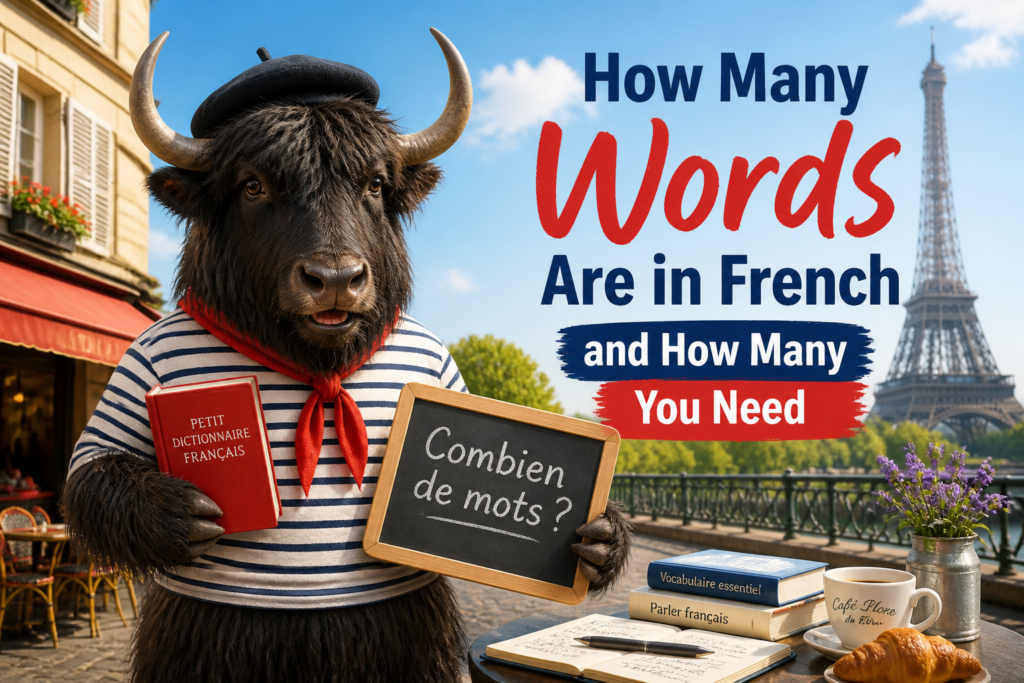
French has a lot of words. Like, a lot a lot. If you open a big dictionary, you might start wondering whether learning French means memorizing half a library and maybe a baker’s daily emotional vocabulary too.
The good news: you absolutely do not need “all of French” to speak French. Not even close.
In this guide, you’ll see roughly how many words French has, why the answer is annoyingly fuzzy, and how many words you actually need for travel, conversation, reading, work, and everyday life. We’ll also look at the kinds of words that matter most, because knowing 500 useful words beats knowing 500 obscure mushroom terms every single time.
If you want the bigger picture of your level, you can also take a French placement test or check your active word bank with this French vocabulary test.
The Short Answer
French has hundreds of thousands of words if you count dictionary entries, technical vocabulary, regional terms, slang, borrowed words, old-fashioned words, and all the specialist stuff normal humans never say out loud.
But most learners do not need hundreds of thousands of words. For practical use:
- Around 500 words can get you through very basic survival situations.
- Around 1,000 to 1,500 words can support simple everyday conversation.
- Around 2,000 to 3,000 words can let you handle a lot of daily life, travel, and basic media.
- Around 4,000 to 6,000 words gives you a much more comfortable independent level.
- Around 8,000+ starts to feel much broader for reading, nuance, and more natural expression.
You do not need dictionary-sized French. You need useful French.
So How Many Words Are in French Exactly?
This is where language gets slippery.
If you ask “How many words are in French?” the answer depends on what counts as a word. Are we counting only standard modern French? What about old words? Medical terms? Regional words from Belgium, Quebec, Switzerland, West Africa, the Caribbean, and beyond? What about derived forms like parler, parlons, parlait, and parlé? Is that one word family or several separate forms?
That is why different dictionaries give different impressions. A major dictionary may contain well over 100,000 entries, but that does not mean an educated native speaker actively uses all of them. Not even remotely.
For a broad point of reference, standard French includes well over 100,000 dictionary words, and if you include specialist and historical vocabulary, the total grows much larger.
In real life, frequency matters more than the raw total. Languages are uneven. A small group of words appears constantly, while a massive number of words appear rarely. That is why learning the right 1,000 words changes your life more than staring sadly at a dictionary the size of a microwave.
Why Counting Words Is Messier Than It Looks
Let’s make the mess useful. Here are the main reasons word counts vary.
| Issue | What It Means | Example | Learner Note |
|---|---|---|---|
| Word Families | One root can create many related words | parler, parleur, parlable | Learning families helps vocabulary grow faster |
| Conjugated Forms | French verbs change form constantly | je vais, nous allons, ils iront | You usually count the base verb as the main word |
| Gender And Agreement | Words can change shape for masculine, feminine, or plural | petit, petite, petits, petites | These are forms of one adjective, not four unrelated words |
| Regional Vocabulary | French varies by country and region | voiture and some regional alternatives | Standard France French is the best default for most learners |
| Specialist Terms | Technical fields add huge vocabularies | law, medicine, chemistry, finance | You can ignore most of this at beginner and intermediate stages |
| Slang And Informal Speech | Spoken French includes a lot beyond textbook French | bosser for “to work” | Useful eventually, but not your first priority |
So yes, French is huge. But your target is not “all French.” Your target is enough French to do what you want.
How Many Words Does A Native French Speaker Know?
Exact numbers vary a lot, but native speakers typically understand many tens of thousands of words and actively use a smaller chunk of them on a regular basis.
That sounds intimidating until you remember two things:
- Native speakers build vocabulary over a lifetime, not in one course book and three panic sessions before a trip to Paris.
- Native speakers also rely heavily on a core group of common words in daily life.
In other words, even fluent native speech is not made of endless rare vocabulary. It is built on common verbs, common nouns, common connectors, and familiar patterns used again and again.
How Many French Words Do You Actually Need?
Here is the practical answer most learners are really looking for.
| Approximate Vocabulary Size | What You Can Usually Do | French Example | English Translation |
|---|---|---|---|
| 250–500 words | Handle greetings, basic needs, numbers, food, directions, simple questions | Je voudrais un café, s’il vous plaît. | I would like a coffee, please. |
| 500–1,000 words | Manage survival travel, simple chats, basic descriptions, routine tasks | Je cherche la gare et je ne parle pas très bien français. | I’m looking for the train station and I don’t speak French very well. |
| 1,000–2,000 words | Talk about daily life, work, hobbies, family, plans, preferences | Je travaille la semaine, mais le week-end je vois mes amis. | I work during the week, but on weekends I see my friends. |
| 2,000–3,000 words | Follow many everyday conversations and understand more media with support | J’ai compris l’idée générale, mais j’ai raté quelques détails. | I understood the general idea, but I missed a few details. |
| 4,000–6,000 words | Function more independently in conversation, reading, and work-related contexts | On peut en discuter demain si tu veux plus de précisions. | We can discuss it tomorrow if you want more details. |
| 8,000+ words | Read more comfortably, catch nuance, and express yourself more naturally | Le ton de l’article est assez nuancé, presque ironique. | The tone of the article is quite nuanced, almost ironic. |
These are rough ranges, not sacred language commandments carved into baguette stone. Your actual ability also depends on grammar, listening practice, pronunciation, and how well you know high-frequency words.
What 500 French Words Can Do
With roughly 500 useful words, you can start doing things. Not elegant things. Not poetic things. But real things.
You can greet people, order food, ask where the bathroom is, understand prices, say what you want, and survive short predictable exchanges.
That vocabulary should include high-frequency items like:
| French | Pronunciation | Meaning | Example Sentence | Translation | Learner Note |
|---|---|---|---|---|---|
| bonjour | bohn-zhoor | hello | Bonjour, madame. | Hello, ma’am. | Basic polite greeting |
| s’il vous plaît | seel voo pleh | please | Un café, s’il vous plaît. | A coffee, please. | Use this in polite situations |
| merci | mehr-see | thank you | Merci pour votre aide. | Thank you for your help. | merci beaucoup = thank you very much |
| où | oo | where | Où est la gare ? | Where is the station? | Very high-value question word |
| combien | kohm-byen | how much / how many | Combien ça coûte ? | How much does it cost? | Excellent travel word |
| je veux | zhuh vuh | I want | Je veux de l’eau. | I want some water. | Useful, but je voudrais is softer and more polite |
| je voudrais | zhuh voo-dreh | I would like | Je voudrais une chambre. | I would like a room. | Safer than sounding bossy |
| je ne comprends pas | zhuh nuh kohm-prahn pah | I don’t understand | Désolé, je ne comprends pas. | Sorry, I don’t understand. | In fast speech, ne often drops in conversation |
| j’aime | zhem | I like | J’aime ce restaurant. | I like this restaurant. | Notice the elision: je becomes j’ before a vowel |
| aller | ah-lay | to go | Je vais au travail. | I’m going to work. | One of the most common French verbs |
If your goal is travel or simple conversation, 500 good words are not trivial. They are your first working toolbox.
What 1,000 To 2,000 French Words Can Do
This is where things start to feel like actual language instead of emergency phrase collecting.
With 1,000 to 2,000 words, you can usually talk about:
- your family
- your work or studies
- daily routines
- likes and dislikes
- travel plans
- shopping and services
- basic opinions
- simple stories in the past or future
You still won’t understand everything, of course. Native-speed French will continue to be rude and inconsiderate. But you can function in many common situations.
At this stage, common verbs become especially important. If you have not already, spend time with common French verbs, because verbs do a ridiculous amount of heavy lifting.
The Words That Matter Most
Not all words are equally useful. Some words appear constantly. Others mostly sit around in dictionaries waiting to feel important.
If you want fast progress, focus on these categories first:
- high-frequency verbs
- common nouns for people, places, time, food, and everyday objects
- basic adjectives
- question words
- pronouns
- connectors like “and,” “but,” “because,” “so”
- negation patterns like ne…pas
- polite social phrases
- numbers, dates, and time expressions
- common chunks, not just isolated words
That last point matters a lot. Learn phrases, not just dictionary entries.
For example, knowing prendre means “to take” is nice. Knowing prendre le train, prendre un café, and prendre une décision is much better. Real language lives in combinations.
10 High-Value French Words And Phrases
Here are a few excellent examples of useful French you will actually meet early and often.
| French | Pronunciation | Meaning | Example Sentence | Translation | Learner Note |
|---|---|---|---|---|---|
| être | etruh | to be | Je suis fatigué aujourd’hui. | I am tired today. | Core verb; feminine speaker says fatiguée |
| avoir | ah-vwahr | to have | Nous avons une réunion à dix heures. | We have a meeting at ten o’clock. | Also used in many expressions like avoir faim |
| faire | fehr | to do / to make | Je fais mes devoirs ce soir. | I’m doing my homework tonight. | Very common multi-use verb |
| aller | ah-lay | to go | On va au cinéma ? | Shall we go to the movies? | On va is extremely common spoken French |
| pouvoir | poo-vwahr | can / to be able to | Vous pouvez répéter, s’il vous plaît ? | Can you repeat, please? | Excellent polite helper verb |
| vouloir | voo-lwahr | to want | Je voudrais parler au responsable. | I would like to speak to the manager. | Conditional form sounds polite |
| il y a | eel ee ah | there is / there are | Il y a un problème avec ma réservation. | There is a problem with my reservation. | One chunk; learn it as a whole |
| il faut | eel foh | it is necessary / you need to | Il faut partir maintenant. | We need to leave now. | Very common for obligation |
| parce que | parss kuh | because | Je reste ici parce que je suis fatigué. | I’m staying here because I’m tired. | Useful connector for longer sentences |
| qu’est-ce que | kess kuh | what | Qu’est-ce que tu fais ? | What are you doing? | Notice the elision and linked sounds in speech |
French Learners Often Overestimate Nouns And Underestimate Chunks
A lot of learners chase long noun lists: spoon, cloud, squirrel, receipt, lamp, shelf. Those words matter, sure. But language becomes usable faster when you also learn ready-made pieces.
Examples of useful chunks:
- je ne sais pas — I don’t know
- ça dépend — it depends
- tout de suite — right away
- en fait — actually / in fact
- bien sûr — of course
- pas du tout — not at all
- je crois que — I think that
- j’ai besoin de — I need
These chunks let you sound more natural, connect ideas, and keep conversations moving even when your vocabulary is not huge yet.
How Vocabulary Size Connects To CEFR Levels
Vocabulary size and CEFR levels do not match perfectly, but there is a loose relationship.
| CEFR Level | Rough Vocabulary Range | What It Usually Feels Like | French Example |
|---|---|---|---|
| A1 | 500–1,000 | Basic introductions and simple needs | Je m’appelle Sarah et j’habite à Lyon. |
| A2 | 1,000–1,500+ | Routine situations and simple descriptions | Le week-end, je vais souvent au marché. |
| B1 | 2,000–3,000+ | Everyday independence with some gaps | Je peux expliquer le problème, mais pas en détail. |
| B2 | 4,000–6,000+ | Comfortable conversation and broader reading | Le film était intéressant, même si la fin était prévisible. |
| C1+ | 8,000+ | Nuance, abstraction, stronger reading and expression | Son argument est convaincant, mais il manque de preuves. |
If you are curious where you currently fit, try the French placement test. It gives a more useful snapshot than vague panic or wild optimism.
What Kind Of French Words Should Beginners Learn First?
If you are early in your French journey, start with frequency and usefulness. A smart beginner list should include:
- pronouns: je, tu, il, elle, nous, vous, ils, elles
- articles: un, une, le, la, les, des, l’
- question words: qui, que, quoi, où, quand, pourquoi, comment, combien
- top verbs: être, avoir, aller, faire, pouvoir, vouloir, devoir, savoir, venir, prendre
- daily nouns: food, family, transport, weather, places, time, money
- basic adjectives: grand, petit, bon, mauvais, beau, nouveau, cher, important
- connectors: et, mais, ou, donc, parce que
A great place to start is this list of 100 essential French words. That kind of core vocabulary punches way above its weight.
A Few French Frequency Truths Worth Knowing
Here are a few truths that save learners time.
- You will see the same small set of verbs constantly.
- Function words matter hugely: articles, pronouns, prepositions, and connectors.
- Spoken French often uses a narrower, more repetitive vocabulary than formal writing.
- Understanding a word is easier than using it actively.
- Knowing a word once is not the same as owning it in real conversation.
So if your passive vocabulary is larger than your speaking vocabulary, congratulations: you are normal.
Useful French Vocabulary For Talking About Quantity And Language Learning
If you want to discuss language learning itself in French, these words are handy.
| French | Pronunciation | Meaning | Example Sentence | Translation | Learner Note |
|---|---|---|---|---|---|
| un mot | uhn moh | a word | Je ne connais pas ce mot. | I don’t know that word. | Masculine noun |
| le vocabulaire | luh voh-kab-yoo-lehr | vocabulary | Je dois enrichir mon vocabulaire. | I need to expand my vocabulary. | Often used with apprendre or réviser |
| la langue | lah lahng | language | Le français est une belle langue. | French is a beautiful language. | Feminine noun |
| courant | koo-rahn | common / fluent depending on context | C’est un mot très courant. | It’s a very common word. | Context matters |
| fréquent | fray-kahn | frequent | Ce verbe est très fréquent à l’oral. | This verb is very frequent in spoken French. | à l’oral = in spoken language |
| débutant | day-boo-tahn | beginner | Je suis encore débutant en français. | I’m still a beginner in French. | Feminine form: débutante |
| intermédiaire | ahn-tehr-may-dee-ehr | intermediate | J’ai un niveau intermédiaire. | I have an intermediate level. | Same spelling for masculine and feminine |
| couramment | koo-rah-mahn | fluently | Elle parle français couramment. | She speaks French fluently. | Adverb form |
| apprendre | ah-prahn-druh | to learn | J’apprends dix nouveaux mots par jour. | I learn ten new words per day. | Notice the apostrophe in j’apprends |
| réviser | ray-vee-zay | to review / revise | Je révise mon vocabulaire le soir. | I review my vocabulary in the evening. | Very useful study verb |
Common Mistakes Learners Make About Vocabulary Size
Let’s save you some wasted effort.
| Mistake | What To Do Instead | French Example | Translation |
|---|---|---|---|
| Trying to learn rare words too early | Focus on common words first | Je prends le bus tous les jours. | I take the bus every day. |
| Memorizing isolated lists without context | Learn words inside phrases and sentences | J’ai besoin d’un billet pour demain. | I need a ticket for tomorrow. |
| Ignoring verbs | Build around common verbs immediately | On peut commencer maintenant. | We can start now. |
| Ignoring function words | Master articles, pronouns, and connectors | Je vais au bureau, puis je rentre à la maison. | I go to the office, then I go home. |
| Counting words instead of building skill | Track comprehension and usage, not just totals | Je comprends, mais je ne parle pas encore facilement. | I understand, but I still don’t speak easily. |
How To Build A Useful French Vocabulary Faster
If your goal is to reach practical French sooner, here is the non-glamorous but effective path.
- Learn high-frequency words first.
- Study common verbs aggressively.
- Learn phrases, not just single words.
- Review with spaced repetition.
- Read and listen to easy material often.
- Reuse new words in your own sentences.
- Notice collocations, like what words naturally go together.
- Return to the same useful words until they become automatic.
And yes, repetition is boring. So is brushing your teeth, yet somehow everyone remains very attached to the results.
A Good Goal For Most Learners
If you are wondering what to aim for, here is a simple answer:
- First goal: 500 high-frequency words and phrases
- Second goal: 1,500 practical words plus core verbs and connectors
- Third goal: 3,000 useful words with lots of listening and reading
That progression gets you much farther than chasing giant vocabulary numbers with poor retention.
If you want a structured next step, start with 100 essential French words, then expand with common French verbs, and check your progress with the French vocabulary test.
Quick Reference Summary
- French has well over 100,000 words if you count dictionary vocabulary broadly.
- You do not need anything close to that to speak French.
- About 500 words can support survival French.
- About 1,000 to 2,000 words can support basic everyday conversation.
- About 2,000 to 3,000 words can take you through a lot of daily life.
- Vocabulary size matters, but frequency matters more.
- Common verbs, chunks, pronouns, articles, and connectors deserve early attention.
- Useful phrases beat random rare words.
Final Yak Takeaway
French has a huge vocabulary, yes. But that is not your problem. Your problem is learning the right words in the right order and using them often enough that they stop running away.
You do not need all the words. You need enough of the common ones to start living in the language.
And once you can ask for coffee, explain a problem, make a plan, tell a story, and understand a joke half a second too late, you are doing real French already. Which is honestly the whole point.
For more beginner-friendly help, explore the full Learn French hub or revisit this guide any time at How Many Words Are in French.