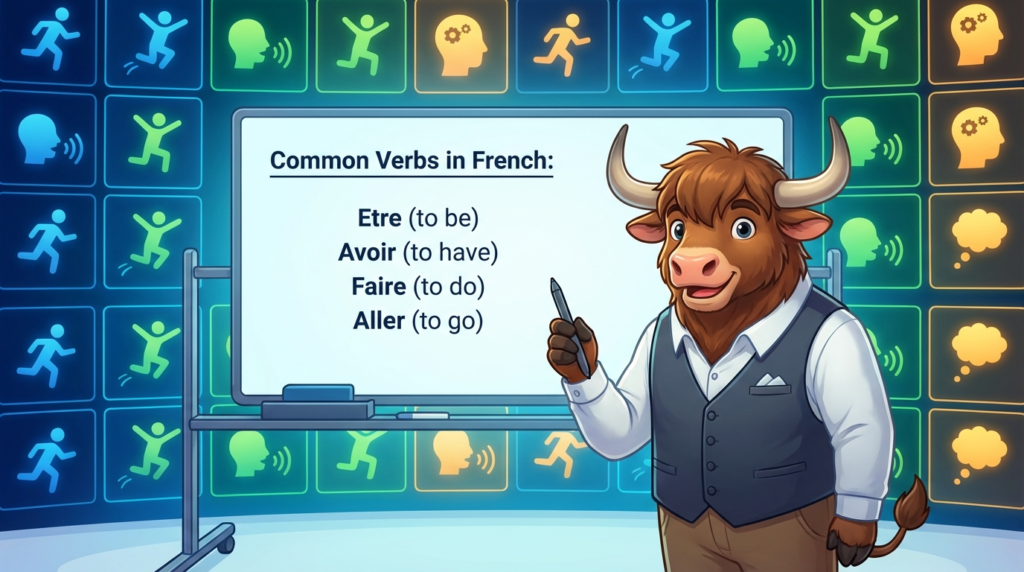
Topic: Les verbes français du quotidien (the ones you’ll use before lunch)
Common French Verbs: 100 Essentials You’ll Actually Use
This is your “I can actually speak French” verb starter pack: 100 high-frequency verbs, each with IPA pronunciation, a real-life example, and a tap-to-hear audio button.
Quick note: you don’t need to memorize every tense today. Learn the meaning + a couple of ready-to-use sentences, and your French will suddenly feel… suspiciously functional.
Yak Snark: French verbs are like house keys: you only notice them when you don’t have them. Let’s keep you out of linguistic lockouts.
8 “Just Give Me the Useful Ones” Verbs
These show up everywhere. Learn these first, and French starts cooperating.
- -er verbs usually end in /e/ (parler /paʁle/). Not “par-LAY” (close… but keep it crisp).
- The French R is from the throat: /ʁ/ (like a gentle gargle, not a pirate growl).
- Nasal vowels (ɑ̃, ɔ̃, ɛ̃) go through the nose: prendre /pʁɑ̃dʁ/.
18 Ready-to-Use Verb Phrases (Say These, Win Life)
These are “grab-and-go” sentences built from common verbs. Tap audio and borrow shamelessly.
Je peux vous aider ?
/ʒə pø vu.z‿ede/
EN: Can I help you? (polite)
Tu peux répéter, s’il te plaît ?
/ty pø ʁepete sil tə plɛ/
EN: Can you repeat, please? (casual)
Je voudrais réserver une table.
/ʒə vudʁɛ ʁezɛʁve yn tabl/
EN: I’d like to book a table.
Je vais vous envoyer le lien.
/ʒə vɛ vu.z‿ɑ̃vwaje lə ljɛ̃/
EN: I’m going to send you the link.
Je ne sais pas.
/ʒə nə sɛ pa/
EN: I don’t know.
Je comprends, merci.
/ʒə kɔ̃pʁɑ̃ mɛʁsi/
EN: I understand, thanks.
Ça coûte combien ?
/sa kut kɔ̃bjɛ̃/
EN: How much does it cost?
Je cherche la sortie.
/ʒə ʃɛʁʃ la sɔʁti/
EN: I’m looking for the exit.
Vous pouvez m’aider ?
/vu puve m‿ede/
EN: Can you help me? (polite)
Je dois travailler ce soir.
/ʒə dwa tʁavaje sə swaʁ/
EN: I have to work tonight.
On se retrouve à 18 h ?
/ɔ̃ sə ʁə.tʁuv a dizɥit œʁ/
EN: Shall we meet at 6 pm?
Je vais prendre l’addition.
/ʒə vɛ pʁɑ̃dʁ ladisjɔ̃/
EN: I’ll take the bill (ask for it).
Je préfère marcher.
/ʒə pʁefeʁ maʁʃe/
EN: I prefer to walk.
Je peux payer par carte ?
/ʒə pø peje paʁ kaʁt/
EN: Can I pay by card?
Je viens dans deux minutes.
/ʒə vjɛ̃ dɑ̃ dø minyt/
EN: I’ll be there in two minutes.
J’ai oublié mon mot de passe.
/ʒe ublije mɔ̃ mo də pas/
EN: I forgot my password.
Je peux essayer ?
/ʒə pø esɛje/
EN: Can I try (it on)?
Je suis en retard, désolé.
/ʒə sɥi ɑ̃ ʁətaʁ dezɔle/
EN: I’m late, sorry.
A Tiny Grammar Reality Check (No Tears)
- Infinitives are the dictionary form: parler, finir, prendre.
- Reflexive verbs use se: se lever (to get up), se sentir (to feel).
- Most-used irregulars: être, avoir, aller, faire. They’re the VIPs—learn a few common sentences and you’re set.
The Big List: 100 Common French Verbs (Grouped by Real Life)
Search above to filter. The audio button plays the example sentence so you hear the verb in action.
| French | IPA | Meaning (EN) | Example (FR) | Translation (EN) | Audio |
|---|---|---|---|---|---|
| être | /ɛtʁ/ | to be | Je suis fatigué. | I’m tired. | |
| avoir | /avwaʁ/ | to have | J’ai du temps. | I have time. | |
| aller | /ale/ | to go | On va au centre-ville. | We’re going downtown. | |
| faire | /fɛʁ/ | to do / make | Je fais un café. | I’m making a coffee. | |
| venir | /vəniʁ/ | to come | Tu viens avec moi ? | Are you coming with me? | |
| partir | /paʁtiʁ/ | to leave (depart) | Je pars à huit heures. | I’m leaving at 8. | |
| arriver | /aʁive/ | to arrive | On arrive bientôt. | We’re arriving soon. | |
| pouvoir | /puvwaʁ/ | can / to be able to | Je peux expliquer. | I can explain. | |
| vouloir | /vulwaʁ/ | to want | Je veux essayer. | I want to try. | |
| devoir | /dəvwaʁ/ | must / to have to | Je dois partir. | I have to leave. | |
| savoir | /savwaʁ/ | to know (a fact / how) | Je sais le faire. | I know how to do it. | |
| connaître | /kɔnɛtʁ/ | to know (a person/place) | Je connais ce quartier. | I know this neighborhood. | |
| prendre | /pʁɑ̃dʁ/ | to take | Je prends le métro. | I take the metro. | |
| mettre | /mɛtʁ/ | to put / to wear | Je mets mon manteau. | I’m putting on my coat. | |
| dire | /diʁ/ | to say / tell | Je te dis la vérité. | I’m telling you the truth. |
| French | IPA | Meaning (EN) | Example (FR) | Translation (EN) | Audio |
|---|---|---|---|---|---|
| parler | /paʁle/ | to speak | Je parle un peu français. | I speak a little French. | |
| demander | /dəmɑ̃de/ | to ask (for) | Je demande un renseignement. | I’m asking for information. | |
| répondre | /ʁepɔ̃dʁ/ | to answer | Je réponds plus tard. | I’ll reply later. | |
| expliquer | /ɛksplike/ | to explain | Tu peux expliquer ? | Can you explain? | |
| raconter | /ʁakɔ̃te/ | to tell (a story) | Raconte-moi tout. | Tell me everything. | |
| appeler | /ap(ə)le/ | to call | Je t’appelle ce soir. | I’ll call you tonight. | |
| envoyer | /ɑ̃vwaje/ | to send | Je vous envoie un email. | I’m sending you an email. | |
| recevoir | /ʁəsəvwaʁ/ | to receive | J’ai reçu ton message. | I received your message. | |
| écrire | /ekʁiʁ/ | to write | Je vais écrire une note. | I’m going to write a note. | |
| lire | /liʁ/ | to read | Je lis le menu. | I’m reading the menu. | |
| traduire | /tʁadɥiʁ/ | to translate | Tu peux traduire ça ? | Can you translate that? | |
| discuter | /diskyte/ | to discuss | On discute demain. | We’ll discuss tomorrow. | |
| répéter | /ʁepete/ | to repeat | Je répète lentement. | I’ll repeat slowly. | |
| prononcer | /pʁɔnɔ̃se/ | to pronounce | Je prononce mal ce mot. | I pronounce this word badly. |
| French | IPA | Meaning (EN) | Example (FR) | Translation (EN) | Audio |
|---|---|---|---|---|---|
| voir | /vwaʁ/ | to see | Je vois le problème. | I see the problem. | |
| regarder | /ʁəɡaʁde/ | to watch / look at | Je regarde une série. | I’m watching a series. | |
| entendre | /ɑ̃tɑ̃dʁ/ | to hear | Je n’entends rien. | I can’t hear anything. | |
| écouter | /ekute/ | to listen | Écoute, s’il te plaît. | Listen, please. | |
| sentir | /sɑ̃tiʁ/ | to feel / smell | Ça sent bon. | That smells good. | |
| goûter | /ɡute/ | to taste | Je goûte la sauce. | I’m tasting the sauce. | |
| comprendre | /kɔ̃pʁɑ̃dʁ/ | to understand | Je comprends maintenant. | I understand now. | |
| penser | /pɑ̃se/ | to think | Je pense que oui. | I think so. | |
| croire | /kʁwaʁ/ | to believe | Je crois que c’est vrai. | I believe it’s true. | |
| imaginer | /imaʒine/ | to imagine | Imagine un peu ! | Just imagine! | |
| apprendre | /apʁɑ̃dʁ/ | to learn | J’apprends le français. | I’m learning French. | |
| oublier | /ublije/ | to forget | J’ai oublié mon nom. | I forgot my name. | |
| se souvenir | /sə suvəniʁ/ | to remember | Je me souviens de toi. | I remember you. | |
| choisir | /ʃwaziʁ/ | to choose | Je choisis celui-ci. | I choose this one. | |
| décider | /deside/ | to decide | Je décide ce soir. | I’ll decide tonight. |
| French | IPA | Meaning (EN) | Example (FR) | Translation (EN) | Audio |
|---|---|---|---|---|---|
| se lever | /sə ləve/ | to get up | Je me lève tôt. | I get up early. | |
| se réveiller | /sə ʁeveje/ | to wake up | Je me réveille à 7 h. | I wake up at 7. | |
| se laver | /sə lave/ | to wash (oneself) | Je me lave les mains. | I wash my hands. | |
| se doucher | /sə duʃe/ | to shower | Je me douche vite. | I shower quickly. | |
| s’habiller | /sabije/ | to get dressed | Je m’habille en noir. | I’m getting dressed in black. | |
| manger | /mɑ̃ʒe/ | to eat | On mange dehors. | We’re eating out. | |
| boire | /bwaʁ/ | to drink | Je bois de l’eau. | I drink water. | |
| cuisiner | /kɥizine/ | to cook | Je cuisine ce soir. | I’m cooking tonight. | |
| travailler | /tʁavaje/ | to work | Je travaille demain. | I work tomorrow. | |
| étudier | /etydje/ | to study | J’étudie à la maison. | I study at home. | |
| enseigner | /ɑ̃sɛɲe/ | to teach | Elle enseigne le français. | She teaches French. | |
| se reposer | /sə ʁəpoze/ | to rest | Je me repose un peu. | I’m resting a bit. | |
| se dépêcher | /sə depeʃe/ | to hurry | Dépêche-toi, s’il te plaît. | Hurry up, please. | |
| s’asseoir | /saswaʁ/ | to sit down | Vous pouvez vous asseoir. | You can sit down. | |
| se coucher | /sə kuʃe/ | to go to bed | Je me couche tard. | I go to bed late. | |
| dormir | /dɔʁmiʁ/ | to sleep | Je dors bien. | I sleep well. |
| French | IPA | Meaning (EN) | Example (FR) | Translation (EN) | Audio |
|---|---|---|---|---|---|
| marcher | /maʁʃe/ | to walk | On marche jusqu’ici. | We walk up to here. | |
| courir | /kuʁiʁ/ | to run | Je cours le matin. | I run in the morning. | |
| conduire | /kɔ̃dɥiʁ/ | to drive | Je conduis prudemment. | I drive carefully. | |
| entrer | /ɑ̃tʁe/ | to enter | On entre maintenant. | We’re going in now. | |
| sortir | /sɔʁtiʁ/ | to go out / exit | Je sors ce soir. | I’m going out tonight. | |
| monter | /mɔ̃te/ | to go up | On monte au troisième. | We go up to the third floor. | |
| descendre | /desɑ̃dʁ/ | to go down | Je descends ici. | I’m getting off here. | |
| rester | /ʁɛste/ | to stay | Je reste deux jours. | I’m staying two days. | |
| retourner | /ʁətuʁne/ | to return (go back) | Je retourne au bureau. | I’m going back to the office. | |
| voyager | /vwajaʒe/ | to travel | J’aime voyager léger. | I like traveling light. | |
| visiter | /vizite/ | to visit | On visite le musée. | We’re visiting the museum. | |
| réserver | /ʁezɛʁve/ | to book / reserve | Je réserve un billet. | I’m booking a ticket. | |
| attendre | /atɑ̃dʁ/ | to wait | J’attends ici. | I’ll wait here. | |
| chercher | /ʃɛʁʃe/ | to look for | Je cherche mon téléphone. | I’m looking for my phone. | |
| trouver | /tʁuve/ | to find | J’ai trouvé la solution. | I found the solution. |
| French | IPA | Meaning (EN) | Example (FR) | Translation (EN) | Audio | |
|---|---|---|---|---|---|---|
| ouvrir | /uvʁiʁ/ | to open | J’ouvre la fenêtre. | I’m opening the window. | ||
| fermer | /fɛʁme/ | to close | Ferme la porte, s’il te plaît. | Close the door, please. | ||
| enlever | /ɑ̃ləve/ | to remove | J’enlève mes chaussures. | I’m taking off my shoes. | ||
| porter | /pɔʁte/ | to wear / carry | Je porte un pull. | I’m wearing a sweater. | ||
| apporter | /apɔʁte/ | to bring (a thing) | J’apporte un dessert. | I’m bringing a dessert. | ||
| acheter | /aʃte/ | to buy | J’achète du pain. | I’m buying bread. | ||
| vendre | /vɑ̃dʁ/ | to sell | Ils vendent des livres. | They sell books. | ||
| payer | /peje/ | to pay | Je paie en espèces. | I’m paying in cash. | ||
| coûter | /kute/ | to cost | Ça coûte dix euros. | It costs ten euros. | ||
| commander | /kɔmɑ̃de/ | to order | Je commande un thé. | I’m ordering a tea. | ||
| préparer | /pʁepaʁe/ | to prepare | Je prépare mes affaires. | I’m preparing my things. | ||
| nettoyer | /netwaje/ | to clean | Je nettoie la cuisine. | I’m cleaning the kitchen. | ||
| ranger | /ʁɑ̃ʒe/ | to tidy / put away | Je range ma chambre. | I’m tidying my room. | ||
| réparer | /ʁepaʁe/ | to repair | On répare le vélo. | We’re fixing the bike. | ||
| utiliser | /ytilize/ | to use | J’utilise une appli. | I use an app. | ||
| essayer | /esɛje/ | to try | Je vais essayer. | I’m going to try. | ||
| commencer | /kɔmɑ̃se/ | to start | On commence à midi. | We start at noon. | ||
| finir | finir | /finiʁ/ | to finish | Je finis bientôt. | I’m finishing soon. | |
| aider | /ede/ | to help | Tu peux m’aider ? | Can you help me? | ||
| laisser | /lese/ | to leave / let | Laisse-moi deux minutes. | Give me two minutes. | ||
| tenir | /təniʁ/ | to hold / keep | Je tiens mon sac. | I’m holding my bag. | ||
| suivre | /sɥivʁ/ | to follow | Suivez-moi, s’il vous plaît. | Follow me, please. | ||
| changer | /ʃɑ̃ʒe/ | to change | Je change de place. | I’m changing seats. | ||
| arrêter | /aʁete/ | to stop | On s’arrête ici. | We’re stopping here. | ||
| continuer | /kɔ̃tinɥe/ | to continue | On continue demain. | We’ll continue tomorrow. |
Tricky Pairs That Confuse Everyone (Including Confident People)
These are the “same-ish in English, totally different in French” pairs. Learn one sentence for each, and you’ll sound weirdly competent.
savoir vs connaître
/savwaʁ/ vs /kɔnɛtʁ/
Rule: savoir = know a fact/how • connaître = know a person/place
écouter vs entendre
/ekute/ vs /ɑ̃tɑ̃dʁ/
Rule: écouter = listen (on purpose) • entendre = hear (it happens)
regarder vs voir
/ʁəɡaʁde/ vs /vwaʁ/
Rule: regarder = watch/look at • voir = see (notice/spot)
sortir vs partir
/sɔʁtiʁ/ vs /paʁtiʁ/
Rule: sortir = go out (for an activity) • partir = leave/depart
mettre vs porter
/mɛtʁ/ vs /pɔʁte/
Rule: mettre = put on (action) • porter = wear/carry (state)
- Pick 5 verbs you actually use daily (eat, go, want, take, work).
- Say each example sentence 3 times with audio.
- Swap one word (today/tonight/tomorrow, here/there, coffee/tea) and repeat.