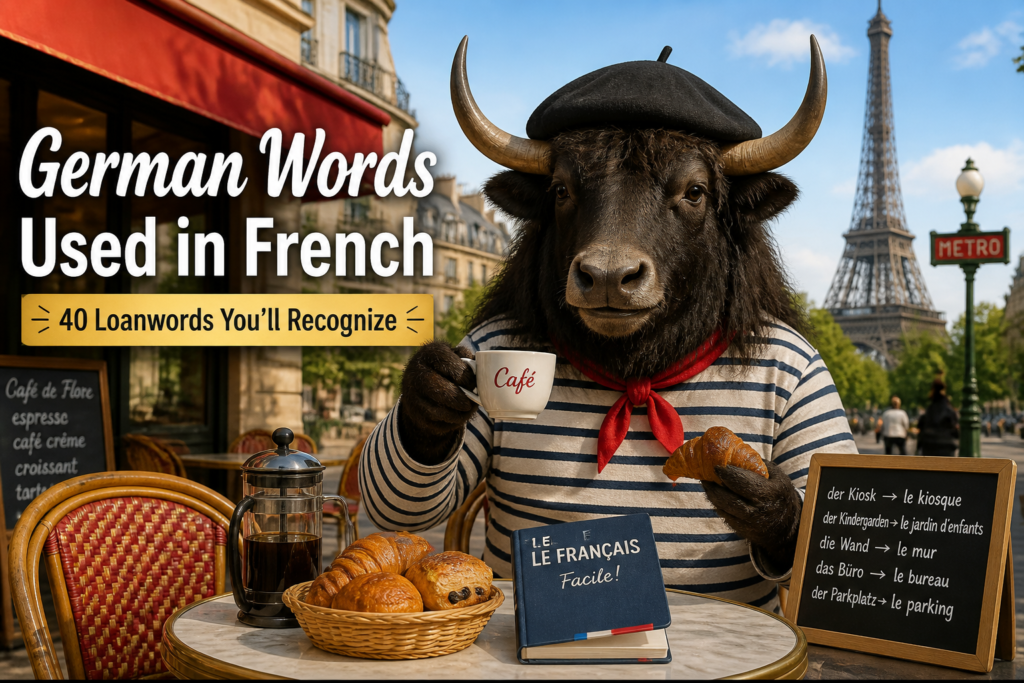
French loves to pretend it is above borrowing words from the neighbors, and then it quietly walks off with quite a few of them anyway. German has given French a solid batch of useful, colorful, and occasionally very food-related words.
Some of these came through border regions like Alsace-Lorraine. Others arrived through military history, trade, music, beer culture, or just the eternal human need to name a sausage properly.
And yes, a few look delightfully recognizable if you already know English or a little German. That is always a nice little win.
In this guide, you’ll learn 40 German-origin words used in modern French, how to pronounce them, what they mean, and how they actually show up in real sentences. If you want a broader starting point for French study, visit the Learn French hub.
What Counts As A German Loanword In French?
An emprunt is a borrowed word. In this article, we are looking at French words that came from German, often directly, sometimes through regional contact. A few have shifted slightly in spelling, pronunciation, or tone once they settled into French life and started paying linguistic rent.
Most are standard in France French. A few are especially common in Alsace or in food, military, or historical contexts. I’ll flag that when it matters.
French may be fancy, but it still says things like choucroute, bretzel, and kitsch. Civilization survives.
The 40 German Words Used In French
The table below gives you the core meaning fast. After that, you’ll get extra notes and examples for the most useful or interesting ones.
| French | Pronunciation | Meaning | Example Sentence | Translation | Learner Note |
|---|---|---|---|---|---|
| le bretzel | breht-sel | pretzel | J’ai pris un bretzel à la boulangerie. | I got a pretzel at the bakery. | Very common in Alsace. |
| la choucroute | shoo-kroot | sauerkraut; also the dish | On mange de la choucroute ce soir. | We’re eating sauerkraut tonight. | Can mean the cabbage or the full dish. |
| le schnaps | shnaps | strong fruit liquor | Il a offert un schnaps après le repas. | He offered a schnapps after the meal. | Often regional or culinary. |
| la bière | byair | beer | Je voudrais une bière, s’il vous plaît. | I’d like a beer, please. | From Germanic origin, very old borrowing. |
| la flammekueche | flam-keush | Alsatian tart | La flammekueche est délicieuse. | The flammekueche is delicious. | Often treated as a regional food word. |
| le kirsch | keersh | cherry brandy | On met parfois du kirsch dans ce dessert. | People sometimes put kirsch in this dessert. | Common in cooking too. |
| le kouglof | koo-glof | ring-shaped cake | Ma grand-mère prépare un kouglof pour Noël. | My grandmother makes a kouglof for Christmas. | Alsatian specialty. |
| le knack | knak | sausage; snap | J’ai commandé une knack avec de la moutarde. | I ordered a knack sausage with mustard. | Often seen as saucisse knack. |
| la quetsche | ketch | plum variety | Cette tarte aux quetsches est incroyable. | This plum tart is incredible. | Common in eastern France. |
| le rösti | reus-tee | potato pancake | J’ai mangé un rösti au déjeuner. | I ate a rösti for lunch. | Also linked to Swiss German areas. |
| le bunker | bun-ker | bunker | Le bunker date de la guerre. | The bunker dates from the war. | Military/historical use. |
| le feldwebel | felt-vé-bel | sergeant major type rank | Le feldwebel donne les ordres. | The feldwebel gives the orders. | Mostly historical. |
| le kapo | ka-po | camp overseer | Le livre mentionne un kapo. | The book mentions a kapo. | Historical and serious context. |
| le stalag | sta-lag | POW camp | Son grand-père a été prisonnier dans un stalag. | His grandfather was a prisoner in a stalag. | Historical term. |
| le blitz | blits | blitz; rapid attack | L’équipe a lancé un blitz en fin de match. | The team launched a blitz at the end of the match. | Also used figuratively. |
| le bivouac | bee-voo-ak | bivouac, camp | Nous avons passé la nuit en bivouac. | We spent the night in bivouac. | Older borrowing via military use. |
| la valse | vals | waltz | Ils dansent la valse. | They are dancing the waltz. | Very common cultural word. |
| le lied | leet | German art song | Ce chanteur interprète un lied de Schubert. | This singer performs a Schubert lied. | Mainly music context. |
| le leitmotiv | light-mo-teef | recurring theme | La liberté est le leitmotiv du roman. | Freedom is the recurring theme of the novel. | Often figurative in French. |
| le folklore | fol-klor | folklore | Le folklore alsacien est très riche. | Alsatian folklore is very rich. | Extremely common. |
| le kitsch | keetch | tacky, kitsch style | La déco est un peu kitsch, mais drôle. | The decor is a bit kitschy, but funny. | Common in everyday speech. |
| le ersatz | air-zats | substitute, inferior replacement | Ce café est un ersatz de cappuccino. | This coffee is a substitute for cappuccino. | Usually negative. |
| le vasistas | va-zee-stas | small window fanlight | Ouvre le vasistas, il fait chaud. | Open the little window, it’s hot. | A classic fun borrowing. |
| le quartz | kwarts | quartz | Cette montre fonctionne au quartz. | This watch runs on quartz. | Science/everyday object word. |
| le zinc | zink | zinc | Le toit est en zinc. | The roof is made of zinc. | Also slang for bar counter in French. |
| le hamster | am-ster | hamster | Le hamster dort toute la journée. | The hamster sleeps all day. | Final -h is silent in French. |
| la halte | alt | stop, halt | Le train fait une halte de dix minutes. | The train makes a ten-minute stop. | Common transport/travel word. |
| la hase | az | female hare | La hase traverse le champ. | The female hare crosses the field. | Literary or specific vocabulary. |
| la horde | ord | horde | Une horde de touristes est arrivée. | A horde of tourists arrived. | Very common figurative word. |
| le havre | av-r | harbor, haven | Ce village est un havre de paix. | This village is a haven of peace. | Common in the phrase havre de paix. |
| la hache | ash | axe | Le bûcheron prend sa hache. | The lumberjack takes his axe. | Very old Germanic origin. |
| le heaume | om | helmet, helm | Le chevalier porte un heaume. | The knight wears a helmet. | Mainly historical/literary. |
| le casque | kask | helmet, headset | N’oublie pas ton casque à vélo. | Don’t forget your bike helmet. | Germanic origin, very common. |
| le galop | ga-lo | gallop | Le cheval part au galop. | The horse takes off at a gallop. | Common noun and expression. |
| le maréchal | ma-ray-shal | marshal | Le maréchal inspecte les troupes. | The marshal inspects the troops. | Historical and official contexts. |
| le sabre | sa-br | saber | Le soldat tient un sabre. | The soldier holds a saber. | Old military borrowing path. |
| la soupe | soop | soup | Je prépare une soupe de légumes. | I’m making a vegetable soup. | Ancient Germanic origin. |
| la trêve | trehv | truce | Les deux camps ont signé une trêve. | The two sides signed a truce. | Useful news word. |
| le guichet | gee-shay | ticket window, counter | Le guichet ferme à 18 heures. | The ticket window closes at 6 p.m. | Very useful in travel French. |
| la guerre | gair | war | La guerre a bouleversé le pays. | The war changed the country completely. | Very old borrowing, core word. |
Useful Notes On Pronunciation And Usage
A quick pattern you’ll notice: French often smooths out German sounds. The word keeps its basic shape, but the pronunciation becomes more French-friendly. In other words, the word moved countries and got a haircut.
- ch in borrowed words like kirsch or quetsche may sound closer to sh or k/sh depending on the word and region.
- The letter h is usually silent in French, so hamster, halte, and havre do not start with an English-style breathy sound.
- Some words keep a strong regional flavor in eastern France, especially food words like bretzel, kouglof, and flammekueche.
- Words such as kitsch, leitmotiv, and ersatz are often used in educated or journalistic French, not just in dictionaries gathering dust.
10 High-Value Words To Actually Remember First
If you do not feel like memorizing all 40 today, which is fair and healthy, start with these ten.
| French | Pronunciation | Meaning | Example Sentence | Translation | Learner Note |
|---|---|---|---|---|---|
| la bière | byair | beer | Il fait chaud, je prends une bière. | It’s hot, I’m having a beer. | Super useful in real life, allegedly. |
| le bretzel | breht-sel | pretzel | Ce bretzel est encore chaud. | This pretzel is still warm. | Easy cultural word. |
| la choucroute | shoo-kroot | sauerkraut dish | La choucroute est typique de l’Alsace. | Choucroute is typical of Alsace. | Very common in menus. |
| le kitsch | keetch | kitsch, tacky style | Son salon est complètement kitsch. | His living room is completely kitsch. | Useful for opinions. |
| le leitmotiv | light-mo-teef | main recurring theme | L’amour est le leitmotiv du film. | Love is the film’s recurring theme. | Common in essays and media. |
| la valse | vals | waltz | Cette musique me donne envie de danser la valse. | This music makes me want to dance the waltz. | Common culture word. |
| la halte | alt | stop, halt | Nous faisons une halte sur la route. | We’re making a stop on the road. | Very handy travel word. |
| le guichet | gee-shay | ticket window, service counter | Le guichet de la gare est ouvert. | The station ticket window is open. | Useful for trains and admin life. |
| la soupe | soop | soup | Je veux une soupe ce soir. | I want soup tonight. | Basic everyday word. |
| la guerre | gair | war | Ce musée raconte l’histoire de la guerre. | This museum tells the history of the war. | Core vocabulary word. |
Food Words From German In French
This is where the borrowing gets especially delicious. Border regions, especially Alsace, have given standard French several German or Germanic food words that still feel very alive today.
Le bretzel means pretzel.
Example: On partage un bretzel à l’apéro.
We’re sharing a pretzel before dinner drinks.
Learner note: In France, apéro is the pre-meal drink-and-snack moment everyone claims will be short. It never is.
La choucroute means sauerkraut, but in French it often refers to the whole Alsatian dish with cabbage, sausages, and potatoes.
Example: La choucroute garnie est très copieuse.
The dressed sauerkraut dish is very filling.
Le schnaps is a strong alcohol, often fruit-based.
Example: Après le dessert, ils ont servi un schnaps.
After dessert, they served a schnapps.
Le kouglof is a ring-shaped cake from Alsace.
Example: Le dimanche, ma tante prépare parfois un kouglof.
On Sundays, my aunt sometimes makes a kouglof.
La quetsche is a plum variety, common in eastern France.
Example: J’adore la confiture de quetsches.
I love plum jam made from quetsches.
Le kirsch is cherry brandy.
Example: Il y a un peu de kirsch dans cette forêt-noire.
There’s a little kirsch in this Black Forest cake.
Le rösti is more associated with Switzerland, but it is another Germanic food word you may meet in French menus.
Example: Je vais prendre le rösti avec une salade.
I’ll have the rösti with a salad.
Culture, Style, And Abstract Words
These are especially useful because they appear in articles, reviews, conversations, and opinion pieces.
Le kitsch means tacky, overly decorative, or so bad it circles around to fun again.
Example: Cette lampe rose est kitsch, mais je l’adore.
This pink lamp is kitschy, but I love it.
Le leitmotiv literally comes from music and means a recurring theme or central idea.
Example: Le respect est le leitmotiv de son discours.
Respect is the recurring theme of his speech.
Le folklore means folklore, traditional customs, stories, and cultural identity.
Example: Le festival met en valeur le folklore local.
The festival highlights local folklore.
Le ersatz means an inferior substitute. It is not a compliment.
Example: Ce produit est un ersatz de chocolat.
This product is a poor substitute for chocolate.
Learner note: You may also see un ersatz de démocratie or un ersatz de solution in serious writing. Very shady. Grammatically neat, emotionally rude.
Travel And Everyday Words You Can Actually Use
Not every loanword is exotic. Some are hiding in ordinary French, minding their own business.
| French | Pronunciation | Meaning | Example Sentence | Translation | Learner Note |
|---|---|---|---|---|---|
| la halte | alt | stop | On fait une halte avant de continuer. | We’re making a stop before continuing. | Useful in travel and writing. |
| le guichet | gee-shay | counter, ticket window | Le guichet numéro 3 est fermé. | Window number 3 is closed. | Very practical station word. |
| le vasistas | va-zee-stas | small top window | Ferme le vasistas, il pleut. | Close the small window, it’s raining. | Classic household word. |
| le casque | kask | helmet, headset | Mon casque audio ne marche plus. | My headphones don’t work anymore. | Modern everyday use. |
| le zinc | zink | zinc; bar counter | Ils discutent au zinc du café. | They’re chatting at the café counter. | Nice bonus slang meaning. |
| la soupe | soop | soup | La soupe est prête. | The soup is ready. | Very common basic noun. |
Important usage note for le zinc: besides the metal, French slang also uses le zinc to mean the bar counter in a café. So être accoudé au zinc means leaning on the bar, not hugging industrial roofing material.
Historical And Military Loanwords
A noticeable chunk of German-origin words in French comes from war and military history. These are not cheerful, but they are useful for reading history, watching documentaries, or following serious discussions.
- le bunker — bunker
- le feldwebel — a German military rank
- le kapo — concentration camp overseer
- le stalag — prisoner-of-war camp
- le blitz — lightning attack, now also figurative
- le sabre — saber
- le maréchal — marshal
- la trêve — truce
- la guerre — war
Example: Le documentaire explique comment fonctionnait un stalag.
The documentary explains how a POW camp worked.
Example: Après des semaines de conflit, une trêve a été annoncée.
After weeks of conflict, a truce was announced.
Example: L’équipe a tenté un blitz offensif en seconde période.
The team attempted an attacking blitz in the second half.
Learner note: blitz can be literal in history or figurative in sports, business, and media. French loves a dramatic metaphor almost as much as English does.
Common Patterns English Speakers Should Notice
Some of these words are easy because English has them too: bunker, blitz, folklore, hamster, quartz, kitsch. That means your brain gets a discount for once.
But do not assume the pronunciation is identical.
- hamster in French sounds more like am-ster, with a silent h.
- kitsch often sounds close to keetch.
- leitmotiv in French is usually pronounced in a French way, not a full German one.
- guichet may not look German at first anymore, but it is a useful everyday word worth learning as standard French.
Mini Table Of Regional Flavor Words
If you are traveling in Alsace or reading about eastern France, these are especially worth spotting.
| French | Pronunciation | Meaning | Example Sentence | Translation | Learner Note |
|---|---|---|---|---|---|
| le bretzel | breht-sel | pretzel | Les bretzels sont partout au marché de Noël. | Pretzels are everywhere at the Christmas market. | Alsace favorite. |
| la choucroute | shoo-kroot | sauerkraut dish | La choucroute est un classique alsacien. | Choucroute is an Alsatian classic. | Very common. |
| le kouglof | koo-glof | cake | On sert du kouglof au petit déjeuner. | Kouglof is served at breakfast. | Regional specialty. |
| la quetsche | ketch | plum | La saison des quetsches commence. | Plum season is starting. | Eastern France usage. |
| la flammekueche | flam-keush | Alsatian tart | Nous partageons une flammekueche. | We’re sharing a flammekueche. | Also called tarte flambée. |
Common Mistakes And Easy Fixes
- Do not pronounce the French h. Say hamster, halte, and havre without an English-style h sound.
- Do not force German pronunciation too hard. In French, these words usually follow French sound habits.
- Watch gender. It is un bretzel, une bière, une soupe, un bunker, une trêve.
- Remember article changes. Before a vowel sound, French often uses l’, as in l’Alsace or l’apéro in examples around these words.
- Do not overuse rare words. feldwebel and kapo are historical, not casual conversation material.
Practice: Can You Guess The Meaning?
Try these before checking the answers in your head.
- Leitmotiv — a random snack, a recurring theme, or a winter coat?
- Choucroute — sauerkraut, a dance step, or a train station?
- Guichet — a ticket counter, a necklace, or a bicycle bell?
- Kitsch — elegant and minimalist, overly decorative, or painfully punctual?
- Halte — stop, whisper, or pencil?
Answers: recurring theme, sauerkraut, ticket counter, overly decorative, stop. Look at you, being all suspiciously competent.
Where To Go Next
If you want to see how French also borrows from other languages, compare this guide with English words used in French, Spanish words used in French, and regional words used in French.
Want to check your level before diving deeper? Try the French placement test or sharpen your recall with the French vocabulary test.
Quick Reference Summary
- French has borrowed many words from German, especially in food, culture, and military history.
- Several are especially common in Alsace: bretzel, choucroute, kouglof, quetsche.
- Very useful everyday or widely recognized examples include bière, soupe, guichet, halte, kitsch, and leitmotiv.
- Pronunciation usually follows French habits, not full German pronunciation.
- Some words are common in modern speech; others are mostly historical.
The big takeaway: German loanwords in French are not just dusty museum pieces. Some are on menus, some are in newspapers, some are in train stations, and some are sitting in a café looking a bit kitsch. Learn the common ones first, and suddenly French starts feeling a little less mysterious and a lot more human.