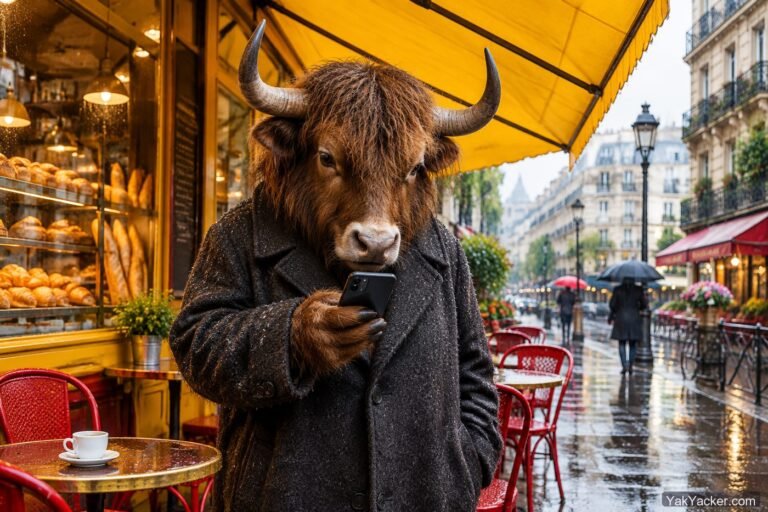
Good morning in French is usually bonjour. Easy, right? Yes… and also not quite. French greetings are wonderfully practical, slightly fussy, and very sensitive to context. One tiny word can sound warm, polite, cold, formal, charming, or like you forgot how humans work.
If you want to sound natural, you need more than a dictionary answer. You need to know when to say bonjour, when not to say it, how to pronounce it without panic, and what people actually do in real life in France.
The good news: this is one of the most useful French words you will ever learn. The even better news: once you get it right, people usually become much nicer immediately. Funny how basic politeness keeps working.
If you want the bigger greetings picture, you can also check how to say hello in French, good afternoon in French, and more useful French greetings. For broader learning, visit the main Learn French page.
What Does Bonjour Mean?
Bonjour means good morning, but in everyday French it also works as hello during the daytime.
That is the first big thing English speakers should know: French does not divide the day exactly like English does. In many situations, bonjour is the normal greeting from morning until late afternoon, and sometimes even into early evening depending on the setting.
In French, bonjour is not just a time-of-day greeting. It is the default polite daytime hello.
How To Pronounce Bonjour
Bonjour = bohn-zhoor
A simple beginner-friendly pronunciation guide is bohn-zhoor, where:
- bon sounds a bit like “bohn” with a nasal French sound
- jour sounds like “zhoor”
- the j in French sounds like the s in “measure”
- the final r is soft and French, not a big hard English r
You do not need perfect phonetics on day one. If you say something close to bohn-zhoor with a polite tone, people will understand you just fine.
One useful note: the n in bon is not fully pronounced like in English. It helps nasalize the vowel. So not “bonnn.” More like the sound floats into your nose a little. Very French. Very efficient. Very unfair to beginners.
When To Use Bonjour
Use bonjour when you greet someone during the day in a polite or neutral way. This includes:
- walking into a bakery
- entering a shop
- meeting a coworker in the morning
- saying hello to your neighbor
- starting a conversation with a stranger
- greeting a teacher, receptionist, waiter, or cashier
- beginning an email a bit formally
In France, saying bonjour before asking for help is a big deal. If you walk into a store and immediately ask a question without greeting the person first, it can sound rude. Not criminal, just socially clunky.
So instead of jumping straight to:
Où sont les toilettes ? — Where is the bathroom?
Start with:
Bonjour, où sont les toilettes ? — Hello, where is the bathroom?
Useful Bonjour Phrases And Real-Life Sentences
Here are the most useful ways to use bonjour naturally, with pronunciation help, meaning, and example sentences you might actually use.
| French | Pronunciation | Meaning | Example Sentence | Translation | Learner Note |
|---|---|---|---|---|---|
| Bonjour | bohn-zhoor | Good morning / Hello | Bonjour, madame. | Good morning, ma’am. | The standard polite daytime greeting. |
| Bonjour, monsieur | bohn-zhoor muh-syuh | Good morning, sir | Bonjour, monsieur, vous allez bien ? | Good morning, sir, are you well? | Very polite; useful in shops and formal situations. |
| Bonjour, madame | bohn-zhoor mah-dam | Good morning, ma’am | Bonjour, madame, j’ai une réservation. | Good morning, ma’am, I have a reservation. | Safe and polite with adult women. |
| Bonjour à tous | bohn-zhoor ah toos | Good morning, everyone | Bonjour à tous, merci d’être là. | Good morning, everyone, thanks for being here. | Great for groups, meetings, or classes. |
| Bonjour à toutes et à tous | bohn-zhoor ah toot eh ah toos | Good morning, everyone | Bonjour à toutes et à tous, commençons. | Good morning, everyone, let’s begin. | More inclusive and slightly more formal. |
| Bonjour, ça va ? | bohn-zhoor sah vah | Hello, how are you? | Bonjour, ça va ? Tu as bien dormi ? | Hi, how are you? Did you sleep well? | Casual to neutral; use mostly with people you know. |
| Bonjour, comment allez-vous ? | bohn-zhoor koh-mahn-tah-lay-voo | Good morning, how are you? | Bonjour, comment allez-vous ? | Good morning, how are you? | Polite and formal. |
| Bonjour, comment vas-tu ? | bohn-zhoor koh-mahn vah-too | Hi, how are you? | Bonjour, comment vas-tu ? Ça fait longtemps. | Hi, how are you? It’s been a long time. | Use with friends, family, or people you know well. |
| Bonjour tout le monde | bohn-zhoor toot luh mohnd | Hello everyone | Bonjour tout le monde, on commence dans cinq minutes. | Hello everyone, we’re starting in five minutes. | Common and friendly in groups. |
| Bonjour, je voudrais… | bohn-zhoor zhuh voo-dray | Hello, I would like… | Bonjour, je voudrais un café, s’il vous plaît. | Hello, I’d like a coffee, please. | Very useful in cafés, shops, and restaurants. |
| Bonjour, excusez-moi… | bohn-zhoor ex-kew-zay-mwah | Hello, excuse me… | Bonjour, excusez-moi, la gare est où ? | Hello, excuse me, where is the station? | Good for asking strangers for help politely. |
| Re-bonjour | ruh-bohn-zhoor | Hello again | Re-bonjour, j’ai oublié mes clés. | Hello again, I forgot my keys. | Very common when you see someone again the same day. |
Bonjour Vs Salut
This is one of the most important greeting choices in French.
| Greeting | Pronunciation | Meaning | Use It When | Learner Note |
|---|---|---|---|---|
| Bonjour | bohn-zhoor | Hello / Good morning | You want to be polite, neutral, or professional | Always safe in daytime situations. |
| Salut | sah-loo | Hi / Bye | You are speaking to friends, family, classmates, close coworkers | Too casual for many strangers and service situations. |
If you are unsure, choose bonjour. It is the safer option. French learners often overuse salut because it feels easy and friendly, but with strangers it can sound too casual.
For example:
- Bonjour, madame. — Good morning, ma’am.
- Salut, Paul ! — Hi, Paul!
Can Bonjour Mean Good Morning And Hello?
Yes. Very often, bonjour does both jobs.
In English, “good morning” can sometimes sound a little marked or extra polite. In French, bonjour is completely normal and frequent. People say it all the time. In shops especially, it is almost mandatory social fuel.
So if you are translating from English, do not always think:
- bonjour = only good morning
Think:
- bonjour = good morning / hello during the day
What Time Of Day Do You Stop Saying Bonjour?
There is no perfectly universal magic minute, because real people are messy and language likes context. But in general:
- bonjour is used in the morning
- it usually continues through much of the afternoon as a normal greeting
- later in the day, people switch to bonsoir for good evening / hello in the evening
If you want to learn that shift more clearly, see good afternoon in French.
A simple learner rule is this:
Use bonjour from morning through daytime. Use bonsoir in the evening.
Good enough for almost all beginner situations.
Polite Shop And Travel French With Bonjour
Here are some extra useful combinations because bonjour shines brightest in real life, especially when you need coffee, train tickets, directions, or basic survival.
| French | Pronunciation | Meaning | Example Sentence | Translation | Learner Note |
|---|---|---|---|---|---|
| Bonjour, s’il vous plaît | bohn-zhoor seel voo play | Hello, please | Bonjour, s’il vous plaît, un billet pour Lyon. | Hello, please, one ticket to Lyon. | A polite softener, though usually followed by a request. |
| Bonjour, j’ai une question | bohn-zhoor zhay ewn kwes-tyohn | Hello, I have a question | Bonjour, j’ai une question sur le menu. | Hello, I have a question about the menu. | Very useful and polite. |
| Bonjour, vous avez… ? | bohn-zhoor voo-zah-vay | Hello, do you have…? | Bonjour, vous avez du pain complet ? | Hello, do you have whole wheat bread? | Notice the liaison in vous avez: voo-zah-vay. |
| Bonjour, je cherche… | bohn-zhoor zhuh shersh | Hello, I’m looking for… | Bonjour, je cherche la pharmacie. | Hello, I’m looking for the pharmacy. | Useful for travel and shopping. |
| Bonjour, c’est à quel étage ? | bohn-zhoor say tah kel eh-tazh | Hello, which floor is it on? | Bonjour, c’est à quel étage ? | Hello, which floor is it on? | Good in hotels, offices, and department stores. |
| Bonjour, j’ai réservé | bohn-zhoor zhay ray-zair-vay | Hello, I booked / I have a reservation | Bonjour, j’ai réservé une table pour deux. | Hello, I booked a table for two. | Excellent restaurant phrase. |
Common Mistakes English Speakers Make
- Using salut with everyone. It is friendly, but often too casual with strangers.
- Skipping bonjour in shops. In France, greeting first matters a lot.
- Pronouncing the J like English J. It should sound like the “s” in “measure,” not “jungle.”
- Saying good morning too literally. Remember that bonjour also means daytime hello, not just early morning good morning.
- Forgetting register. Bonjour, comment allez-vous ? is formal; Bonjour, ça va ? is more relaxed.
Curious Bit: Why Bonjour Feels So Important In France
French greeting culture often puts a lot of weight on acknowledging the other person before getting to business. That means bonjour is not just a word; it is a social signal that says, “Yes, I see you, and no, I was not raised by wolves.”
That is why a simple bonjour can completely change the tone of an interaction. It is small, but it opens doors. Sometimes literally, if the person at the counter likes you more.
Mini Practice
Choose the best option for each situation.
- You enter a bakery at 10 a.m. → Bonjour
- You text your best friend in the morning → Salut or Bonjour, depending on tone
- You greet your professor before class → Bonjour
- You see a receptionist again later the same day → Re-bonjour
- You greet a group in a meeting → Bonjour à tous
Try translating these:
- Good morning, I would like a coffee. → Bonjour, je voudrais un café.
- Hello again, I forgot my phone. → Re-bonjour, j’ai oublié mon téléphone.
- Good morning, everyone. → Bonjour à tous.
Quick Reference Summary
- Bonjour means good morning and also hello during the day.
- Pronounce it roughly as bohn-zhoor.
- Use it with strangers, in shops, at work, in class, and in polite situations.
- Salut is more casual and better for friends.
- Re-bonjour means hello again.
- In France, saying bonjour first is important social etiquette.
Keep Going
If you want to build your French greetings properly, continue with how to say hello in French and useful French greetings. If you want to check your level, try the French placement test or the French vocabulary test.
Yak Takeaway
If you learn only one French greeting today, make it bonjour. It is polite, natural, useful almost everywhere, and it instantly makes you sound more like a functioning member of society. Which, in any language, is a pretty strong start.