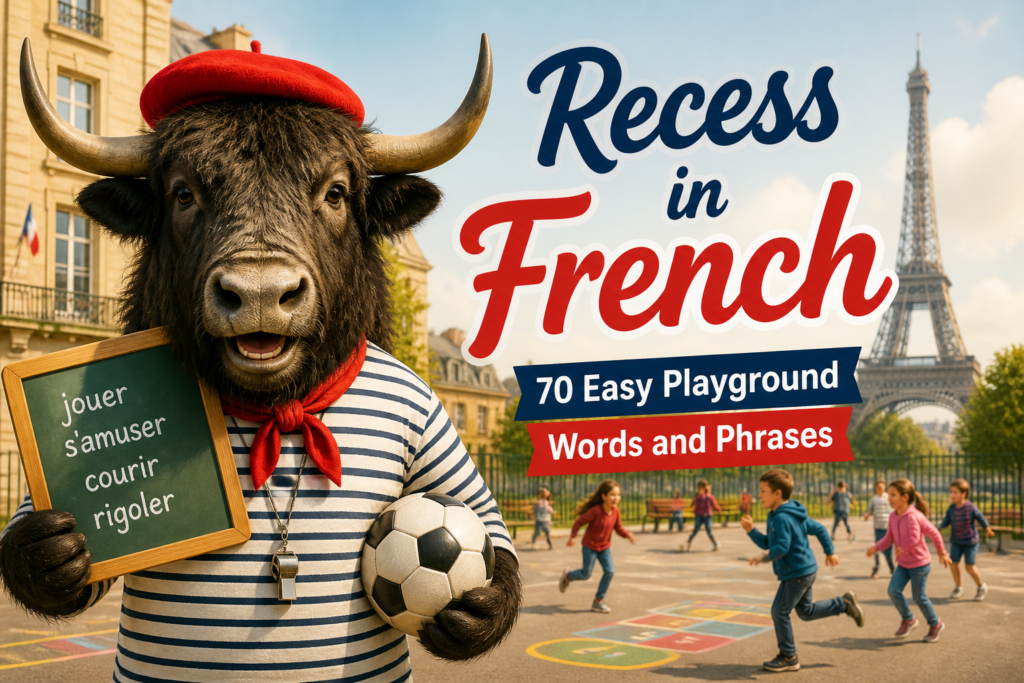
Recess looks different everywhere, but the vocabulary is wonderfully chaotic in all languages: kids running, teachers counting heads, somebody losing a ball, somebody pretending that tag is absolutely not tag. If you want to talk about the playground in French, this guide gives you the words people actually use.
In France, la récréation is the usual word for school recess. You will also hear people shorten it to la récré, because French loves chopping words down when everybody already knows what you mean.
This article focuses on practical France French, with clear pronunciation help and real example sentences. If you want more school-related words after this, hop over to school vocabulary in French or the broader Learn French hub.
The Most Useful Recess Words First
| French | Pronunciation | Meaning | Example Sentence | Translation | Learner Note |
|---|---|---|---|---|---|
| la récréation | lah ray-cray-ah-syohn | recess | Les enfants sont en récréation. | The children are at recess. | Often shortened to la récré. |
| la récré | lah ray-cray | recess, break | On se retrouve à la récré. | We’ll meet up at recess. | Very common, casual everyday form. |
| la cour de récréation | lah koor duh ray-cray-ah-syohn | playground, schoolyard | Les élèves jouent dans la cour de récréation. | The students are playing in the playground. | La cour alone often works in context. |
| la cour | lah koor | yard, playground | Va dans la cour avec les autres. | Go into the yard with the others. | Common in schools. |
| jouer | zhoo-ay | to play | Ils veulent jouer au ballon. | They want to play ball. | Super common verb. |
| un élève | uhn ay-lev | student, pupil | Chaque élève sort en récréation à dix heures. | Each student goes out for recess at ten o’clock. | For school students, not university students. |
| un professeur | uhn pro-feh-suhr | teacher | Le professeur surveille la cour. | The teacher is supervising the playground. | Le prof is the informal short form. |
| surveiller | sur-vay-yay | to supervise, watch over | Deux adultes surveillent les enfants. | Two adults are supervising the children. | Useful school word. |
| courir | koo-reer | to run | Tu peux courir, mais pas pousser. | You can run, but don’t push. | Very handy playground verb. |
| s’amuser | zah-myoo-zay | to have fun | Les enfants s’amusent beaucoup à la récré. | The children are having a lot of fun at recess. | Reflexive verb: literally “to enjoy oneself.” |
Playground Equipment In French
These are the words you need when recess turns into climbing, swinging, sliding, and the occasional dramatic argument about whose turn it is.
| French | Pronunciation | Meaning | Example Sentence | Translation | Learner Note |
|---|---|---|---|---|---|
| un toboggan | uhn toh-boh-gan | slide | Les petits adorent le toboggan. | The little ones love the slide. | Very common in France. |
| une balançoire | oon bah-lahn-swar | swing | Elle attend son tour pour la balançoire. | She is waiting her turn for the swing. | Feminine noun. |
| un mur d’escalade | uhn mur des-kah-lad | climbing wall | Le mur d’escalade est fermé aujourd’hui. | The climbing wall is closed today. | d’ appears before a vowel. |
| une corde | oon kord | rope | Les enfants sautent à la corde. | The children are skipping rope. | Also means rope in general. |
| une marelle | oon mah-rel | hopscotch | On a dessiné une marelle à la craie. | We drew a hopscotch grid with chalk. | The game and the grid are both marelle. |
| un banc | uhn bahn | bench | Ils laissent leurs sacs sur le banc. | They leave their bags on the bench. | Nasal sound in banc. |
| un terrain | uhn teh-ryan | court, field, play area | Les grands jouent sur le terrain de sport. | The older kids play on the sports field. | Context decides whether it is a field or court. |
| un panier de basket | uhn pah-nyay duh bas-ket | basketball hoop | Le ballon est coincé dans le panier de basket. | The ball is stuck in the basketball hoop. | Basket in French often means basketball. |
| un but | uhn by | goal | Il tire vers le but. | He shoots toward the goal. | Used in football/soccer. |
| un préau | uhn pray-oh | covered playground area | Quand il pleut, les élèves restent sous le préau. | When it rains, the students stay under the covered area. | Very France-school specific and useful. |
People And Places Around Recess
| French | Pronunciation | Meaning | Example Sentence | Translation | Learner Note |
|---|---|---|---|---|---|
| un camarade | uhn kah-mah-rad | classmate, schoolmate | Je joue avec mes camarades. | I play with my classmates. | A friendly school word. |
| un copain / une copine | uhn koh-pan / oon koh-peen | friend | Ma copine m’attend dans la cour. | My friend is waiting for me in the playground. | Casual and common. |
| le maître / la maîtresse | luh met-ruh / lah met-res | teacher | La maîtresse appelle les élèves. | The teacher calls the students. | Common in primary school in France. |
| le prof | luh prof | teacher | Le prof dit de rentrer. | The teacher says to come back inside. | Informal short form of professeur. |
| le surveillant / la surveillante | luh sur-vay-yahn / lah sur-vay-yahnt | supervisor | La surveillante parle à deux élèves. | The supervisor is talking to two students. | Useful in school settings. |
| la cloche | lah klosh | bell | La cloche sonne à dix heures trente. | The bell rings at ten thirty. | A classic recess word. |
| la classe | lah klas | classroom, class | On retourne en classe après la récré. | We go back to class after recess. | Can mean the room or the class group. |
| les toilettes | lay twa-let | the bathroom, toilets | Je vais aux toilettes avant de sortir. | I’m going to the bathroom before going out. | Always plural in French. |
| la cantine | lah kahn-teen | school cafeteria | Après la récré, on va à la cantine. | After recess, we go to the cafeteria. | Very common school word. |
| la file | lah feel | line, queue | Les élèves se mettent en file. | The students line up. | Useful for school routines. |
Actions Kids Do At Recess
| French | Pronunciation | Meaning | Example Sentence | Translation | Learner Note |
|---|---|---|---|---|---|
| jouer à chat | zhoo-ay ah shah | to play tag | Ils jouent à chat pendant la récré. | They are playing tag during recess. | Not “play cat,” despite appearances. French enjoys this joke. |
| jouer au ballon | zhoo-ay oh bah-lohn | to play ball | On joue au ballon près du mur. | We’re playing ball near the wall. | à + le = au. |
| sauter à la corde | soh-tay ah lah kord | to skip rope | Elles sautent à la corde ensemble. | They are skipping rope together. | Very common playground phrase. |
| grimper | gran-pay | to climb | Il aime grimper partout. | He likes climbing everywhere. | Sometimes used by adults in mildly tired tones. |
| glisser | glee-say | to slide | Les enfants glissent sur le toboggan. | The children slide on the slide. | Also means “to slip.” |
| se balancer | suh bah-lahn-say | to swing | Elle se balance très haut. | She is swinging very high. | Reflexive verb. |
| attendre son tour | ah-tahn-druh sohn toor | to wait your turn | Tu dois attendre ton tour. | You have to wait your turn. | Great phrase for polite playground survival. |
| faire la queue | fehr lah kuh | to line up, queue | Les enfants font la queue pour le toboggan. | The children line up for the slide. | Common in France. |
| partager | par-tah-jay | to share | Il partage son ballon avec ses amis. | He shares his ball with his friends. | Very useful basic verb. |
| se reposer | suh ruh-poh-zay | to rest | Après avoir couru, elle se repose sur un banc. | After running, she rests on a bench. | Another reflexive verb. |
Games Kids Talk About In French
Some game names vary by country, region, or school. That is completely normal. Playground language is gloriously local.
| French | Pronunciation | Meaning | Example Sentence | Translation | Learner Note |
|---|---|---|---|---|---|
| chat | shah | tag | On fait un chat ? | Shall we play tag? | Often just called chat. |
| cache-cache | kash-kash | hide-and-seek | Les plus jeunes jouent à cache-cache. | The younger kids are playing hide-and-seek. | Easy to remember and fun to say. |
| la marelle | lah mah-rel | hopscotch | Tu veux jouer à la marelle ? | Do you want to play hopscotch? | Same word as the grid itself. |
| le foot | luh foot | soccer, football | Ils jouent au foot dans un coin de la cour. | They’re playing soccer in one corner of the yard. | Very common short word in France. |
| le basket | luh bas-ket | basketball | On joue au basket après. | We’ll play basketball afterward. | Again, French likes shortening things. |
| la corde à sauter | lah kord ah soh-tay | skipping rope | Où est la corde à sauter ? | Where is the skipping rope? | The object, not the action. |
| les billes | lay bee-yuh | marbles | Il apporte ses billes à l’école. | He brings his marbles to school. | Classic playground word. |
| la corde | lah kord | rope game | Elles jouent à la corde pendant la pause. | They’re playing rope games during the break. | Context matters. |
| 1, 2, 3, soleil | uhn duh trwah soh-lay | Red Light, Green Light | On joue à 1, 2, 3, soleil près du mur. | We’re playing Red Light, Green Light near the wall. | A very French playground game name. |
| chat perché | shah pehr-shay | tag where you’re safe when elevated | Ils préfèrent jouer à chat perché. | They prefer to play that version of tag. | Regional familiarity may vary, but common in France. |
Useful Recess Phrases Kids Actually Say
| French | Pronunciation | Meaning | Example Sentence | Translation | Learner Note |
|---|---|---|---|---|---|
| On joue ? | ohn zhoo | Want to play? | On joue à cache-cache ? | Want to play hide-and-seek? | Very natural and simple. |
| Tu viens ? | tyu vee-yan | Are you coming? | Tu viens avec nous ? | Are you coming with us? | Useful everywhere, not just at recess. |
| C’est mon tour. | say mohn toor | It’s my turn. | C’est mon tour après Paul. | It’s my turn after Paul. | Core playground diplomacy. |
| À toi. | ah twah | Your turn. | J’ai fini. À toi. | I’m done. Your turn. | Short and common. |
| Attends ! | ah-tahn | Wait! | Attends, je mets mes chaussures. | Wait, I’m putting on my shoes. | The final s is silent. |
| Plus vite ! | ploo veet | Faster! | Courez plus vite ! | Run faster! | Common in games and races. |
| Doucement ! | doo-smohn | Slowly! Easy! | Doucement, tu vas tomber. | Easy, you’re going to fall. | Can sound caring or cautionary. |
| Fais attention ! | feh zah-tahn-syohn | Be careful! | Fais attention au ballon. | Be careful of the ball. | Very useful warning phrase. |
| Je peux jouer ? | zhuh puh zhoo-ay | Can I play? | Je peux jouer avec vous ? | Can I play with you? | Excellent beginner phrase. |
| On y va ! | oh-nee vah | Let’s go! | On y va, la cloche va sonner. | Let’s go, the bell is going to ring. | The y links smoothly to va. |
Teacher And Supervisor Phrases You’ll Hear
| French | Pronunciation | Meaning | Example Sentence | Translation | Learner Note |
|---|---|---|---|---|---|
| Range-toi. | rahnzh twah | Line up. | Les enfants, rangez-vous devant la porte. | Children, line up in front of the door. | Singular range-toi; plural rangez-vous. |
| On rentre. | ohn rahntr | We’re going back inside. | La récré est finie, on rentre. | Recess is over, we’re going back inside. | Very common school phrase. |
| Arrête de courir. | ah-ret duh koo-reer | Stop running. | Arrête de courir près des petits. | Stop running near the little ones. | de before infinitive verb. |
| Ne pousse pas. | nuh pooss pah | Don’t push. | Ne pousse pas dans la file. | Don’t push in the line. | Classic ne…pas negation. |
| Partage. | par-tazh | Share. | Partage le ballon avec les autres. | Share the ball with the others. | Imperative form. |
| Laisse-le tranquille. | less luh trahn-keel | Leave him alone. | Laisse-le tranquille, il ne veut pas jouer. | Leave him alone, he doesn’t want to play. | le here is “him,” not “the.” |
| C’est interdit. | sayt an-tehr-dee | That’s not allowed. | Monter sur le grillage, c’est interdit. | Climbing on the fence is not allowed. | Useful school and rule phrase. |
| Faites moins de bruit. | fet mwan duh brwee | Make less noise. | Faites moins de bruit près des classes. | Make less noise near the classrooms. | Plural/formal command. |
| Vous avez cinq minutes. | voo zah-vay sank mee-noot | You have five minutes. | Vous avez cinq minutes avant la cloche. | You have five minutes before the bell. | Liaison in vous avez. |
| Qui a le ballon ? | kee ah luh bah-lohn | Who has the ball? | Qui a le ballon rouge ? | Who has the red ball? | Very practical question. |
Objects And Everyday Playground Stuff
| French | Pronunciation | Meaning | Example Sentence | Translation | Learner Note |
|---|---|---|---|---|---|
| un ballon | uhn bah-lohn | ball | Le ballon est sous le banc. | The ball is under the bench. | General word for a ball. |
| une craie | oon cray | chalk | On écrit par terre avec une craie. | We write on the ground with chalk. | Useful for hopscotch too. |
| un sac | uhn sak | bag | Mon sac est resté en classe. | My bag stayed in the classroom. | Very common everyday word. |
| une veste | oon vest | jacket | Prends ta veste, il fait froid. | Take your jacket, it’s cold. | Also useful for weather talk. |
| des chaussures | day shoh-suur | shoes | Ses chaussures sont pleines de boue. | His shoes are full of mud. | Usually plural. |
| de la boue | duh lah bood | mud | Il y a de la boue près du terrain. | There is mud near the field. | Partitive article de la. |
| une flaque | oon flak | puddle | Ne saute pas dans la flaque. | Don’t jump in the puddle. | Very useful rainy-day word. |
| le grillage | luh gree-yazh | fence | Le ballon passe au-dessus du grillage. | The ball goes over the fence. | Common around schoolyards. |
| la porte | lah port | door, gate | Les élèves attendent près de la porte. | The students wait near the door. | Simple and essential. |
| un coin | uhn kwan | corner | Ils discutent dans un coin de la cour. | They are chatting in one corner of the yard. | Nasal-ish sound, not exactly “kwin.” |
Weather And Recess
Because recess vocabulary gets very dramatic the moment there is rain, wind, or suspicious mud.
| French | Pronunciation | Meaning | Example Sentence | Translation | Learner Note |
|---|---|---|---|---|---|
| Il pleut. | eel pluh | It’s raining. | Il pleut, alors on reste sous le préau. | It’s raining, so we stay under the covered area. | Weather phrase, not literal “he cries.” |
| Il fait beau. | eel feh boh | The weather is nice. | Il fait beau aujourd’hui, la cour est pleine. | The weather is nice today, the playground is full. | Classic weather phrase. |
| Il fait froid. | eel feh frwah | It’s cold. | Il fait froid, mets ton manteau. | It’s cold, put on your coat. | Another core weather phrase. |
| Il y a du vent. | eel ee-ah dy vahn | It’s windy | Il y a du vent, le ballon part vite. | It’s windy, the ball goes fast. | Literally “there is wind.” |
| le soleil | luh soh-lay | sun | Les enfants jouent au soleil. | The children are playing in the sun. | Useful noun and weather word. |
| l’ombre | lohmbr | shade | On s’assoit à l’ombre. | We sit in the shade. | Elision: la ombre becomes l’ombre. |
Quick Notes On Pronunciation And Usage
La récré is one of those lovely French shortcuts that makes you sound more natural immediately.
A few useful things to notice:
- In les enfants and vous avez, French often links the words smoothly. That little connection is called liaison. You do not need to obsess over it, but hearing it helps a lot.
- French loves contractions: à le becomes au, so you say jouer au ballon, not jouer à le ballon.
- La récréation is formal-ish and complete; la récré is what people often say in normal speech.
- Le foot in France means soccer. Not American football. Nobody is putting on shoulder pads at primary school.
- Les toilettes is plural even when English says “the bathroom.” French is just being French.
Mini Variants And Related Words
| French | Meaning | Learner Note |
|---|---|---|
| la récréation / la récré | recess | La récré is shorter and more natural in everyday speech. |
| un professeur / un prof | teacher | Prof is the casual short form. |
| un camarade / un copain | classmate / friend | Camarade is more school-specific; copain is more friendly and general. |
| la cour de récréation / la cour | playground / yard | La cour is often enough when everyone knows the context. |
| le maître / la maîtresse | primary school teacher | Very common in France for younger children. |
| jouer à chat | to play tag | The game name may vary a bit by region and school. |
Practice: Can You Recognize These?
Try these quick translations before peeking at the answers in your head like a suspiciously competitive eight-year-old.
- C’est mon tour. → It’s my turn.
- Ne pousse pas. → Don’t push.
- On rentre. → We’re going back inside.
- Je peux jouer ? → Can I play?
- Il pleut, on reste sous le préau. → It’s raining, we’re staying under the covered area.
- Les enfants font la queue pour le toboggan. → The children are lining up for the slide.
Where To Go Next
If you want to keep building this topic, check out playground vocabulary in French, toys and games in French, and French vocabulary test. If you want to see your overall level, try the French placement test CEFR.
Yak Takeaway
If you remember just a few core words, make them la récré, la cour, jouer, attendre son tour, and on rentre. That tiny set already lets you understand a surprising amount of real playground French. Recess vocabulary is practical, lively, and honestly a lot more fun than memorizing random fruit for the fifteenth time.