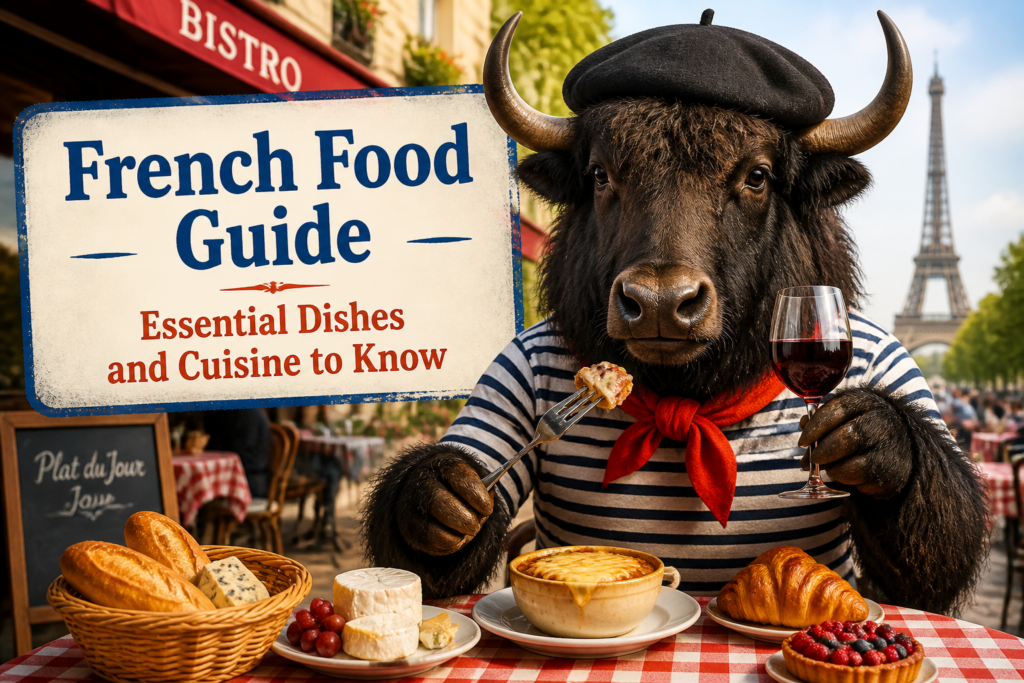
French food has a reputation. Sometimes it is elegant and tiny. Sometimes it is basically melted cheese with potatoes and nobody is pretending otherwise. Both versions are gloriously French.
If you want to eat like you live there, you need more than just croissant and baguette. You need the words people actually use on menus, in bakeries, at markets, and while arguing politely about whether the quiche is homemade.
In this guide, you will learn essential French food vocabulary, classic dishes, useful menu phrases, and the little learner notes that stop you from accidentally ordering something mysterious with total confidence.
Which is brave, but risky.
If you want a broader starting point for French learning, visit the French learning hub. You can also check your level with the French placement test or see how much food vocabulary you already know with the French vocabulary test.
How French Food Words Work
Before the dishes, a few useful patterns:
- le = the for masculine nouns
- la = the for feminine nouns
- l’ = the before a vowel sound
- un = a, an for masculine nouns
- une = a, an for feminine nouns
- des = some, plural
Examples: le pain (bread), la soupe (soup), l’omelette (omelet), un fromage (a cheese), une salade (a salad).
You will also see contractions all over menus:
- au = à + le
- aux = à + les
- du = de + le
- des = de + les
So gratin dauphinois is not the same pattern, but soupe aux légumes means soup with vegetables, and tarte au citron means lemon tart.
On French menus, little words like au, aux, and de do a lot of heavy lifting. Ignore them and the menu starts looking like decorative wallpaper.
Essential French Food Categories
| French | Pronunciation | Meaning | Example Sentence | Translation | Learner Note |
|---|---|---|---|---|---|
| une entrée | oon ahn-TRAY | starter, appetizer | Je vais prendre une entrée. | I’m going to have a starter. | In France, entrée means starter, not main course. |
| un plat | uhn plah | main dish | Le plat du jour est excellent. | The dish of the day is excellent. | Plat du jour is very common on menus. |
| un dessert | uhn day-SAIR | dessert | Tu prends un dessert ? | Are you having a dessert? | The final t is silent. |
| une boisson | oon bwah-sohn | drink, beverage | Quelle boisson voulez-vous ? | What drink would you like? | Polite and neutral. |
| un menu | uhn muh-NEW | set menu | Le menu comprend une entrée et un plat. | The set menu includes a starter and a main. | Can also mean menu in general, depending on context. |
| à la carte | ah lah kart | ordering individual items | On mange à la carte ou on prend le menu ? | Are we ordering à la carte or getting the set menu? | Used in English too, but very normal in French restaurants. |
Bakery Basics You Will See Everywhere
A French bakery is not just a bakery. It is a daily survival system with butter. These are the words you will meet fast.
| French | Pronunciation | Meaning | Example Sentence | Translation | Learner Note |
|---|---|---|---|---|---|
| une baguette | oon bag-ET | baguette | Je voudrais une baguette, s’il vous plaît. | I’d like a baguette, please. | A classic bakery phrase. |
| un croissant | uhn kwah-SAHN | croissant | Je mange un croissant au petit-déjeuner. | I eat a croissant for breakfast. | The final t is silent. |
| un pain au chocolat | uhn pan oh shoh-koh-LAH | chocolate pastry | Elle prend un pain au chocolat avec un café. | She has a chocolate pastry with a coffee. | In parts of southwest France, you may hear chocolatine. |
| une brioche | oon bree-YOSH | brioche | Cette brioche est très moelleuse. | This brioche is very soft. | Moelleux/moelleuse means soft, fluffy. |
| une tarte | oon tart | tart, pie | La tarte aux pommes est maison. | The apple tart is homemade. | Maison on a menu often means house-made. |
| une pâtisserie | oon pah-teess-REE | pastry; pastry shop | On va à la pâtisserie du coin. | We’re going to the local pastry shop. | Can mean both the item and the shop, depending on context. |
Classic French Dishes To Recognize On Menus
These are the famous dishes that appear in guidebooks, cafés, brasseries, and bistros. Some are fancy. Some are hearty. Some are the culinary equivalent of putting on a wool coat and accepting winter.
| French | Pronunciation | Meaning | Example Sentence | Translation | Learner Note |
|---|---|---|---|---|---|
| le coq au vin | luh kok oh van | chicken braised in wine | Le coq au vin est un plat traditionnel. | Coq au vin is a traditional dish. | Au vin means cooked with wine. |
| le bœuf bourguignon | luh buff boor-ghee-NYON | beef stew from Burgundy | Mon père adore le bœuf bourguignon. | My father loves beef bourguignon. | Bourguignon means from Burgundy style. |
| la ratatouille | lah rah-tah-TOOY | vegetable stew | La ratatouille se mange chaude ou froide. | Ratatouille can be eaten hot or cold. | Very southern, very useful, very not just a cartoon. |
| la quiche lorraine | lah keesh loh-REN | bacon and egg tart from Lorraine | Nous partageons une quiche lorraine. | We’re sharing a quiche lorraine. | Quiche is feminine: une quiche. |
| la soupe à l’oignon | lah soop ah lo-NYON | French onion soup | Je prends la soupe à l’oignon en entrée. | I’m having onion soup as a starter. | Notice elision in l’oignon. |
| le cassoulet | luh kah-soo-LAY | slow-cooked bean and meat casserole | Le cassoulet est très copieux. | Cassoulet is very filling. | Copieux means generous, hearty, filling. |
| la choucroute | lah shoo-KROOT | sauerkraut dish with meat | En Alsace, la choucroute est incontournable. | In Alsace, choucroute is unmissable. | A regional specialty from eastern France. |
| le confit de canard | luh kohn-FEE duh kah-NAR | duck confit | Le confit de canard est croustillant à l’extérieur. | Duck confit is crispy on the outside. | De canard means made with duck. |
| la blanquette de veau | lah blahn-KET duh voh | veal stew in white sauce | Ma grand-mère fait une excellente blanquette de veau. | My grandmother makes an excellent veal stew. | A very classic family-style dish. |
| le steak-frites | luh steak freet | steak and fries | Le steak-frites est simple mais délicieux. | Steak and fries is simple but delicious. | Common in brasseries and cafés. |
| l’omelette | loh-muh-LET | omelet | Je voudrais une omelette aux fines herbes. | I’d like an herb omelet. | Aux fines herbes means with herbs. |
| le gratin dauphinois | luh grah-TAN doh-fee-NWAH | baked potato dish with cream | Le gratin dauphinois accompagne souvent la viande. | Gratin dauphinois often comes with meat. | Gratin often means baked with a browned top. |
Cheese, Because Obviously
French cheese vocabulary can become a full-time job. Start with the classics and survive from there.
| French | Pronunciation | Meaning | Example Sentence | Translation | Learner Note |
|---|---|---|---|---|---|
| le fromage | luh froh-MAHZH | cheese | Le fromage fait partie du repas. | Cheese is part of the meal. | Very common after the main course. |
| le camembert | luh kah-mahn-BEAR | Camembert | Le camembert est plus fort qu’il n’en a l’air. | Camembert is stronger than it looks. | Yes, cheese can look innocent and still attack. |
| le brie | luh bree | Brie | J’aime le brie avec du pain frais. | I like brie with fresh bread. | Du pain means some bread. |
| le chèvre | luh SHEV-ruh | goat cheese | On prend une salade au chèvre chaud. | We’re having a warm goat cheese salad. | Chèvre literally means goat. |
| le roquefort | luh rok-FOR | Roquefort blue cheese | Le roquefort a un goût très prononcé. | Roquefort has a very strong taste. | Goût prononcé = strong flavor. |
| un plateau de fromages | uhn plah-TOH duh froh-MAHZH | cheese board | On partage un plateau de fromages ? | Shall we share a cheese board? | Very useful in restaurants. |
Sweet Things Worth Knowing
If your French collapses when dessert arrives, that is understandable but inconvenient.
| French | Pronunciation | Meaning | Example Sentence | Translation | Learner Note |
|---|---|---|---|---|---|
| la crème brûlée | lah krem broo-LAY | crème brûlée | La crème brûlée est bien caramélisée. | The crème brûlée is nicely caramelized. | The final e in brûlée marks feminine agreement. |
| la mousse au chocolat | lah mooss oh shoh-koh-LAH | chocolate mousse | La mousse au chocolat est légère et riche à la fois. | Chocolate mousse is light and rich at the same time. | A very common dessert. |
| le fondant au chocolat | luh fohn-DAHN oh shoh-koh-LAH | molten chocolate cake | Je choisis le fondant au chocolat. | I’m choosing the molten chocolate cake. | Fondant suggests soft or melting texture. |
| les profiteroles | lay pro-fee-tuh-ROL | cream puffs with chocolate sauce | Les profiteroles sont énormes ici. | The profiteroles are huge here. | Plural dish name, so use les. |
| la tarte tatin | lah tart tah-TAN | upside-down caramelized apple tart | La tarte tatin est servie tiède. | The tarte tatin is served warm. | Tiède means lukewarm or warm. |
| une île flottante | oon eel floh-TAHNT | floating island dessert | Ma mère adore l’île flottante. | My mother loves floating island. | The î does not change the basic pronunciation much for beginners. |
Useful Menu Words That Save You From Guessing
These little menu words matter a lot. They tell you how something is cooked, served, or flavored.
| French | Pronunciation | Meaning | Example Sentence | Translation | Learner Note |
|---|---|---|---|---|---|
| grillé | gree-YAY | grilled | Je préfère le poisson grillé. | I prefer grilled fish. | Masculine form; feminine is grillée. |
| frit | free | fried | Le poulet frit est croustillant. | The fried chicken is crispy. | Watch the silent final consonant. |
| rôti | roh-TEE | roasted | Le porc rôti est servi avec des pommes de terre. | The roast pork is served with potatoes. | Very common on family-style menus. |
| maison | meh-ZOHN | homemade, house special | Le dessert maison change tous les jours. | The homemade dessert changes every day. | Usually a good sign. |
| à point | ah pwan | medium cooked | Je voudrais le steak à point. | I’d like the steak medium. | For meat doneness. |
| bien cuit | bee-EN kwee | well done | Elle préfère la viande bien cuite. | She prefers well-done meat. | Cuit means cooked. |
| saignant | say-NYAHN | rare | Je prends mon steak saignant. | I take my steak rare. | Common in restaurants. |
| avec | ah-VEK | with | Une salade avec la vinaigrette à part, s’il vous plaît. | A salad with the dressing on the side, please. | Very useful all-purpose word. |
| sans | sahn | without | Je le prends sans oignons. | I’ll take it without onions. | Vital for preferences and allergies. |
| à part | ah par | on the side, separate | La sauce est servie à part. | The sauce is served on the side. | Useful restaurant phrase. |
Useful French Phrases For Ordering Food
Now for the phrases that make you sound like a functioning adult in a restaurant instead of a person pointing at a menu with hopeful eyes.
| French | Pronunciation | Meaning | Example Sentence | Translation | Learner Note |
|---|---|---|---|---|---|
| Je voudrais… | zhuh voo-DRAY | I would like… | Je voudrais une quiche lorraine. | I would like a quiche lorraine. | Polite and safe almost everywhere. |
| Je vais prendre… | zhuh vay prahn-druh | I’ll have… | Je vais prendre le menu du jour. | I’ll have the set menu of the day. | Natural and common. |
| Qu’est-ce que vous recommandez ? | kess kuh voo reh-koh-mahn-DAY | What do you recommend? | Qu’est-ce que vous recommandez comme dessert ? | What do you recommend for dessert? | Qu’est-ce que is a very common question pattern. |
| C’est quoi, ce plat ? | say kwah suh plah | What is this dish? | C’est quoi, le cassoulet ? | What is cassoulet? | Casual but normal. In more formal settings, use Qu’est-ce que c’est ? |
| Je suis allergique à… | zhuh swee zah-lair-ZHEEK ah | I am allergic to… | Je suis allergique aux noix. | I am allergic to nuts. | Very important phrase. Note aux before plural nouns. |
| Sans… s’il vous plaît. | sahn seel voo play | Without… please. | Sans fromage, s’il vous plaît. | Without cheese, please. | Short, polite, and useful. |
| L’addition, s’il vous plaît. | lah-dee-syon seel voo play | The bill, please. | Excusez-moi, l’addition, s’il vous plaît. | Excuse me, the bill, please. | Do not ask for la note everywhere unless you know the local habit; l’addition is safe. |
| On partage ? | ohn par-TAZH | Shall we share? | On partage une entrée ? | Shall we share a starter? | Casual and very useful with friends. |
| C’est délicieux. | say day-lee-SYUH | It’s delicious. | Cette soupe est délicieuse, vraiment. | This soup is delicious, really. | Adjective agrees: délicieuse with feminine noun. |
| Je n’ai plus faim. | zhuh nay ploo fan | I’m not hungry anymore. | Je n’ai plus faim, mais je veux un dessert. | I’m not hungry anymore, but I want dessert. | A deeply human sentence. |
| J’ai encore faim. | zhay ahn-kor fan | I’m still hungry. | J’ai encore faim après l’entrée. | I’m still hungry after the starter. | Encore = still, again. |
| C’est trop bon. | say troh bon | It’s so good. | Le gratin est trop bon. | The gratin is so good. | Casual and very natural in spoken French. |
French Breakfast, Lunch, And Dinner Words
| French | Pronunciation | Meaning | Example Sentence | Translation | Learner Note |
|---|---|---|---|---|---|
| le petit-déjeuner | luh puh-tee day-zhuh-NAY | breakfast | Au petit-déjeuner, je prends du café et du pain. | For breakfast, I have coffee and bread. | Literally “little lunch.” |
| le déjeuner | luh day-zhuh-NAY | lunch | On déjeune à midi. | We eat lunch at noon. | In standard France French, déjeuner is lunch. |
| le dîner | luh dee-NAY | dinner | Nous dînons vers vingt heures. | We have dinner around eight o’clock. | Standard France French usage. |
| un apéritif | uhn ah-pay-ree-TEEF | pre-dinner drink, aperitif | On prend un apéritif avant le repas. | We have an aperitif before the meal. | Often shortened to apéro in casual speech. |
| un repas | uhn ruh-PAH | meal | C’était un excellent repas. | It was an excellent meal. | Useful general word. |
| un goûter | uhn goo-TAY | afternoon snack | Les enfants prennent un goûter après l’école. | The children have an afternoon snack after school. | Very common in French daily life. |
Regional And Cultural Notes That Actually Help
- In standard France French, le déjeuner is lunch and le dîner is dinner.
- In some other French-speaking regions, especially parts of Belgium or Switzerland, meal terms can differ. If needed, context usually saves everyone.
- Pain au chocolat is the standard term in most of France, but chocolatine is famous in the southwest.
- Une entrée in France is a starter, not the main course. This one catches English speakers all the time.
- Restaurant French often uses short descriptions instead of full sentences: saumon grillé, légumes de saison means grilled salmon, seasonal vegetables.
French menus also love regional identity. Words like provençal, bourguignon, alsacien, or basque often tell you the style or origin of the dish.
Common Mistakes English Speakers Make With Food French
- Saying “entrée” like in American English: In France, une entrée is the starter.
- Forgetting gender: un fromage but une soupe. Articles matter.
- Ignoring agreement: La soupe est délicieuse, not délicieux, because soupe is feminine.
- Using just a noun to order: Pointing and saying croissant works sometimes, but Je voudrais un croissant works much better and makes you sound less like a confused pigeon.
- Missing elision: l’omelette, l’oignon, j’aime. French likes to smooth vowel sounds together.
- Not using contractions: Say aux noix, not à les noix. Say du fromage, not de le fromage.
If you remember just one restaurant phrase, make it Je voudrais… It is the Swiss army knife of polite ordering.
Quick Practice
Try these mini drills.
Match The Meaning
- une entrée = starter
- un plat = main dish
- sans oignons = without onions
- maison = homemade
- l’addition = the bill
Translate Into French
- I would like a cheese board. → Je voudrais un plateau de fromages.
- What do you recommend? → Qu’est-ce que vous recommandez ?
- Without cheese, please. → Sans fromage, s’il vous plaît.
- The onion soup is delicious. → La soupe à l’oignon est délicieuse.
- I’m still hungry. → J’ai encore faim.
Spot The Fix
- Je voudrais une fromage. → Je voudrais un fromage.
- Le soupe est bon. → La soupe est bonne.
- Je suis allergique à les noix. → Je suis allergique aux noix.
- Je prends le steak bien cuite. → Je prends le steak bien cuit.
Quick Reference Food Words To Keep Handy
- le pain = bread
- le beurre = butter
- le fromage = cheese
- la viande = meat
- le poisson = fish
- les légumes = vegetables
- les pommes de terre = potatoes
- la salade = salad
- la sauce = sauce
- le dessert = dessert
- le vin = wine
- l’eau = water
If you want to keep building this topic, the full guide on French food, cuisine, and dishes is a useful place to review the vocabulary again in context.
Yak Takeaway
To handle French food like a local, you do not need a culinary degree or a dramatic scarf. You need a few key dish names, a few menu words, and two or three polite ordering phrases you can use without panicking. Start with une entrée, un plat, un dessert, Je voudrais…, and sans… s’il vous plaît. That alone gets you surprisingly far, and possibly all the way to crème brûlée.