French animal names show up everywhere: in storybooks, at the zoo, on farm signs, in idioms, and in the kind of small talk people make when a dog trots past and completely steals the conversation. Learning them is practical, and honestly, a lot more fun than memorizing random office furniture.
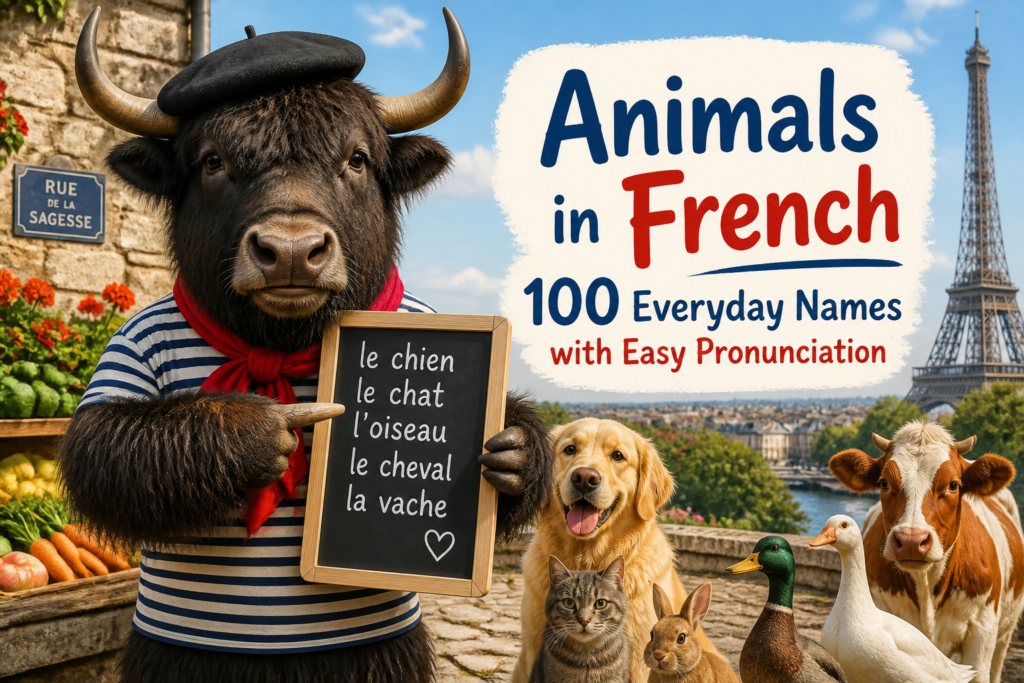
In this guide, you’ll learn 100 everyday animal names in French with easy pronunciation, clear meanings, and real example sentences. We’ll stick to standard France French unless a useful regional note matters.
Yes, chat and chien come early. Civilization remains intact.
If you want more French basics after this, explore French lessons on Yak Yacker, or test yourself with the French vocabulary test and the French placement test.
How To Read These Animal Names
The pronunciation guide is written for English speakers, not for phonetics professors with tiny clipboards. A few quick tips:
- ch often sounds like “sh” in French: chat → “sha”
- Final consonants are often silent: lion is not pronounced like English “lie-on”
- Nasal sounds matter: on, an, and in don’t sound exactly like English vowels
- Articles matter too: le, la, l’, and un/une help you learn gender naturally
For repeated everyday use, learn the noun with an article when possible: le chien, la souris, l’oiseau. It saves future grammar headaches. Tiny effort now, less suffering later.
Pets And Everyday Household Animals
| French | Pronunciation | Meaning | Example Sentence | Translation | Learner Note |
|---|---|---|---|---|---|
| le chien | luh shyen | dog | Le chien dort près de la porte. | The dog is sleeping near the door. | Very common word; singular masculine. |
| le chat | luh sha | cat | Le chat regarde les oiseaux par la fenêtre. | The cat is watching the birds through the window. | Final t is silent. |
| le poisson | luh pwah-son | fish | Le poisson nage lentement dans l’aquarium. | The fish swims slowly in the aquarium. | Also used for fish as food, depending on context. |
| l’oiseau | lwah-zoh | bird | L’oiseau chante tôt le matin. | The bird sings early in the morning. | Starts with elision: l’ because oiseau begins with a vowel sound. |
| le lapin | luh la-pan | rabbit | Le lapin mange une carotte. | The rabbit is eating a carrot. | The in is nasal, not “lap-in.” |
| le hamster | luh am-ster | hamster | Le hamster court dans sa roue. | The hamster runs in its wheel. | Borrowed word, pretty straightforward. |
| la souris | lah soo-ree | mouse | La souris se cache sous le canapé. | The mouse is hiding under the sofa. | Also means “computer mouse.” Context does the work. |
| le cochon d’Inde | luh ko-shon dannd | guinea pig | Le cochon d’Inde adore les légumes frais. | The guinea pig loves fresh vegetables. | Literally odd-looking to English speakers; common term. |
| la tortue | lah tor-tew | turtle / tortoise | La tortue avance très lentement. | The turtle moves very slowly. | French often uses one word for both turtle and tortoise. |
| le perroquet | luh peh-ro-kay | parrot | Le perroquet répète quelques mots. | The parrot repeats a few words. | The final t is silent. |
If you want more feathered vocabulary, see bird names in French. If your interests are wetter and smell faintly of aquariums, there’s also fish names in French.
Farm Animals In French
| French | Pronunciation | Meaning | Example Sentence | Translation | Learner Note |
|---|---|---|---|---|---|
| la vache | lah vash | cow | La vache est dans le champ. | The cow is in the field. | Very common feminine noun. |
| le taureau | luh toh-roh | bull | Le taureau est très puissant. | The bull is very powerful. | Different from la vache. |
| le veau | luh voh | calf | Le veau suit sa mère. | The calf follows its mother. | Also appears in food contexts. |
| le cheval | luh shuh-val | horse | Le cheval court vite. | The horse runs fast. | Plural is irregular: chevaux. |
| le poney | luh po-nay | pony | Le poney plaît beaucoup aux enfants. | The pony is very popular with children. | Common in riding contexts. |
| l’âne | lahn | donkey | L’âne porte de lourds sacs. | The donkey carries heavy bags. | Starts with a vowel, so l’. |
| le cochon | luh ko-shon | pig | Le cochon aime la boue. | The pig likes mud. | Can also be used insultingly about a messy person. |
| le mouton | luh moo-ton | sheep | Le mouton broute dans la prairie. | The sheep grazes in the meadow. | French often uses this as singular sheep. |
| la chèvre | lah shev-ruh | goat | La chèvre grimpe sur les rochers. | The goat climbs on the rocks. | The accent matters in spelling. |
| la poule | lah pool | hen | La poule pond un œuf. | The hen lays an egg. | Useful everyday farm word. |
| le coq | luh kok | rooster | Le coq chante à l’aube. | The rooster crows at dawn. | Short word, clearly pronounced. |
| le canard | luh ka-nar | duck | Le canard nage sur l’étang. | The duck swims on the pond. | Final d is silent. |
| l’oie | lwah | goose | L’oie traverse la cour. | The goose crosses the yard. | Short but tricky spelling. |
| la dinde | lah dand | turkey | La dinde se promène dans la ferme. | The turkey walks around the farm. | The final sound is nasal. |
| le poussin | luh poo-san | chick | Le poussin reste près de sa mère. | The chick stays close to its mother. | Useful springtime word. |
Wild Mammals You’ll Hear A Lot
| French | Pronunciation | Meaning | Example Sentence | Translation | Learner Note |
|---|---|---|---|---|---|
| le lion | luh lee-on | lion | Le lion dort presque toute la journée. | The lion sleeps almost all day. | Two clear syllables in French. |
| le tigre | luh tee-gruh | tiger | Le tigre a des rayures noires. | The tiger has black stripes. | Final e is light, not strongly pronounced. |
| l’éléphant | lay-lay-fan | elephant | L’éléphant a une excellente mémoire. | The elephant has an excellent memory. | Nasal ending in -phant. |
| la girafe | lah zhee-raf | giraffe | La girafe a un long cou. | The giraffe has a long neck. | g before i sounds soft. |
| le zèbre | luh zeb-ruh | zebra | Le zèbre ressemble un peu à un cheval rayé. | The zebra looks a bit like a striped horse. | Accent grave changes the vowel. |
| l’ours | loors | bear | L’ours cherche de la nourriture. | The bear is looking for food. | Starts with vowel sound, so l’. |
| le loup | luh loo | wolf | Le loup hurle la nuit. | The wolf howls at night. | Final p is silent. |
| le renard | luh ruh-nar | fox | Le renard est rusé. | The fox is clever. | Common in stories and idioms. |
| le cerf | luh serf | deer / stag | Le cerf traverse la forêt au lever du soleil. | The deer crosses the forest at sunrise. | Can specifically mean stag in some contexts. |
| le sanglier | luh son-glee-ay | wild boar | Le sanglier sort du bois au crépuscule. | The wild boar comes out of the woods at dusk. | Very common in France-related wildlife talk. |
| l’écureuil | lay-kew-ruy | squirrel | L’écureuil monte rapidement dans l’arbre. | The squirrel climbs quickly up the tree. | One of those words that looks harder than it is. |
| le hérisson | luh ay-ree-son | hedgehog | Le hérisson se roule en boule. | The hedgehog curls into a ball. | The initial h is silent. |
| la chauve-souris | lah shov-soo-ree | bat | La chauve-souris vole la nuit. | The bat flies at night. | Literally a special compound word; feminine. |
| le singe | luh sanzh | monkey | Le singe grimpe de branche en branche. | The monkey climbs from branch to branch. | Nasal vowel in the first syllable. |
| le gorille | luh go-reey | gorilla | Le gorille est impressionnant mais calme. | The gorilla is impressive but calm. | The ll here sounds like a soft y. |
| le kangourou | luh kon-goo-roo | kangaroo | Le kangourou avance en sautant. | The kangaroo moves by hopping. | Very close to English but with French rhythm. |
| le chameau | luh sha-moh | camel | Le chameau supporte bien la chaleur. | The camel handles heat well. | One hump or more? French context usually handles it. |
| le dromadaire | luh dro-ma-dair | dromedary | Le dromadaire a une seule bosse. | The dromedary has one hump. | Useful distinction from chameau. |
| l’hippopotame | lee-po-po-tam | hippopotamus | L’hippopotame reste longtemps dans l’eau. | The hippopotamus stays in the water for a long time. | Long word, but very regular. |
| le rhinocéros | luh ree-no-say-ross | rhinoceros | Le rhinocéros a une peau très épaisse. | The rhinoceros has very thick skin. | Accent helps you spot the stress pattern. |
Bird Names In French
| French | Pronunciation | Meaning | Example Sentence | Translation | Learner Note |
|---|---|---|---|---|---|
| le pigeon | luh pee-zhon | pigeon | Le pigeon marche sur la place. | The pigeon walks around the square. | Very urban, very common. |
| le moineau | luh mwah-noh | sparrow | Le moineau se pose sur le balcon. | The sparrow lands on the balcony. | Frequent everyday bird word in France. |
| le corbeau | luh kor-boh | crow | Le corbeau pousse un cri rauque. | The crow lets out a harsh cry. | Often confused with raven words by learners. |
| le hibou | luh ee-boo | owl | Le hibou voit bien dans l’obscurité. | The owl sees well in the dark. | The h is silent. |
| l’aigle | legl | eagle | L’aigle plane au-dessus de la vallée. | The eagle glides above the valley. | Short and elegant, like the bird itself. |
| le cygne | luh seen-yuh | swan | Le cygne nage avec grâce. | The swan swims gracefully. | The spelling looks more frightening than the sound. |
| la mouette | lah moo-et | seagull | La mouette crie près du port. | The seagull cries near the harbor. | Common coastal word. |
| le paon | luh pan | peacock | Le paon ouvre ses plumes colorées. | The peacock opens its colorful feathers. | Nasal vowel; not “pay-on.” |
| l’autruche | loh-troosh | ostrich | L’autruche court très vite. | The ostrich runs very fast. | Useful zoo word. |
| le pingouin | luh pan-gwan | auk / penguin in common speech | Le pingouin vit dans les régions froides. | The penguin lives in cold regions. | In everyday French, people often use this loosely for penguin. |
Reptiles, Amphibians, And Creepy-Crawlies
| French | Pronunciation | Meaning | Example Sentence | Translation | Learner Note |
|---|---|---|---|---|---|
| le serpent | luh ser-pan | snake | Le serpent glisse dans l’herbe. | The snake slides through the grass. | Nasal ending again. |
| le crocodile | luh kro-ko-deel | crocodile | Le crocodile reste immobile dans l’eau. | The crocodile stays motionless in the water. | Close to English. |
| l’alligator | la-lee-ga-tor | alligator | L’alligator attend sa proie. | The alligator waits for its prey. | Less common than crocodile, but useful. |
| le lézard | luh lay-zar | lizard | Le lézard se chauffe au soleil. | The lizard warms itself in the sun. | Final d is silent. |
| la grenouille | lah gruh-nooy | frog | La grenouille saute dans l’étang. | The frog jumps into the pond. | The ouille sound takes practice. |
| le crapaud | luh kra-poh | toad | Le crapaud reste près des pierres humides. | The toad stays near the damp stones. | Different from grenouille. |
| l’araignée | la-ray-nyay | spider | L’araignée tisse sa toile dans le coin. | The spider weaves its web in the corner. | Feminine noun with elision. |
| la fourmi | lah foor-mee | ant | La fourmi transporte une miette. | The ant carries a crumb. | Simple and common. |
| l’abeille | la-bayy | bee | L’abeille cherche des fleurs. | The bee is looking for flowers. | Feminine noun; useful in spring vocabulary. |
| la guêpe | lah gep | wasp | La guêpe tourne autour du verre. | The wasp circles around the glass. | Short word, dangerous personality. |
| la mouche | lah moosh | fly | La mouche se pose sur la table. | The fly lands on the table. | Very useful summer complaint word. |
| le moustique | luh moos-teek | mosquito | Le moustique pique pendant la nuit. | The mosquito bites during the night. | Excellent word to know if you enjoy complaining accurately. |
| le papillon | luh pa-pee-yon | butterfly | Le papillon vole de fleur en fleur. | The butterfly flies from flower to flower. | Very common and pleasant vocabulary item. |
| la coccinelle | lah kok-see-nel | ladybug | La coccinelle se pose sur ma main. | The ladybug lands on my hand. | Feminine noun; nice beginner word. |
| le ver | luh vair | worm | Le ver est dans la terre humide. | The worm is in the damp soil. | Do not confuse with vert or verre; same sound, different meanings. |
Sea Animals And Water Creatures
| French | Pronunciation | Meaning | Example Sentence | Translation | Learner Note |
|---|---|---|---|---|---|
| le dauphin | luh do-fan | dolphin | Le dauphin saute hors de l’eau. | The dolphin jumps out of the water. | Nasal ending in -phin. |
| la baleine | lah ba-len | whale | La baleine remonte à la surface. | The whale comes back up to the surface. | Common marine word. |
| le requin | luh ruh-kan | shark | Le requin nage près du récif. | The shark swims near the reef. | The quin part is nasal. |
| la méduse | lah may-dewz | jellyfish | La méduse flotte dans l’eau. | The jellyfish floats in the water. | Useful beach vocabulary. |
| le crabe | luh krab | crab | Le crabe marche de côté. | The crab walks sideways. | Final e is not strongly pronounced. |
| la crevette | lah kruh-vet | shrimp | La crevette est petite mais rapide. | The shrimp is small but fast. | Common in food and sea-life contexts. |
| le homard | luh o-mar | lobster | Le homard vit au fond de la mer. | The lobster lives at the bottom of the sea. | Initial h is silent. |
| le phoque | luh fok | seal | Le phoque se repose sur un rocher. | The seal rests on a rock. | Looks odd, sounds simple. |
| la pieuvre | lah pyuh-vruh | octopus | La pieuvre cache ses bras sous le sable. | The octopus hides its arms under the sand. | In France French, pieuvre is very common; poulpe also exists. |
| l’étoile de mer | lay-twal duh mair | starfish | L’étoile de mer est collée au rocher. | The starfish is attached to the rock. | Multi-word expression, very useful. |
More Everyday Animal Names To Reach 100
| French | Pronunciation | Meaning | Example Sentence | Translation | Learner Note |
|---|---|---|---|---|---|
| le hamster nain | luh am-ster nan | dwarf hamster | Le hamster nain dort toute la journée. | The dwarf hamster sleeps all day. | Common pet phrase. |
| la perruche | lah peh-roosh | budgie / parakeet | La perruche fait beaucoup de bruit. | The budgie makes a lot of noise. | Very useful pet bird word. |
| le furet | luh few-ray | ferret | Le furet explore chaque coin de la pièce. | The ferret explores every corner of the room. | Common enough in pet vocabulary. |
| la brebis | lah bruh-bee | ewe | La brebis reste avec son petit. | The ewe stays with her young. | More specific than mouton. |
| le bouc | luh book | male goat | Le bouc a de longues cornes. | The male goat has long horns. | Specific farm vocabulary. |
| le bélier | luh bay-lee-ay | ram | Le bélier protège le troupeau. | The ram protects the flock. | More precise animal term. |
| le poulain | luh poo-lan | foal | Le poulain court derrière sa mère. | The foal runs behind its mother. | Horse vocabulary. |
| la jument | lah zhew-mon | mare | La jument boit près de la barrière. | The mare drinks near the fence. | Female horse. |
| le hibou grand-duc | luh ee-boo gran-dewk | eagle owl | Le hibou grand-duc chasse au crépuscule. | The eagle owl hunts at dusk. | A more specific owl term. |
| le vautour | luh voh-toor | vulture | Le vautour tourne dans le ciel. | The vulture circles in the sky. | Useful wildlife word. |
Quick Notes On Gender, Plurals, And Pronunciation
- Masculine examples: le chien, le chat, le cheval, le lion
- Feminine examples: la souris, la vache, la girafe, la baleine
- Use l’ before a vowel sound: l’oiseau, l’ours, l’éléphant, l’araignée
- Plural usually adds -s: les chiens, les vaches, les lions
- But pronunciation often stays the same: le chat and les chats sound very similar
- Liaison can appear: les oiseaux sounds roughly like “lay-zwah-zoh”
That last point matters. French spelling loves to look busy even when the mouth is doing surprisingly little. Stylish, efficient, mildly rude to beginners.
Useful Real-Life Phrases With Animal Names
| French Phrase | Pronunciation | Meaning | Example Sentence | Translation | Learner Note |
|---|---|---|---|---|---|
| J’ai un chien. | zhay uh(n) shyen | I have a dog. | J’ai un chien très calme. | I have a very calm dog. | Basic beginner phrase with avoir. |
| Tu aimes les chats ? | tew em lay sha | Do you like cats? | Tu aimes les chats ou les chiens ? | Do you like cats or dogs? | Easy small-talk question. |
| Il y a un oiseau dans le jardin. | eel yah uh(n) nwah-zoh don luh zhar-dan | There is a bird in the garden. | Il y a un oiseau dans le jardin ce matin. | There is a bird in the garden this morning. | Il y a means “there is/there are.” |
| Le cheval est magnifique. | luh shuh-val ay ma-nyee-feek | The horse is magnificent. | Le cheval est magnifique et très rapide. | The horse is magnificent and very fast. | Useful adjective pattern. |
| Les vaches sont dans le champ. | lay vash son don luh shon | The cows are in the field. | Les vaches sont dans le champ derrière la ferme. | The cows are in the field behind the farm. | Simple plural sentence. |
| J’ai peur des araignées. | zhay pur day za-ray-nyay | I’m afraid of spiders. | J’ai peur des araignées depuis mon enfance. | I’ve been afraid of spiders since childhood. | Notice de + les = des. |
| Le lion dort. | luh lee-on dor | The lion is sleeping. | Le lion dort à l’ombre. | The lion is sleeping in the shade. | Great very short practice sentence. |
| On a vu un renard. | on ah vew uh(n) ruh-nar | We saw a fox. | On a vu un renard près de la route. | We saw a fox near the road. | On often means “we” in everyday French. |
| La baleine est énorme. | lah ba-len ay ay-norm | The whale is enormous. | La baleine est énorme mais paisible. | The whale is enormous but peaceful. | Easy descriptive sentence. |
| Le moustique m’a piqué. | luh moos-teek mah pee-kay | The mosquito bit me. | Le moustique m’a piqué pendant la nuit. | The mosquito bit me during the night. | Very practical travel French, sadly. |
Common Mistakes English Speakers Make
- Saying every final consonant: in words like chat, renard, and loup, the last letter is often silent.
- Forgetting gender: learn la souris, not just souris.
- Ignoring elision: say l’oiseau, not le oiseau.
- Using English sounds for nasal vowels: lapin, mouton, and requin need French nasal vowels.
- Mixing up singular and plural articles: le chien = the dog, les chiens = the dogs.
Learn animal names with their article, say them out loud, and use them in tiny sentences. That’s how vocabulary stops being trivia and starts becoming French.
Quick Reference Summary
- Pets: le chien, le chat, le lapin, le hamster, la souris, la tortue
- Farm Animals: la vache, le cheval, le cochon, le mouton, la chèvre, la poule
- Wild Animals: le lion, le tigre, l’éléphant, le loup, le renard, l’ours
- Birds: l’oiseau, le pigeon, le hibou, l’aigle, la mouette
- Sea Life: le dauphin, la baleine, le requin, la méduse, le crabe
- Small Creatures: l’abeille, la fourmi, l’araignée, le moustique, le papillon
Yak Takeaway: if you can say le chien, la vache, le lion, and le moustique, you already have a surprisingly useful chunk of French. The next time a conversation drifts toward pets, farms, zoos, nature, or annoying things that bite, you’ll be ready.