
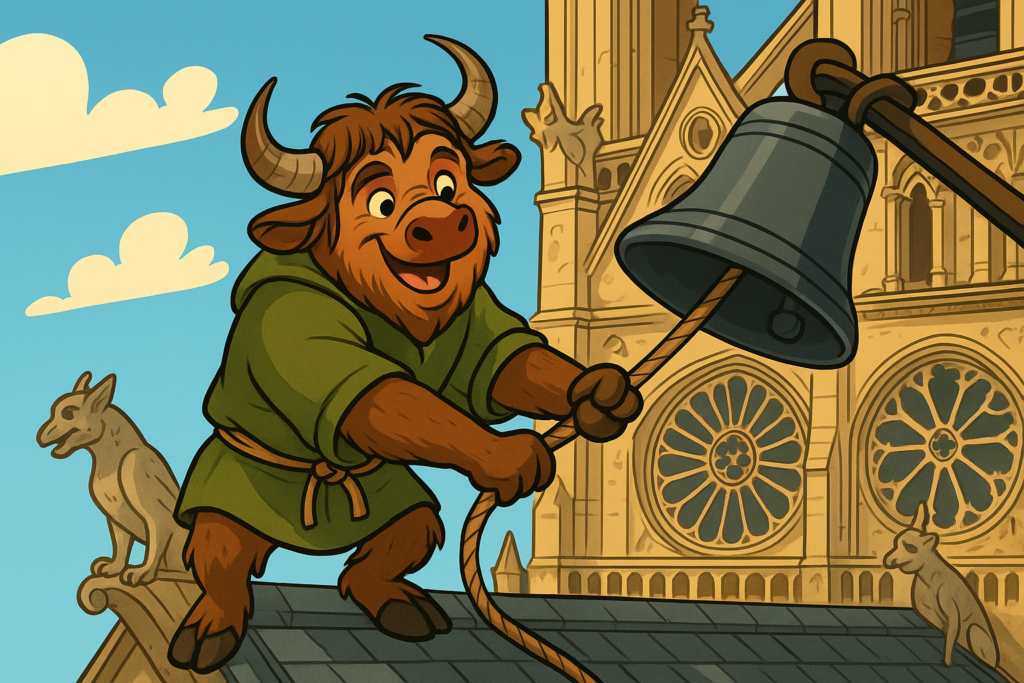
This B1 Intermediate retelling of Notre-Dame de Paris keeps the plot clear for learners while still giving the story some atmosphere and momentum. Quasimodo est le sonneur de cloches de la cathédrale Notre-Dame. Il est sourd et il a un visage très différent des autres.
This version teaches French through English and includes clickable word help inside the story, full story audio, and lesson notes after the reading. It is free to use on Yak Yacker and is designed to feel natural, readable, and manageable for learners.
Quasimodo est le de la cathédrale Notre-Dame. Il est et il a un très différent des autres. Mais il aime beaucoup sa cathédrale.
Un jour, sur la devant Notre-Dame, une jeune fille . Elle s'appelle Esmeralda. Elle est et comme une chèvre.
Quasimodo Esmeralda . Il pense : "Elle est comme une dans la nuit." Mais il a peur de lui parler.
L'archidiacre Frollo aussi Esmeralda. Il veut la . Mais son cœur est et .
Pendant la Fête des Fous, les gens crient : "Quasimodo est le plus laid ! Il est le Pape des Fous !" Ils rient de lui. Quasimodo est triste.
Esmeralda s'approche de Quasimodo. Elle ne pas. Elle dit : "Tu as ?" et elle lui . Quasimodo pleure de joie.
"Pourquoi es-tu avec moi ?" demande Quasimodo. Esmeralda répond : "Parce que tu es une ."
Frollo est . Il veut Esmeralda pour lui seul. Il dit à Phoebus, le capitaine : "Attention à la ." Mais Phoebus aime Esmeralda aussi.
Un soir, Frollo Phoebus et Esmeralda. Il est . Il prend un couteau et il Phoebus. Les gardes arrêtent Esmeralda.
"C'est elle la meurtrière !" crient les gardes. Esmeralda est condamnée à mort. Elle a très peur.
Quasimodo voit les gardes Esmeralda. Il de la tour, rapide comme un singe. Il la prend dans ses bras et crie : "Sanctuaire ! Sanctuaire !"
Les gens crient : "Il l' dans l'église !" Esmeralda est en à Notre-Dame. Quasimodo lui apporte à manger et la protège.
Mais Frollo entre en dans la cathédrale. Il dit à Esmeralda : "Sois à moi, ou tu mourras." Esmeralda avec courage.
Les amis d'Esmeralda, les truands, Notre-Dame pour la libérer. Quasimodo croit qu'ils veulent lui faire du mal. Il pour la défendre.
Dans la , Frollo utilise un . Il fait sortir Esmeralda et la livre à la mort. Quasimodo comprend son horrible trahison.
Plein de colère, Quasimodo Frollo du haut de la tour. Il regarde Esmeralda une dernière fois. Puis il se couche près d'elle pour toujours.
This story gives each character a strong role, and the French often shows it clearly. Quasimodo is the bell-ringer, Esmeralda is the young dancer, and Frollo is the archdeacon. If you can spot these roles, the plot becomes much easier to follow.
A useful habit in French stories is to notice how characters are described with simple but vivid words. Here, Quasimodo is different, Esmeralda is free and beautiful, and Frollo is dark and jealous. Those descriptions do a lot of work.
- le sonneur de cloches = the bell-ringer
- une jeune fille = a young girl
- l'archidiacre = the archdeacon
- jaloux / jalouse = jealous
This story is full of emotions, and French often uses short, direct words for them. You see fear, joy, sadness, anger, and courage all in one tale. Learning these words helps you understand not just what happens, but how each person feels about it.
Notice the contrast between Quasimodo and the crowd: the crowd laughs, but Esmeralda shows kindness. That contrast is one of the emotional engines of the story.
- avoir peur = to be afraid
- pleurer de joie = to cry with joy
- furieux / furieuse = furious
- gentil / gentille = kind
French storytelling often uses clear action verbs to move the scene forward: regarder, parler, suivre, protéger, arrêter, condamner. These verbs are easy to spot and they tell you who is doing what to whom. In a dramatic story like this, that matters a lot.
Also notice the little words that show relationships and possession: pour lui seul, avec courage, dans la confusion, du haut de la tour. These phrases help French sound natural and precise, especially in tense scenes.
- regarder = to look at / watch
- suivre = to follow
- protéger = to protect
- condamner à mort = to sentence to death
This story is powerful because it mixes beauty, cruelty, pity, and loyalty. In French, the language stays fairly direct, which makes the emotions hit harder. If you can retell the story using a few key verbs and feeling words, you are already doing real comprehension work.
Next time, try telling the story in three steps: who the character is, what they want, and what changes. That simple pattern is a very French-friendly way to remember a big story without getting lost in the drama.
- Who is the character?
- What do they want?
- What changes at the end?
Notre-Dame de Paris comes from the French / Victor Hugo tradition and is best known as a novel. This Yak Yacker article is an original learner retelling based on Victor Hugo, 1831; public domain, so the wording here is simplified for modern learners rather than copied from one old edition.
Older printings, translations, and retellings of this story can vary quite a bit. The original audience was usually adult/general, but this version is adapted for B1 Intermediate learners studying French. Adult/dark; simplify carefully.
If you want to look into the source tradition, start with Project Gutenberg.
If you want to keep going, browse more in our French section and review the B1 French Vocabulary List. After that, try Basic Questions in French for another useful next step.