Dive into a classic French fable with our beginner-friendly retelling of 'The Lion and the Rat.' In this beloved tale, a proud lion learns a valuable lesson from the most unexpected teacher-a tiny rat. When the lion is trapped in a hunter's net, it's the rat's sharp teeth and quick thinking that save the day. Along the way, you'll pick up essential French words for animals, nature, and simple actions, all wrapped in a story about friendship and gratitude.
Our interactive graded reader makes learning feel like play. Just click any word to see its meaning, listen to the full story audio recorded by a native French speaker, and review bite-sized lesson notes that highlight grammar and vocabulary. Designed for complete beginners (CEFR A1), this free resource gives you everything you need to understand and enjoy the story-no dictionary required.
Le lion dans la .
Le petit rat sur le .
Le lion le rat.
« S'il te plaît, ! » dit le rat. « Un jour, je vais . »
Le lion . « Tu es ! » Il le rat partir.
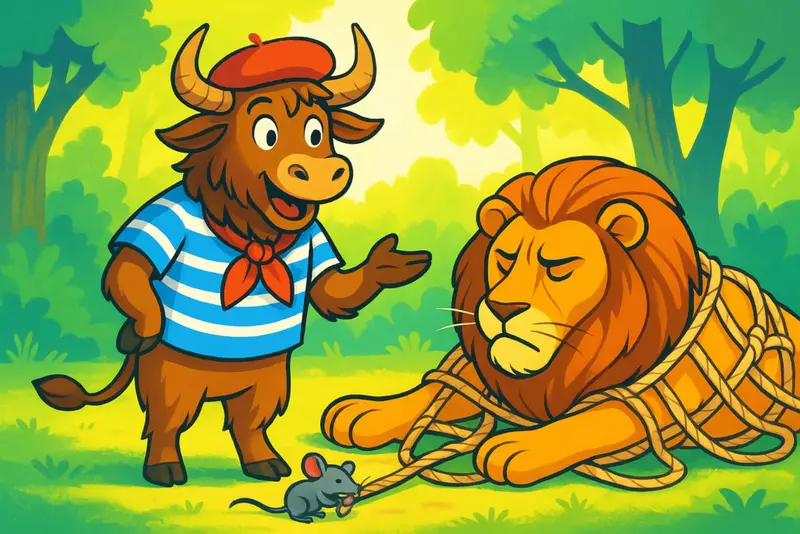
Des attrapent le lion dans un .
Le rat et le filet. Le lion est . « Merci, petit rat ! »
The lion sleeps in the forest.
The little rat runs over the lion.
The lion catches the rat.
"Please don't eat me!" says the rat. "One day, I will help you."
The lion laughs. "You are too small!" He lets the rat go.
Hunters catch the lion in a net.
The rat arrives and gnaws the net. The lion is free. "Thank you, little rat!"
In this classic fable, the main characters are animals. Recognizing these French words will help you follow the story. Notice that all nouns have a gender: 'le' for masculine nouns like 'lion' and 'rat', and 'la' for feminine ones like 'forêt'.
- le lion - lion
- le rat - rat
- la forêt - forest
- des chasseurs - hunters
The story is told in the present tense, which is perfect for describing what happens now. You'll see many common verbs that show the actions of the animals. Pay attention to the endings, as they change with the subject.
- dort (sleeps) - Le lion dort.
- court (runs) - Le petit rat court.
- attrape (catches) - Le lion attrape le rat.
- ronge (gnaws) - Le rat ronge le filet.
The little rat makes a polite request using 's'il te plaît' and a negative command 'ne me mange pas'. Later, he makes a promise with 'je vais t'aider' - a common way to talk about the near future. These patterns are very useful in everyday French.
- S'il te plaît - "please" (informal)
- Ne me mange pas ! - "Don't eat me!"
- Je vais t'aider - "I'm going to help you"
- Merci - "thank you"
You've encountered new words and patterns. Try listening to the story again and see if you can recognize them. Can you retell the fable in your own words? Even a few sentences is a great start.
Le Lion et le Rat comes from the French / La Fontaine tradition and is best known as a fable. This Yak Yacker article is an original learner retelling based on La Fontaine/Aesop tradition public domain, so the wording here is simplified for modern learners rather than copied from one old edition.
Older printings, translations, and retellings of this story can vary quite a bit. The original audience was usually kids/general, but this version is adapted for A1 Beginner learners studying French. Good A1 kindness/moral story.
If you want to look into the source tradition, start with Project Gutenberg.
If you want to keep going, browse more in our French section and review the A1 French Vocabulary List. After that, try Basic Questions in French for another useful next step.