This A1 Beginner retelling of Diamants et Crapauds keeps the plot clear for learners while still giving the story some atmosphere and momentum. La cadette est douce et gentille.
This version teaches French through English and includes clickable word help inside the story, full story audio, and lesson notes after the reading. It is free to use on Yak Yacker and is designed to feel natural, readable, and manageable for learners.
Une a deux filles.
est et .
La est et .
La mère l'aînée. Elle la cadette.
La cadette .
Un jour, la cadette va de l'eau à la .
Une femme .
Elle dit : « J'ai . de l'eau, s'il te plaît. »
La cadette de l'eau à la femme.
La vieille femme est une .
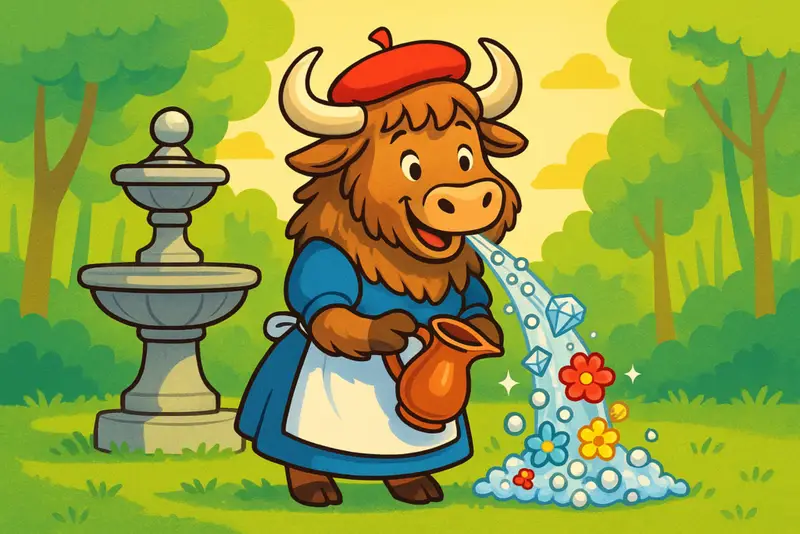
La fée dit : « Tu es . Je te donne un . »
« Quand tu , des fleurs et des diamants de ta bouche. »
La cadette à la maison.
Sa mère : « Pourquoi tu es ? »
La fille : « Pardon, Maman. »
Deux roses, deux perles et deux diamants de sa bouche.
La mère est .
« ? ? »
La fille son à la fontaine.
La mère sa fille aînée.
« Va à la fontaine ! avec la vieille femme ! »
L'aînée va à la fontaine.
Elle n'est pas .
Une arrive.
Elle de l'eau.
L'aînée dit : « Je ne suis pas ta ! »
« l'eau toi-même ! »
La belle dame est la .
La fée dit : « Tu es . Je te donne un . »
« Quand tu , des crapauds et des serpents de ta bouche. »
L'aînée à la maison.
Sa mère : « Eh bien, ma fille ? »
L'aînée répond : « Maman, je… »
Deux crapauds et deux serpents de sa bouche.
La mère : « ! C'est la de la cadette ! »
Elle la cadette de la maison.
La fille dans la forêt.
Un prince .
Il la fille triste.
« Pourquoi ? »
Elle son histoire.
Des fleurs et des diamants de sa bouche.
Le prince est .
« Tu es ! ! »
Le prince et la cadette .
Ils vivent dans le château.
L'aînée reste avec sa mère.
Personne ne les .
L'aînée , et des crapauds .
, elles sont et .
A widow has two daughters.
The elder is mean and lazy.
The younger is sweet and kind.
The mother prefers the elder. She hates the younger.
The younger must work a lot.
One day, the younger goes to fetch water from the fountain.
A poor woman arrives.
She says: "I am thirsty. Give me some water, please."
The younger gives water to the old woman.
The old woman is a fairy.
The fairy says: "You are kind. I give you a gift."
"When you speak, flowers and diamonds come out of your mouth."
The younger returns home.
Her mother shouts: "Why are you late?"
The girl replies: "Sorry, Mama."
Two roses, two pearls, and two diamonds fall from her mouth.
The mother is very surprised.
"What? How?"
The girl tells her adventure at the fountain.
The mother calls her elder daughter.
"Go to the fountain! Be kind to the old woman!"
The elder goes to the fountain.
She is not happy.
A beautiful lady arrives.
She asks for water.
The elder says: "I am not your servant!"
"Get the water yourself!"
The beautiful lady is the fairy.
The fairy says: "You are mean. I give you a gift."
"When you speak, toads and snakes come out of your mouth."
The elder returns home.
Her mother asks: "Well, my daughter?"
The elder replies: "Mama, I..."
Two toads and two snakes come out of her mouth.
The mother cries: "Horror! It's the younger one's fault!"
She chases the younger from the house.
The poor girl cries in the forest.
A prince passes by.
He sees the sad girl.
"Why are you crying?"
She tells her story.
Flowers and diamonds fall from her mouth.
The prince is amazed.
"You are wonderful! Come with me!"
The prince and the younger get married.
They live happily in the castle.
The elder stays with her mother.
Nobody likes them.
The elder speaks, and toads come out.
Finally, they are alone and sad.
This fairy tale is full of sparkling diamonds, pretty flowers, and… warty toads! Let's learn some of the key French words you'll hear again and again.
- la fée - fairy
- le diamant - diamond
- la fleur - flower
- le crapaud - toad
- le serpent - snake
- le don - gift
In French, adjectives change depending on who you're talking about. The story shows us two very different sisters.
The older sister is méchant (mean, masculine form) but since she's a girl, we say méchante. The younger sister is gentille (kind).
- méchant / méchante - mean
- gentil / gentille - kind
- paresseux / paresseuse - lazy
- doux / douce - gentle
Notice how the younger sister speaks when she helps the old woman: « Donne-moi de l'eau, s'il te plaît. » Adding s'il te plaît makes the request polite.
The older sister rudely says: « Je ne suis pas ta servante ! » and « Prends l'eau toi-même ! » No magic words there!
- s'il te plaît - please (informal)
- merci - thank you
- pardon - excuse me / sorry
- Use these little words to sound friendly and kind!
Now you know some key words and phrases. Try to retell the story in your own words-or just describe the characters!
You might say: La cadette est gentille. L'aînée est méchante. The more you play with these words, the sooner they'll feel natural.
Diamants et Crapauds comes from the French / Perrault tradition and is best known as a fairy tale. This Yak Yacker article is an original learner retelling based on Perrault, 1697; public domain, so the wording here is simplified for modern learners rather than copied from one old edition.
Older printings, translations, and retellings of this story can vary quite a bit. The original audience was usually kids, but this version is adapted for A1 Beginner learners studying French. Simple good-sister/bad-sister structure.
If you want to look into the source tradition, start with Project Gutenberg.
If you want to keep going, browse more in our French section and review the A1 French Vocabulary List. After that, try Most Common French Adjectives for another useful next step.