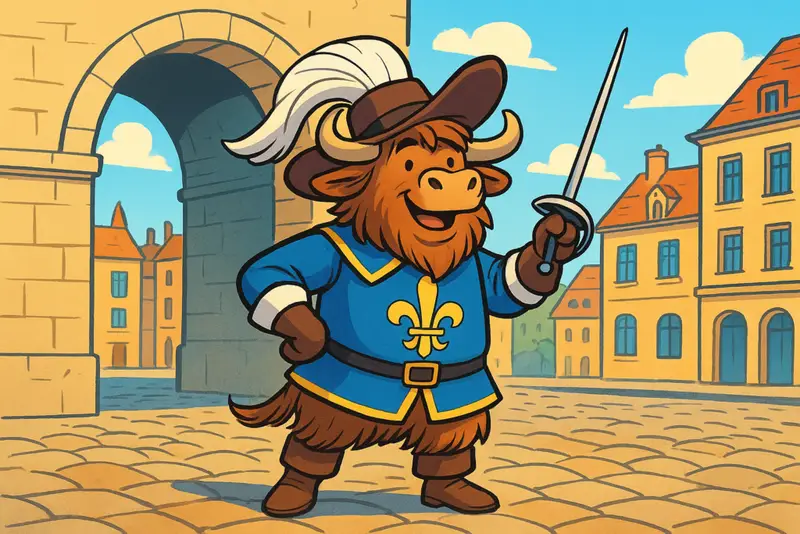
This B1 Intermediate retelling of Les Trois Mousquetaires keeps the plot clear for learners while still giving the story some atmosphere and momentum. D'Artagnan arrive à Paris pour devenir mousquetaire. Il n'a pas d'argent, mais il a un grand rêve.
This version teaches French through English and includes clickable word help inside the story, full story audio, and lesson notes after the reading. It is free to use on Yak Yacker and is designed to feel natural, readable, and manageable for learners.
D'Artagnan arrive à Paris pour devenir . Il n'a pas d'argent, mais il a un .
Dans la rue, il un homme. « Vous êtes ! » dit l'homme. D'Artagnan voit que c'est Rochefort, l'agent du Cardinal.
Ils . Rochefort sa lettre de recommandation. D'Artagnan est : « Je vous retrouverai ! »
Plus tard, il rencontre trois mousquetaires : Athos, Porthos et Aramis. Ils veulent contre lui, .
« À quelle heure ? Où ? » demande Athos, .
Soudain, les du Cardinal . « Nous sommes chez le Cardinal. avec nous ! » crient-ils.
D'Artagnan aux mousquetaires pour les . « Tous pour un, un pour tous ! » dit-il.
Après la , D'Artagnan et les trois hommes deviennent amis. « Vous êtes , dit Athos. Nous sommes frères maintenant. »
D'Artagnan rencontre Constance Bonacieux, la de la reine. Il d'elle. « Je vous protégerai toujours », promet-il.
Le Cardinal Richelieu veut la reine. Il écrit une au Duc de Buckingham. La reine doit récupérer ses qu'elle a donnés au duc.
Constance D'Artagnan : « Sauvez la reine ! Allez en Angleterre chercher les ferrets. » D'Artagnan sans hésiter.
Athos, Porthos et Aramis avec lui. Mais en chemin, ils sont . Seul D'Artagnan arrive à Calais.
En Angleterre, il voit le duc. « Je dois les ferrets à la reine », dit D'Artagnan. Le duc découvre que deux diamants , mais il les fait remplacer rapidement. « ! »
D'Artagnan revient à temps pour le de la reine. Le Cardinal est surpris de voir les ferrets. La reine est sauvée.
D'Artagnan retrouve Constance. « Vous avez ! » s'exclame-t-elle. Le Cardinal est furieux, mais il D'Artagnan.
Les quatre amis continuent leurs aventures, toujours ensemble. « Tous pour un, un pour tous ! » -ils.
D'Artagnan arrives in Paris to become a musketeer. He has no money, but he has a big dream.
In the street, he bumps into a man. "You are clumsy!" says the man. D'Artagnan sees it is Rochefort, the Cardinal's agent.
They fight. Rochefort steals his letter of recommendation. D'Artagnan is furious: "I will find you again!"
Later, he meets three musketeers: Athos, Porthos, and Aramis. They want to fight him, one after the other.
"What time? Where?" asks Athos, calmly.
Suddenly, the Cardinal's guards arrive. "We are on the Cardinal's grounds. Fight with us!" they cry.
D'Artagnan joins the musketeers to fight them. "All for one, one for all!" he says.
After the victory, D'Artagnan and the three men become friends. "You are brave, says Athos. We are brothers now."
D'Artagnan meets Constance Bonacieux, the queen's seamstress. He falls in love with her. "I will always protect you," he promises.
Cardinal Richelieu wants to discredit the queen. He writes a false letter to the Duke of Buckingham. The queen must retrieve her diamond studs that she gave to the duke.
Constance begs D'Artagnan: "Save the queen! Go to England to fetch the studs." D'Artagnan accepts without hesitation.
Athos, Porthos, and Aramis leave with him. But on the way, they are attacked. Only D'Artagnan reaches Calais.
In England, he sees the duke. "I must bring the studs back to the queen," says D'Artagnan. The duke discovers that two diamonds are missing, but he has them quickly replaced. "Hurry up!"
D'Artagnan returns in time for the queen's ball. The Cardinal is surprised to see the studs. The queen is saved.
D'Artagnan reunites with Constance. "You succeeded!" she exclaims. The Cardinal is furious, but he respects D'Artagnan.
The four friends continue their adventures, always together. "All for one, one for all!" they repeat.
Let's pick out some words and phrases that capture the spirit of this chapter. They'll come in handy whenever you want to talk about bravery, mistakes, or determination in French.
- maladroit / maladroite - clumsy (notice how it describes an accident in the street)
- furieux / furieuse - furious (stronger than just angry; D'Artagnan's feeling after the letter is stolen)
- courageux / courageuse - brave (Athos uses it to welcome the young hero)
- sauver - to save (repeated when protecting the queen or a loved one)
- un ferret - a diamond stud (a specific jewelry term you meet because of the queen's urgent mission)
You saw both past tenses at work in the narration. The passé composé pushes the action forward - it's for events that happened and are now complete (il a heurté un homme, elle a donné les ferrets). The imparfait paints the background, describing states and ongoing situations (il n'avait pas d'argent, le Cardinal voulait discréditer la reine).
A good rule of thumb: if you can frame the scene (weather, feelings, settings), use the imparfait; if you're answering "What happened next?", reach for the passé composé. In dialogues, of course, you often slip into the present, making the exchanges immediate and lively.
From D'Artagnan's fierce « Je vous retrouverai ! » to the legendary « Tous pour un, un pour tous ! », the story uses direct speech to build tension and cement loyalty. Notice how the formal "vous" is used between adversaries (Rochefort and D'Artagnan), while "tu" might appear later among the friends - though in this adaptation they stick with "vous" for a slightly old-world, respectful tone even in brotherhood.
The slogan "Tous pour un, un pour tous" is a wonderful example of a simple, memorable construction that became a symbol of solidarity. Try creating your own motto with "pour" - you just need a collective word and a singular one, linked by purpose.
You've just tasted a classic adventure in French - well done! To deepen the experience, you could listen to a short audio adaptation of the same chapter, focusing on the rhythm of the dialogues. Or read a simplified graphic novel version where the pictures support your understanding without needing a dictionary.
If you feel like writing, imagine a diary entry by Constance after the ball. Start with "Aujourd'hui, la reine a porté ses ferrets…" and use a mix of passé composé and imparfait to describe the relief and joy. Keep the adventure going - and remember, every page builds your French, one step at a time.
Les Trois Mousquetaires comes from the French / Dumas tradition and is best known as a adventure novel. This Yak Yacker article is an original learner retelling based on Alexandre Dumas, 1844; public domain, so the wording here is simplified for modern learners rather than copied from one old edition.
Older printings, translations, and retellings of this story can vary quite a bit. The original audience was usually general/adult, but this version is adapted for B1 Intermediate learners studying French. Great for episodic adventure; simplify political names.
If you want to look into the source tradition, start with Project Gutenberg.
If you want to keep going, browse more in our French section and review the B1 French Vocabulary List. After that, try Basic Questions in French for another useful next step.